


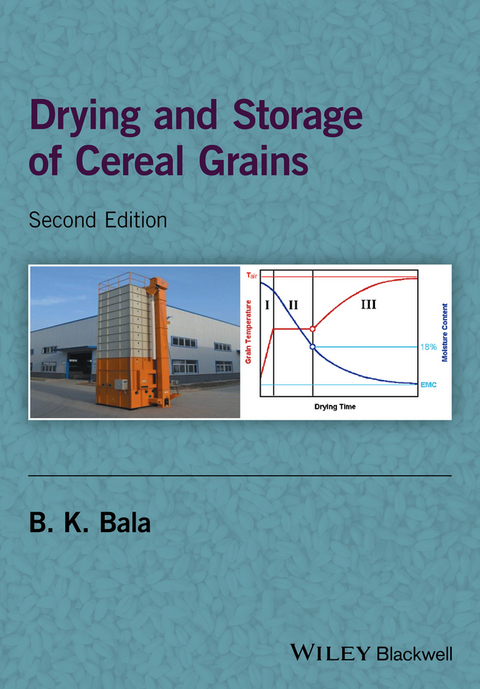
Drying and Storage of Cereal Grains (eBook)
John Wiley & Sons (Verlag)
978-1-119-12459-7 (ISBN)
Finite Element Analysis and Computational Fluid Dynamics have been introduced in modelling and simulation of drying and storage systems, these techniques are expected to dominate the future research and development of drying and storages, and should reduce losses and improve the quality of agricultural products, enhancing food security globally.
Drying and Storage of Cereal Grains, Second Edition, covers the wide spectrum of drying and storage methods applied to economically important cereal produce, providingnumerical examples for better understanding the complexity in drying and storage systems through modelling and simulation, aiding design and management of drying and storage systems. Chapters 1 to 8 look at air and grain moisture equilibria, psychrometry, physical and thermal properties of cereal grains, principles of air flow, and provide detailed analyses of grain drying.Chapters 9 to 13 focus on temperature and moisture in grain storages, and provide comprehensive treatment of modern grain storage systems. The book also includes a number of unsolved problems at the end of each chapter for further practice.
This revised second edition includes new sections on -
• heat of sorption
• finite element modeling of single kernel
• CFD modeling of fluidized bed drying
• exergy analysis and neural network modeling
• numerical solution of two dimensional temperature and moisture changes in stored grain
This book will provide students in agricultural engineering and food engineering with a wide spectrum of drying and storage studies previously unavailable in a single monograph. It will also serve as an excellent reference for practicing agricultural engineers, food engineers and food technologists.
Finite Element Analysis and Computational Fluid Dynamics have been introduced in modelling and simulation of drying and storage systems, these techniques are expected to dominate the future research and development of drying and storages, and should reduce losses and improve the quality of agricultural products, enhancing food security globally. Drying and Storage of Cereal Grains, Second Edition, covers the wide spectrum of drying and storage methods applied to economically important cereal produce, providingnumerical examples for better understanding the complexity in drying and storage systems through modelling and simulation, aiding design and management of drying and storage systems. Chapters 1 to 8 look at air and grain moisture equilibria, psychrometry, physical and thermal properties of cereal grains, principles of air flow, and provide detailed analyses of grain drying.Chapters 9 to 13 focus on temperature and moisture in grain storages, and provide comprehensive treatment of modern grain storage systems. The book also includes a number of unsolved problems at the end of each chapter for further practice. This revised second edition includes new sections on - heat of sorption finite element modeling of single kernel CFD modeling of fluidized bed drying exergy analysis and neural network modeling numerical solution of two dimensional temperature and moisture changes in stored grain This book will provide students in agricultural engineering and food engineering with a wide spectrum of drying and storage studies previously unavailable in a single monograph. It will also serve as an excellent reference for practicing agricultural engineers, food engineers and food technologists.
B K Bala, Department of Agro Product Processing Technology, Jessore University of Science and Technology, Bangladesh.
2
Moisture Contents and Equilibrium Moisture Content Models
2.1 Introduction
Moisture contained in a grain is an indicator of its quality and a key to safe storage and can be of two types: ‘water of composition’, called absorbed water, which is contained within the plant cells of which the grain kernel is composed of and adsorbed water which is present on the surface but not within the cells. The moisture content of the grains may be determined on farms, in stores and under laboratory conditions. These necessitate some standards for representation of moisture content and methods of its measurement.
2.2 Moisture Content Representation
Moisture content is usually expressed in per cent of moisture present in the grain, and there are two methods for expressing these percentages: (i) wet basis and (ii) dry basis.
Moisture content of a grain on a wet basis is expressed as the ratio of the weight of water present to the total weight of the grain. It is normally expressed in per cent. Moisture content on a wet basis is used for commercial designation and also universally by farmers, agriculturalists and merchants. This method of expression tends to give incorrect impression when applied to drying since both moisture content and the basis on which it is computed change as drying proceeds. For this reason moisture content on a dry basis is used in many engineering calculations and mainly used by researchers.
Moisture content on a wet basis is given by
Alternatively, moisture content on a dry basis compares the weight of the moisture present with the weight of dry matter in the grain. This can be expressed as
It may be necessary to convert moisture content from wet basis to dry basis, and vice versa. To convert moisture content from a wet basis to a dry basis, subtract each side of Equation 2.1 from 1.
This equation on simplification gives
To convert moisture content from a dry basis to a wet basis, Equation 2.2 may be rewritten as
This equation on simplification yields
Example 2.1
2000 kg of freshly harvested paddy with a moisture content of 25% (d.b.) is dried to a moisture content of 14% (d.b.). Determine the final weight of the grain after drying.
Solution
From Equation 2.5, we can write
Here W25 + Wd = 2000 kg and Md = 0.25
Hence
Again for 12% m.c.,
Hence the final weight of the dried grain is 1792 kg.
Example 2.2
8000 kg of paddy with a moisture content of 0.12 (d.b.) is required for a research project on grain storage. It was decided that the available freshly harvested paddy with a moisture content of 0.20 (w.b.) should be procured, and then it will be dried to a moisture content of 12% on a dry basis. How many kilograms of freshly harvested paddy are to be procured?
Solution
From Equation 2.5, we can write
Here Wd + W12 = 8000 kg and Md = 0.12
Hence
Again from Equation 2.4,
For Mw = 0.20,
Again for 25% m.c. (d.b.),
Hence 8928.58 kg of freshly harvested paddy is to be procured.
Example 2.3
Ten tonnes of rice is dried from an initial moisture content of 22.0 to 12% (w.b.) in a batch dryer using diesel fuel. Calculate (i) how much diesel is needed and (ii) cost of drying per kg. Use latent heat of vaporization of moisture = 10 MJ/kg, heating value of diesel = 42.7 MJ/l and price of diesel = Tk. 55.0/l.
Solution
The initial moisture content on a dry basis is
and the final moisture content on a dry basis is
Moisture in the grain is
and the dry matter is
The moisture removal is given by
Diesel needed is given by
Cost of drying per kg is given by
2.3 Determination of Moisture Content
Determination of moisture content of a grain is essential to know its keeping quality. It is also important to know the moisture content during drying and storage. Price of grains depends on moisture content. Again, if the farmers sell overdried grains, they sell the dry matter of grains for the price of water. For underdried grains the farmers are offered lower prices. Also the quality of the grains will deteriorate soon during storage. These also emphasize further the need to determine the moisture content of cereal grains.
The methods of determining moisture content can be classified as (i) direct method and (ii) indirect method. Direct method involves the actual removal of moisture and its measurement. The moisture contents are expressed either on a wet basis or on a dry basis. The following are the common methods for direct determination of moisture content:
- Oven method
- Infrared lamp method
- Brown–Duvel method
Indirect method involves the measurement of some properties related to the moisture in grains. The moisture content is expressed on a wet basis. This method is much quicker but less accurate. The instrument has to be calibrated against a primary method. The following are the common methods for determining moisture content through the measurement of some parameters of moisture contained in the grains:
- Resistance method
- Capacitance method
- Chemical method
- Relative humidity method
2.3.1 Direct Methods
2.3.1.1 Oven Methods
Operating conditions and procedures are different for various materials. Air oven method or water oven method may be used for direct determination of moisture content, but the air oven method is commonly used for grains.
Air Oven Method, 130 ± 1°C
- One-stage method (for grains under 13% moisture content)
- Grind duplicate samples of 2–3 g each and weigh accurately.
- Heat for 1 h at 130°C.
- Remove from oven and place in a desiccator. Then reweigh. Samples should be within 0.1% moisture content of each other.
- Two-stage method (for grains over 13% moisture content)
- Weigh accurately a 25–30 g sample of whole grain.
- Place in the oven for 14–16 h.
- Remove from the oven and place in a desiccator. Then reweigh.
- Grind a sample of the partially dried grain and proceed for the one-stage method.
Water Oven or Air Oven method, 100°C
- Weigh two 25–30 g samples accurately and place them in the oven.
- Heat for 72–96 h at 90–100°C.
- Remove from the oven and place in the desiccator. Then reweigh. Sample should be within 0.1% moisture content of each other.
An alternative approach is to use a vacuum oven. Grain is ground and placed in the oven at 100°C and 25 mm pressure for approximately 5 h.
The grain sample should be in the oven until weight loss stops. It is practically impossible to remove all the moisture from grains without their deterioration. If the grain samples are kept too long in the oven, organic materials of the samples will be lost, and these will appear as moisture loss and give inaccurate value. So moisture content should be determined according to the standards set by the professional organization and/or government regulations.
2.3.1.2 Infrared Lamp Method
Moisture meter employing infrared lamp is available commercially. Moisture content is measured directly by the evaporation of water from the grain sample by heating with an infrared lamp. Milling of grain sample is not essential, but this will reduce the time required for the evaporation of water from the grain sample.
This meter consists of a balance and an infrared lamp. The pan of the balance is counterbalanced by a fixed and an adjustable weight along a lever. There is also a scale calibrated in moisture content. The infrared lamp is mounted on a swivelling arm above the pan.
The procedures for measuring moisture content are as follows:
- Set the balance at a zero position by placing the moisture content indicator at zero position.
- Weigh a fixed amount of the sample accurately.
- Place the sample on the pan of the balance at zero position and place equal weight on the counterbalance such that the balance indicates zero position and the moisture content indicator is at 0% moisture level.
- Heat the sample by infrared lamp until weight loss stops.
- Set the balance again at the zero position by shifting the moisture content indicator.
- Read the moisture content in per cent from the calibrated scale indicated by the pointer.
The range of moisture content that can be read is from 0 to 100%. If the sample to be tested is so wet that it cannot be milled, it should be pre-dried to reduce the time required for moisture content determination. It is interesting to note that this meter does enable the determination of high moisture contents.
2.3.1.3 Brown–Duvel Method
In this method a sample of...
| Erscheint lt. Verlag | 4.11.2016 |
|---|---|
| Sprache | englisch |
| Themenwelt | Technik ► Lebensmitteltechnologie |
| Weitere Fachgebiete ► Land- / Forstwirtschaft / Fischerei | |
| Schlagworte | Agriculture • air flow • Backwaren, Getreideerzeugnisse • Bakery & Cereals • cereal • CFD • crops • drying • Feldfrüchte • Feldfrüchte • finite element analysis • Food Quality Assurance • Food Science & Technology • Grain • Landwirtschaft • Lebensmittelforschung u. -technologie • Lebensmittel / Qualitätskontrolle • Lebensmittel / Qualitätskontrolle • Moisture • Psychrometry • Storage • Temperature • thermal |
| ISBN-10 | 1-119-12459-X / 111912459X |
| ISBN-13 | 978-1-119-12459-7 / 9781119124597 |
| Informationen gemäß Produktsicherheitsverordnung (GPSR) | |
| Haben Sie eine Frage zum Produkt? |
 EPUB (Adobe DRM)
Kopierschutz: Adobe-DRM
Adobe-DRM ist ein Kopierschutz, der das eBook vor Mißbrauch schützen soll. Dabei wird das eBook bereits beim Download auf Ihre persönliche Adobe-ID autorisiert. Lesen können Sie das eBook dann nur auf den Geräten, welche ebenfalls auf Ihre Adobe-ID registriert sind.
Details zum Adobe-DRM
Dateiformat: EPUB (Electronic Publication)
EPUB ist ein offener Standard für eBooks und eignet sich besonders zur Darstellung von Belletristik und Sachbüchern. Der Fließtext wird dynamisch an die Display- und Schriftgröße angepasst. Auch für mobile Lesegeräte ist EPUB daher gut geeignet.
Systemvoraussetzungen:
PC/Mac: Mit einem PC oder Mac können Sie dieses eBook lesen. Sie benötigen eine
eReader: Dieses eBook kann mit (fast) allen eBook-Readern gelesen werden. Mit dem amazon-Kindle ist es aber nicht kompatibel.
Smartphone/Tablet: Egal ob Apple oder Android, dieses eBook können Sie lesen. Sie benötigen eine
Geräteliste und zusätzliche Hinweise
Buying eBooks from abroad
For tax law reasons we can sell eBooks just within Germany and Switzerland. Regrettably we cannot fulfill eBook-orders from other countries.
aus dem Bereich


