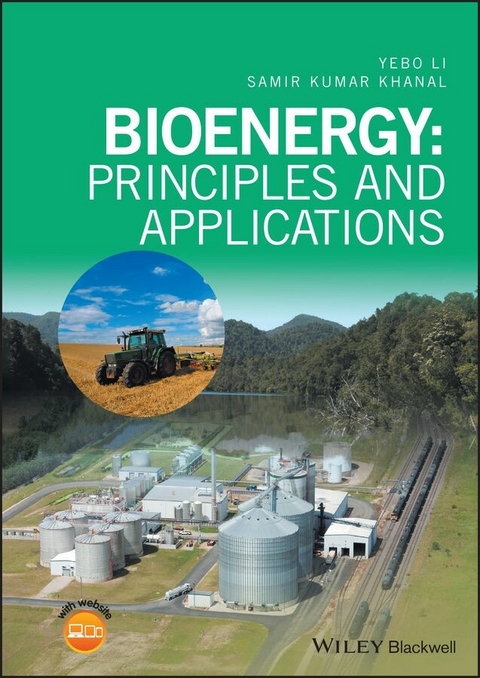
Bioenergy (eBook)
John Wiley & Sons (Verlag)
978-1-118-56837-8 (ISBN)
The search for altenative, renewable sources of fuel and energy from plants, algae, and waste materials has catalyzed in recent years. With the growing interest in bioenergy development and production there has been increasing demand for a broad ranging introductory text in the field. Bioenergy: Principles and Practices provides an invaluable introduction to the fundamentals of bioenergy feedstocks, processing, and industry.
Bioenergy provides readers with an understanding of foundational information on 1st, 2nd, and 3rd generation biofuels. Coverage spans from feedstock production of key energy sources such as grasses, canes, and woody plants through chemical conversion processes and industrial application. Each chapter provides a thorough description of fundamental concepts, definitions of key terms, case studies and practical examples and exercises.
Bioenergy: Principles and Practices will be an essential resource for students, bioengineers, chemists, and industry personnel tying key concepts of bioenergy science to valuable real world application.
Yebo Li is an Assitant Professor in the Department of Food, Agricultural, and Biological Engineering and Director of the Bioproducts and Bioengineering Laboratory at the Ohio State University.
Samir Kumar Khanal, PhD, P.E. is an Associate Professor of Bioengineering in the Bioenergy Research Group?in the Department of Molecular Biosciences and Bioengineering at the University of Hawaii-Manoa.
BIOENERGY: PRINCIPLES AND APPLICATIONS BIOENERGY: PRINCIPLES AND APPLICATIONS With growing concerns over climate change and energy insecurity coupled with dwindling reserves of fossil energy resources, there is a growing search for alternative, renewable energy resources. Energy derived from renewable bioresources such as biomass (energy crops, agri- and forest residues, algae, and biowastes) has received significant attention in recent years. With the growing interest in bioenergy, there has been increasing demand for a broad-ranging, introductory textbook that provides an essential overview of this very subject to students in the field. Bioenergy: Principles and Applications offers an invaluable introduction to both fundamental and applied aspects of bioenergy feedstocks and their processing, as well as lifecycle and techno-economic analyses, and policies as applied to bioenergy. Bioenergy: Principles and Applications provides readers with foundational information on first-, second-, and third-generation bioenergy, ranging from plant structure, carbohydrate chemistry, mass and energy balance, thermodynamics, and reaction kinetics to feedstock production, logistics, conversion technologies, biorefinery, lifecycle and techno-economic analyses, and government policies. This textbook gives students and professionals an incomparable overview of the rapidly growing field of bioenergy. Bioenergy: Principles and Applications will be an essential resource for students, engineers, researchers, and industry personnel interested in, and working in, the bioenergy field.
YEBO LI is a Professor in the Department of Food, Agricultural, and Biological Engineering at the Ohio State University. SAMIR KUMAR KHANAL is an Associate Professor in the Department of Molecular Biosciences and Bioengineering at the University of Hawai'i at Manoa.
CHAPTER 1
Introduction to Bioenergy
Samir Kumar Khanal and Yebo Li
What is included in this chapter?
This chapter provides an introduction to non‐renewable and renewable energy resources. Different forms of non‐renewable and renewable energy and their current demand/consumption are discussed. An overview of bioenergy, its merits and demerits, and current status are also presented.
1.1 Energy
Our modern society depends on energy for nearly everything, including our basic needs that we often take for granted (e.g., to supply drinking water, produce food, and even provide air in some cases). Whether we admit it or not, we are addicted to energy in order to power appliances, light our homes, streets, and offices, and, perhaps more importantly, power the advanced technological gadgets we keep in our pockets. Many of the things we commonly overlook, like our vast transportation networks, are heavily reliant on an abundant and consistent supply of energy. Yet energy, in the form of electricity and fuel, is not as ubiquitous worldwide as it is in the USA and Western Europe. In many rural areas of developing countries, energy is derived from burning wood and local biomass resources, and the ability to secure energy consistently has significant socio‐economic implications affecting the quality of life for local communities. In all cases, in both developing and developed nations, energy is essential for the growth, prosperity, and well‐being of society.
Sustainability (i.e., meeting the needs of present generations without compromising the needs of those in the future) is another key issue of great concern caused by the rapidly growing global population and the corresponding increase in energy demand. As of October 2011, the world population reached 7.0 billion, and the United Nations projects that the population will continue to grow to 10.1 billion by the end of the twenty‐first century (UNFPA, 2011). Standards of living are also on the rise, particularly in developing countries, a fact that is expected to contribute significantly to increased energy consumption and the stress already being placed on our diminishing non‐renewable resources (i.e., fossil fuels), which currently meet over 85% of primary energy demands.
Discussions of energy are often associated with countries’ gross domestic product (GDP), and per capita energy consumption is frequently viewed as an index of development. For example, developing countries have very low per capita energy consumption, typically less than 1.0 metric ton of oil equivalent per year (toe/year) compared to over 4.0 toe/year for developed countries (IEA, 2010a). For example, developing countries such as Nepal, India, Kenya, and Ghana have per capita total primary energy supply (TPES; inclusive of total energy consumed for exports, imports, etc.) of just 0.34, 0.54, 0.47, and 0.41 toe/year, respectively. In comparison, the world’s average per capita TPES is 1.83 toe/year (IEA, 2010a). GDP growth and increases in electricity demands are linearly correlated with a coefficient of approximately 1 (i.e., every 1% increase in GDP is associated with a 1% increase in electricity demand; IEA, 2010b).
In 2010, global energy consumption was around 524 quadrillion Btu (QBtu – 13,205 million metric tons of oil equivalent or Mtoe). This value is projected to increase by 56% to 820 QBtu (20,664 Mtoe) by 2040 based on the International Energy Outlook 2013 (EIA, 2013). Currently, over 85% of total energy consumption is met through the use of non‐renewable sources such as petroleum, coal, natural gas, and nuclear energy. China recently overtook the USA with total primary energy consumption of 2,550 Mtoe (101.2 QBtu; EIA, 2013).
According to the International Energy Outlook 2013 (EIA, 2013), the dynamics of energy consumption are changing dramatically. Non‐OECD (Organization for Economic Cooperation and Development) countries, which account for 90% of global population growth and 70% of economic outputs, are expected to have over 85% growth in energy consumption from 2010 to 2040. Energy consumption in non‐OECD developing Asian countries, especially China and India, will increase by 112% from 2010 to 2040. The rest of the non‐OECD countries are also projected to show a strong growth in energy consumption during the projected period: for example, by 76% in the Middle East, by 85% in Africa, and by 62% in Central and South America. It is projected that China’s energy consumption will grow by as much as twice that of the USA between 2010 and 2040. Because of its large population, however, on a per capita basis, China’s energy use will still be half that of the USA. Another country of interest is India, which currently ranks as the third largest consumer (615 Mtoe or 24.4 QBtu) of energy. Despite the unprecedented rapid development of China seen over the last decade, the growth rate and energy consumption of other countries, such as India, Brazil, Indonesia, and the Middle Eastern nations, are expected to be even higher.
Many developing countries continue to struggle to provide sufficient energy to address the basic needs of all citizens. In India, nearly 840 million people lack proper access to modern energy services. Based on a 2009 estimate, over 1.3 billion people in sub‐Saharan Africa and developing Asian countries do not have access to electricity, and nearly 2.7 billion people in these countries, 40% of the world’s population, still rely on traditional biomass for cooking. Perhaps not surprisingly, 84% of people without electricity live in remote rural areas of these countries (IEA, 2011b). In these situations, bioenergy, especially biogas (which is covered in Chapters 17 and 18), may be a viable and attractive option for supplying cheap and consistent energy to rural populations.
Throughout this chapter, there is a fundamental, resounding question: What major energy resources can be implemented to meet the rising energy demands of rapidly growing populations? The answer is not easy for many reasons, including the uncertainty of various factors such as the availability of non‐renewable resources; threats to the environment, such as climate change; geo‐politics and energy security; changing governmental policies and regulations in light of emission and safety concerns, especially for nuclear power plants; and the unpredictable cost of fossil fuels. One thing, however, is certain: our future energy portfolio will be extremely diverse and an increasing share of our energy will come from renewable sources, which have the highest annual growth rate of 2.5% among all energy resources (EIA, 2013).
1.2 Non‐renewable Energy
Non‐renewable energy is derived from materials or resources that cannot be replaced during a human lifetime and that, by definition, are available only in limited (finite) reserves. The world TPES by fuel type in 2012 is shown in Figure 1.1. Petroleum, natural gas, coal, and nuclear energy, which are considered to be conventional non‐renewable energy resources, are discussed in detail in the rest of this section.
Fig. 1.1 World total primary energy supply by fuel type in 2012.
Source: Data from IEA, 2014.
Petroleum, the primary source of transportation fuel, is a fossil fuel that accounts for nearly 31% of the world’s TPES based on 2012 data. Table 1.1 shows the major crude oil consumption by nations and regions in 2011. The total world liquid fuel consumption in 2011 was 87.3 million barrels (bbl) per day, with the USA accounting for nearly 22% of total demand (EIA, 2012). It is interesting to note that the USA imported nearly 45% of the petroleum (crude oil and petroleum products) that it consumed in 2011 (EIA, 2012).
Table 1.1 Major petroleum oil consumers in the world in 2011
Source: Data from http://www.eia.gov/
| Countries/regions | Petroleum oil consumption (million barrels per day) |
| USA | 18.34 |
| Europe | 15.08 |
| China | 8.92 |
| Japan | 4.48 |
| Africa | 3.51 |
| India | 3.43 |
| Saudi Arabia | 2.99 |
| Brazil | 2.79 |
| Russia | 2.73 |
| Germany | 2.42 |
| Canada | 2.24 |
| South Korea | 2.23 |
| Iran | 2.03 |
| France | 1.82 |
Coal is estimated to be the world’s most abundant fossil fuel. Globally, it is the second most heavily used resource after petroleum, and accounted for nearly 29% of the TPES in 2012. Coal plays a critical role in electricity generation, comprising over 40% of the global electricity output in 2010 (IEA, 2011b). China is the largest consumer of coal, with a demand of 2,653 million metric tons coal equivalent (Mtce) or 73.5 QBtu in 2010, over 48% of the total global demand. The USA and India are the second and third largest consumers of coal, respectively. Table 1.2 compares the major coal‐consuming regions of the world.
Table 1.2...
| Erscheint lt. Verlag | 15.9.2016 |
|---|---|
| Sprache | englisch |
| Themenwelt | Naturwissenschaften ► Biologie ► Botanik |
| Technik | |
| Weitere Fachgebiete ► Land- / Forstwirtschaft / Fischerei | |
| Schlagworte | Agricultural Economics & Resource Management • Agriculture • Ãkonomie u. Ressourcenmanagement i. d. Landwirtschaft • Bioenergie • bioenergy • Biorenewable Resources • Biowissenschaften • Botanik • Botanik / Biotechnologie • Companion • contributors • exercise • fundamentals • Heat • henrys • ideal gas • Introduction • kumar khanal • Landwirtschaft • Life Sciences • Nachwachsende Rohstoffe • Nonrenewable • Ökonomie u. Ressourcenmanagement i. d. Landwirtschaft • Plant Biotechnology • problems units • References • references exercise • renewable • samir • section • Units • useful • xlist • xwebsite |
| ISBN-10 | 1-118-56837-0 / 1118568370 |
| ISBN-13 | 978-1-118-56837-8 / 9781118568378 |
| Informationen gemäß Produktsicherheitsverordnung (GPSR) | |
| Haben Sie eine Frage zum Produkt? |
 EPUB (Adobe DRM)
Kopierschutz: Adobe-DRM
Adobe-DRM ist ein Kopierschutz, der das eBook vor Mißbrauch schützen soll. Dabei wird das eBook bereits beim Download auf Ihre persönliche Adobe-ID autorisiert. Lesen können Sie das eBook dann nur auf den Geräten, welche ebenfalls auf Ihre Adobe-ID registriert sind.
Details zum Adobe-DRM
Dateiformat: EPUB (Electronic Publication)
EPUB ist ein offener Standard für eBooks und eignet sich besonders zur Darstellung von Belletristik und Sachbüchern. Der Fließtext wird dynamisch an die Display- und Schriftgröße angepasst. Auch für mobile Lesegeräte ist EPUB daher gut geeignet.
Systemvoraussetzungen:
PC/Mac: Mit einem PC oder Mac können Sie dieses eBook lesen. Sie benötigen eine
eReader: Dieses eBook kann mit (fast) allen eBook-Readern gelesen werden. Mit dem amazon-Kindle ist es aber nicht kompatibel.
Smartphone/Tablet: Egal ob Apple oder Android, dieses eBook können Sie lesen. Sie benötigen eine
Geräteliste und zusätzliche Hinweise
Buying eBooks from abroad
For tax law reasons we can sell eBooks just within Germany and Switzerland. Regrettably we cannot fulfill eBook-orders from other countries.
aus dem Bereich