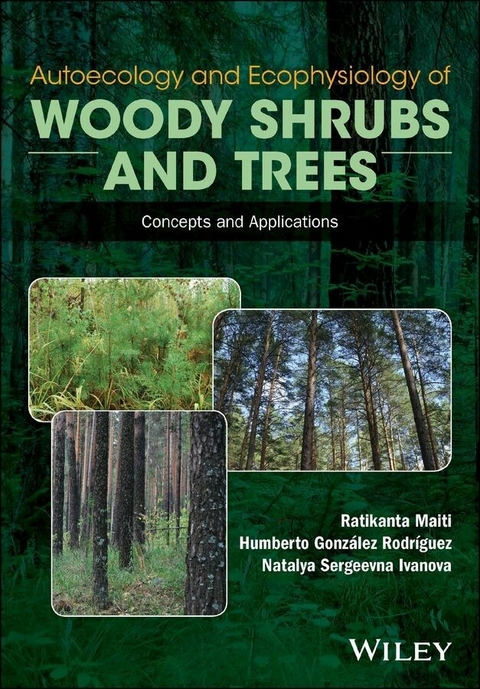
Autoecology and Ecophysiology of Woody Shrubs and Trees (eBook)
John Wiley & Sons (Verlag)
978-1-119-10446-9 (ISBN)
Forest trees and shrubs play vital ecological roles, reducing the carbon load from the atmosphere by using carbon dioxide in photosynthesis and by the storage of carbon in biomass and wood as a source of energy. Autoecology deals with all aspects of woody plants; the dynamism of populations, physiological traits of trees, light requirements, life history patterns, and physiological and morphological characters. Ecophysiology is defined by various plant growth parameters such as leaf traits, xylem water potential, plant height, basal diameter, and crown architecture which are, in turn, influenced by physiological traits and environmental conditions in the forest ecosystem. In short, this book details research advances in various aspects of woody plants to help forest scientists and foresters manage and protect forest trees and plan their future research.
Autoecology and Ecophysiology of Woody Shrubs and Trees is intended to be a guide for students of woody plant autoecology and ecophysiology, as well as for researchers in this field. It is also an invaluable resource for foresters to assist in effective management of forest resources.
Professor Ratikanta Maiti, Visiting Scientist, Forest Science Faculty, Universidad Autonoma de Nuevo Leon (UANL), Linares, Nuevo Leon, Mexico. Dr Maiti is a world renowned botanist and plant physiologist. He has published around 500 research papers and more than 30 books on plant science and crops, and has received various international awards.
Dr Humbero Gonzalez Rodriguez, Director, Forest Science Faculty, Universidad Autonoma de Nuevo Leon (UANL), Linares, Nuevo Leon, Mexico.Dr Rodriguez is a renowned plant physiology and author of several books. At UANL he works on various aspects of ecophysiology, with special reference to abiotic stress resistance. He has published more than 150 research papers.
Dr Natalya Sergeevna Ivanova, Senior Scientist, Botanical Garden of Ural Branch RAS, Professor of the Russian Academy of Natural Sciences, Ekaterinburg, Russia. Dr Ivanova is a botanist and forester, and has researched the diversity of forest types and dynamics of forest vegetation in the Urals (Russia) since 1991. She has studied patterns of natural and anthropogenic dynamics of forest vegetation in the mountains of South and Middle Urals, carrying out complex forest geobotanical researches. In 2012 she was awarded the Medal of the VI Vernadsky for success in the development of national science by the Presidium of the Russian Academy of Natural Sciences.
Forest trees and shrubs play vital ecological roles, reducing the carbon load from the atmosphere by using carbon dioxide in photosynthesis and by the storage of carbon in biomass and wood as a source of energy. Autoecology deals with all aspects of woody plants; the dynamism of populations, physiological traits of trees, light requirements, life history patterns, and physiological and morphological characters. Ecophysiology is defined by various plant growth parameters such as leaf traits, xylem water potential, plant height, basal diameter, and crown architecture which are, in turn, influenced by physiological traits and environmental conditions in the forest ecosystem. In short, this book details research advances in various aspects of woody plants to help forest scientists and foresters manage and protect forest trees and plan their future research. Autoecology and Ecophysiology of Woody Shrubs and Trees is intended to be a guide for students of woody plant autoecology and ecophysiology, as well as for researchers in this field. It is also an invaluable resource for foresters to assist in effective management of forest resources.
Professor Ratikanta Maiti, Visiting Scientist, Forest Science Faculty, Universidad Autonoma de Nuevo Leon (UANL), Linares, Nuevo Leon, Mexico. Dr Maiti is a world renowned botanist and plant physiologist. He has published around 500 research papers and more than 30 books on plant science and crops, and has received various international awards. Dr Humbero Gonzalez Rodriguez, Director, Forest Science Faculty, Universidad Autonoma de Nuevo Leon (UANL), Linares, Nuevo Leon, Mexico.Dr Rodriguez is a renowned plant physiology and author of several books. At UANL he works on various aspects of ecophysiology, with special reference to abiotic stress resistance. He has published more than 150 research papers. Dr Natalya Sergeevna Ivanova, Senior Scientist, Botanical Garden of Ural Branch RAS, Professor of the Russian Academy of Natural Sciences, Ekaterinburg, Russia. Dr Ivanova is a botanist and forester, and has researched the diversity of forest types and dynamics of forest vegetation in the Urals (Russia) since 1991. She has studied patterns of natural and anthropogenic dynamics of forest vegetation in the mountains of South and Middle Urals, carrying out complex forest geobotanical researches. In 2012 she was awarded the Medal of the VI Vernadsky for success in the development of national science by the Presidium of the Russian Academy of Natural Sciences.
Preface, vii
List of contributors, ix
1 Background, 1
Part I:
2 Autoecology, 15
3 Vegetation and biodiversity, 25
4 Case study: A trip to regions of biodiversity and rainforest in Riviera Maya, 31
5 Plant traits, 42
6 Leaf traits, 74
7 Wood characteristics, 83
8 Phenology, 111
9 Phenology, morphology and variability in pollen viability of four woody species (Cordia boissieri, Parkinsonia texana, P. aculeata and Leucophyllum frutescens) exposed to environmental temperature, north-eastern Mexico, 124
10 Pollen biology and plant productivity: A review, 133
11 Seed characteristics, 158
12 Tree mortality, 162
13 Plant traits related to the productivity of trees, 168
Part II:
14 Ecophysiology, 181
15 Research advances in plant ecophysiology, 190
16 Carbon capture, carbon sequestration and carbon fixation, 199
17 Plant nutrients, 220
18 Litterfall and forest productivity, 238
19 Nutrient cycling, 244
20 Plant water relations and forest productivity, 248
21 Cold tolerance of trees, 261
22 Heat stress tolerance of trees, 266
23 Seed characteristics, seed dormancy, germination and plant propagation, 270
24 Root growth, 278
25 Features of boreal forest in Russia: A special study, 285
26 Case study: Autoecology, biodiversity and adaptive characteristics of Prosopis in the Arizona region, 312
Appendix 1: Leaf Morphology, 325
Index, 333
| Erscheint lt. Verlag | 8.4.2016 |
|---|---|
| Sprache | englisch |
| Themenwelt | Naturwissenschaften ► Biologie ► Botanik |
| Naturwissenschaften ► Biologie ► Ökologie / Naturschutz | |
| Technik | |
| Weitere Fachgebiete ► Land- / Forstwirtschaft / Fischerei | |
| Schlagworte | Agriculture • Ãkologie / Pflanzen • Ãkologie / Populationen u. Lebensgemeinschaften • autoecology • Biowissenschaften • ecophysiology • forest ecology • forestry • Forstwirtschaft • Landwirtschaft • Life Sciences • Ökologie / Pflanzen • Ökologie / Populationen u. Lebensgemeinschaften • plant ecology • Population & Community Ecology • shrubbery • Shrubs • Trees • woodland ecology • Woodlands |
| ISBN-10 | 1-119-10446-7 / 1119104467 |
| ISBN-13 | 978-1-119-10446-9 / 9781119104469 |
| Informationen gemäß Produktsicherheitsverordnung (GPSR) | |
| Haben Sie eine Frage zum Produkt? |
 PDF (Adobe DRM)
Kopierschutz: Adobe-DRM
Adobe-DRM ist ein Kopierschutz, der das eBook vor Mißbrauch schützen soll. Dabei wird das eBook bereits beim Download auf Ihre persönliche Adobe-ID autorisiert. Lesen können Sie das eBook dann nur auf den Geräten, welche ebenfalls auf Ihre Adobe-ID registriert sind.
Details zum Adobe-DRM
Dateiformat: PDF (Portable Document Format)
Mit einem festen Seitenlayout eignet sich die PDF besonders für Fachbücher mit Spalten, Tabellen und Abbildungen. Eine PDF kann auf fast allen Geräten angezeigt werden, ist aber für kleine Displays (Smartphone, eReader) nur eingeschränkt geeignet.
Systemvoraussetzungen:
PC/Mac: Mit einem PC oder Mac können Sie dieses eBook lesen. Sie benötigen eine
eReader: Dieses eBook kann mit (fast) allen eBook-Readern gelesen werden. Mit dem amazon-Kindle ist es aber nicht kompatibel.
Smartphone/Tablet: Egal ob Apple oder Android, dieses eBook können Sie lesen. Sie benötigen eine
Geräteliste und zusätzliche Hinweise
Buying eBooks from abroad
For tax law reasons we can sell eBooks just within Germany and Switzerland. Regrettably we cannot fulfill eBook-orders from other countries.
aus dem Bereich