Autoecology and Ecophysiology of Woody Shrubs and Trees (eBook)
John Wiley & Sons (Verlag)
978-1-119-10447-6 (ISBN)

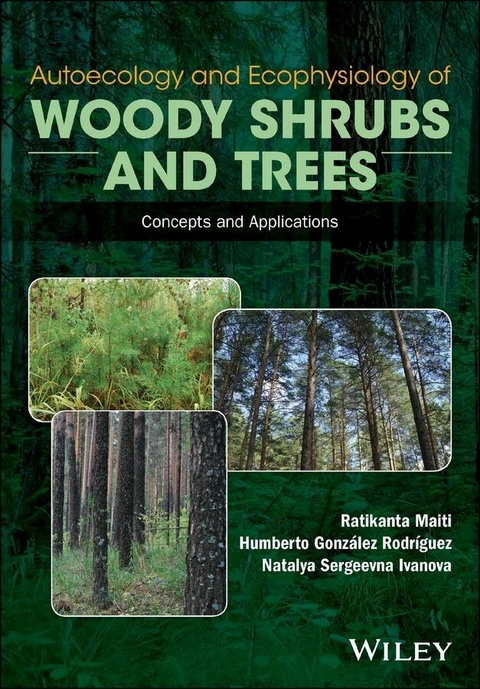
Forest trees and shrubs play vital ecological roles, reducing the carbon load from the atmosphere by using carbon dioxide in photosynthesis and by the storage of carbon in biomass and wood as a source of energy. Autoecology deals with all aspects of woody plants; the dynamism of populations, physiological traits of trees, light requirements, life history patterns, and physiological and morphological characters. Ecophysiology is defined by various plant growth parameters such as leaf traits, xylem water potential, plant height, basal diameter, and crown architecture which are, in turn, influenced by physiological traits and environmental conditions in the forest ecosystem. In short, this book details research advances in various aspects of woody plants to help forest scientists and foresters manage and protect forest trees and plan their future research.
Autoecology and Ecophysiology of Woody Shrubs and Trees is intended to be a guide for students of woody plant autoecology and ecophysiology, as well as for researchers in this field. It is also an invaluable resource for foresters to assist in effective management of forest resources.
Forest trees and shrubs play vital ecological roles, reducing the carbon load from the atmosphere by using carbon dioxide in photosynthesis and by the storage of carbon in biomass and wood as a source of energy. Autoecology deals with all aspects of woody plants; the dynamism of populations, physiological traits of trees, light requirements, life history patterns, and physiological and morphological characters. Ecophysiology is defined by various plant growth parameters such as leaf traits, xylem water potential, plant height, basal diameter, and crown architecture which are, in turn, influenced by physiological traits and environmental conditions in the forest ecosystem. In short, this book details research advances in various aspects of woody plants to help forest scientists and foresters manage and protect forest trees and plan their future research. Autoecology and Ecophysiology of Woody Shrubs and Trees is intended to be a guide for students of woody plant autoecology and ecophysiology, as well as for researchers in this field. It is also an invaluable resource for foresters to assist in effective management of forest resources.
Professor Ratikanta Maiti, Visiting Scientist, Forest Science Faculty, Universidad Autonoma de Nuevo Leon (UANL), Linares, Nuevo Leon, Mexico. Dr Maiti is a world renowned botanist and plant physiologist. He has published around 500 research papers and more than 30 books on plant science and crops, and has received various international awards. Dr Humbero Gonzalez Rodriguez, Director, Forest Science Faculty, Universidad Autonoma de Nuevo Leon (UANL), Linares, Nuevo Leon, Mexico.Dr Rodriguez is a renowned plant physiology and author of several books. At UANL he works on various aspects of ecophysiology, with special reference to abiotic stress resistance. He has published more than 150 research papers. Dr Natalya Sergeevna Ivanova, Senior Scientist, Botanical Garden of Ural Branch RAS, Professor of the Russian Academy of Natural Sciences, Ekaterinburg, Russia. Dr Ivanova is a botanist and forester, and has researched the diversity of forest types and dynamics of forest vegetation in the Urals (Russia) since 1991. She has studied patterns of natural and anthropogenic dynamics of forest vegetation in the mountains of South and Middle Urals, carrying out complex forest geobotanical researches. In 2012 she was awarded the Medal of the VI Vernadsky for success in the development of national science by the Presidium of the Russian Academy of Natural Sciences.
Preface, vii
List of contributors, ix
1 Background, 1
Part I:
2 Autoecology, 15
3 Vegetation and biodiversity, 25
4 Case study: A trip to regions of biodiversity and rainforest in Riviera Maya, 31
5 Plant traits, 42
6 Leaf traits, 74
7 Wood characteristics, 83
8 Phenology, 111
9 Phenology, morphology and variability in pollen viability of four woody species (Cordia boissieri, Parkinsonia texana, P. aculeata and Leucophyllum frutescens) exposed to environmental temperature, north-eastern Mexico, 124
10 Pollen biology and plant productivity: A review, 133
11 Seed characteristics, 158
12 Tree mortality, 162
13 Plant traits related to the productivity of trees, 168
Part II:
14 Ecophysiology, 181
15 Research advances in plant ecophysiology, 190
16 Carbon capture, carbon sequestration and carbon fixation, 199
17 Plant nutrients, 220
18 Litterfall and forest productivity, 238
19 Nutrient cycling, 244
20 Plant water relations and forest productivity, 248
21 Cold tolerance of trees, 261
22 Heat stress tolerance of trees, 266
23 Seed characteristics, seed dormancy, germination and plant propagation, 270
24 Root growth, 278
25 Features of boreal forest in Russia: A special study, 285
26 Case study: Autoecology, biodiversity and adaptive characteristics of Prosopis in the Arizona region, 312
Appendix 1: Leaf Morphology, 325
Index, 333
Chapter 1
Background
In a forest different species of trees, shrubs and herbs grow together mutually, share solar radiation for photosynthesis and absorb soil moisture and nutrients from the soil horizon with their efficient root systems distributed at different soil profiles depending on the species. They grow together and maintain their dynamic growth if not disturbed by environmental stresses, such as cyclones, illegal logging, over-grazing by animals, expansion of agriculture other human activities and so on. The plants absorb soil moisture and nutrients for their growth and development. The mature leaves finally fall to the ground, mix with the soil and thereby recycle nutrients. Adverse climatic conditions, high temperatures, global warming, cyclones, water and cold stress affect the growth of the trees and shrubs in the forests prevailing in different regions of the world. Some species have a capacity of adaptation to these environmental stresses, others are susceptible and fail to survive. Forests give us timber, fire wood, medicinal plants, other products for our livelihood and forage for animals. There exists a great diversity in the leaf canopy and crown architecture, branching patterns, leaf morphology and floral structure. Forests provide different types of soft and hard woods for the wood and paper industries depending on the structural organisation of wood. Different species flower in different seasons, produce fruits and disperse seeds for germination, regeneration of seedlings and maintaining their life cycles. Forests save our lives by absorbing and reducing the carbon dioxide load liberated in the lower horizon of the atmosphere through the process of photosynthesis, liberating oxygen for our respiration and storing carbon in the wood, important for the wood industry. Most of them are perennial, few are annual. Different species flower at different times of the year depending on their photoperiod requirement. They flower, produce fruits and finally disperse seeds on the ground which germinate and emerge on the advent of favorable weather, thereby maintaining the life cycle. It is necessary to understand the dynamic activities of the species present in a forest varying widely in different climatic zones of the world, in arid, semiarid, temperate or alpine zones. The authors have original findings of these activities.
A knowledge of the autoecology and ecophysiology of the trees in a forest is an essential pre-requisite to understand the growth of trees required for efficient forest management by forest managers and rangers. They should know the phenology (flowering, fruiting, seed dispersal) and the effects of environments on the growth and development of each species and globally for taking effective measures for maintaining forest health. We present here up to date literature on various aspects of autoecology and ecophysiology from tropical, temperate, arid–semiarid and a few alpine forests globally. We present here our research advances on various aspects of autoecology and ecophysiology of semiarid Tamaulipan thorns which may serve as a model to study the autoecology of trees in other regions. In addition, we provide an extensive review on various aspects of autoecology globally.
1.1 A definition of autoecology
Autoecology involves all aspects of the dynamism of populations and the physiological traits of trees, their light requirements and also their life history pattern and physiological and morphological characters (Fetcher et al., 1994).
1.2 A definition of ecophysiology
Ecophysiology (from Greek , oikos, “house(hold)”; , physis, “nature, origin”; and , -logia, “discussion”), environmental physiology or physiological ecology is a biological discipline that studies the adaptation of an organism's physiology to environmental conditions. It is closely related to comparative physiology and evolutionary physiology. See: ecophysiology of tree growth onWikipedia, the free online encyclopedia.
Ecophysiology of tree growth can be defined in terms of an increase in the size of an individual or a stand. Growth is usually expressed as a change in size per unit of time and area. The growth of trees is influenced by several physiological traits and environmental conditions of the forest ecosystem. This also deals with various functional, physiological and biophysical aspects of woody trees to plant productivity. There is a great necessity to determine the variability of physiological functions among tree species and their adaptation to the environment.
1.3 Environment
Forest environment plays an important role in the growth of a tree. Environment can be classified as climatic, edaphic, physiographic and biotic. The climatic factors prevailing in different semiarid, tropical and temperate regions affect the growth and adaptation of trees. The climatic factors related to atmospheric conditions are solar radiation, light, air composition, wind, temperature, precipitation, relative humidity and intensity of light. These climatic factors determine the distribution of vegetation.
We want to mention here a brief account of climate change and its effect on forests. A change in climate due to an increase of carbon dioxide concentration has a direct impact on the productivity of forests. Climate determines the distribution of vegetation in a forest ecosystem. There exists a good relation of the climate with the conservation and development of forest. It is essential for foresters to have good understanding of the climate changes and its impact on forest productivity and to take the necessary measures to protect it.
We are very much concerned about how human activities such as the burning of fossil fuels, conversion of forests to agricultural lands and other illegal activities cause a significant increase of carbon dioxide and other green house gases (GHG) in the atmosphere. On the other hand, both forests and human uses of forest products contribute to a gradual increase of GHG in the atmosphere. Fortunately the trees and forests with their ability to absorb CO2 and carbon have an opportunity to mitigate climate change. GHG cause the retention of heat in the lower atmosphere due to absorption of light and its reflection by clouds and other gases.
The earth receives radiant energy from solar radiation for its utilisation by the plants for photosynthesis and by humans for other activities. Short-wave solar energy (visible) received from the sun passes through the atmosphere, thereby warming the earth's surface. Long-wave thermal radiation is absorbed by a number of GHG. These GHG accumulate in small amounts in the lower layer of the atmosphere and reflect long-wave thermal radiation in all directions. Some of the radiation is directed towards the earth's surface. The amount of GHG in the atmosphere influences global temperature.
Green house gases present in the earth's surface are water vapour (H2O), carbon dioxide (CO2), nitrous oxide (NO2), ozone (O3), carbon monoxide (CO) and chlorofluorocarbons (CFC). The concentrations of these gases have changed in the earth over geological time scales. The increase of agriculture, animal husbandry, grazing and an increase in human population has indirectly increased the levels of these GHG, enhancing global warming, thereby threatening the security of human life, animals and so on. Over and above this, an incessant logging of trees for timber has a direct impact in the increase of GHG. Constant emissions of carbon dioxide and its accumulation in the lower profile of the atmosphere enhances contamination, but thanks to the forest ecosystem of trees and shrubs, even the lower organisms capture carbon dioxide and utilise it in the process of photosynthesis and the accumulation of carbon in wood and biomass, thereby reducing the carbon dioxide load and at the same time liberating oxygen necessary for the respiration of living organisms. Now we can present a brief account on the effects of environmental components on forest growth and productivity.
1.4 Solar radiation
Solar radiation is the main source of energy for our life and all living organisms. It provides light, temperature and energy for growth and development. Although a large part of radiation is absorbed by the atmosphere, a small part reaches the earth's surface and is captured by leaves through chlorophylls and converted into chemical energy by the process of photosynthesis. This energy is stored in the grains and fruits serving as a source of energy for us. Not all solar radiation fully reaches the earth's surface. A large part of the ultraviolet rays (wavelength 0.12–0.40 µm) are absorbed by oxygen, nitrogen and ozone present in the atmosphere. The visible portion of solar radiation (wave length 0.40–0.71 µm) is called visible light.
1.5 Solar radiation and vegetation
Solar radiation supplies heat, illumination and chemicals and produces electrical effects on the earth's surface. Solar radiation contributes with light and temperature for the growth of the ecosystem: a proper temperature range is necessary for various physiological activities, viz. transpiration, photosynthesis and respiration. For proper growth of plants a suitable range of temperature is very essential. An optimum air temperature is necessary for the germination of seeds. Higher air temperature increases microbial activity on the soil surface, leading to a rapid decomposition of organic matter, release of nutrients and formation of humus. Temperature affects the activities of enzymes. Plants are adapted to different regions, such as arid, temperate...
| Erscheint lt. Verlag | 7.4.2016 |
|---|---|
| Sprache | englisch |
| Themenwelt | Naturwissenschaften ► Biologie ► Botanik |
| Naturwissenschaften ► Biologie ► Ökologie / Naturschutz | |
| Technik | |
| Weitere Fachgebiete ► Land- / Forstwirtschaft / Fischerei | |
| Schlagworte | Agriculture • Ãkologie / Pflanzen • Ãkologie / Populationen u. Lebensgemeinschaften • autoecology • Biowissenschaften • ecophysiology • forest ecology • forestry • Forstwirtschaft • Landwirtschaft • Life Sciences • Ökologie / Pflanzen • Ökologie / Populationen u. Lebensgemeinschaften • plant ecology • Population & Community Ecology • shrubbery • Shrubs • Trees • woodland ecology • Woodlands |
| ISBN-10 | 1-119-10447-5 / 1119104475 |
| ISBN-13 | 978-1-119-10447-6 / 9781119104476 |
| Informationen gemäß Produktsicherheitsverordnung (GPSR) | |
| Haben Sie eine Frage zum Produkt? |
 EPUB (Adobe DRM)
Kopierschutz: Adobe-DRM
Adobe-DRM ist ein Kopierschutz, der das eBook vor Mißbrauch schützen soll. Dabei wird das eBook bereits beim Download auf Ihre persönliche Adobe-ID autorisiert. Lesen können Sie das eBook dann nur auf den Geräten, welche ebenfalls auf Ihre Adobe-ID registriert sind.
Details zum Adobe-DRM
Dateiformat: EPUB (Electronic Publication)
EPUB ist ein offener Standard für eBooks und eignet sich besonders zur Darstellung von Belletristik und Sachbüchern. Der Fließtext wird dynamisch an die Display- und Schriftgröße angepasst. Auch für mobile Lesegeräte ist EPUB daher gut geeignet.
Systemvoraussetzungen:
PC/Mac: Mit einem PC oder Mac können Sie dieses eBook lesen. Sie benötigen eine
eReader: Dieses eBook kann mit (fast) allen eBook-Readern gelesen werden. Mit dem amazon-Kindle ist es aber nicht kompatibel.
Smartphone/Tablet: Egal ob Apple oder Android, dieses eBook können Sie lesen. Sie benötigen eine
Geräteliste und zusätzliche Hinweise
Buying eBooks from abroad
For tax law reasons we can sell eBooks just within Germany and Switzerland. Regrettably we cannot fulfill eBook-orders from other countries.
aus dem Bereich