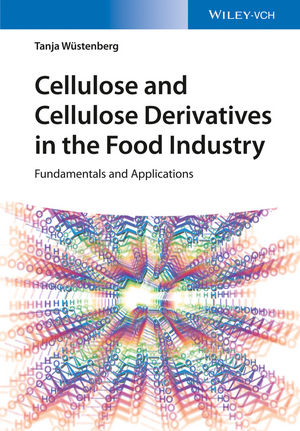
Cellulose and Cellulose Derivatives in the Food Industry (eBook)
This book is an essential source of information and includes recommendations and instructions of a general nature to assist readers in the exploration of possible applications of cellulose and its derivatives, as well as providing food for thought for the generation of new ideas for product development. Topics include gelling and rheological properties, synergistic effects with other hydrocolloids, as well as nutritional and legal aspects.
The resulting compilation covers all the information and advice needed for the successful development, implementation, and handling of cellulose-containing products.
Tanya Wüstenberg joined Dow Wolff Cellulosics (now Dow Company) in 2003 and worked as application manager for 10 years. During this period she became passionate about cellulose and cellulose derivatives and their multifunctional properties. She studied food technology at the University of Applied Sciences Fulda (Germany) and obtained her diploma as food engineer 1998. Thereafter, Tanja Wüstenberg worked as development engineer in the food industry for many years and held positions at the Fraunhofer Institute for Process Engineering and Packaging (IVV) and Sensient Food Ingredients. Furthermore, she headed the European Technical Center at National Starch & Chemical in Hamburg (Germany) for several years. Tanja Wüstenberg is an expert in the application of cellulose ethers and the development of innovative cellulose-based products. She published several brochures on hydrocolloids and a German language cellulose book.
Preface
GENERAL OVERVIEW OF FOOD HYDROCOLLOIDS
Introduction to the World of Hydrocolloids
Plant Extracts
Seed Flours
Exudates
Bacterial Polysaccharides
Overview Tables for the Most Important Cellulose Derivatives
Commercial Development - Global Market
RHEOLOGY OF FOOD HYDROCOLLOIDS
Introduction to Rheology, Rheometry, and Visco-Elasticity
Definitions
Basic Data
Different Types of Flow Behaviour
Structures of Polymers with Shear-Thinning Flow Behaviour
Causes of Shear-Thickening of Products
Factors that Influence Rheological Behaviour
Viscosity Measurement of Thickening Hydrocolloid Solutions
Characterization of Gels
Viscosimeters and Rheometers
Relationship between Rheology and Sensory
CELLULOSE
Introduction, History and Development
Raw Materials and Biological Origin
Manufacture of Pulp
Chemical Composition and Structure
Rheology
Stability
Analysis and Rheometry
Synergies with Other Hydrocolloids
Application in Food Products
Options for Derivatization of Cellulose
Nutritional Properties
Legislation
MICROCRYSTALLINE CELLULOSE
General Manufacturing Process
Chemistry
Rheology
Stability
Rheometry
Preparation of MCC Dispersions in Food
Synergies with Other Hydrocolloids
Functions and Properties of MCC
Food Applications with Typical Formulations
Non-food Applications
Nutritional Properties
Legislation
FUNDAMENTALS OF WATER-SOLUBLE CELLULOSE ETHERS AND METHYLCELLULOSE
Manufacturing Process of Cellulose Ethers
Chemistry
Rheology
Stability
Rheometry
Synergies with Other Hydrocolloids
Food Applications with Typical Formulations
Non-food Applications
Nutritional Properties
Legislation
ETHYLCELLULOSE
Manufacturing
Chemistry
Rheology
Stability
Rheometry
Synergies with Other Hydrocolloids
Food Applications with Typical Formulations
Non-food Applications
Nutritional Properties
Legislation
HYDROXYPROPYLCELLULOSE
Manufacturing
Chemistry
Rheology
Stability
Rheometry
Synergies with Other Hydrocolloids
Food Applications with Typical Formulations
Non-food Applications
Nutritional Properties
Legislation
HYDROXYPROPYLMETHYLCELLULOSE
Manufacturing
Chemistry
Rheology
Stability
Rheometry
Synergies with Other Hydrocolloids
Food Applications with Typical Formulations
Non-food Applications
Nutritional Properties
Legislation
METHYLETHYLCELLULOSE
Manufacturing
Chemistry
Rheology
Stability
Rheometry
Synergies with Other Hydrocolloids
Food Applications with Typical Formulations
Non-food Applications
Nutritional Properties
Legislation
SODIUM CARBOXYMETHYLCELLULOSE
Manufacturing
Chemistry
Rheology
Stability
Rheometry
Synergies of Cellulose Gum with Other Hydrocolloids
Functional Properties of Carboxymethylcellulose
Use of Purified CMC in Regulated Applications
Food Applications with Typical Formulations
Non-food Applications
Nutritional Properties
Legislation
CROSSLINKED SODIUM CARBOXYMETHYLCELLULOSE
Manufacturing
Chemistry
Rheology
Stability
Rheometry
Synergies with Other Hydrocolloids
Food Applications with Typical Formulations
Non-food Applications
Nutritional Properties
Legislation
ENZYMATICALLY HYDROLYSED CARBOXYMETHYLCELLULOSE
Manufacturing
Chemistry
Rheology
Stability
Rheometry
Synergies with Other Hydrocolloids
Food Applications with Typical Formulations
Non-food Applications
Nutritional Properties
Legislation
NANOCELLULOSE
Definition and Summary
Commercial Products
History and Terminology
Manufacturing Process
Chemistry and Rheometry
Rheology
Stability
Synergies with Other Substances
Food Applications
Non-Food Applications
Nutritional Properties and Toxicity
Safety Aspects
Index
| Erscheint lt. Verlag | 5.8.2014 |
|---|---|
| Sprache | englisch |
| Themenwelt | Naturwissenschaften ► Biologie |
| Technik | |
| Weitere Fachgebiete ► Land- / Forstwirtschaft / Fischerei | |
| Schlagworte | Cellulose • cellulose derivatives in the food industry • Cellulose/Paper/Textile Chemistry • Cellulose-, Papier- u. Textilchemie • Chemie • Chemistry • enzymatically hydrolsed carboxymethylcellulose • Ethylcellulose • Food Hydrocolloids • Food Processing, Production & Manufacture • Food Science & Technology • Herstellung u. Verarbeitung von Lebensmitteln • hydoxypropylmethylcellulose • hyrdoxypropylcellulose • Lebensmittelforschung u. -technologie • Lebensmitteltechnik • methylethylcellulose • Microcrystalline Cellulose • Nachhaltige u. Grüne Chemie • Nachhaltige u. Grüne Chemie • Nanocellulose • Oberflächen- u. Kolloidchemie • Oberflächen- u. Kolloidchemie • Surface & Colloid Chemistry • Sustainable Chemistry & Green Chemistry • Zellulose |
| ISBN-10 | 3-527-68295-3 / 3527682953 |
| ISBN-13 | 978-3-527-68295-9 / 9783527682959 |
| Informationen gemäß Produktsicherheitsverordnung (GPSR) | |
| Haben Sie eine Frage zum Produkt? |
 PDF (Adobe DRM)
Kopierschutz: Adobe-DRM
Adobe-DRM ist ein Kopierschutz, der das eBook vor Mißbrauch schützen soll. Dabei wird das eBook bereits beim Download auf Ihre persönliche Adobe-ID autorisiert. Lesen können Sie das eBook dann nur auf den Geräten, welche ebenfalls auf Ihre Adobe-ID registriert sind.
Details zum Adobe-DRM
Dateiformat: PDF (Portable Document Format)
Mit einem festen Seitenlayout eignet sich die PDF besonders für Fachbücher mit Spalten, Tabellen und Abbildungen. Eine PDF kann auf fast allen Geräten angezeigt werden, ist aber für kleine Displays (Smartphone, eReader) nur eingeschränkt geeignet.
Systemvoraussetzungen:
PC/Mac: Mit einem PC oder Mac können Sie dieses eBook lesen. Sie benötigen eine
eReader: Dieses eBook kann mit (fast) allen eBook-Readern gelesen werden. Mit dem amazon-Kindle ist es aber nicht kompatibel.
Smartphone/Tablet: Egal ob Apple oder Android, dieses eBook können Sie lesen. Sie benötigen eine
Geräteliste und zusätzliche Hinweise
Buying eBooks from abroad
For tax law reasons we can sell eBooks just within Germany and Switzerland. Regrettably we cannot fulfill eBook-orders from other countries.
aus dem Bereich