


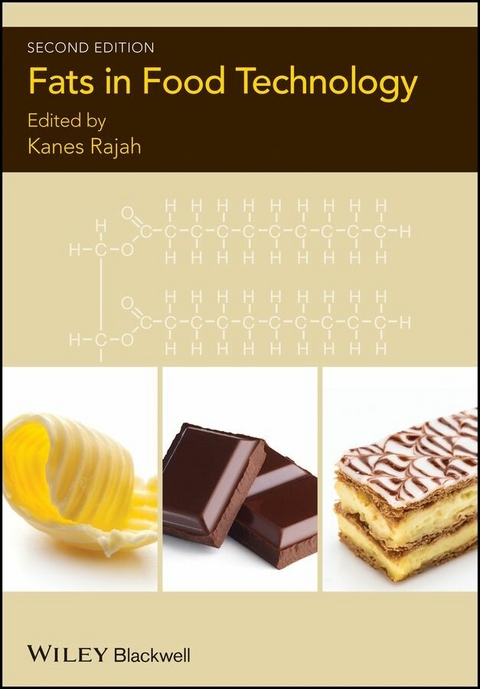
Fats in Food Technology (eBook)
John Wiley & Sons (Verlag)
978-1-118-78876-9 (ISBN)
Dr Kanes K. Rajah, Director, Centre for Entrepreneurship, University of Greenwich and Management and Food Technology Consultant, Klondyke Management Consultants, London, UK
Fats are present in some form in the vast majority of processed foods we consume, as well as in many natural products. Changes in consumer behaviour, centered around an increased emphasis on healthy food consumption, mean that it is more important than ever for food scientists to understand the properties, roles and behaviours that fats play in food and in diets. Fats in Food Technology, Second Edition is an in-depth examination of the roles and behaviours of fats in food technology and the benefits that they impart to consumers. It considers both fats that are naturally present in foods (such as milk fat in cheese) and fats that have been added to improve physical, chemical and organoleptic properties (like cocoa butter in chocolate). Newly revised and updated, the book contains useful information on the market issues that have driven change and the disciplines that have helped to regulate the trade and use of fats and oils in food technology. Drawing on the recent literature as well as the personal R&D experiences of the authors, the book highlights those areas where potential efficiencies in processing and economy in the cost of raw materials can be made. Issues concerning health, diet and lifestyle are covered in dedicated chapters. This book will be useful to anyone in industry and research establishments who has an interest in the technology of fat-containing food products, including scientists in the dairy, spreads, bakery, confectionery and wider food industries, as well those involved in the production of edible oils.
Professor Kanes K Rajah is Dean of the School of Business and Entrepreneurship, Royal Agricultural University, Cirencester, UK and Management Food Consultant.
1. Physical Properties of fats in food.
Tetsuo Koyano, Meiji Seika Kaisha Ltd, Saitama, Japan and Kiyotaka Sato and Satoru Ueno, Faculty of Applied Biological Science, Hiroshima University, Japan.
2. Bakery Fats.
Paul Wassell, Principal Application Specialist, Oils & Fats Innovation Group, Denmark.
3. Water continuous emulsions.
Dr. HMP Ranjith, Diotte Consulting & Technology, Nantwich, UK.
4. Hydrogenation and fractionation.
Albert Dijkstra, Consultant to the Oils and Fats Industry, St Eutrope-de-Born, France.
5. Fats for chocolate and sugar confectionery.
Geoff Talbot, The Fat Consultant, Bedford, UK.
6. Spreadable Products.
Kanes Rajah, University of Greenwich, UK.
7. Emulsifiers and stabilizers.
Author TBC.
8. Role of milkfat in hard and semihard cheese.
Tim Guinee, Dairy Products Research Centre, Teagasc, Fermoy, Ireland and Barry Law, Consultant to the Dairy Industry, Sydney, Australia.
9. Culinary fats: solid and liquid frying oils, and speciality oils.
Mark Farmer, Danisco, Denmark.
10. Effect of fat content on food safety of dairy products.
Upuli Wijewardene, University of Salford, UK.
Appendix: nomenclature for fatty acids and triglycerides.
References
Chapter 2
Bakery fats1
Paul Wassell
Food Nanotechnology Group, Environmental Quality and Food Safety Research Unit, University of Chester, Chester, UK
PVO Innovation Centre, Pasir Gudang, Johor Bahru, Malaysia
2.1 Introduction
Fats and oils have been used throughout the years in food preparation to provide structure, flavour and nutritive value. Geography and agricultural practices have influenced the fat used in food preparation. For example, people in northern climates have tended to use plastic fats such as butter and suet, whereas in more southerly climates liquid oils such as olive oil are more popular.
Economic conditions and population growth led to the invention of margarine (Young and Wassell, 2008a) as a substitute for butter, and developments in refining technology and fat modification techniques allowed the use of a widening range of fats in margarines and as alternatives for lard and suet.
Progress in the technology of butter production, oil refining and modification and in margarine and shortening manufacture has provided the food processor with a wide variety of fats and oils with differing functional properties to meet product and process needs.
The structural and crystalline properties of fats determine their functionality in food. This is readily illustrated in the manufacture of baked products such as short pastry, cake and puff or flaky pastry. Advances in emulsion technology and emulsifier systems have been applied to bakery products, giving improvements in bread volume and shelf-life as well as leading to recipe balance in other baked products and altering the requirement for plastic fats so that fluid and liquid shortenings can be used (Podmore, 1996). The use of powdered fat and fat powders can add convenience in a number of food sectors (e.g. in prepared cake mixes, toppings and bread improvers).
In the more developed countries, nutritional demands (Mozaffarian et al., 2010; NICE, 2010), combined with rapid changes in lifestyles and eating habits which require quicker and easier food preparation at the point of use, have challenged suppliers in several important ways. These demands require the manufacturer of oils and fats to deliver products with the desired functionality but with improved nutritional and health characteristics—such as lower fat content, high in polyunsaturated and mono-unsaturated fatty acids and with a lower component of ‘trans’ fatty acids. Since publication of the first edition of this book (Podmore, 2002), much of the aforementioned has already gone through significant change. More changes are now driven by further nutritional requirements to meet new legislation (SACN, 2007; Stender et al., 2006, 2009; Wassell et al., 2010a). Continued developments will lead to a search for novel oils and altered approaches to blending and modification (Marangoni, 2007; Shigemi, 2006; van Duijn et al., 2006).
The acceleration of economic globalisation has created a situation where consumers in once so-called ‘less-developed countries’ also require the latest and most available technologies. Growth economies such as Brazil, India, and China have enormous populations to feed. However, as these economies continue to strengthen, they are already developing the technology to exploit oils that are readily available to them (Wang et al., 2012). For instance, Malaysia and Indonesia use the fractionation process and some of the most up-to-date technology to produce a range of palm-oil-based bakery fats and margarines.
Fats in their natural state have been used as a bakery ingredient for countless years to improve the palatability and nutritive value of foods. However, increasing industrialisation and population expansion in the later part of the nineteenth century led to a shortage of traditional fats. These conditions stimulated the invention of the first substitute food—margarine. Margarine was invented in 1869 by a French chemist, Mégè Mouries (French patent 86480), and the invention was exploited by Dutch butter exporters. Starting from modest beginnings, the margarine industry has developed into an important and sophisticated food-processing industry. Additionally, it has had important repercussions on the agricultural industry, for as margarine production has expanded, it has stimulated an expansion in the production and export of tropical oils and oilseeds, and these now represent a substantial proportion of world trade in agricultural products.
Progress in the understanding of the function of the ingredients in food now means that the fat processor and food manufacturer can work together to improve the food products available to the consumer. Crystalline form and product consistency have a profound influence on the performance of fats in foods, particularly in baked products. Thus, an understanding of physical properties such as crystallisation behaviour, polymorphism and crystal structure in fats is necessary to control production processes so that they can be ‘tailor-made’ to suit particular applications.
2.2 Production of margarine and shortening
The modern processor has available bland oxidatively stable and low coloured edible oils of vegetable and animal origin, achieved by the processes shown in Figure 2.1. The quality standards for edible oils continue to be raised and so handling and refining practices are being continually improved which, combined with a clearer understanding of the influence of the minor components on shelf-life and flavour stability, leads to modified refining methods.
Figure 2.1 The stages of oil and fat refining.
The refining process must be carried out to remove those impurities that have an adverse effect on oil quality but to avoid damaging the triacylglycerols. There is also a requirement that beneficial minor components be retained. Important minor components to be retained are tocopherols and phytosterols, which are biologically active and show antioxidant activity. Lower-temperature methods of refining and deodorisation are being applied to minimise this loss.
The refiner has the option of chemical or physical refining. The choice between the two methods depends on the economics of the processes. Most types of vegetable oil can be physically refined, a major exception being cottonseed oil because of the presence of gossypol (de Greyt and Kellens, 2000). These natural oils can be modified by hydrogenation, interesterification and fractionation, used either singly or in combination, to produce fats that bear no relation to the original material.
In the 1990s there was a change in emphasis away from hydrogenation as the way of providing the hard stock for the formulation of shortening and margarine oil blends. There were two main reasons for this change. The first reason is the ready availability of relatively inexpensive palm fractions and increasing confidence in their performance in bakery fat formulations (Sundram, 2005). The second reason is the finding that ‘trans’ fatty acids are implicated in the development of coronary heart disease (Willett et al., 1992; Stender and Dyerberg, 2003). Since the hydrogenation reaction can generate high levels of ‘trans’ fatty acids, there has been a trend toward reducing reliance on hydrogenated oils in formulations. Instead palm stearins from the fractionation of palm oil have been found to be a valuable alternative to hydrogenated oils (Morin, 2006). However, the use of palm stearins, with their flat melting profile, gives rise to higher solid fat contents in the 30–40°C temperature range. This has led to increased use of interesterification in order to lessen this effect.
Blending oils and fats to achieve the required solid-to-liquid ratio is a major part of the processor's skill as it is critical to the firmness and texture of the finished product. Added to this is the influence of the crystal habit of the oils and fats selected and their polymorphism. Thus, the processor requires an understanding of these characteristics when preparing blends for margarines and shortenings (Narine and Marangoni, 1999; Wassell and Young, 2007).
Irrespective of how the hard stock is obtained, the basic requirements for blending are unchanged in that the desired solid-to-liquid ratios and crystallising characteristics be achieved in order to provide a stable finished product of the correct firmness, texture and crystal form.
2.3 Crystallisation behaviour
In common with all other long-chain molecules, fats and fatty acids exhibit polymorphism—that is, the ability to exist in more than one crystalline form and so possess multiple melting points. Triglycerides occur in any one of three basic polymorphs, designated α, β′ and β (Bailey, 1950):
- the α form is the most loosely packed arrangement and hence is the least stable and has the lowest melting point;
- the β′ form is more stable than the α form but transforms irreversibly to the β form;
- the β form is the most closely packed and is the polymorph with the highest melting point.
Work by Timms (1984) describes the behaviour of a monoacid triglyceride, showing that, with rapid cooling, the α form is obtained which, on slow heating, melts to resolidify and give the β′ form. After further slow heating, it melts and resolidifies in the β form. Most fats possess an α form that is so unstable that it can be ignored; some also possess both β′ and...
| Erscheint lt. Verlag | 7.2.2014 |
|---|---|
| Sprache | englisch |
| Themenwelt | Technik ► Lebensmitteltechnologie |
| Weitere Fachgebiete ► Land- / Forstwirtschaft / Fischerei | |
| Schlagworte | Ãle u. Fette • changes • Consumer behaviour • consumption • Dairy Food • diets • Edition • emphasis • Examination • Fette • Food • Food chemistry • Foods • Food Science & Technology • food scientists • Form • Healthy • important • indepth • Lebensmittelchemie • Lebensmittelforschung u. -technologie • Lebensmitteltechnik • majority • many • Milchprodukte • Natural Products • Oils & Fats • Öle u. Fette • present • Properties • roles • Technology • vast |
| ISBN-10 | 1-118-78876-1 / 1118788761 |
| ISBN-13 | 978-1-118-78876-9 / 9781118788769 |
| Informationen gemäß Produktsicherheitsverordnung (GPSR) | |
| Haben Sie eine Frage zum Produkt? |
 EPUB (Adobe DRM)
Kopierschutz: Adobe-DRM
Adobe-DRM ist ein Kopierschutz, der das eBook vor Mißbrauch schützen soll. Dabei wird das eBook bereits beim Download auf Ihre persönliche Adobe-ID autorisiert. Lesen können Sie das eBook dann nur auf den Geräten, welche ebenfalls auf Ihre Adobe-ID registriert sind.
Details zum Adobe-DRM
Dateiformat: EPUB (Electronic Publication)
EPUB ist ein offener Standard für eBooks und eignet sich besonders zur Darstellung von Belletristik und Sachbüchern. Der Fließtext wird dynamisch an die Display- und Schriftgröße angepasst. Auch für mobile Lesegeräte ist EPUB daher gut geeignet.
Systemvoraussetzungen:
PC/Mac: Mit einem PC oder Mac können Sie dieses eBook lesen. Sie benötigen eine
eReader: Dieses eBook kann mit (fast) allen eBook-Readern gelesen werden. Mit dem amazon-Kindle ist es aber nicht kompatibel.
Smartphone/Tablet: Egal ob Apple oder Android, dieses eBook können Sie lesen. Sie benötigen eine
Geräteliste und zusätzliche Hinweise
Buying eBooks from abroad
For tax law reasons we can sell eBooks just within Germany and Switzerland. Regrettably we cannot fulfill eBook-orders from other countries.
aus dem Bereich


