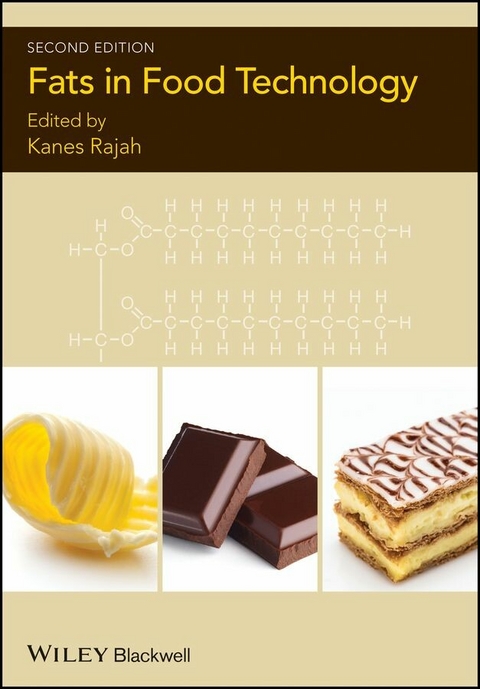
Fats in Food Technology (eBook)
John Wiley & Sons (Verlag)
978-1-118-78877-6 (ISBN)

Fats are present in some form in the vast majority of processed foods we consume, as well as in many 'natural' products. Changes in consumer behaviour, centered around an increased emphasis on healthy food consumption, mean that it is more important than ever for food scientists to understand the properties, roles and behaviours that fats play in food and in diets.
Fats in Food Technology, Second Edition is an in-depth examination of the roles and behaviours of fats in food technology and the benefits that they impart to consumers. It considers both fats that are naturally present in foods (such as milk fat in cheese) and fats that have been added to improve physical, chemical and organoleptic properties (like cocoa butter in chocolate). Newly revised and updated, the book contains useful information on the market issues that have driven change and the disciplines that have helped to regulate the trade and use of fats and oils in food technology. Drawing on the recent literature as well as the personal R&D experiences of the authors, the book highlights those areas where potential efficiencies in processing and economy in the cost of raw materials can be made. Issues concerning health, diet and lifestyle are covered in dedicated chapters.
This book will be useful to anyone in industry and research establishments who has an interest in the technology of fat-containing food products, including scientists in the dairy, spreads, bakery, confectionery and wider food industries, as well those involved in the production of edible oils.
Professor Kanes K Rajah is Dean of the School of Business and Entrepreneurship, Royal Agricultural University, Cirencester, UK and Management Food Consultant.
Fats are present in some form in the vast majority of processed foods we consume, as well as in many natural products. Changes in consumer behaviour, centered around an increased emphasis on healthy food consumption, mean that it is more important than ever for food scientists to understand the properties, roles and behaviours that fats play in food and in diets. Fats in Food Technology, Second Edition is an in-depth examination of the roles and behaviours of fats in food technology and the benefits that they impart to consumers. It considers both fats that are naturally present in foods (such as milk fat in cheese) and fats that have been added to improve physical, chemical and organoleptic properties (like cocoa butter in chocolate). Newly revised and updated, the book contains useful information on the market issues that have driven change and the disciplines that have helped to regulate the trade and use of fats and oils in food technology. Drawing on the recent literature as well as the personal R&D experiences of the authors, the book highlights those areas where potential efficiencies in processing and economy in the cost of raw materials can be made. Issues concerning health, diet and lifestyle are covered in dedicated chapters. This book will be useful to anyone in industry and research establishments who has an interest in the technology of fat-containing food products, including scientists in the dairy, spreads, bakery, confectionery and wider food industries, as well those involved in the production of edible oils.
Professor Kanes K Rajah is Dean of the School of Business and Entrepreneurship, Royal Agricultural University, Cirencester, UK and Management Food Consultant.
1. Physical Properties of fats in food.
Tetsuo Koyano, Meiji Seika Kaisha Ltd, Saitama, Japan and Kiyotaka Sato and Satoru Ueno, Faculty of Applied Biological Science, Hiroshima University, Japan.
2. Bakery Fats.
Paul Wassell, Principal Application Specialist, Oils & Fats Innovation Group, Denmark.
3. Water continuous emulsions.
Dr. HMP Ranjith, Diotte Consulting & Technology, Nantwich, UK.
4. Hydrogenation and fractionation.
Albert Dijkstra, Consultant to the Oils and Fats Industry, St Eutrope-de-Born, France.
5. Fats for chocolate and sugar confectionery.
Geoff Talbot, The Fat Consultant, Bedford, UK.
6. Spreadable Products.
Kanes Rajah, University of Greenwich, UK.
7. Emulsifiers and stabilizers.
Author TBC.
8. Role of milkfat in hard and semihard cheese.
Tim Guinee, Dairy Products Research Centre, Teagasc, Fermoy, Ireland and Barry Law, Consultant to the Dairy Industry, Sydney, Australia.
9. Culinary fats: solid and liquid frying oils, and speciality oils.
Mark Farmer, Danisco, Denmark.
10. Effect of fat content on food safety of dairy products.
Upuli Wijewardene, University of Salford, UK.
Appendix: nomenclature for fatty acids and triglycerides.
References
| Erscheint lt. Verlag | 27.1.2014 |
|---|---|
| Sprache | englisch |
| Themenwelt | Naturwissenschaften ► Biologie |
| Technik ► Lebensmitteltechnologie | |
| Weitere Fachgebiete ► Land- / Forstwirtschaft / Fischerei | |
| Schlagworte | Ãle u. Fette • changes • Consumer behaviour • consumption • Dairy Food • diets • Edition • emphasis • Examination • Fette • Food • Food chemistry • Foods • Food Science & Technology • food scientists • Form • Healthy • important • indepth • Lebensmittelchemie • Lebensmittelforschung u. -technologie • Lebensmitteltechnik • majority • many • Milchprodukte • Natural Products • Oils & Fats • Öle u. Fette • present • Properties • roles • Technology • vast |
| ISBN-10 | 1-118-78877-X / 111878877X |
| ISBN-13 | 978-1-118-78877-6 / 9781118788776 |
| Informationen gemäß Produktsicherheitsverordnung (GPSR) | |
| Haben Sie eine Frage zum Produkt? |
 PDF (Adobe DRM)
Kopierschutz: Adobe-DRM
Adobe-DRM ist ein Kopierschutz, der das eBook vor Mißbrauch schützen soll. Dabei wird das eBook bereits beim Download auf Ihre persönliche Adobe-ID autorisiert. Lesen können Sie das eBook dann nur auf den Geräten, welche ebenfalls auf Ihre Adobe-ID registriert sind.
Details zum Adobe-DRM
Dateiformat: PDF (Portable Document Format)
Mit einem festen Seitenlayout eignet sich die PDF besonders für Fachbücher mit Spalten, Tabellen und Abbildungen. Eine PDF kann auf fast allen Geräten angezeigt werden, ist aber für kleine Displays (Smartphone, eReader) nur eingeschränkt geeignet.
Systemvoraussetzungen:
PC/Mac: Mit einem PC oder Mac können Sie dieses eBook lesen. Sie benötigen eine
eReader: Dieses eBook kann mit (fast) allen eBook-Readern gelesen werden. Mit dem amazon-Kindle ist es aber nicht kompatibel.
Smartphone/Tablet: Egal ob Apple oder Android, dieses eBook können Sie lesen. Sie benötigen eine
Geräteliste und zusätzliche Hinweise
Buying eBooks from abroad
For tax law reasons we can sell eBooks just within Germany and Switzerland. Regrettably we cannot fulfill eBook-orders from other countries.
aus dem Bereich