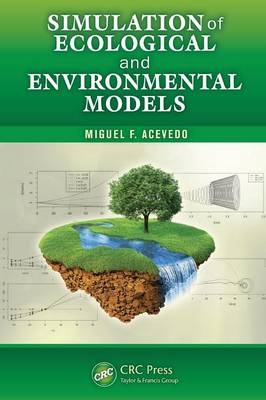
Simulation of Ecological and Environmental Models
Crc Press Inc (Verlag)
9781439885062 (ISBN)
Learn How to Use a Broad Range of Environmental Models
The textbook is organized into three parts to allow greater flexibility using the material in various countries and types of curricula. The first part provides a tutorial-style mathematical review and a gentle introduction to the basics of R software. The second part explains the fundamentals of modeling methodology through one-dimensional models. After a review of matrix algebra, the third part progresses to multidimensional models, focusing on structured populations, communities, and ecosystems. The final chapters show how simple models are hooked together to generate more comprehensive models.
Build from Fundamental Concepts to Problem Solving
Each chapter starts with conceptual and theoretical material to give a firm foundation in how the methods work. Examples and exercises illustrate the applications and demonstrate how to go from concepts to problem solving. Hands-on computer sessions let students grasp the practical implications and learn by doing. Throughout, the computer examples and exercises use seem, an open-source R package developed by the author, which lets students quickly produce simulations and explore the effects of changing conditions in the model.
This practical book is a comprehensive, unified presentation of ecological and environmental models. It describes the mathematical fundamentals to analyze models and the methodology to simulate them, with a focus on understanding environmental change—a key element of environmental management and problem solving.
Miguel F. Acevedo has 38 years of academic experience, the last 20 of these as faculty member of the University of North Texas (UNT). His career has been interdisciplinary, especially at the interface of science and engineering. He obtained his Ph.D. in biophysics from the University of California Berkeley and master degrees in electrical engineering and computer science from Berkeley and the University of Texas at Austin, respectively. Prior to UNT, he was at the Universidad de Los Andes in Merida, Venezuela, where he taught for 18 years. He has served on the Science Advisory Board of the U.S. Environmental Protection Agency and on many review panels of the U.S. National Science Foundation. He has received numerous research grants and written many journal articles, book chapters, and proceedings articles. UNT has recognized him with the Regent’s Professor rank, the Citation for Distinguished Service to International Education, and the Regent’s Faculty Lectureship. For more information, see Dr. Acevedo’s page at UNT.
Part I Introduction, Mathematical Review, and Software Fundamentals: Introduction. Review of Basic Mathematical Concepts and Introduction to R. Part II One-Dimensional Models and Fundamentals of Modeling Methodology: Exponential Model. Model Simulation. Model Evaluation. Nonlinear Models. Stability and Disturbances. Sensitivity Analysis, Response Surfaces, and Scenarios. Part III Multidimensional Models: Structured Populations, Communities, and Ecosystems: Linear Dynamical Systems. Structured Population Models. Ecotoxicological Modeling. Community Dynamics. Ecosystems: Nutrients and Energy. Aquatic Ecosystems. Terrestrial Ecosystems: Soils, Plants, and Water. Terrestrial Ecosystems: Vegetation Dynamics. Bibliography. Index.
| Erscheint lt. Verlag | 28.9.2012 |
|---|---|
| Zusatzinfo | 13 Tables, black and white; 265 Illustrations, black and white |
| Verlagsort | Bosa Roca |
| Sprache | englisch |
| Maße | 178 x 254 mm |
| Gewicht | 1088 g |
| Themenwelt | Naturwissenschaften ► Biologie ► Ökologie / Naturschutz |
| Naturwissenschaften ► Geowissenschaften ► Geologie | |
| Technik ► Umwelttechnik / Biotechnologie | |
| Weitere Fachgebiete ► Land- / Forstwirtschaft / Fischerei | |
| ISBN-13 | 9781439885062 / 9781439885062 |
| Zustand | Neuware |
| Informationen gemäß Produktsicherheitsverordnung (GPSR) | |
| Haben Sie eine Frage zum Produkt? |
aus dem Bereich