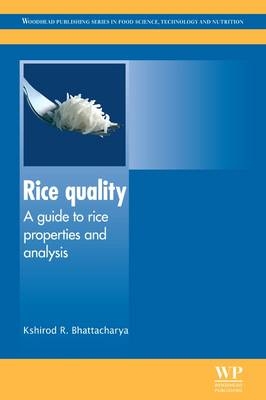
Rice Quality
Woodhead Publishing Ltd (Verlag)
978-1-84569-485-2 (ISBN)
Rice is a unique and highly significant crop, thought to help feed nearly half the planet on a daily basis. An understanding of its properties and their significance is essential for the provision of high quality products. This is all the more true today as international trade in rice trade has been increasing rapidly in recent years. This important book reviews variability in rice characteristics and their effects on rice quality.After an introduction on rice quality that also explores paradoxes associated with the crop, the book goes on to examine rice physical properties and milling quality. This leads to a discussion of the effects that the degree of milling has on rice quality. The ageing of rice and its cooking and eating quality are investigated in the following chapters before an analysis of the effect of parboiling on rice quality. Later chapters consider the product-making and nutritional quality of rice and investigate speciality rices and rice breeding for desirable quality. The book concludes with an extensive chapter on rice quality analysis and an appendix containing selected rice quality test procedures.With its distinguished author Rice quality: a guide to rice properties and analysis proves an invaluable resource for professionals in the rice industry and researchers and post-graduate students interested in rice.
Dr Kshirod R. Bhattacharya worked in the Central Food Technological Research Institute, Mysore, India. Currently he is Advisor to Tilda Riceland Pvt. Ltd, India, in particular advising the company’s Rice Research and Development Centre. He is renowned for his research and work to understand the rice grain and improve its quality.
Author contact details
Woodhead Publishing Series in Food Science, Technology and Nutrition
Preface
Acknowledgements
Dedication
Chapter 1: An introduction to rice: its qualities and mysteries
Abstract:
1.1 Rice in history
1.2 More rice paradoxes
1.3 Rice data and the tales they tell
1.4 Rice quality
Chapter 2: Physical properties of rice
Abstract:
2.1 Introduction
2.2 Grain appearance
2.3 Density and friction
2.4 Effect of moisture content
2.5 Miscellaneous properties
2.6 Chalky grains
Chapter 3: Milling quality of rice
Abstract:
3.1 Milling of rice
3.2 Grain cracking or fissuring at or around harvest
3.3 Drying of rice
3.4 Why the rice grain fissures
3.5 Miscellaneous factors that affect milling quality of rice
3.6 Fundamental cause of rice breakage: interrelationship and synergy between different factors
Chapter 4: Degree of milling (DM) of rice and its effect
Abstract:
4.1 Milling paddy grain and how much to mill
4.2 Effect of degree of milling (DM) on rice quality
Chapter 5: Ageing of rice
Abstract:
5.1 Introduction
5.2 Consumers’ perception of changes in rice behaviour during storage
5.3 Changes in physicochemical properties of rice during ageing as measured in the laboratory
5.4 Theories of rice ageing: relation to individual constituents
5.5 Some final rice paradoxes
5.6 Can the ageing process be hastened or retarded?
Chapter 6: Cooking quality of rice
Abstract:
6.1 Introduction
6.2 Absorption of water by rice during cooking at or near the boiling temperature
6.3 Hydration at lower temperatures
6.4 Loss of solids during cooking
6.5 Effect of presoaking in ambient water on cooking
6.6 Other changes/events occurring during cooking
6.7 Laboratory cooking of rice for various tests
Chapter 7: Eating quality of rice
Abstract:
7.1 Introduction
7.2 The initiation: the water-uptake paradigm
7.3 The period of data accumulation: the amylose paradigm
7.4 Exploration at the molecular level: the amylopectin paradigm
7.5 Rheology of rice-flour paste
7.6 Other factors that effect the eating quality of rice
7.7 Testing for rice quality
Chapter 8: Effect of parboiling on rice quality
Abstract:
8.1 Introduction: parboiled rice
8.2 Changes brought about in the rice grain and its constituents during the parboiling process
8.3 Properties of parboiled rice
8.4 Effect of rice variety on properties of parboiled rice
8.5 Products from parboiled rice
Chapter 9: Product-making quality of rice
Abstract:
9.1 Introduction
9.2 Table rice
9.3 Rice flour and products thereof
9.4 Rice breakfast cereals and snacks made from wholegrain rice
9.5 Other rice products
Chapter 10: Speciality rices
Abstract:
10.1 Introduction
10.2 Aromatic rices
10.3 Basmati
10.4 Jasmine
10.5 Other speciality rices
Chapter 11: Nutritional quality of rice
Abstract:
11.1 Introduction: why do we have to eat?
11.2 Nutritive value of rice is not a small matter
11.3 The perspective of nutrition of the poor rice-eater
11.4 Wholegrains versus refined grains: two views
11.5 No, wholegrains confer untold benefits
11.6 The perspective of the nutritive value of individual rice constituents
11.7 Biotechnological approach to upgrade the nutritive value of rice
Chapter 12: Rice breeding for desirable quality
Abstract:
12.1 Introduction
12.2 Plant characteristics for optimum harvest
12.3 Physical and morphological properties of the paddy grain that affect the quality of the final product
12.4 Susceptibility of the rice grain to cracking
12.5 End-use quality
12.6 Conclusions
Chapter 13: Analysis of rice quality
Appendix: some selected rice quality test procedures
Index
| Reihe/Serie | Woodhead Publishing Series in Food Science, Technology and Nutrition |
|---|---|
| Verlagsort | Cambridge |
| Sprache | englisch |
| Maße | 156 x 234 mm |
| Gewicht | 1060 g |
| Themenwelt | Technik ► Lebensmitteltechnologie |
| Weitere Fachgebiete ► Land- / Forstwirtschaft / Fischerei | |
| ISBN-10 | 1-84569-485-6 / 1845694856 |
| ISBN-13 | 978-1-84569-485-2 / 9781845694852 |
| Zustand | Neuware |
| Informationen gemäß Produktsicherheitsverordnung (GPSR) | |
| Haben Sie eine Frage zum Produkt? |
aus dem Bereich