Anatomy and Physiology of Farm Animals (eBook)
1376 Seiten
Wiley (Verlag)
978-1-394-18792-8 (ISBN)
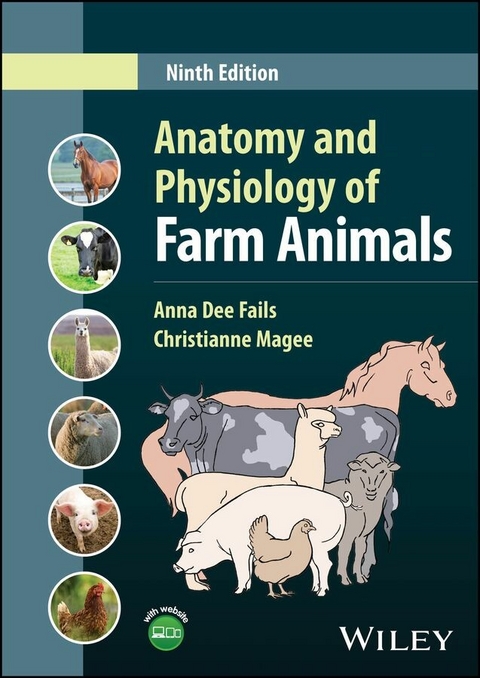
A complete guide to the anatomy and physiology of farm animals, fully updated and revised
In the newly revised ninth edition of Anatomy and Physiology of Farm Animals, distinguished veterinary professors Drs. Anna Fails and Christianne Magee deliver a comprehensive guide for animal science, veterinary technician, and pre-veterinary students and instructors seeking a well-organized and easy-to-understand resource. The new edition offers modified and refined learning objectives at the beginning of each chapter, as well as a brand-new chapter on llamas/alpacas that highlights the significant species differences and explains the roles of these species in the wool and packing industries.
Additional illustrations enhance comprehension and improve the anatomy sections of the book. New 'Study Prompts,' integrative application questions, are included in each chapter in differently colored text and stimulate understanding of the material. Finally, a reorganized companion website is included with the book. It integrates fully with the print text and provides supplemental content, including word roots, clinical cases, study and practice questions, and additional images, diagrams, and videos.
Readers will also find:
- An excellent anatomy and physiology resource for high school and undergraduate students in animal science, veterinary medicine, and zoology programs
- Comprehensive explorations of the anatomy and physiology of the cell
- Practical discussions of embryology, the skeletal system, and microscopic anatomy
- Complete discussion of the physiology of muscle and the anatomy and physiology of the nervous system
A valuable comprehensive resource for advanced high school and undergraduate animal science students in agriculture, pre-veterinary, and veterinary technical program, Anatomy and Physiology of Farm Animals will also benefit people practicing in allied professions and veterinary practitioners.
Anna Dee Fails, DVM, PhD, is Associate Professor in the Department of Biomedical Sciences at Colorado State University, Fort Collins, Colorado, USA.
Christianne Magee, DVM, PhD, Dip ACT, is Associate Professor in the Department of Biomedical Sciences at Colorado State University, Fort Collins, Colorado, USA. She's also a Diplomate of the American College of Theriogenology.
A complete guide to the anatomy and physiology of farm animals, fully updated and revised In the newly revised ninth edition of Anatomy and Physiology of Farm Animals, distinguished veterinary professors Drs. Anna Fails and Christianne Magee deliver a comprehensive guide for animal science, veterinary technician, and pre-veterinary students and instructors seeking a well-organized and easy-to-understand resource. The new edition offers modified and refined learning objectives at the beginning of each chapter, as well as a brand-new chapter on llamas/alpacas that highlights the significant species differences and explains the roles of these species in the wool and packing industries. Additional illustrations enhance comprehension and improve the anatomy sections of the book. New Study Prompts, integrative application questions, are included in each chapter in differently colored text and stimulate understanding of the material. Finally, a reorganized companion website is included with the book. It integrates fully with the print text and provides supplemental content, including word roots, clinical cases, study and practice questions, and additional images, diagrams, and videos. Readers will also find: An excellent anatomy and physiology resource for high school and undergraduate students in animal science, veterinary medicine, and zoology programsComprehensive explorations of the anatomy and physiology of the cell Practical discussions of embryology, the skeletal system, and microscopic anatomy Complete discussion of the physiology of muscle and the anatomy and physiology of the nervous system A valuable comprehensive resource for advanced high school and undergraduate animal science students in agriculture, pre-veterinary, and veterinary technical program, Anatomy and Physiology of Farm Animals will also benefit people practicing in allied professions and veterinary practitioners.
Chapter 1
INTRODUCTION TO ANATOMY AND PHYSIOLOGY
- Anatomical Nomenclature, Directional Terms, and Planes of Section
- Microscopic Anatomy: Animal Cells and Tissues
- The General Plan of the Animal Body
Learning Objectives
- Define and explain the significance of the bold italic terms in this chapter.
- Use anatomical directional terms correctly when describing anatomy.
- Describe the planes of section that can be used to divide body regions.
- Describe how to classify structures as part of a body system, organ, tissue, or cell type.
- Briefly outline the four basic tissue types and their primary subcategories. What are the distinguishing features of each of the primary subcategory tissue types? Where might these tissue types or their primary subcategories be found?
- Describe the primary components of blood and how serum differs from plasma.
- Explain the difference between secretion and excretion.
- Explain the difference between an endocrine gland and an exocrine gland. Provide examples for each, and name one tissue that has both endocrine and exocrine functions.
- Describe the concept of “potential” spaces as applies to body cavities.
- Describe how the mammalian embryonic coelom is divided in the adult and name the serous membrane associated with those cavities.
The term anatomy literally translates as “to cut apart,” as it acknowledges the central role of dissection in the study of body structure. In contemporary usage, though, it has come to refer more generally to the science that deals with the form and structure of all organisms.
In contrast to anatomy, which deals primarily with structure, physiology is the study of the integrated functions of the body and the functions of all its parts (systems, organs, tissues, cells, and cell components), including biophysical and biochemical processes.
Study in a typical gross (macroscopic) anatomy laboratory is often based primarily on the dissection of animal cadavers. While virtual reality anatomy tools exist to provide learners with access to models or 3D images outside of the laboratory space, dissection coupled with handling and direct observation of grossly visible structures provides a concept of the shape, texture, location, and relations of structures visible to the unaided eye that can be gained in no other way. Similarly, the use of the microscope with properly prepared tissue sections on slides through which the student can navigate fosters a comprehensive understanding of structures that are so small they cannot be seen without microscopic assistance (microscopic anatomy).
Although anatomy and physiology are commonly pursued as more or less independent disciplines, they are both facets of the study of the animal body. A thorough knowledge of structure imparts much information about its function; it is impossible to gain a thorough understanding of function without a basic knowledge of structure. Conversely, a mere description of structure without describing function would be of little practical value.
This text chiefly describes gross anatomy, the study of the form and relationships (relative positions) of the structures of the body that can be seen with the unaided eye. The science of anatomy is so extensive that it is divided into many specialized branches. Comparative anatomy is the study of the structures of various species of animals, with particular emphasis on those characteristics that aid in classification. Embryology (Chapter 3) is the study of developmental anatomy, covering the period from conception (fertilization of the egg) to birth. Another large branch of anatomy consists of the study of tissues and cells that can be seen only with the aid of a microscope. This is known as microscopic anatomy.
Our approach to the study of anatomy will be chiefly by systems, an approach which can be described as systematic anatomy. To name a particular subdivision of systematic anatomy (Table 1-1), the suffix ‐ology, which means branch of knowledge or science, is added to the root word referring to the system.
Physiology has also become so extensive in scope that many areas of specialization are recognized. Like anatomy, these may be based on body systems (e.g., neurophysiology, gastrointestinal physiology, cardiovascular physiology, respiratory physiology, endocrine physiology, and reproductive physiology) or the level of biological organization (cell physiology and organismal physiology). All these subdivisions become parts of such overall areas of study as applied physiology, comparative physiology, pathophysiology, medical physiology, and mammalian physiology. We will be concerned with these systems and studies as they relate specifically to farm animals.
Anatomical Nomenclature, Directional Terms, and Planes of Section
Anatomy is a very old scientific discipline, and anatomists have been giving names to body parts for a very long time, sometimes naming the structure after themselves, or more usually by using Greek (Gr.) or Latin (L.) terms to describe a structure. In the online version of this text, helpful word roots have been provided for each chapter to help the reader understand the terminology used for anatomical nomenclature. It should also not be surprising that many anatomical constructs have been referred to by a variety of names over the centuries, and veterinary anatomy is further burdened by nonuniform attempts to adopt names of homologous human structures. Consequently, there are sometimes multiple names for anatomical structures. A committee of The World Association of Veterinary Anatomists (WAVA) debates and decides the single, most appropriate term for structures in veterinary anatomy. In 1963, the first “Nomina Anatomica Veterinaria” (literally, “Veterinary Anatomical Names”) or NAV came into widespread use. This guide has since undergone a series of revisions, and the latest version (6th edition, revised) is available on the WAVA website. Our textbook endeavors to abide by the NAV guidelines for naming structures, deviating only when common usage overwhelmingly argues for an alternative term.
Table 1‐1. Nomenclature for Systematic Anatomy
| System | Name of Study | Chief Structures |
|---|
| Skeletal system | Osteology | Bones |
| Articular system | Arthrology (Syndesmology) | Joints |
| Muscular system | Myology | Muscles |
| Digestive system | Splanchnology | Stomach and intestines |
| Respiratory system | Lungs and airways |
| Urinary system | Kidneys and urinary bladder |
| Reproductive system | Ovaries and testes |
| Endocrine system | Endocrinology | Ductless glands |
| Nervous system | Neurology | Brain, spinal cord, and nerves |
| Circulatory system | Cardiology | Heart and vessels |
In order to communicate with others about the physical location and relationships of anatomical structures, a specialized lexicon that describes locations and directions within the body has been developed. Since the body is mobile, the frames of reference must apply regardless of the position or direction of the animal (Fig. 1-1). Directional terminology in animal anatomy differs from that in human anatomy because of the orientation of bipedal versus quadrupedal stance. The student of animal anatomy will see that the terms anterior, posterior, superior, and inferior are not used except in two specific body regions: the eyes and teeth (see Chapters 12 and 20).
Cranial is a directional term meaning toward the head. The shoulder is cranial to the hip; it is closer to the head than the hip.
Caudal means toward the tail. The rump is caudal to the shoulder.
Rostral and caudal are directional terms used in reference to features of the head, where “rostral” (toward the nose) replaces cranial (since, technically, ALL the structures in the head are “cranial”).
The median plane is an imaginary plane passing through the body so as to divide the body into equal right and left halves. A beef carcass is split into two halves on the median plane.
A sagittal plane is any plane parallel to the median plane. The terms median and sagittal are sufficient to describe any of the planes that divide the body into right and left portions, but the median plane is also sometimes called the midsagittal plane, and sagittal planes other than the median are also referred to as...
| Erscheint lt. Verlag | 28.2.2025 |
|---|---|
| Sprache | englisch |
| Themenwelt | Veterinärmedizin |
| Schlagworte | Farm animal anatomy • farm animal anatomy book • farm animal anatomy questions • farm animal anatomy website • farm animal physiology • farm animal physiology book • farm animal physiology questions • farm animal physiology website • farm animal reference |
| ISBN-10 | 1-394-18792-0 / 1394187920 |
| ISBN-13 | 978-1-394-18792-8 / 9781394187928 |
| Informationen gemäß Produktsicherheitsverordnung (GPSR) | |
| Haben Sie eine Frage zum Produkt? |
 EPUB (Adobe DRM)
Kopierschutz: Adobe-DRM
Adobe-DRM ist ein Kopierschutz, der das eBook vor Mißbrauch schützen soll. Dabei wird das eBook bereits beim Download auf Ihre persönliche Adobe-ID autorisiert. Lesen können Sie das eBook dann nur auf den Geräten, welche ebenfalls auf Ihre Adobe-ID registriert sind.
Details zum Adobe-DRM
Dateiformat: EPUB (Electronic Publication)
EPUB ist ein offener Standard für eBooks und eignet sich besonders zur Darstellung von Belletristik und Sachbüchern. Der Fließtext wird dynamisch an die Display- und Schriftgröße angepasst. Auch für mobile Lesegeräte ist EPUB daher gut geeignet.
Systemvoraussetzungen:
PC/Mac: Mit einem PC oder Mac können Sie dieses eBook lesen. Sie benötigen eine
eReader: Dieses eBook kann mit (fast) allen eBook-Readern gelesen werden. Mit dem amazon-Kindle ist es aber nicht kompatibel.
Smartphone/Tablet: Egal ob Apple oder Android, dieses eBook können Sie lesen. Sie benötigen eine
Geräteliste und zusätzliche Hinweise
Buying eBooks from abroad
For tax law reasons we can sell eBooks just within Germany and Switzerland. Regrettably we cannot fulfill eBook-orders from other countries.
aus dem Bereich