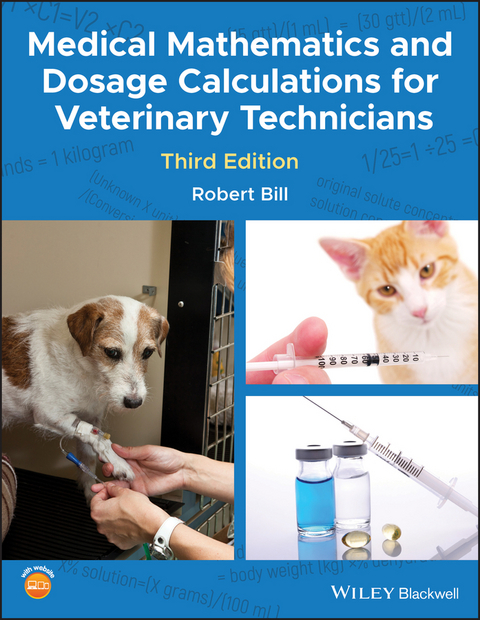
Medical Mathematics and Dosage Calculations for Veterinary Technicians (eBook)
John Wiley & Sons (Verlag)
978-1-118-92414-3 (ISBN)
This user-friendly guide to medical mathematics helps veterinary technician students develop the math skills required before going into the practice setting.
- New workbook format allows readers to practice problems right inside the book
- Covers math fundamentals, metric and non-metric conversions, dosing and concentration, IV drug infusion, prescriptions, and doctors' orders
- Offers step-by-step instructions for performing calculations
- Newly expanded to include calculation of constant rate infusions, dilutions, compounding, and anesthesia applications
- Features a full answer key and images from the book in PowerPoint for instructors on a companion website
Robert Bill is a Professor Emeritus of Veterinary Pharmacology and former Program Director of the Veterinary Technology Program in the College of Veterinary Medicine at Purdue University in West Lafayette, Indiana, USA.
This user-friendly guide to medical mathematics helps veterinary technician students develop the math skills required before going into the practice setting. New workbook format allows readers to practice problems right inside the book Covers math fundamentals, metric and non-metric conversions, dosing and concentration, IV drug infusion, prescriptions, and doctors' orders Offers step-by-step instructions for performing calculations Newly expanded to include calculation of constant rate infusions, dilutions, compounding, and anesthesia applications Features a full answer key and images from the book in PowerPoint for instructors on a companion website The text is organized to help readers with rudimentary math skills as well as those who just need a little review on how to perform medically related mathematical calculations....Overall, this is a well-organized textbook that will help students at all levels of mathematic competency navigate the sometimes-challenging area of medical calculations. - JAVMA Vol 255 No. 6
Robert Bill is a Professor Emeritus of Veterinary Pharmacology and former Program Director of the Veterinary Technology Program in the College of Veterinary Medicine at Purdue University in West Lafayette, Indiana, USA.
2
Review of Key Medical Math Fundamentals: Decimals
OBJECTIVES
The student will be able to:
- accurately communicate decimal numbers in writing and speaking,
- add and subtract decimals,
- multiply and divide decimals,
- apply scientific notation, and
- round numbers.
Drug dosages, concentrations of drugs in vials, and drug units are commonly expressed as decimal numbers. Therefore, it is imperative that the veterinary professional be able to accurately add, subtract, multiply, and divide using decimal numbers. It is assumed the reader has a working knowledge of using decimals; therefore, this chapter will focus on a quick review with an emphasis on where common dosage calculation errors occur.
2.1 Relative Values of Decimal Numbers
The decimal point, or “point,” orients the reader to the values of the decimal number. Each space to the left of the decimal point increases by a power of 10. Therefore, the first space to the left of the decimal point is “ones,” the next space to the left is “tens,” the next is “hundreds,” and so on.
Each space to the right of the decimal point decreases by a power of 10 starting with “tenths.” The second space to the right of the decimal point is the “hundredths,” the next is “thousandths,” and so on. Note that there are no “oneths” to the right of the decimal point and the first place to the right starts with “tenths.” The numerals to the left of the decimal point are whole numbers (5, 62, 379) and the numerals to the right of the decimal point represent decimal fractions (e.g. one tenth, four hundredths).
Notice how all decimal fractions end in “th(s),” such as “four tenths” or “one thousandth.” Thus, the number 12.35 would contain the whole number “12” and the decimal fraction of “thirty‐five hundredths.”
The number shown in Figure 2.1 is 7842.125 and illustrates each of the places in the number.
Figure 2.1 The location of whole numbers and decimal fractions in a decimal number
2.2 Properly Communicating Decimal Numbers
When reading a decimal number aloud, there are two ways to communicate the number. The number in Figure 2.1 can be read as either “seven thousand, eight hundred forty‐two and one hundred twenty‐five thousandths” or as “seven eight four two point one two five.”
The first method is more formal and uses the word “and” to represent the decimal point. All units to the right of the decimal point are read as units of the farthest right place. Therefore, in the number above, there are “125 thousandths.” For the number “1.12,” the value to the right of the decimal point would be read aloud as “twelve hundredths” because the farthest right place that has a number is the hundredths place. When the value of a decimal number is less than 1, such as 0.5, the number would be read only as “five tenths” without stating the zero in the ones place.
The second method for communicating decimal numbers tends to convey the information in a shorter and more concise manner. The numbers are read left to right with the decimal point being spoken as “point.” No place values (hundreds, tenths, thousandths, etc.) are stated in this method. Therefore, “234.56” would simply be read aloud as “two three four point five six.” In contrast to the first method above, where the zero is not read for numbers with a value less than 1, in this second method the zero is communicated along with the “point.” Thus 0.5 would be read as “zero point five.” There are additional examples in Table 2.1.
Table 2.1 The correct way to read decimal numbers
| 36.89 | “Thirty‐six and eighty‐nine hundredths”“Three six point eight nine” |
| 0.9 | “Nine tenths”“Zero point nine” |
| 0.076 | “Seventy‐six thousandths”“Zero point zero seven six” |
| 30.08 | “Thirty and eight hundredths”“Three zero point zero eight” |
Regardless of which method is used when a number is verbally communicated, it is essential that the number be communicated accurately. This can be a challenge when numbers are being communicated while masked for surgery or other procedures because the voice becomes muffled. It also becomes a challenge when communicating numbers by phone, particularly as cell phone reception can garble clear communication. In addition to the physical challenges with communicating numbers, some numbers sounds very similar to others, and the veterinary technician needs to be especially precise in communicating these numbers. It is a good practice to repeat any number that may be confusing, or to emphasize a key feature of the number, such as “One five POINT three,” to make sure the recipient correctly receives the number. If there is ever a question about what number was stated by another staff member or the veterinarian, the veterinary technician is ethically and morally obligated to ask that the number be repeated. Reluctance to ask because of perceived irritation or frustration of the person stating the number is absolutely no reason not to be crystal clear on what number was being communicated. The veterinary technician is the advocate for the patient, and therefore it is essential all numeric communications be accurately communicated 100% of the time.
Commonly miscommunicated numbers
There are several numbers that, when read, sound very similar. It is important that the veterinary professional clearly enunciate these to prevent accidental miscommunication of a spoken value. It is also important that, if any question arises of what value is being communicated, the receiver of the spoken value ask for the value to be repeated. A patient's life could hang in the balance.
- Thirteen sounds like thirty.
- Fourteen sounds like forty.
- Fifteen sounds like fifty.
- Sixteen sounds like sixty.
- Seventeen sounds like seventy.
- Eighteen sounds like eighty.
- Nineteen sounds like ninety.
While all of the decimal fractions sound like their counterpart in the whole numbers (e.g. “tenth” and “ten,” “hundredth” and “hundred”), generally, the context in which the number is spoken prevents it from being confused (e.g. “three hundred and twenty‐three hundredths” for the number 300.23). If there is any doubt, however, the number needs to be repeated to confirm all parties understand the actual number communicated.
2.3 The Rules for the Use of Zero in Decimal Numbers
Rule 1: Whole numbers (e.g. 2, 45, 789) have implied decimal points and trailing zeroes to the right of the decimal point that are usually not written or spoken. “25” and “25.00” both represent the same value of 25 and therefore would be communicated as “twenty‐five” unless greater precision is required. For example, a patient's blood chemistry value may always be printed out or displayed on the laboratory equipment with a number in the 1/10ths slot. In those situations, “25.0” would be communicated as “twenty‐five point zero” or “two five point zero” to emphasize that there is no other number in the 1/10ths slot. Another example may be that a dose of a toxic drug is required to be calculated to the nearest 1/10th. In that situation the digit in the 1/10th slot would always be written or communicated, even if the digit was zero.
Another reason for leaving off the trailing zeros is because the decimal point could potentially be mistaken as a comma. For example, at quick glance, the numbers “25.000” and “25,000” look very similar, especially if the numbers are handwritten by a doctor or a veterinary technician in a hurry. A mistake made by not correctly interpreting the comma or decimal point can result in a dose miscalculation of a thousand times more than what was intended! To avoid this problem with handwritten numbers, commas should not to be used in written calculations.
In our global economy it is important to remember that a comma is used in place of the decimal point in many non‐English speaking countries in continental Europe and Latin America (except Mexico) and also in South Africa. In these countries the decimal point is used like the comma to separate the digits in large numbers and the comma is used to separate the ones from the 1/10ths in the number. Thus, one may see “2.64 mg” written as “2,64 mg” in France, Germany, Austria, and many other countries around the world. The period as the decimal separator is used predominantly in North America (with the exception of French‐speaking Canada) and in the UK, Australia, and other countries where English is commonly used in business or medical...
| Erscheint lt. Verlag | 26.11.2018 |
|---|---|
| Sprache | englisch |
| Themenwelt | Veterinärmedizin |
| Schlagworte | animal drug prescriptions • animal medical dosage calculations • animal medicine • Arzneimitteldosierung • clinical pathology for veterinarians • diagnostic imaging for animals • dosage calculations • dosage calculations for veterinarians • Dosierung • <p>veterinary medicine • Medical Math • Medical Mathematics and Dosage Calculations for Veterinary Professionals</p> • medical math for veterinarians • medical math fundamentals • Pflege i. d. Veterinärmedizin • pharmacology for veterinarians • Veterinärmedizin • Veterinärmedizin / Pharmakologie, Toxikologie, Therapeutik • Veterinärtechnik • veterinary anesthesia applications • veterinary dosing information • veterinary drug prescriptions • Veterinary Medicine • veterinary medicine calculations of constant rate infusions • veterinary medicine compounding • veterinary medicine dilutions • Veterinary Nursing & Animal Care • Veterinary Pharmacology • Veterinary Pharmacology, Toxicology & Therapeutics |
| ISBN-10 | 1-118-92414-2 / 1118924142 |
| ISBN-13 | 978-1-118-92414-3 / 9781118924143 |
| Informationen gemäß Produktsicherheitsverordnung (GPSR) | |
| Haben Sie eine Frage zum Produkt? |
 EPUB (Adobe DRM)
Kopierschutz: Adobe-DRM
Adobe-DRM ist ein Kopierschutz, der das eBook vor Mißbrauch schützen soll. Dabei wird das eBook bereits beim Download auf Ihre persönliche Adobe-ID autorisiert. Lesen können Sie das eBook dann nur auf den Geräten, welche ebenfalls auf Ihre Adobe-ID registriert sind.
Details zum Adobe-DRM
Dateiformat: EPUB (Electronic Publication)
EPUB ist ein offener Standard für eBooks und eignet sich besonders zur Darstellung von Belletristik und Sachbüchern. Der Fließtext wird dynamisch an die Display- und Schriftgröße angepasst. Auch für mobile Lesegeräte ist EPUB daher gut geeignet.
Systemvoraussetzungen:
PC/Mac: Mit einem PC oder Mac können Sie dieses eBook lesen. Sie benötigen eine
eReader: Dieses eBook kann mit (fast) allen eBook-Readern gelesen werden. Mit dem amazon-Kindle ist es aber nicht kompatibel.
Smartphone/Tablet: Egal ob Apple oder Android, dieses eBook können Sie lesen. Sie benötigen eine
Geräteliste und zusätzliche Hinweise
Buying eBooks from abroad
For tax law reasons we can sell eBooks just within Germany and Switzerland. Regrettably we cannot fulfill eBook-orders from other countries.
aus dem Bereich