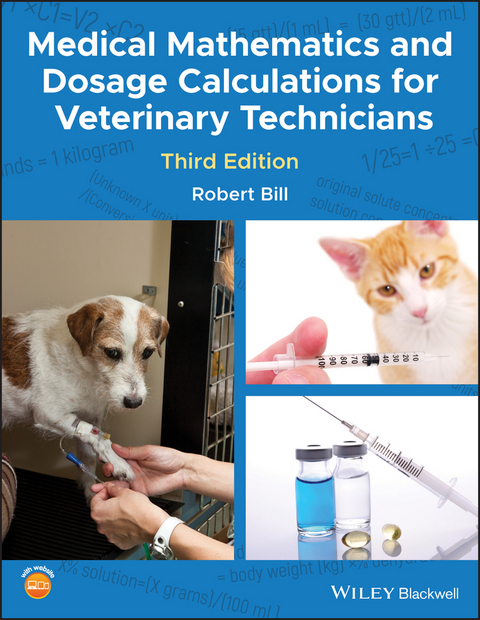
Medical Mathematics and Dosage Calculations for Veterinary Technicians (eBook)
John Wiley & Sons (Verlag)
978-1-118-92413-6 (ISBN)
This user-friendly guide to medical mathematics helps veterinary technician students develop the math skills required before going into the practice setting.
- New workbook format allows readers to practice problems right inside the book
- Covers math fundamentals, metric and non-metric conversions, dosing and concentration, IV drug infusion, prescriptions, and doctors' orders
- Offers step-by-step instructions for performing calculations
- Newly expanded to include calculation of constant rate infusions, dilutions, compounding, and anesthesia applications
- Features a full answer key and images from the book in PowerPoint for instructors on a companion website
Robert Bill is a Professor Emeritus of Veterinary Pharmacology and former Program Director of the Veterinary Technology Program in the College of Veterinary Medicine at Purdue University in West Lafayette, Indiana, USA.
This user-friendly guide to medical mathematics helps veterinary technician students develop the math skills required before going into the practice setting. New workbook format allows readers to practice problems right inside the book Covers math fundamentals, metric and non-metric conversions, dosing and concentration, IV drug infusion, prescriptions, and doctors' orders Offers step-by-step instructions for performing calculations Newly expanded to include calculation of constant rate infusions, dilutions, compounding, and anesthesia applications Features a full answer key and images from the book in PowerPoint for instructors on a companion website The text is organized to help readers with rudimentary math skills as well as those who just need a little review on how to perform medically related mathematical calculations....Overall, this is a well-organized textbook that will help students at all levels of mathematic competency navigate the sometimes-challenging area of medical calculations. - JAVMA Vol 255 No. 6
Robert Bill is a Professor Emeritus of Veterinary Pharmacology and former Program Director of the Veterinary Technology Program in the College of Veterinary Medicine at Purdue University in West Lafayette, Indiana, USA.
Title Page 5
Copyright Page 6
Contents 7
About the Companion Website 11
Section I Review of Math Fundamentals 13
Chapter 1 Math Fundamentals: Self-assessment 15
Self-assessment Exercises 15
Chapter 2 Review of Key Medical Math Fundamentals: Decimals 23
2.1 Relative Values of Decimal Numbers 23
2.2 Properly Communicating Decimal Numbers 24
2.3 The Rules for the Use of Zero in Decimal Numbers 25
2.4 Comparing Decimals – Which Number Is Larger? 26
2.5 A Quick Guide to Using Scientific Notation 27
2.6 Tips for Adding and Subtracting Decimal Numbers 29
2.7 Tips for Multiplying Decimal Numbers 30
2.8 Tips for Dividing Decimal Numbers 31
2.9 Accurately Rounding Decimal Numbers 34
2.10 Chapter 2 Practice Problems 35
Chapter 3 Review of Key Math Fundamentals: Fractions 39
3.1 Fundamentals of Working with Medical Math Fractions 39
3.2 Working with Improper Fractions, Proper Fractions, and Mixed Numbers 40
3.3 Equivalent Fractions in Medical Math 41
3.4 Simplifying or Reducing Fractions 42
3.5 Adding Fractions in Medical Math 43
3.6 Subtracting Fractions in Medical Math 45
3.7 Multiplying Fractions in Medical Math 46
3.8 Dividing Fractions in Medical Math 49
3.9 Conversion Between Fractions and Decimals 51
3.10 Rounding Fractions in Medical Math 53
3.11 Chapter 3 Practice Problems 54
Chapter 4 Review of Key Math Fundamentals: Percentages 59
4.1 Conversion of Percentages to Fractions 59
4.2 Conversion Between Percentages and Decimal Numbers 60
4.3 Conversion of Fractions to Percentages 61
4.4 Finding Percentages of a Whole 61
4.5 Subtracting or Adding the Percentage Fraction of the Whole 62
4.6 Determining Percentages Represented by the Fractional Component 64
4.7 Chapter 4 Practice Problems 65
Chapter 5 Review of Key Math Fundamentals: Finding the Unknown X 69
5.1 Analyzing the Problem and Setting up the Equation 69
5.2 Addition: Moving Numbers to the Other Side of the Equation 70
5.3 Subtraction: Moving Negative Numbers or a Negative Unknown X 71
5.4 Finding the Unknown X in Multiplication Problems 74
5.5 When the Unknown X is in the Denominator 79
5.6 Finding the Unknown X in Division Problems 82
5.7 Unknown X Involving Division of Fractions 83
5.8 Chapter 5 Practice Problems 86
Section II Understanding Units and Labels 89
Chapter 6 Measurements Used in Veterinary Medicine 91
6.1 Metric Units: The Basics 91
6.2 Metric Units of Weight and Mass 92
6.3 Metric Units of Volume 94
6.4 Metric Units of Length 95
6.5 Metric Units of Concentration and Density 96
6.6 Nonmetric Units: Household, Apothecary, and Avoirdupois Units 97
6.7 Conversion between Quantities of Volume and Mass: Special Cases 99
6.8 Converting Between Units: The Proportion and Cancel-Out Methods 99
6.8.1 Using the Proportion Method 100
6.8.2 Using the Cancel-out Method 103
6.9 Estimating the Answer: Does Your Answer Make Sense? 105
6.10 Chapter 6 Practice Problems 108
Chapter 7 Understanding Drug Orders and Drug Labels 111
7.1 The Dosage Regimen 111
7.1.1 The Dosage Regimen: Doses and Dosages 112
7.1.2 The Dosage Regimen: The Route of Administration 112
7.1.3 The Dosage Regimen: The Dose Interval 114
7.2 The Dosage Form 114
7.3 The Best Practices for Writing Drug Orders 115
7.3.1 Handling Unclear Drug Orders 116
7.4 Understanding the Drug Label: The Drug Names 116
7.5 Understanding the Drug Label: Concentrations and Dosage Forms 119
7.6 Understanding the Drug Label: Regulatory Label Information 121
7.6.1 Controlled Substances and Prescription Labeling 122
7.6.2 Prescription, Legend, and Over-The-Counter Label Indicators 122
7.7 Understanding the Drug Label: Hazards, Storage, and Expiration Dates 122
7.7.1 Storage Information on the Label 123
7.7.2 Expiration Dates 123
7.8 Chapter 7 Practice Problems 124
Section III Dose Calculations 127
Chapter 8 Basic Dose Calculations 129
8.1 The Basic Steps in Dose Calculation 129
8.2 Converting the Animal's Weight into the Units Needed to Calculate the Dose 131
8.3 Determining the Dose for the Patient 132
8.4 Determining the Amount of Dose Forms Needed per Dose 134
8.5 Determining the Number of Dosage Forms Needed to Complete the Dosage Regimen 137
8.5.1 The Most Common Mistake Made when Determining the Total Number of Units to Be Dispensed 138
8.6 Determining the Cost for Dispensed Medication 140
8.7 Using a Syringe with Liquid Dosage Formulations 141
8.7.1 Syringes in Veterinary Medicine 142
8.7.2 Measuring Fluid within the Syringe 143
8.8 Chapter 8 Practice Problems 144
Chapter 9 Intravenous Infusion Calculations 149
9.1 Performing IV Infusions and the Use of IV Administration Sets 149
9.2 The Basics of Setting IV Fluid Rate Using the Drip Chamber 150
9.3 Setting the IV Fluid Rate: Constant Rate Infusions (CRI) 154
9.4 Calculating Infusion Rates when Adding Drugs to IV Fluids 156
9.5 Calculating Standard IV Fluid Rates 159
9.6 Calculating IV Fluid Rate Stop Times 163
9.7 Chapter 9 Practice Problems 165
Section IV Other Calculations Used in Veterinary Medicine 169
Chapter 10 Ratios, Proportions, and Dilutions 171
10.1 Ratios and Proportions 171
10.2 The Basics of Making a Dilution 173
10.3 Making Serial Dilutions 174
10.4 Calculating Diluent Needed to Deliver a Specific Dose or Drug Concentration 175
10.5 Calculating Dilutions Using the V1xC1=V2xC2 Formula 176
10.6 Diluting Percent Solutions 178
10.7 Diluting Solutions Expressed as Ratios 179
10.8 Making Dilutions with Mixed Types of Concentrations 180
10.9 Chapter 10 Practice Problems 181
Chapter 11 Additional Calculations Used by Veterinary Professionals 183
11.1 Mean, Median, Mode, and Range 183
11.2 Converting between Fahrenheit and Celsius 187
11.3 Roman Numerals 191
11.4 Chapter 11 Practice Problems 193
Appendix: Answers to Practice Problems 195
Index 235
EULA 240
| Erscheint lt. Verlag | 13.11.2018 |
|---|---|
| Sprache | englisch |
| Themenwelt | Veterinärmedizin |
| Schlagworte | animal drug prescriptions • animal medical dosage calculations • animal medicine • Arzneimitteldosierung • clinical pathology for veterinarians • diagnostic imaging for animals • dosage calculations • dosage calculations for veterinarians • Dosierung • <p>veterinary medicine • Medical Math • Medical Mathematics and Dosage Calculations for Veterinary Professionals</p> • medical math for veterinarians • medical math fundamentals • Pflege i. d. Veterinärmedizin • pharmacology for veterinarians • Veterinärmedizin • Veterinärmedizin / Pharmakologie, Toxikologie, Therapeutik • Veterinärtechnik • veterinary anesthesia applications • veterinary dosing information • veterinary drug prescriptions • Veterinary Medicine • veterinary medicine calculations of constant rate infusions • veterinary medicine compounding • veterinary medicine dilutions • Veterinary Nursing & Animal Care • Veterinary Pharmacology • Veterinary Pharmacology, Toxicology & Therapeutics |
| ISBN-10 | 1-118-92413-4 / 1118924134 |
| ISBN-13 | 978-1-118-92413-6 / 9781118924136 |
| Informationen gemäß Produktsicherheitsverordnung (GPSR) | |
| Haben Sie eine Frage zum Produkt? |
 PDF (Adobe DRM)
Kopierschutz: Adobe-DRM
Adobe-DRM ist ein Kopierschutz, der das eBook vor Mißbrauch schützen soll. Dabei wird das eBook bereits beim Download auf Ihre persönliche Adobe-ID autorisiert. Lesen können Sie das eBook dann nur auf den Geräten, welche ebenfalls auf Ihre Adobe-ID registriert sind.
Details zum Adobe-DRM
Dateiformat: PDF (Portable Document Format)
Mit einem festen Seitenlayout eignet sich die PDF besonders für Fachbücher mit Spalten, Tabellen und Abbildungen. Eine PDF kann auf fast allen Geräten angezeigt werden, ist aber für kleine Displays (Smartphone, eReader) nur eingeschränkt geeignet.
Systemvoraussetzungen:
PC/Mac: Mit einem PC oder Mac können Sie dieses eBook lesen. Sie benötigen eine
eReader: Dieses eBook kann mit (fast) allen eBook-Readern gelesen werden. Mit dem amazon-Kindle ist es aber nicht kompatibel.
Smartphone/Tablet: Egal ob Apple oder Android, dieses eBook können Sie lesen. Sie benötigen eine
Geräteliste und zusätzliche Hinweise
Buying eBooks from abroad
For tax law reasons we can sell eBooks just within Germany and Switzerland. Regrettably we cannot fulfill eBook-orders from other countries.
aus dem Bereich