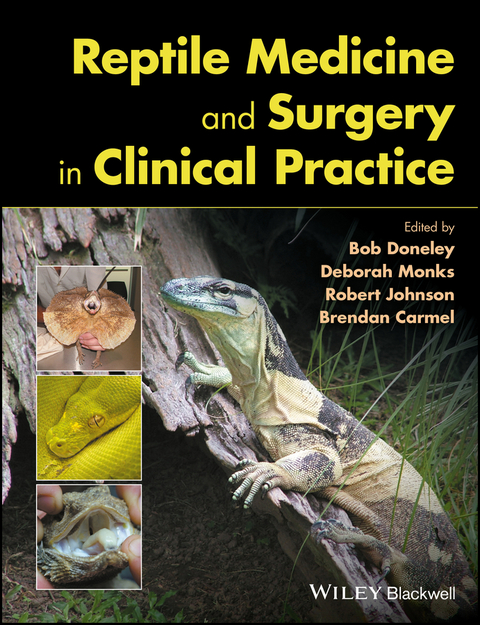
Reptile Medicine and Surgery in Clinical Practice (eBook)
John Wiley & Sons (Verlag)
978-1-118-97769-9 (ISBN)
A concise and practical quick reference guide to treating reptiles in first opinion veterinary practice
Reptile Medicine and Surgery in Clinical Practice is the ideal guide for the busy veterinarian treating reptile cases. Designed as a quick reference guide, but with comprehensive coverage of all the topics needed for first opinion practice, the book presents the principles of reptile medicine and surgery.
Richly illustrated chapters cover anatomy, physiology, behaviour, husbandry, reproduction, common diseases and disorders, and much more. Application in a clinical setting is emphasized throughout, including guidance on the physical examination, diagnostic testing and imaging, treatment options, and anaesthetic and surgical techniques.
- Practical quick-reference guide-ideal for the busy, first-opinion veterinary practitioner
- Richly illustrated in full colour throughout
- Edited by a team of highly experienced exotic animal veterinarians
- Useful reference for those studying for postgraduate certificates in exotic animal medicine
With contributions from experts around the globe, Reptile Medicine and Surgery in Clinical Practice is a valuable reference offering a balanced international view of herpetological medicine.
Bob Doneley is an Associate Professor and Head of the Avian and Exotic Pet Service at the School of Veterinary Science, University of Queensland, Australia.
Deborah Monks is the principal of the Brisbane Bird and Exotics Veterinary Service, Australia.
Robert Johnson is the principal of the South Penrith Veterinary Clinic, Australia.
Brendan Carmel is the principal of the Warranwood Veterinary Centre, Australia.
A concise and practical quick reference guide to treating reptiles in first opinion veterinary practice Reptile Medicine and Surgery in Clinical Practice is the ideal guide for the busy veterinarian treating reptile cases. Designed as a quick reference guide, but with comprehensive coverage of all the topics needed for first opinion practice, the book presents the principles of reptile medicine and surgery. Richly illustrated chapters cover anatomy, physiology, behaviour, husbandry, reproduction, common diseases and disorders, and much more. Application in a clinical setting is emphasized throughout, including guidance on the physical examination, diagnostic testing and imaging, treatment options, and anaesthetic and surgical techniques. Practical quick-reference guide ideal for the busy, first-opinion veterinary practitioner Richly illustrated in full colour throughout Edited by a team of highly experienced exotic animal veterinarians Useful reference for those studying for postgraduate certificates in exotic animal medicine With contributions from experts around the globe, Reptile Medicine and Surgery in Clinical Practice is a valuable reference offering a balanced international view of herpetological medicine.
Bob Doneley is an Associate Professor and Head of the Avian and Exotic Pet Service at the School of Veterinary Science, University of Queensland, Australia. Deborah Monks is the principal of the Brisbane Bird and Exotics Veterinary Service, Australia. Robert Johnson is the principal of the South Penrith Veterinary Clinic, Australia. Brendan Carmel is the principal of the Warranwood Veterinary Centre, Australia.
List of Contributors xi
Preface xv
1 Taxonomy and Introduction to Common Species 1
Bob Doneley
2 Anatomy and Physiology of Reptiles 15
Bairbre O'Malley
3 Behaviour in the Wild and in Captivity 33
Robert Johnson
4 Husbandry and Nutrition 45
Michelle Kischinovsky, Aidan Raftery and Shivananden Sawmy
5 Enclosure Design 61
Michael McFadden, Deborah Monks, Bob Doneley and Robert Johnson
6 Lighting 75
Frances M. Baines
7 Reproduction 91
Timothy J. Portas
8 Reptile Paediatrics 105
Deborah Monks and Bob Doneley
9 Setting Up and Equipping a Reptile Practice 115
Bob Doneley, Shane Simpson, Angela M. Lennox and John Chitty
10 The Reptile Consultation 125
Bob Doneley and Brendan Carmel
11 Diagnostic Testing 135
Rachel E. Marschang, Frank Pasmans, Tim Hyndman, Mark Mitchell and An Martel
12 Diagnostic Imaging 145
Zden¨§k Knotek, Shane Simpson and Paolo Martelli
13 Clinical Techniques and Supportive Care 159
Kimberly Vinette Herrin
14 Reptile Pharmacology 175
Tim Hyndman
15 Nutritional and Metabolic Diseases 185
Brendan Carmel and Robert Johnson
16 Infectious Diseases and Immunology 197
Tim Hyndman and Rachel E. Marschang
17 Differential Diagnoses: A Problem/Based Approach 217
Helen McCracken, Brendan Carmel, John Chitty, Bob Doneley, Robert Johnson, Angela M. Lennox, Deborah Monks and Annabelle Olsson
18 Disorders of the Integument 255
Linda Vogelnest
19 Diseases of the Gastrointestinal System 273
Robert Johnson and Bob Doneley
20 Diseases of the Cardiovascular System 287
Tegan Stephens and Alex Rosenwax
21 Diseases of the Respiratory System 299
Melinda L. Cowan
22 Disorders of the Reproductive System 307
Timothy J. Portas
23 Diseases of the Urinary Tract 323
Peter Holz
24 Diseases of the Nervous System 331
Hamish Baron and David N. Phalen
25 Disorders of the Musculoskeletal System 345
Adolf K. Maas
26 Diseases of the Organs of Special Senses 357
Alex Rosenwax and Tegan Stephens
27 Analgesia and Anaesthesia 369
Annabelle Olsson and Mark Simpson
28 Surgery 383
Zden¨§k Knotek and Stacey Leonatti Wilkinson
29 Turtle Shell Repair 397
Jane Roffey and Sasha Miles
30 Necropsy 409
Catherine M. Shilton
31 Reptile Parasitology in Health and Disease 425
Jan Slapeta, David Modry, Robert Johnson
32 Nursing the Reptile Patient 441
Gary Fitzgerald and Emma Whitlock
33 Euthanasia 449
Tim Hyndman
Appendix 1: Formulary 453
Appendix 2: Reference Intervals for Commonly Kept Reptile Species 473
Index 481
"There are 33 chapters covering everything from anatomy and husbandry, to diseases, imaging, nutrition and surgery. Diseases have been covered in chapters dedicated to systems [...] There are two absolute standouts of this book that I haven't encountered in many other books before. There are two successive chapters on 'Setting Up and Equipping a Reptile Practice' and 'The Reptile Consultation', which provide beautiful guiding principles for getting into this growing field, right down to marketing of the service. The second standout is chapter 17: 'Differential Diagnoses: A Problem-Based Approach'. The chapter runs for 36 pages and contains nothing but lists of differentials for common presenting signs of the four major reptile taxa: snakes, lizards, chelonians and crocodilians. Every major disease text should contain such a chapter and I cannot wait until the authors release the searchable app for this. [...] The text probably won't contain the level of information a reptilian disease researcher might covet, but would be perfect for the general practitioner looking to start in reptiles, the general practitioner faced with a single question from a keen owner, the already established reptile expert and most certainly would be perfect for those veterinarians embarking upon membership examinations to Australian and New Zealand College in exotic pet medicine."
Australian Veterinary Journal Volume 97 No 10, October 2019
1
Taxonomy and Introduction to Common Species
Bob Doneley
Taxonomy
Class Reptilia is one of the largest groups of vertebrates, with over 10,000 species. It is also the oldest, evolving some 310–320 million years ago during the Carboniferous period. They share several common characteristics: all are covered with scales or scutes and are ectothermic. Most lay amniotic eggs (oviparity), although some are live bearers (viviparity, including ovovivaparity). They may be carnivorous, omnivorous or herbivorous.
Class Reptilia is made up of four orders: Squamata, Testudines, Crocodilia and Rhynchocephalia (Table 1.1). Each order is further divided into sub‐orders, families, genera and species.
Table 1.1 Reptile orders.
| Order and sub‐order | Common name | Species (n) |
| Squamata | Squamates | 9,671 |
| Lacertilia | Lizards | 5,987 |
| Serpentes | Snakes | 3,496 |
| Amphisbaenia | Worm lizards | 188 |
| Testudines | Turtles, tortoises and terrapins | 341 |
| Crocodylia | Crocodiles, gharials, caimans and alligators | 25 |
| Rhynchocephalia | Tuataras | 1 |
Squamata
Squamates are characterized by their scaled skin, which is shed periodically (ecdysis), and a moveable quadrate bone that allows the maxilla to open wide relative to the rest of the skull. The order is divided into three sub‐orders: Lacertilia (the lizards), Serpentes (the snakes) and Amphisbaenia (the worm lizards), although some classifications place Amphisbaenia within Lacertilia.
Lacertilia has five infraorders based mainly on morphological similarities between family groups. These are the Diploglossa (including the glass lizards and the American legless lizards), Gekkota (the geckos, the blind lizards and the legless lizards), Iguania (including the agamids, chameleons, iguanas, anoles, collared lizards and the neotropical ground lizards), Platynota (varanids and Gila monsters) and Scincomorpha (including skinks, tegus, plated lizards and spiny‐tail lizards). Most are omnivorous or carnivorous. They are primarily oviparous, although some are ovoviviparous.
Serpentes has two infraorders: Alethinophidia (including the boas, pythons, vipers, elapids, colubrids, file snakes and rattle snakes) and Scolecophidia (the blind snakes). All snakes are carnivorous. Most are oviparous, although some are ovoviviparous.
Amphisbaenia has five families found in the northern hemisphere, Africa and South America. They are largely legless squamates with rudimentary eyes capable of only detecting light (two species have rudimentary forelimbs). Their skin is loosely attached to the body, and appears to be their means of locomotion; the skin moves and ‘drags’ the body behind it. They are carnivorous, with strong jaws and interlocking teeth. Most species lay eggs, although some are known to be ovoviviparous.
Testudines
Testudines, sometimes known as Chelonia, are the turtles, tortoises and terrapins. They are characterized by a bony or cartilaginous shell developed from their ribs. There is some confusion in the terminology. In North America, ‘turtle’ is used to describe the whole order, while in Europe and Australia it refers to freshwater and sea‐dwelling chelonians, with ‘tortoise’ used to describe terrestrial, non‐swimming species. ‘Terrapin’ is a term used to describe several small species of turtle living in fresh or brackish water. Terrapins do not form a taxonomic unit and are not closely related. There are two suborders of Testudines: the Pleurodirans (three families), also called the side‐necked or long‐necked turtles, have long necks that are folded sideways to align them with the shell; the Cryptodirans (eleven families), or short‐neck turtles and tortoises, pull their neck straight back to conceal their head within the shell. Sea turtles are Cryptodirans, although they have lost the ability to retract their heads.
Crocodylia
Crocodylia, an order of large, predatory, semi‐aquatic reptiles, is divided into three families: Crocodylidae (the true crocodiles), Alligatoridae (the alligators and caimans) and Gavialidae (the gharial and false gharial).
Rhynchocephalia
Rhynchocephalia is a primitive order of lizard‐like reptiles that includes only one living species, the Tuatara (Sphenodon punctatus) of New Zealand. There is debate as to whether S. guntheri is a separate species. They are slow‐growing, reaching sexual maturity at 10–20 years, and breed until they are at least 60 years old. It takes the female between one to three years to develop eggs and up to seven months to form the shell. It then takes between 12 and 15 months from copulation to hatching. Thus, reproduction occurs at two‐ to five‐yearly intervals, the longest of any reptile.
Tuatara lack external ears and possess a parietal eye (a light‐sensitive spot located on the top of the animal’s head, thought to play a role in setting circadian rhythms). They are capable of autotomy and have only rudimentary hemipenes. Tuatara have unique dentition, namely two rows of acrodont teeth in the maxilla and one row in the mandible.
Commonly Kept Species
Key
The following abbreviations are used in this section:
- d, days
- G, gestation
- I, incubation
- m, months
- O, oviparous
- OV, ovoviviparous
- PBT, preferred body temperature
- y, years
Tables
- Table 1.2 Lizards
- Table 1.3 Geckos
- Table 1.5 Chameleons
- Table 1.6 Snakes
- Table 1.7 Turtles
- Table 1.8 Tortoises
Table 1.2 Lizards.
| Reptile | Origin | Species | Habitat | Diet | Sexual maturity | Mode of reprod. | Incubation or Gestation | Thermal gradient (°C) | PBT (°C) | Relative humidity (%) | Longevity (years) |
| Bearded dragon (Figure 1.1) | Australia | Most common: inland or central (Pogona vitticeps) eastern (P. barbata) blacksoil (P. henrylawsoni) dwarf (P. minor) Others include: western (P. minima) northwest (P. mitchelli) Nullarbor (P. nullarbor) Kimberley (P. microlepitoda) | Terrestrial | Omnivorous, although the juveniles are initially insectivorous but will eat vegetables and flowers as they grow | 9–24 ma | O | (I) 61–74 d at 30–31 °C (P. vitticeps) | 28–40 | 35 | 25–40 | 10–15 |
| Blue‐tongued skink (Figure 1.2) | Australia | eastern (Tiliqua scincoides scincoides) pygmy (T. adelaidensis) centralian (T. multifasciata) blotched (T. nigrolutea) western (T. occipitalis) | Terrestrial | Omnivorous | 18–36 mb | OV | (G) 3–5 m | 28–32 (higher for inland species) | 25–35 | 25–40 | 10–15 |
| Shingleback | Australia | Also known as bobtail lizard (T. rugosa) | Terrestrial | Omnivorous | 18–36 mc | OV | (I) 4–5 m | 36–40 | 25–45 | 25–40 | 10–15 |
| Frilled lizard | Australia | Chlamydosaurus kingii | Primarily arboreal | Primarily insectivorous but will accept some vegetables | 12–18 m (male) to 2–3 y (female) | O | (I) 60–90 d | 32–37 | 28–38 | 50–70 | 10–15 |
a Depending on species (small species mature younger than larger species).
b Male matures earlier than female.
c This species forms close pair bonding and should be paired before sexual maturity.
Table 1.3 Geckos.
| Reptile | Origin | Species | Habitat | Diet | Sexual maturity | Mode of reprod. | Incubation or Gestation | Thermal gradient (°C) | PBT (°C) | Relative humidity (%) | Longevity (years) |
| Leopard gecko | Pakistan, northern India and Asian desert regions | Eublepharis... |
| Erscheint lt. Verlag | 17.11.2017 |
|---|---|
| Sprache | englisch |
| Themenwelt | Veterinärmedizin ► Kleintier |
| Schlagworte | Bob Doneley • Brendan Carmel • Deborah Monks • diagnosing reptile diseases and disorders • diagnostic testing and imaging in reptiles • exotic animal diseases • exotic animal disorders • exotic animal veterinarians • exotic pets • herpetological medicine • Herpetology • <p>herpetologists • medical treatment of exotic animals • medical treatment of reptiles • reptile anaesthesia • reptile anatomy • reptile behaviour • reptile diseases • reptile husbandry • reptile medicine • Reptile Medicine and Surgery in Clinical Practice</p> • reptile physical examination • reptile physiology • reptile reproduction • Reptiles • reptile surgery • reptile veterinarian • Reptilien • Robert Johnson • treating reptile diseases and disorders • treatment of reptiles • Veterinärchirurgie • Veterinärmedizin • Veterinärmedizin / Exoten • Veterinärmedizin f. Zoo- u. Wildtiere • Veterinary Medicine • Veterinary Medicine - Exotic Pets • Veterinary Medicine - Zoo & Wildlife |
| ISBN-10 | 1-118-97769-6 / 1118977696 |
| ISBN-13 | 978-1-118-97769-9 / 9781118977699 |
| Informationen gemäß Produktsicherheitsverordnung (GPSR) | |
| Haben Sie eine Frage zum Produkt? |
 EPUB (Adobe DRM)
Kopierschutz: Adobe-DRM
Adobe-DRM ist ein Kopierschutz, der das eBook vor Mißbrauch schützen soll. Dabei wird das eBook bereits beim Download auf Ihre persönliche Adobe-ID autorisiert. Lesen können Sie das eBook dann nur auf den Geräten, welche ebenfalls auf Ihre Adobe-ID registriert sind.
Details zum Adobe-DRM
Dateiformat: EPUB (Electronic Publication)
EPUB ist ein offener Standard für eBooks und eignet sich besonders zur Darstellung von Belletristik und Sachbüchern. Der Fließtext wird dynamisch an die Display- und Schriftgröße angepasst. Auch für mobile Lesegeräte ist EPUB daher gut geeignet.
Systemvoraussetzungen:
PC/Mac: Mit einem PC oder Mac können Sie dieses eBook lesen. Sie benötigen eine
eReader: Dieses eBook kann mit (fast) allen eBook-Readern gelesen werden. Mit dem amazon-Kindle ist es aber nicht kompatibel.
Smartphone/Tablet: Egal ob Apple oder Android, dieses eBook können Sie lesen. Sie benötigen eine
Geräteliste und zusätzliche Hinweise
Buying eBooks from abroad
For tax law reasons we can sell eBooks just within Germany and Switzerland. Regrettably we cannot fulfill eBook-orders from other countries.
aus dem Bereich