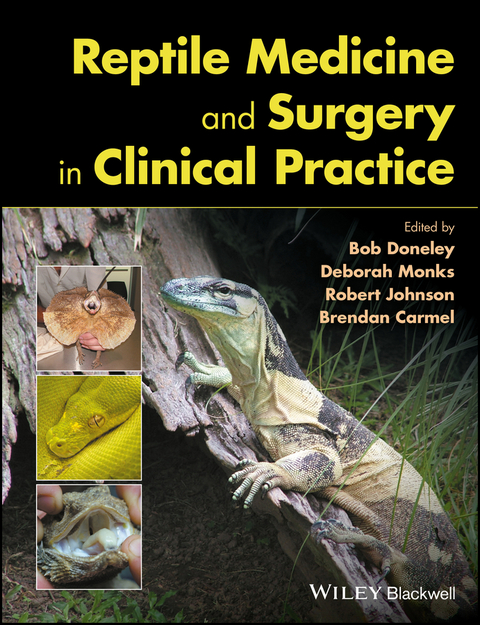
Reptile Medicine and Surgery in Clinical Practice (eBook)
John Wiley & Sons (Verlag)
978-1-118-97768-2 (ISBN)
A concise and practical quick reference guide to treating reptiles in first opinion veterinary practice
Reptile Medicine and Surgery in Clinical Practice is the ideal guide for the busy veterinarian treating reptile cases. Designed as a quick reference guide, but with comprehensive coverage of all the topics needed for first opinion practice, the book presents the principles of reptile medicine and surgery.
Richly illustrated chapters cover anatomy, physiology, behaviour, husbandry, reproduction, common diseases and disorders, and much more. Application in a clinical setting is emphasized throughout, including guidance on the physical examination, diagnostic testing and imaging, treatment options, and anaesthetic and surgical techniques.
- Practical quick-reference guide-ideal for the busy, first-opinion veterinary practitioner
- Richly illustrated in full colour throughout
- Edited by a team of highly experienced exotic animal veterinarians
- Useful reference for those studying for postgraduate certificates in exotic animal medicine
With contributions from experts around the globe, Reptile Medicine and Surgery in Clinical Practice is a valuable reference offering a balanced international view of herpetological medicine.
Bob Doneley is an Associate Professor and Head of the Avian and Exotic Pet Service at the School of Veterinary Science, University of Queensland, Australia.
Deborah Monks is the principal of the Brisbane Bird and Exotics Veterinary Service, Australia.
Robert Johnson is the principal of the South Penrith Veterinary Clinic, Australia.
Brendan Carmel is the principal of the Warranwood Veterinary Centre, Australia.
A concise and practical quick reference guide to treating reptiles in first opinion veterinary practice Reptile Medicine and Surgery in Clinical Practice is the ideal guide for the busy veterinarian treating reptile cases. Designed as a quick reference guide, but with comprehensive coverage of all the topics needed for first opinion practice, the book presents the principles of reptile medicine and surgery. Richly illustrated chapters cover anatomy, physiology, behaviour, husbandry, reproduction, common diseases and disorders, and much more. Application in a clinical setting is emphasized throughout, including guidance on the physical examination, diagnostic testing and imaging, treatment options, and anaesthetic and surgical techniques. Practical quick-reference guide ideal for the busy, first-opinion veterinary practitioner Richly illustrated in full colour throughout Edited by a team of highly experienced exotic animal veterinarians Useful reference for those studying for postgraduate certificates in exotic animal medicine With contributions from experts around the globe, Reptile Medicine and Surgery in Clinical Practice is a valuable reference offering a balanced international view of herpetological medicine.
Bob Doneley is an Associate Professor and Head of the Avian and Exotic Pet Service at the School of Veterinary Science, University of Queensland, Australia. Deborah Monks is the principal of the Brisbane Bird and Exotics Veterinary Service, Australia. Robert Johnson is the principal of the South Penrith Veterinary Clinic, Australia. Brendan Carmel is the principal of the Warranwood Veterinary Centre, Australia.
Title Page 5
Copyright Page 6
Contents 9
List of Contributors 13
Preface 17
Chapter 1 Taxonomy and Introduction to Common Species 19
Taxonomy 19
Squamata 19
Testudines 19
Crocodylia 20
Rhynchocephalia 20
Commonly Kept Species 20
Tables 21
Chapter 2 Anatomy and Physiology of Reptiles 33
Introduction 33
Metabolic Rate 33
Thermoregulation 33
Preferred Optimum Temperature Zone 34
Mechanism of Thermoregulation 34
External Anatomy 34
Chelonia 34
Lizards 35
Snakes 35
Integument 35
Ecdysis 36
Skeletal System 36
Skull 36
Vertebrae 38
Cardiovascular System 40
Intracardiac Blood Shunting 41
Blood Volume 43
Blood Cells 43
Immune System 43
Respiratory System 43
Upper Tract 44
Lower Respiratory Tract 44
Control of Respiration 44
Ventilation 44
Chelonia 44
Lizards 44
Snakes 45
Digestive System 45
Dentition 45
Gastrointestinal Tract 46
Digestion 46
Feeding Frequency 46
Urinary System 46
Clinical Note 47
Osmoregulation 47
Renal Portal System 47
Reproductive System 47
The Male 47
The Female 48
Endocrine System 48
Thyroid Glands 48
Parathyroid Gland 48
Adrenal Glands 48
Pancreas 48
Nervous System 48
Senses 48
Reference 49
Further Reading 49
Chapter 3 Behaviour in the Wild and in Captivity 51
Introduction 51
Normal Needs and Behaviour of Captive Reptiles 51
Physiological Responses 52
Body Temperature and Ectothermy 53
Preferred Body Temperature 54
Body Temperature and Disease 54
Light and Photoreception 54
Chemoreception and Acoustic Sensation 55
Water Exchange and Humidity 55
Digestion and Nutrition 56
Respiration and Circulation 56
Pain and Stress 56
Behaviour Patterns of Captive Reptiles 56
Maintenance Behaviours 56
Distance-Reducing Behaviour 57
Fitness and Environmental Enhancement 59
Pythons 59
Green Pythons 59
Signs of Comfort and Discomfort 60
References 60
Further Reading 61
Chapter 4 Husbandry and Nutrition 63
Introduction 63
Ectothermy 63
Behaviour and Environmental Enrichment 63
Basic Concepts 63
Housing 63
Environmental Enrichment 64
Hygiene 65
Water Quality 65
Conspecifics 66
Transport 66
Handling and Restraint for Feeding and Husbandry Purposes 66
Sex Identification 66
Preventative Health Care 67
Quarantine 67
Record Keeping 67
Nutrition 67
Herbivory 68
Omnivory 68
Carnivory 68
Snake Nutrition 68
Lizard Nutrition 71
Herbivores 71
Omnivores 73
Carnivores 73
Chelonian Nutrition 73
Terrestrial Chelonians 74
Semi-Aquatic Chelonians 75
Aquatic Chelonians 75
Reference 77
Further Reading 77
Chapter 5 Enclosure Design 79
Introduction 79
Indoor or Outdoor Enclosures 79
General Housing Considerations 80
Location 80
Design 80
Construction Materials 82
Furniture 86
Heat Source 87
Lighting 87
Substrate 88
Pest Control 88
Breeding Racks 88
Aquatic Enclosure and Water Quality 90
Summary 91
Further Reading 91
Chapter 6 Lighting 93
Introduction 93
The Solar Spectrum 93
Infrared 93
Visible Light and Ultraviolet A 94
Ultraviolet B 95
Vitamin D3 95
Natural Sunlight 96
Artificial Sunlight 97
Basking Lamps 97
Coloured Lamps 99
Visible Light 99
Ultraviolet Lamps 100
Estimating the Ultraviolet Requirement: The Ferguson Zone Concept 102
Providing the Ultraviolet Gradient 102
Excessive Ultraviolet Exposure/Non-Terrestrial UVB and UVC 104
General Recommendations for Reptile Keepers 106
References 108
Further Reading 108
Chapter 7 Reproduction 109
Reproductive Strategies in Reptiles 109
Anatomy and Physiology 109
Reptile Reproductive Physiology 109
Egg Anatomy 110
Parthenogenesis 110
Gender Assessment in Reptiles 110
Chelonians 110
Crocodilians 110
Lizards 110
Snakes 113
Breeding Management 113
Mating 114
Determination of Gravidity 114
Determination of Length of Gestation 116
Managing Gravid Females 116
Egg Laying 116
Multiple Clutches 117
Egg Incubation 117
Determination of Egg Viability 119
Hatching 119
Embryonic Mortality 120
References 120
Further Reading 121
Chapter 8 Reptile Paediatrics 123
Introduction 123
Hatching/Birth 123
Oviparous neonates 123
Ovoviviparous/Viviparous Neonates 125
Neonatal Care 125
Maternal Factors 125
Post-Hatch/Birth Inappetence 125
Thermoregulation 126
Conspecific Aggression 127
Examination and Diagnostic Testing 127
Treatment 127
Hypothermia 128
Hypoglycaemia 128
Hypocalcaemia 128
Dehydration 129
Anaesthesia 129
Specific Conditions 129
Genetic Defects 129
Infectious Diseases 129
Substrate Ingestion 130
Failure to Thrive 130
Further Reading 131
Chapter 9 Setting Up and Equipping a Reptile Practice 133
Marketing A Reptile Practice 133
Introduction 133
Internal Marketing 133
External Marketing 133
Fee Setting for the Reptile Practice 134
Measuring the Financial Health of the Reptile Practice 134
The Consultation Room 135
Equipment 136
Medical Records 137
Hospitalization of Reptiles 138
Facilities 138
The Enclosure 138
Heat Source 140
Humidity 140
Light 140
Hiding Places 140
Handling Aids 140
Biosecurity 140
The Surgical Suite 140
Instrumentation 141
Other Equipment 141
Anaesthetic Equipment 142
Chapter 10 The Reptile Consultation 143
The Appointment 143
The Diagnostic Pyramid 144
Taking a History 144
The Physical Examination 144
Venomous Reptiles 149
Examination of the Lizard 149
Examination of the Snake 150
Examination of the Chelonian 150
Summary 151
Diagnosis 151
Chapter 11 Diagnostic Testing 153
Introduction 153
Haematology 153
Biochemical Analyses 154
Cytology 156
Serology 157
Virus or Serum Neutralization Tests 157
Haemagglutination Inhibition Tests 158
Enzyme-linked Immunosorbent Assay 158
Molecular Diagnostics 158
Polymerase Chain Reaction 158
Culture 158
Reference 161
Further Reading 162
Chapter 12 Diagnostic Imaging 163
Radiography 163
Sedation and Anaesthesia 163
Positioning 163
Exposure 164
Plain Radiographs 165
Contrast Radiology 165
Evaluation of Radiographs 166
Ultrasonography 168
Chelonians 168
Lizards 169
Snakes 170
Crocodilians 171
Computed Tomography 171
Magnetic Resonance Imaging 172
Diagnostic Endoscopy 172
Oculoscopy, otoscopy 173
Tracheoscopy, Pulmonoscopy 173
Oesophagoscopy and Gastroscopy 174
Cloacoscopy–Cystoscopy, Colonoscopy 174
Coelioscopy 175
Lizards 175
Snakes 175
Training 175
References 175
Chapter 13 Clinical Techniques and Supportive Care 177
General Handling 177
Snakes 177
Lizards 177
Turtles 178
Crocodilians 178
Diagnostic Techniques 179
Blood Collection 179
Blood Handling 180
Microbiology 181
Treatment Techniques 181
Heating 181
Lighting 182
Fluid Therapy 182
Nutritional Support 184
Nutritional Delivery 185
Respiratory Support 186
Administering Medications 186
Intracoelomic Dosing 187
Maintaining Vascular Access 187
Lizards 187
Chelonians 187
Blood Transfusion 188
Bandaging and Wound Management 188
Enemas 188
Acknowledgements 189
Reference 189
Further Reading 189
Chapter 14 Reptile Pharmacology 193
Introduction 193
Administrationof Drugs for Reptiles 193
DrugCompounding 195
AntibioticTherapy 195
Which Antibiotic(s) Should be Used? 195
What Dose and Dose Interval Should be Used? 196
What Antibiotic Course Duration Should be Used? 199
Antifungals 199
Antivirals 199
Antiparasitics 200
Anti-Inflammatories and Analgesics 200
LearningMore 201
References 201
Further Reading 202
Chapter 15 Nutritional and Metabolic Diseases 203
Metabolic Bone Disease 203
Causes 203
Vitamin D Synthesis 203
Pathogenesis 204
Clinical Signs 204
Differential Diagnosis 206
Diagnosis 206
Treatment 207
Prognosis 208
Renal Secondary Hyperparathyroidism 208
Causes 208
Pathogenesis 208
Diagnosis 208
Treatment 208
Obesity 208
Pathogenesis 208
Treatment 209
Hypovitaminosis A 210
Pathogenesis 210
Clinical signs 211
Diagnosis 211
Treatment 211
Prevention 211
Hypervitaminosis A 211
Causes 211
Clinical signs 211
Treatment 212
Prevention 212
Thiamine Deficiency 212
Cause 212
Clinical signs 212
Treatment 212
Postprandial Cardiac Hypertrophy in Pythons 212
Hyperglycaemia in Bearded Dragons 212
References 213
Further Reading 213
Chapter 16 Infectious Diseases and Immunology 215
Introduction 215
Upper Respiratory Tract 215
Lower Respiratory Tract 223
Upper Alimentary Tract 225
Lower Alimentary Tract 225
Liver Disease 226
Neurological Disease 227
Skin and Shell Diseases 229
Kidney and Urinary Tract Disease 230
Blood Disease 231
Formulating a Plan 231
Undiscovered Infectious Agents 232
Immunology 232
Reviews 233
References 233
Further Reading 234
Chapter 17 Differential Diagnoses: A Problem-Based Approach 235
Introduction 235
Snakes 235
Anorexia 235
Distended Coelom 236
Weakness, Decreased Muscle Tone, Lethargy, Reluctance to Move, Loose or Absent Coiling in Pythons 236
Increased Activity 236
Increased Time Spent Basking 237
Increased Time Spent Soaking In Water Bowl 237
Dull, Dry, Pale or Discoloured Skin 237
Dysecdysis (abnormal shedding): fully or partially retained slough 237
Dysecdysis: Increased Frequency of Sloughing 237
Skin Hyperkeratosis, Granulomas, Proliferative Nodules, Papules, Pustules, Blisters, Ulceration 237
Skin Abrasions, Thickening, Disruption 238
Cutaneous and Subcutaneous Swellings 238
Eyes: Colour Change, Opaque or Dry Spectacle 238
Eye or Spectacle Distension 238
Periocular Swelling 238
Oral, Nasal and Choanal Discharge, Excessive Salivation, Mouth Gaping, Wheezing, Stridor, Dyspnoea 239
Gingival Inflammation, Ulceration, Petechiation, Exudation, Tooth Loss 239
Tongue Lesions 239
Oral Mucous Membrane Colour 239
Facial or Cephalic Swelling 239
Regurgitation, Vomiting 239
Diarrhoea 240
Constipation, Reduced Faecal Output 240
Mid-Body Swelling 240
Other Palpable or Visible Internal Swellings (Figure 17.1) 240
Diffuse Distension, Firmness or Puffiness in Caudal Half of Body Cavity 242
Swelling of the Cloaca or Hemipenal Region 242
Prolapse from cloaca 242
Discoloured Urates 242
Gravid Female not Commencing or Completing Parturition or Oviposition 242
Salpingitis 243
Vertebral Swellings and Spondylosis 243
Tail Necrosis, Missing Tail Tip 243
Paralysis 243
Neurological Signs, Including Muscle Fasciculation, Incoordination, Ataxia, Writhing, Star-Gazing, Head Tilt, Opisthotonus, Convulsions 243
Loss of Righting Reflex, Abnormal Body Position and Movement, Inability to Strike at Prey 244
Sudden Death 244
Lizards 244
Anorexia 244
Weight Loss 245
Distended Coelom 245
Lethargy, Weakness, Depression 245
Dull, Dry, Pale or Discoloured Skin 245
Dysecdysis (Abnormal Shedding): Fully or Partially Retained Slough 246
Dysecdysis: Increased Frequency of Sloughing 246
Skin Hyperkeratosis, Granulomas, Proliferative Nodules, Papules, Pustules, Blisters, Ulceration 246
Skin Abrasions, Thickening, Disruption 246
Cutaneous and Subcutaneous Swellings 246
Overgrown or Misshapen Nails 247
Opaque or Dry Spectacle (in Geckos and other Lizard Species with Spectacles) 247
Eyes: Colour Change, Opacities 247
Eye or Spectacle Distension 247
Blepharoedema, Blepharospasm, Ocular Discharge, Periocular Swelling 248
Ear Swelling 248
Nasal Discharge, Excessive Salivation, Open Mouth Breathing, Dyspnoea 248
Oral Discharge, Salivation, Gingival Inflammation, Recession, Ulceration, Hyperplasia or Exudation 249
Dental Loss, Plaque or Calculus 249
Tongue lesions 249
Oral Mucous Membrane Colour 249
Facial or Jaw Swellings, Deformities 250
Diarrhoea 250
Constipation, Reduced Faecal Output 250
Palpable or Visible Internal Swellings 251
Swelling of the Cloaca or Hemipenal Region 251
Prolapse from Cloaca 251
Discoloured Urates 251
Gravid Female not Commencing or Completing Parturition or Oviposition 251
Limb or Vertebral Swellings 252
Missing Digits or Tail Tip, Swellings, Constrictions 252
Lameness 252
Gait and Posture Abnormalities 252
Paresis, Paralysis 253
Neurological Signs, Including Opisthotonus, Head Tilt, Circling, Ataxia, Muscle Fasciculation, Convulsions 253
Sudden Death 253
Chelonians 253
Anorexia 253
Weight Loss 254
Distended Coelom (Bulging Inguinal Fossae) 254
Ascites, Subcutaneous Oedema 255
Lethargy, Weakness or Depression 255
Inability to Submerge (Freshwater and Marine Turtles) 255
Uneven Floating (Freshwater and Marine Turtles) 256
Dry, Sloughing or Discoloured Skin 256
Skin Erythema or Petechiae 256
Skin Abrasions or Ulcerations 256
Cutaneous and Subcutaneous Swellings 257
Shell Fractures and Wounds 257
Soft Shell 257
Shell Deformity 257
Pyramidal Carapace 257
Shell Epidermis (Scute) Discolouration, Flaking, Thickening 257
Shell Epidermis Erythema, Petechiae 258
Shell Epidermis Ulceration, Abscessation 258
Shell Epidermis Masses 258
Overgrown or Misshapen Beak, Toenails 258
Eyes: Colour Changes, Opacities 258
Exophthalmia 259
Blepharoedema, Blepharospasm, Conjunctivitis, Ocular Discharge 259
Loss of Vision 259
Tympanic Membrane Bulge 259
Oral Inflammation, Ulceration, Abscessation 259
Oral Mucous Membrane Colour 260
Nasal or Oral Discharge, Nares Lesions 260
Tracheal Discharge 260
Dyspnoea, Abnormal Respiratory Sounds 260
Regurgitation or Vomiting 261
Diarrhoea 261
Constipation or Reduced Faecal Output 261
Coelomic Masses Palpable or Visible at Inguinal Fossae 261
Cloacal Swelling 262
Bleeding From Cloaca 262
Intracloacal and Pericloacal Ulceration 262
Phallic Prolapse (Large Pink, Purple, Tan or Black Mass with Spade?Shaped Tip) 262
Prolapse of Other Organs from Cloaca (May be Urinary Bladder, Oviduct, Colon or Cloaca) 262
Gravid Female not Commencing or Completing Oviposition 262
Swollen limbs 263
Joint Swelling 263
Missing Digits or Tail Tip 263
Lameness, Gait Abnormalities 263
Paresis or paralysis 263
Neurological Signs Including Ataxia, Hypermetric Gait, Circling, Convulsions 264
Sudden Death 264
Crocodilians 265
Anorexia 265
Weight Loss, Suboptimal Growth Rate 265
Distended coelom 265
Changes in Behaviour 265
Increased Time Spent Basking 266
Increased Time Spent Submerged in Water 266
Inability to Submerge, Floating Just Below Surface 266
Abnormal Swimming Motion, Posture 266
Skin Discolouration (Generalized or Focal) 266
Skin Hyperkeratosis, Granulomas, Proliferative Nodules, Papules, Pustules, Blisters, Ulceration 266
Skin Abrasions, Thickening, Disruption 267
Cutaneous and Subcutaneous Swellings 267
Eye Distension, Discharge, Conjunctival Swelling 267
Mouth Gaping 267
Gingival or Oral Inflammation, Ulceration, Petechiation, Exudation 267
Tooth Loss or Damage 268
Dyspnoea, Tachypnoea, Nasal Discharge 268
Vomiting, Regurgitation (Uncommon) 268
Diarrhoea (Including Mucoid, Haemorrhagic) 268
Cloacal Swelling 269
Prolapse from Cloaca 269
Gravid Female not Commencing or Completing Oviposition 269
Musculoskeletal Deformities, Swelling and Pain 269
Necrosis or loss of tail, digits 269
Paralysis 270
Neurological Signs Including Weakness, Lethargy, Muscle Tremors, Incoordination, Ataxia, Star-Gazing, Head Tilt, Opisthotonus, Convulsions 270
Sudden Death 270
Further Reading 271
Chapter 18 Disorders of the Integument 273
Approach to Reptilian Skin Disease 274
Step 1: History Taking 274
Step 2: Clinical Examination 274
Step 3: Diagnostic Testing 275
Step 4: Collation of History, Clinical Examination and Diagnostic Test Results 276
Common Dermatoses 276
Dermatoses Characterized by Abnormal Scaling or Colour Change 276
Dysecdysis 277
Infections 278
Hypovitaminosis A 280
Beak and Claw Overgrowth 281
Moist Erythematous, Vesicular, Erosive/Ulcerative and Necrotic Dermatoses 281
Environmental Factors 281
Infections 281
Nutritional Factors 283
Papular and Swollen or Nodular Dermatoses 283
Infections 283
Neoplasia 286
Miscellaneous Dermatoses 286
Nutritional Osteodystrophy 286
Appendix 18.1 Bacterial Species Involved in Reptilian Dermatoses 287
Appendix 18.2 Common Dermatoses in Reptiles and Drug Contraindications 288
References 289
Further Reading 289
Chapter 19 Diseases of the Gastrointestinal System 291
Stomatitis and Dental Disease 291
Aetiology 291
Clinical Signs and Physical Examination Findings 292
Diagnosis and Categorization 292
Treatment 293
Mandibular and Maxillary Fractures 294
Oesophageal Foreign Bodies 294
Regurgitation 294
Aetiology 295
Clinical signs 295
Diagnosis 296
Treatment 296
Diarrhoea 296
Aetiology 296
Clinical signs 296
Diagnosis 296
Treatment 297
Intestinal Obstruction 297
Aetiology 297
Clinical signs 297
Diagnosis 297
Treatment 297
Prognosis 297
Colonic Impaction (Constipation) 297
Aetiology 297
Clinical signs 298
Diagnosis 298
Treatment 298
Cloacal Prolapse 298
Aetiology 299
Diagnosis 299
Treatment 299
Prognosis 300
Cloacitis 300
Aetiology 300
Clinical Signs 300
Diagnosis 301
Treatment 301
Liver Disease 301
Aetiology 301
Clinical signs 301
Diagnosis 302
Treatment 303
Further Reading 303
Chapter 20 Diseases of the Cardiovascular System 305
The Cardiovascular Examination 306
History and Husbandry 306
Physical Examination 306
Laboratory Analysis 307
Imaging 308
Electrocardiography 310
Cardiovascular Disease 311
Congestive Heart Failure 311
Congenital and Hereditary Disease 311
Nutritional Disorders Affecting the Cardiovascular System 312
Trauma 312
Neoplasia 313
Infectious Disorders 313
Bacterial Infections 313
Pathogenesis 313
Parasitic Infections 313
Viral Infections 314
References 314
Further Reading 315
Chapter 21 Diseases of the Respiratory System 317
Predisposing Factors to Respiratory Disease 317
Aetiologies of Respiratory Disease 318
Non-infectious Disease 318
Infectious Diseases 319
Diagnosis of Respiratory Disease 322
Principles of Treatment 323
Further Reading 324
Chapter 22 Disorders of the Reproductive System 325
Dystocia/Post-Ovulatory Egg Stasis 325
Aetiology 325
Pathogenesis 325
Clinical Signs 326
Diagnosis 326
Treatment 327
Prevention and Control 328
Preovulatory Follicular Stasis 329
Aetiology 329
Pathogenesis 329
Clinical signs 330
Diagnosis 330
Treatment 330
Prevention and Control 331
Yolk-Associated Coelomitis 332
Aetiology 332
Pathogenesis 332
Clinical Signs 332
Diagnosis 333
Treatment 333
Prevention and Control 333
Salpingitis 333
Aetiology 333
Pathogenesis 333
Clinical Signs 334
Diagnosis 334
Treatment 334
Prevention and Control 334
Oviductal Prolapse 334
Aetiology 334
Pathogenesis 334
Clinical Signs 334
Diagnosis 335
Treatment 335
Prevention and Control 335
Phallus Prolapse 335
Aetiology 335
Pathogenesis 335
Clinical Signs 336
Diagnosis 336
Treatment 336
Prevention and Control 337
Hemipenal Plugs 337
Aetiology 337
Pathogenesis 337
Clinical Signs 337
Diagnosis 337
Treatment 337
Prevention and Control 337
Ectopic Eggs 338
Aetiology 338
Pathogenesis 338
Clinical Signs 338
Diagnosis 338
Treatment 339
Infertility 339
References 339
Chapter 23 Diseases of the Urinary Tract 341
Renal Disease 341
Diagnosis 341
Aetiology 343
Prognosis and Treatment 347
Lower Urinary Tract Disease 347
Uroliths 347
Further Reading 348
Chapter 24 Diseases of the Nervous System 349
History and Husbandry 349
The Neurological Examination 349
Distant Examination 349
Close Examination 350
Cranial Nerves 350
Assessment of Muscle Innervation 350
Diagnosis 353
Congenital and Hereditary Disorders 353
Non-Infectious Disorders 353
Nutritional Secondary Hyperparathyroidism 353
Hypocalcaemia 354
Trauma 355
Egg Binding 356
Neoplasia 356
Toxicities 356
Infectious Disorders 357
Bacterial Infections 357
Fungal Infections 357
Viral Diseases of Snakes 357
Arenavirus 358
Bornavirus 358
Ferlavirus 359
Sunshinevirus 359
Adenovirus Infection in Bearded Dragons 359
Parasitic Infections 360
Systemic Coccidiosis in Green Turtles (Chelonia mydas) 360
Spirorchid Flukes in Green Turtles 361
Diseases of Unknown Aetiology 361
Other Infections 362
Further Reading 362
Chapter 25 Disorders of the Musculoskeletal System 363
Congenital and Hereditary Disorders 363
Non-Infectious Disorders 364
Metabolic and Nutritional Conditions 364
Trauma 366
Neoplasia 366
Infectious Disorders 367
Bacterial and Mycotic Infections 367
Parasites 368
Skeletal Disorders of Indeterminate or Mixed Origin 369
Spinal Osteopathy 369
Shell Deformities of Chelonia 370
Muscular and Soft Tissue Disorders 371
Congenital and Hereditary Disorders 371
Non-Infectious Disorders 371
Infectious Disorders 372
Further Reading 373
Chapter 26 Diseases of the Organs of Special Senses 375
The Eye 375
Physical Examination 375
Ancillary Tests 375
Special Ophthalmic Instrument Examination 376
Diseases of the Eye 376
Spectacle Disorders 376
Eyelids 378
Periocular Area 379
Conjunctiva 379
Nasolacrimal Duct 380
Cornea 381
Lens 382
Retina 382
Uvea 382
Eye Shape and Position 382
Exophthalmos 382
Enophthalmos 383
Microphthalmia 383
The Ear 383
Aural Abscesses 383
Jacobson’s Organ (Vomeronasal Organ) 384
Heat-Sensitive Receptors or Pit Organs 385
Vestibular disease 385
Further Reading 385
Chapter 27 Analgesia and Anaesthesia 387
Introduction 387
Physiology 387
Intravenous Access 388
Venepuncture in Snakes 388
Venepuncture in Lizards 388
Venepuncture in Turtles 389
Venepuncture in Crocodiles 389
Analgesia 390
Nonsteroidal Anti-Inflammatory Analgesia for Chronic Pain Management 391
Patient Assessment and Preparation for Anaesthesia 391
Premedication 392
Induction of Anaesthesia 392
Maintenance of Anaesthesia 393
Anaesthetic Support 395
Thermal Support 395
Fluid Support 396
Monitoring of Anaesthesia 396
Monitoring Parameters 396
Blood Gases 397
Capnography 397
Pulse Oximetry 397
Doppler 397
Electrocardiogram 398
Recovery and Post-Operative Management 398
Further Reading 398
Chapter 28 Surgery 401
Introduction 401
Patient Assessment and Preparation for Surgery 401
Pre- and Perioperative Care 401
Positioning 401
Patient Preparation 401
Instruments 402
Sutures, Radiosurgery and Surgical Laser 402
Soft-Tissue Surgery 402
Skin Wounds and Burns 402
Subcutaneous Abscess Removal 403
Aural Abscesses 403
Subspectacular Abscess 403
Nasolacrimal Duct Obstruction and Pseudobuphthalmos 404
Enucleation 404
Eyelid Surgery 404
Tracheal Resection and Anastomosis 404
Surgery of the Tongue 404
Oesophagostomy Tube Placement 404
Coeliotomy 405
Coeliotomy in Lizards 405
Coeliotomy in Snakes 406
Coeliotomy in Chelonians 406
Ovariectomy 406
Salpingectomy 406
Salpingotomy 408
Orchidectomy in Lizards 408
Gastrotomy and Gastrectomy 408
Enterotomy 409
Complete or Partial Liver Lobectomy, Liver Biopsy 410
Cystotomy 410
Nephrectomy and Renal Biopsy 411
Prolapsed Hemipene or Phallus 411
Orthopaedic Surgery 411
Principles of Fracture Repair and Bone Healing 411
External Coaptation 411
External and Internal Fixation 412
Amputation 412
Tail 412
Limb or Digit 412
Skull and Facial Bone Fractures 413
Venomoid Surgery 414
References 414
Chapter 29 Turtle Shell Repair 415
Introduction 415
Anatomy 415
Triage 415
Supportive Care and Stabilization 416
Analgesia 417
Control Haemorrhage 417
Warmth 417
Antibiotics 417
Fluid Therapy 417
Initial Fracture Stabilization and Wound Protection 418
Radiographs 418
Computed Tomography 418
Wound Care 418
Vacuum-Assisted Wound Closure 420
Fracture Fixation 420
Adhesives 421
Bridging Methods 422
Orthopaedic Fixation 423
Post-Surgical Care 424
References 425
Further Reading 426
Chapter 30 Necropsy 427
Introduction 427
Preliminary Considerations 427
Maximize Carcase Quality 427
Necropsy Safety 427
Necropsy Equipment 428
Necropsy Procedure 428
External Examination of the Carcase 430
Opening the Carcase 430
Examination of the Major Organ Systems 430
Cardiovascular System 430
Respiratory System 430
Liver and Biliary System 434
Urinary System 436
Reproductive System 436
Haematopoietic and Lymphoid Tissues 436
Gastrointestinal System 436
Musculoskeletal System 439
Nervous System 439
Sample Collection and Submission to the Laboratory for Ancillary Testing 440
Reference 442
Chapter 31 Reptile Parasitology in Health and Disease 443
Introduction to Parasites 443
Practical In-Clinic Diagnostics 443
Overview of Faecal Sample Diagnostic Techniques 445
What to do With Parasitological Results? 446
Parasites Associated with Disease 448
Gastric and Intestinal Cryptosporidium Species 448
Intestinal and Biliary Coccidiosis 449
Intestinal and Liver Amoebiosis Caused by Entamoeba invadens 450
Anaemia and Emaciation Caused by Hookworms and Roundworms (Strongylid and Ascarid Nematodes) 451
Pneumonia Caused by Rhabdias Species and Differentiation from Intestinal Strongyloides Species 453
Non-Pathogenic Pinworms (Oxyurid Nematodes) in Herbivorous Reptiles 454
Anaemia and Emaciation Caused by Snake Mites 454
Other Noteworthy Parasites 455
Management of Parasite Infections 456
Further Reading 457
Chapter 32 Nursing the Reptile Patient 459
Reception 459
Making an Appointment 459
Transportation 459
The Waiting Room 459
Hospital Care 460
Housing 460
Hospital Enclosures 461
Daily Care 461
Weighing 461
Handling 462
Feeding 462
Observations and Record Keeping 462
Medication 462
Anaesthesia and Surgical Nursing 463
Preoperative Nursing 463
Surgical and Anaesthetic Equipment 464
Monitoring the Anaesthesia 465
Patient Support 465
Recovery 466
Further Reading 466
Chapter 33 Euthanasia 467
Introduction 467
Methods of Euthanasia 467
Instantaneous Brain Destruction 467
Decapitation 467
Freezing 467
Pentobarbitone 467
Analgesia 468
Gas 468
Confirming Death 468
Redundancy 469
Further Reading 469
Appendix 1 Formulary 471
Appendix 2 Reference Intervals for Commonly Kept Reptile Species 491
Index 499
EULA 519
"There are 33 chapters covering everything from anatomy and husbandry, to diseases, imaging, nutrition and surgery. Diseases have been covered in chapters dedicated to systems [...] There are two absolute standouts of this book that I haven't encountered in many other books before. There are two successive chapters on 'Setting Up and Equipping a Reptile Practice' and 'The Reptile Consultation', which provide beautiful guiding principles for getting into this growing field, right down to marketing of the service. The second standout is chapter 17: 'Differential Diagnoses: A Problem-Based Approach'. The chapter runs for 36 pages and contains nothing but lists of differentials for common presenting signs of the four major reptile taxa: snakes, lizards, chelonians and crocodilians. Every major disease text should contain such a chapter and I cannot wait until the authors release the searchable app for this. [...] The text probably won't contain the level of information a reptilian disease researcher might covet, but would be perfect for the general practitioner looking to start in reptiles, the general practitioner faced with a single question from a keen owner, the already established reptile expert and most certainly would be perfect for those veterinarians embarking upon membership examinations to Australian and New Zealand College in exotic pet medicine."
Australian Veterinary Journal Volume 97 No 10, October 2019
| Erscheint lt. Verlag | 16.11.2017 |
|---|---|
| Sprache | englisch |
| Themenwelt | Veterinärmedizin ► Kleintier |
| Schlagworte | Bob Doneley • Brendan Carmel • Deborah Monks • diagnosing reptile diseases and disorders • diagnostic testing and imaging in reptiles • exotic animal diseases • exotic animal disorders • exotic animal veterinarians • exotic pets • herpetological medicine • Herpetology • <p>herpetologists • medical treatment of exotic animals • medical treatment of reptiles • reptile anaesthesia • reptile anatomy • reptile behaviour • reptile diseases • reptile husbandry • reptile medicine • Reptile Medicine and Surgery in Clinical Practice</p> • reptile physical examination • reptile physiology • reptile reproduction • Reptiles • reptile surgery • reptile veterinarian • Reptilien • Robert Johnson • treating reptile diseases and disorders • treatment of reptiles • Veterinärchirurgie • Veterinärmedizin • Veterinärmedizin / Exoten • Veterinärmedizin f. Zoo- u. Wildtiere • Veterinary Medicine • Veterinary Medicine - Exotic Pets • Veterinary Medicine - Zoo & Wildlife |
| ISBN-10 | 1-118-97768-8 / 1118977688 |
| ISBN-13 | 978-1-118-97768-2 / 9781118977682 |
| Informationen gemäß Produktsicherheitsverordnung (GPSR) | |
| Haben Sie eine Frage zum Produkt? |
 PDF (Adobe DRM)
Kopierschutz: Adobe-DRM
Adobe-DRM ist ein Kopierschutz, der das eBook vor Mißbrauch schützen soll. Dabei wird das eBook bereits beim Download auf Ihre persönliche Adobe-ID autorisiert. Lesen können Sie das eBook dann nur auf den Geräten, welche ebenfalls auf Ihre Adobe-ID registriert sind.
Details zum Adobe-DRM
Dateiformat: PDF (Portable Document Format)
Mit einem festen Seitenlayout eignet sich die PDF besonders für Fachbücher mit Spalten, Tabellen und Abbildungen. Eine PDF kann auf fast allen Geräten angezeigt werden, ist aber für kleine Displays (Smartphone, eReader) nur eingeschränkt geeignet.
Systemvoraussetzungen:
PC/Mac: Mit einem PC oder Mac können Sie dieses eBook lesen. Sie benötigen eine
eReader: Dieses eBook kann mit (fast) allen eBook-Readern gelesen werden. Mit dem amazon-Kindle ist es aber nicht kompatibel.
Smartphone/Tablet: Egal ob Apple oder Android, dieses eBook können Sie lesen. Sie benötigen eine
Geräteliste und zusätzliche Hinweise
Buying eBooks from abroad
For tax law reasons we can sell eBooks just within Germany and Switzerland. Regrettably we cannot fulfill eBook-orders from other countries.
aus dem Bereich