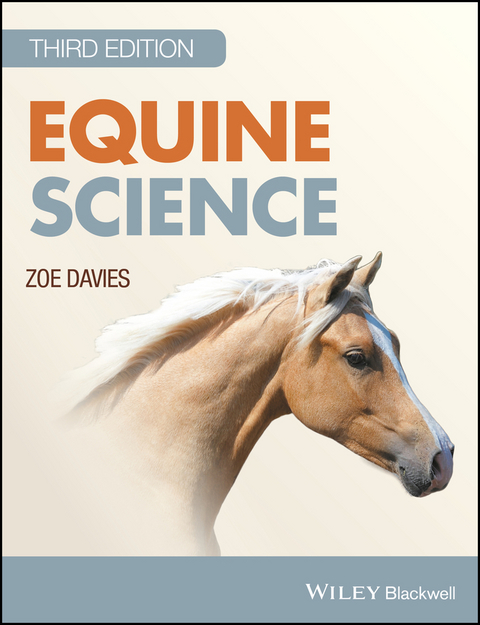
Equine Science (eBook)
John Wiley & Sons (Verlag)
978-1-118-74116-0 (ISBN)
From genetics to functional anatomy, cell biology to the equine digestive system, Equine Science, Third Edition covers all the essential scientific knowledge you need for your equine programme. Thoroughly updated, this new edition features a clear, systematic presentation, stunning full-colour photographs and illustrations, chapter summary points and self-assessment questions throughout.
- Describes the structure and function of the various body systems of the horse
- Explains the scientific rationale behind modern equine training practices
- Features new chapters on exercise physiology and the evolution of the horse
- Reflects the latest scientific advances and changes in the student curriculum
- Includes new information on circadian rhythms and sleep patterns, the immune system, and hindgut microbiology.
A powerful teaching and learning aid, Equine Science, Third Edition is an essential text for students on higher education equine studies and equine science programmes, as well as those studying for BHS qualifications up to BHSII Stage 4 Horse Knowledge and Care.
Zoe Davies is one of only a handful of qualified and Registered Equine Nutritionists in the UK. A former lecturer and external examiner in Equine Science, Zoe is a referral nutritionist, specialising in bloodstock and performance horses.
From genetics to functional anatomy, cell biology to the equine digestive system, Equine Science, Third Edition covers all the essential scientific knowledge you need for your equine programme. Thoroughly updated, this new edition features a clear, systematic presentation, stunning full-colour photographs and illustrations, chapter summary points and self-assessment questions throughout. Describes the structure and function of the various body systems of the horse Explains the scientific rationale behind modern equine training practices Features new chapters on exercise physiology and the evolution of the horse Reflects the latest scientific advances and changes in the student curriculum Includes new information on circadian rhythms and sleep patterns, the immune system, and hindgut microbiology. A powerful teaching and learning aid, Equine Science, Third Edition is an essential text for students on higher education equine studies and equine science programmes, as well as those studying for BHS qualifications up to BHSII Stage 4 Horse Knowledge and Care.
Zoe Davies is one of only a handful of qualified and Registered Equine Nutritionists in the UK. A former lecturer and external examiner in Equine Science, Zoe is a referral nutritionist, specialising in bloodstock and performance horses.
Chapter 1
The Biochemical Nature of Cells
Biochemistry is the study of chemicals within biology. A knowledge of biological molecules and their structure and function is essential for a full understanding of the nature, performance and behaviour of horses. There are approximately one hundred elements that exist on Earth; of these, 16 are essential for life and only four make up 95% of all living matter, namely carbon, hydrogen, oxygen and nitrogen.
The combination of carbon with other elements creates a huge variety of organic molecules, and all organic compounds therefore contain a carbon backbone. The four main classes of organic molecules are proteins, carbohydrates, lipids and nucleic acids. In addition, a relatively small number of inorganic ions such as sodium and potassium are essential for life, as components of larger molecules or extracellular fluids. Table 1.1 shows examples of organic and inorganic molecules.
Table 1.1 Examples of organic and inorganic compounds in the horse's body
| Organic compounds | Inorganic compounds |
| Glucose (C6H12O6) | Water (H2O) |
| Ethane (C2H6) | Ammonia (NH3) |
| Glycine (amino acid) (C2H5NO2) | Carbon dioxide (CO2) |
| Cytosine (nucleotide base) (C4H5N3O) | Nitrate ion (NO3–) |
Horses therefore contain water plus a huge number of macromolecules which have been built up from smaller simpler ones. These molecules are also involved in the basic structure and function of all cells (Figure 1.1). These simple building blocks are similar in all organisms, suggesting a common origin for all life forms.
Figure 1.1 The biochemical nature of cells.
Metabolism
All chemical reactions that take place within the horse are collectively known as ‘metabolism’. Metabolic reactions can be anabolic (building up large molecules from smaller ones) or catabolic (breaking down larger molecules into smaller ones). Anabolic reactions usually involve removal of water molecules and are known as condensation reactions, such as when glycogen is built up from glucose molecules. Catabolic reactions are the reverse and usually involve larger molecules being split when reacting with water. These are known as hydrolysis reactions, for example digestion of proteins in the digestive system.
Horses must have a supply of energy to fuel energy-requiring processes, such as sustaining life and movement. This is obtained from cellular respiration – the oxidation of organic molecules such as glucose into simpler molecules namely carbon dioxide and water.
Water
All life on Earth began in water and water is the main component of all organisms, including horses, providing an environment in which metabolic reactions can occur. Approximately 65–70% of the bodyweight (bwt) of the horse on a fat-free basis is made up of water and newborn foals may contain as much as 90% water. Male horses contain slightly more water than females.
Fluids are present in the body in two main compartments: inside cells and outside cells. Approximately two-thirds of water is found within cells and this is known as intracellular fluid (ICF). The remainder (one-third) is outside cells and is called extracellular fluid (ECF). From this, roughly 80% of ECF is found in interstitial fluid, that is, bathing and surrounding cells in tissues, and about 20% in blood plasma. Interstitial fluid encompasses lymph, cerebrospinal fluid, synovial fluid, and pleural, pericardial and peritoneal fluids, to name but a few.
The horse's body also naturally generates metabolic water as a result of breaking down protein, carbohydrates and fat, mostly from condensation reactions. This does not provide a large amount of water, but does contribute to the daily water balance and may change the horse's need for water. Diet will also affect water requirements. Horses grazing on pasture which has a low dry matter will sometimes drink little or no additional water compared to those on a mostly dry forage diet such as hay. Voluntary water intake by resting horses in a moderate temperature environment is roughly 25–70 ml/kg bwt/day. For a 500-kg horse this equates to 12.5–35 litres per day. Obviously this depends upon water intake such as from feed and drinking and water losses. High-protein feeds such as alfalfa will need more water to help remove excess nitrogen.
Water intake is regulated by the thirst centre in the hypothalamus. Water loss greater than gain (from intake and metabolic water) leads to dehydration. This leads to an increased osmotic pressure of body fluids and decrease in volume leading to stimulation of thirst.
Water is liquid at room temperature and many substances dissolve in it due to its weak polar nature. This means that water molecules have a weak attraction for each other, and other inorganic ions which form large numbers of weak hydrogen bonds. This gives water its unique properties, including acting as a universal solvent and a low viscosity material (Figure 1.2).
Figure 1.2 Structure of water.
The chemical behaviour of water is a result of its dipolar nature having a small negative charge on the oxygen and two small positive charges on the hydrogen atoms. This means water molecules tend to stick together, allowing water to flow, and this is ideal for transport of substances around the body.
To change state from solid to liquid to gas, water requires a substantial amount of energy, which makes water a thermally stable compound. Water evaporates when the hydrogen bonds in water are broken, allowing the surface water molecules to escape as gas and evaporate. It takes a large amount of heat energy to break the hydrogen bonds and this uses up a substantial amount of energy; water therefore has a high latent heat of evaporation. When 1 g of water changes from liquid to vapour, it takes up 580 calories of heat. To put this in perspective, heating 1 g of water from freezing to boiling requires only 117 calories. Sweating causes rapid cooling as water carries away heat energy when it evaporates from the horse's skin.
Important Properties of Water
- • High specific heat capacity – prevents rapid temperature changes and therefore creates a stable chemical environment for the horse's body.
- • High latent heat of evaporation – creates rapid cooling.
- • Good solvent – can take up minerals into the body and transport.
- • Cohesive – water molecules stick together.
- • Lubricant properties – synovial fluid in joints, pleural fluid in lungs and mucus.
- • Support – amniotic fluid supporting and protecting the growing foetus.
Proteins
Proteins play a vital role in virtually all biological processes in horses (Figure 1.3). They make up more than 50% of the dry weight of equine cells. It is also estimated that mammals have the ability to generate approximately two million different types of proteins, coded by genes, each with a specific function and shape.
Figure 1.3 Importance of proteins in the horse's body.
Proteins consist of basic units or amino acids. Plants make all the amino acids they need from smaller molecules, whereas horses (as all animals) must obtain many amino acids from their diet. These are called essential amino acids as they cannot be made in the horse's body. Others can be made in the body and are called non-essential amino acids; however, the division is not clear, as some amino acids can be used to make others and some can be converted to others via the urea cycle. Table 1.2 lists the essential and non-essential amino acids.
Table 1.2 Essential and non-essential amino acids
| Essential amino acids | Non-essential amino acids |
| Lysine | Alanine |
| Methionine (contains sulphur) | Arginine |
| Tryptophan | Asparagine |
| Leucine | Aspartic acid |
| Isoleucine | Cysteine (contains sulphur) |
| Phenylalanine | Glutamine |
| Threonine | Glutamic acid |
| Valine | Glycine |
| Histidine |
| Proline |
| Serine |
| Tyrosine |
| Selenocysteine |
Basic Structure of Amino Acids
Although there are more than 150 amino acids found in cells, only 20 commonly occur in proteins. The remaining non-protein amino acids have roles in metabolic reactions or as hormones and neurotransmitters. A new 21st amino acid has been found, named selenocysteine (SeC), which can be used to make proteins. It has properties making it very suitable in proteins that are involved in antioxidant activity. It is not universal in all organisms. Again, unlike the other amino acids, no free pool of selenocysteine exists in cells because its high...
| Erscheint lt. Verlag | 14.9.2017 |
|---|---|
| Sprache | englisch |
| Themenwelt | Naturwissenschaften ► Biologie |
| Veterinärmedizin ► Pferd | |
| Schlagworte | all about horses • Equine • equine anatomy • equine behavior • equine biology • equine biomechanics • equine cardiovascular system • equine cell biology • equine dentistry • equine dermatology • equine digestive system • equine endocrine system • equine exercise physiology • equine functional anatomy • equine genetics • Equine Health & Nutrition • equine health management • equine legs • equine lower legs • equine management • equine management business • equine management career opportunities</p> • equine management programs • equine management textbook • equine mouth • equine nervous system • Equine nutrition • equine physiology • equine respiratory system • Equine science • equine science courses • equine science textbook • equine skin • equine studies programs • equine studies textbook • equine teeth • Equine Training & Management • equine urinary system • equine veterinary • horse nutrition • horse training • <p>equine studies • Pferdeforschung • Pferde-Gesundheit u. -Nahrung • Pferde-Training u. -Management |
| ISBN-10 | 1-118-74116-1 / 1118741161 |
| ISBN-13 | 978-1-118-74116-0 / 9781118741160 |
| Informationen gemäß Produktsicherheitsverordnung (GPSR) | |
| Haben Sie eine Frage zum Produkt? |
 EPUB (Adobe DRM)
Kopierschutz: Adobe-DRM
Adobe-DRM ist ein Kopierschutz, der das eBook vor Mißbrauch schützen soll. Dabei wird das eBook bereits beim Download auf Ihre persönliche Adobe-ID autorisiert. Lesen können Sie das eBook dann nur auf den Geräten, welche ebenfalls auf Ihre Adobe-ID registriert sind.
Details zum Adobe-DRM
Dateiformat: EPUB (Electronic Publication)
EPUB ist ein offener Standard für eBooks und eignet sich besonders zur Darstellung von Belletristik und Sachbüchern. Der Fließtext wird dynamisch an die Display- und Schriftgröße angepasst. Auch für mobile Lesegeräte ist EPUB daher gut geeignet.
Systemvoraussetzungen:
PC/Mac: Mit einem PC oder Mac können Sie dieses eBook lesen. Sie benötigen eine
eReader: Dieses eBook kann mit (fast) allen eBook-Readern gelesen werden. Mit dem amazon-Kindle ist es aber nicht kompatibel.
Smartphone/Tablet: Egal ob Apple oder Android, dieses eBook können Sie lesen. Sie benötigen eine
Geräteliste und zusätzliche Hinweise
Buying eBooks from abroad
For tax law reasons we can sell eBooks just within Germany and Switzerland. Regrettably we cannot fulfill eBook-orders from other countries.
aus dem Bereich