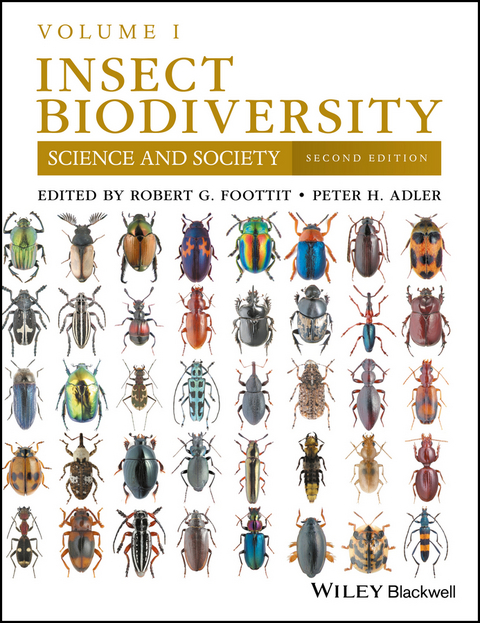
Insect Biodiversity (eBook)
John Wiley & Sons (Verlag)
978-1-118-94554-4 (ISBN)
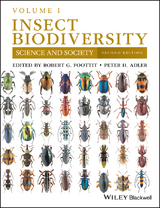
Volume One of the thoroughly revised and updated guide to the study of biodiversity in insects
The second edition of Insect Biodiversity: Science and Society brings together in one comprehensive text contributions from leading scientific experts to assess the influence insects have on humankind and the earth's fragile ecosystems. Revised and updated, this new edition includes information on the number of substantial changes to entomology and the study of biodiversity. It includes current research on insect groups, classification, regional diversity, and a wide range of concepts and developing methodologies. The authors examine why insect biodiversity matters and how the rapid evolution of insects is affecting us all.
This book explores the wide variety of insect species and their evolutionary relationships. Case studies offer assessments on how insect biodiversity can help meet the needs of a rapidly expanding human population, and also examine the consequences that an increased loss of insect species will have on the world. This important text:
- Explores the rapidly increasing influence on systematics of genomics and next-generation sequencing
- Includes developments in the use of DNA barcoding in insect systematics and in the broader study of insect biodiversity, including the detection of cryptic species
- Discusses the advances in information science that influence the increased capability to gather, manipulate, and analyze biodiversity information
- Comprises scholarly contributions from leading scientists in the field
Insect Biodiversity: Science and Society highlights the rapid growth of insect biodiversity research and includes an expanded treatment of the topic that addresses the major insect groups, the zoogeographic regions of biodiversity, and the scope of systematics approaches for handling biodiversity data.
ROBERT G. FOOTTIT is a research scientist specializing in the taxonomy of aphids and related groups, with the Canadian National Collection of Insects and Agriculture and Agri-Food Canada. His research interests include the use of morphological and molecular approaches in the study of aphid species and populations.
PETER H. ADLER is a professor of entomology at Clemson University, where he holds a teaching and research appointment, specializing in the behavior, ecology, genetics, and systematics of insects, particularly butterflies and medically important flies.
Volume One of the thoroughly revised and updated guide to the study of biodiversity in insects The second edition of Insect Biodiversity: Science and Society brings together in one comprehensive text contributions from leading scientific experts to assess the influence insects have on humankind and the earth s fragile ecosystems. Revised and updated, this new edition includes information on the number of substantial changes to entomology and the study of biodiversity. It includes current research on insect groups, classification, regional diversity, and a wide range of concepts and developing methodologies. The authors examine why insect biodiversity matters and how the rapid evolution of insects is affecting us all. This book explores the wide variety of insect species and their evolutionary relationships. Case studies offer assessments on how insect biodiversity can help meet the needs of a rapidly expanding human population, and also examine the consequences that an increased loss of insect species will have on the world. This important text: Explores the rapidly increasing influence on systematics of genomics and next-generation sequencing Includes developments in the use of DNA barcoding in insect systematics and in the broader study of insect biodiversity, including the detection of cryptic species Discusses the advances in information science that influence the increased capability to gather, manipulate, and analyze biodiversity information Comprises scholarly contributions from leading scientists in the field Insect Biodiversity: Science and Society highlights the rapid growth of insect biodiversity research and includes an expanded treatment of the topic that addresses the major insect groups, the zoogeographic regions of biodiversity, and the scope of systematics approaches for handling biodiversity data.
ROBERT G. FOOTTIT is a research scientist specializing in the taxonomy of aphids and related groups, with the Canadian National Collection of Insects and Agriculture and Agri-Food Canada. His research interests include the use of morphological and molecular approaches in the study of aphid species and populations. PETER H. ADLER is a professor of entomology at Clemson University, where he holds a teaching and research appointment, specializing in the behavior, ecology, genetics, and systematics of insects, particularly butterflies and medically important flies.
1 Introduction 1
2 The Importance of Insects 9
Part I Insect Biodiversity: Regional Examples 45
3 Insect Biodiversity in the Nearctic Region 47
4 Amazonian Rainforests and Their Richness and Abundance of Terrestrial Arthropods on the Edge of Extinction: Abiotic-Biotic Players in the Critical Zone 65
5 Insect Biodiversity in the Afrotropical Region 93
6 Biodiversity of Australasian Insects 111
7 Insect Biodiversity in the Palearctic Region 141
Part II Insect Biodiversity: Taxon Examples 203
8 Biodiversity of Aquatic Insects 205
9 Biodiversity of Diptera 229
10 Biodiversity of Heteroptera 279
11 Biodiversity of Coleoptera 337
12 Biodiversity of Hymenoptera 419
13 Diversity and Significance of Lepidoptera: A Phylogenetic Perspective 463
Part III Insect Biodiversity: Tools and Approaches 497
14 The Science of Insect Taxonomy: Prospects and Needs 499
15 Insect Species - Concepts and Practice 527
16 Molecular Dimensions of Insect Taxonomy in the Genomics Era 547
17 DNA Barcodes and Insect Biodiversity 575
18 Insect Biodiversity Informatics 593
19 Parasitoid Biodiversity and Insect Pest Management 603
20 The Taxonomy of Crop Pests: The Aphids 627
21 Adventive (Non-Native) Insects and the Consequences for Science and Society of Species that Become Invasive 641
22 Biodiversity of Blood-sucking Flies: Implications for Humanity 713
23 Reconciling Ethical and Scientific Issues for Insect Conservation 747
24 Taxonomy and Management of Insect Biodiversity 767
25 Insect Biodiversity - Millions and Millions 783
Foreword, Second Edition
Insects are the most exuberant manifestation of Earth’s many and varied life forms. Their rather simple unifying body plan has become modified and adapted to produce an enormous variety of species, and insects exploit virtually all terrestrial and freshwater environments on the planet, as well as many brackish waters. However, as a paradox debated extensively a few decades ago, they are largely absent from the seas and oceans. Features such as wings and the complete metamorphosis of many species have been cited frequently as fostering this massive diversity. The “success” of the insects can be measured by many parameters: their long-term persistence and stability of their basic patterns, the variety of higher groups (with almost 30 orders commonly recognized) and, as emphasized in this book, the wealth of species and similar entities. Each of these species has its individual biological peculiarities, ecological role, distribution, and interactions within the local community. And each may differ in habit and appearance, both from its close relatives and across its range, to reflect local influences and conditions. Every species is thus a mosaic of physical variety and genetic constitution that can lead to taxonomic and ecological ambiguity in interpreting its integrity and the ways in which it may evolve and persist.
Entomologists will continue to debate the number of insect “species” that exist and the levels of past and likely future extinctions that edit any such estimate. The difficulties in gaining consensus have two main axes – first, lack of understanding of how these entities may be recognized and categorized and, second, that many insect groups remain substantially undercollected and are poorly known. The first of these themes dominates much of this book – gaining agreement over “what is a species” is difficult and sometimes contentious. Many taxonomists hold strong and individualistic views, molded by years of study, of the limits of species and the validity of infraspecific categories such as subspecies and races that in practice can function as “evolutionarily significant units” in their insect group. One widespread trend, often not appreciated fully, is that widespread generalist insect species may not persist as such as their environment changes – loss of resources and fragmentation of previously extensive biotopes may cause populations to become isolated, and restricted to a limited subset of resources, such as particular host plants, on which they must then depend and specialize. Such situations may beget speciation, perhaps especially among phytophagous insects that display many examples of such localized but obligatory isolation. Populations involved commonly show haplotype differences and biological idiosyncrasies related to their local conditions, but otherwise are not easily separable. Generalist “species” may commonly comprise complexes of cryptic species masquerading as a single entity. Conventional “typological” taxonomists may tend to mirror the more conservative “generalist” approach, whereas other constituents (such as many butterfly collectors) may opt to recognize numerous isolated populations displaying small phenotypic variations as distinct (specific or subspecific) taxa. Individual specialists in any large insect group are likely to occupy different positions along the gradient of “lumpers” to “splitters” in how they treat such variety, and may defend their stance energetically.
Biologists and philosophers alike continue to debate the merits of the numerous species concepts, drawing on the reality quoted by one recent commentator that “there are n+1 definitions of ‘species’ in a room of n biologists,” with the most common inference that “a species is whatever a taxonomist says it is.” All recognized categories, however, are dynamic. Any given figure for insect diversity (as numbers of species) is a working hypothesis, as is each of the contributing species – so that complete and enduring enumeration is perhaps impossible to achieve.
Documenting and cataloging insect biodiversity as a major component of Earth’s life is a natural quest of human inquiry, but is not an end in itself and, importantly, is not synonymous with conserving insects or a necessary prerequisite to assuring their well-being. Despite many ambiguities in projecting the actual numbers of insect species, no one would query that there are a lot, and that the various ecological processes that sustain ecosystems depend heavily on insect activity. Indeed, “ecological services” such as pollination, recycling of materials, and the economically important activities of predators and parasitoids are signaled increasingly as part of the rationale for insect conservation because these values can be appreciated easily through direct economic impacts. All these themes are dealt with in this book, centered on questions related to our ignorance of fundamental matters of “how many are there?” and “how important are they?”, to which the broad answers of “millions” and “massive” may incorporate considerable uncertainty; this uncertainty, however, is reduced by many of the chapters here.
In any investigations of insect biodiversity, the role of inventory tends to be emphasized, despite the impracticability of achieving complete enumeration. Documenting numbers of species (however they are delimited or defined) gives us foci for conservation advocacy and is pivotal in helping to elucidate patterns of evolution and distribution. Recognizing and naming species allow us to transfer information, but high proportions of undescribed or unrecognizable species necessitate the use of terms such as “morphospecies” in much ecological interpretation of diversity. Accompanying archival deposition of voucher specimens is then needed as the only reliable means through which the consistency of separations can be affirmed and cross-survey comparisons validated. Nevertheless, other than in some temperate regions, particularly in the northern hemisphere, many estimates of insect species richness and the naming of the species present are highly incomplete. Much of the tropics, for example, harbors few resident entomologists other than those involved with pressing problems of human welfare, and more basic and sustained documentation almost inevitably depends on assistance from elsewhere. Some insects, of course, have been explored more comprehensively than others, so that selected taxonomic groups (such as butterflies, larger beetles, and dragonflies) and ecological groups (“pests”) have received more attention than many less charismatic or less economically important groups. Indeed, when collecting Psocoptera in parts of the tropics, I have occasionally been asked by local people why I am not collecting birdwing butterflies, stag beetles, or other “popular” (or commercially desirable!) insects, and my responses have done little to change their opinions of my insanity!
In short, many gaps in knowledge of insect diversity persist, and seem unlikely to be redressed effectively in the near future, other than by “guesstimates” extrapolating from sometimes rather dubious foundations. However, sufficient knowledge does exist to endorse the practical need to protect natural habitats from continued despoliation and, as far as practicable, from the effects of climate change. Citations of impressively large numbers of insect species can become valuable advocacy in helping to conserve areas with largely unheralded wealth of biodiversity. The presence of unusual lineages of insects, of narrow-range endemics, and highly localized radiations and distributional idiosyncrasies (such as isolated populations beyond the main range of the taxon) are all commonplace scenarios, and may in various ways help us to designate priorities for allocating the limited conservation resources available. Many such examples from selected insect groups are revealed in this book – but evaluating the richness and ecological importance of the so-called meek inheritors, that vast majority of insects that do not intrude notably on human intelligence and welfare, remains a major challenge. Many such taxa receive attention from only a handful of entomologists at any time, and some are essentially “orphaned” for considerable periods. Progress with their documentation is inevitably slow and sporadic. Some hyperdiverse orders and families of insects exhibit daunting complexity of form and biology, as “black hole groups” whose elucidation is among the major challenges that face us.
Insect conservation has drawn heavily on issues relevant to biodiversity and appreciation of the vast richness of insects, not only of easily recognizable “species”, but also of the occurrence of subspecies and other infraspecific variants, such as significant populations. This more complex dimension of insect biodiversity is receiving considerable attention as new molecular tools (such as DNA analysis) enable us to probe characters in ways undreamed of only a decade or so ago to augment the perspective provided by morphological interpretation, and assess relationships within lineages and their rates of differentiation. Applications of these tools proliferate, sometimes to the extent where small molecular differences treated in isolation may confuse, rather than clarify, relationships implied from more traditional approaches. The vast arrays of cryptic species gradually being revealed suggest that even our most up-to-date estimates of species numbers based on...
| Erscheint lt. Verlag | 24.7.2017 |
|---|---|
| Sprache | englisch |
| Themenwelt | Naturwissenschaften ► Biologie ► Zoologie |
| Veterinärmedizin | |
| Schlagworte | Animal Science & Zoology • approached to insect biodiversity • Biodiversität • biodiversity of aquatic insects • biodiversity of Coleoptera • biodiversity of Diptera • biodiversity of heteropteran • biodiversity of hymenoptera • Biowissenschaften • diversity and significance of lepidoptera • Entomologie • Entomology • Evolution • Evolution / Systematik • Guide to insect biodiversity • improving biology's general reference system for insects • insect biodiversity • insect biodiversity in the Afrontropical region • insect biodiversity in the Amazon • insect biodiversity in the Nearatic region • insect biodiversity in the Palearctic region • insect biodiversity of Australasian region • insect biomechanics • insect development biology • Insect Ecology • insect evolution • insect genetics • insect paleolimnology • Insect physiology • insects and climate change • Insekten • Life Sciences • Peter H. Adler • Robert G. Footit • Systematics • the science and taxonomy • tools to insect biodiversity • Zoologie |
| ISBN-10 | 1-118-94554-9 / 1118945549 |
| ISBN-13 | 978-1-118-94554-4 / 9781118945544 |
| Informationen gemäß Produktsicherheitsverordnung (GPSR) | |
| Haben Sie eine Frage zum Produkt? |
 EPUB (Adobe DRM)
Kopierschutz: Adobe-DRM
Adobe-DRM ist ein Kopierschutz, der das eBook vor Mißbrauch schützen soll. Dabei wird das eBook bereits beim Download auf Ihre persönliche Adobe-ID autorisiert. Lesen können Sie das eBook dann nur auf den Geräten, welche ebenfalls auf Ihre Adobe-ID registriert sind.
Details zum Adobe-DRM
Dateiformat: EPUB (Electronic Publication)
EPUB ist ein offener Standard für eBooks und eignet sich besonders zur Darstellung von Belletristik und Sachbüchern. Der Fließtext wird dynamisch an die Display- und Schriftgröße angepasst. Auch für mobile Lesegeräte ist EPUB daher gut geeignet.
Systemvoraussetzungen:
PC/Mac: Mit einem PC oder Mac können Sie dieses eBook lesen. Sie benötigen eine
eReader: Dieses eBook kann mit (fast) allen eBook-Readern gelesen werden. Mit dem amazon-Kindle ist es aber nicht kompatibel.
Smartphone/Tablet: Egal ob Apple oder Android, dieses eBook können Sie lesen. Sie benötigen eine
Geräteliste und zusätzliche Hinweise
Buying eBooks from abroad
For tax law reasons we can sell eBooks just within Germany and Switzerland. Regrettably we cannot fulfill eBook-orders from other countries.
aus dem Bereich