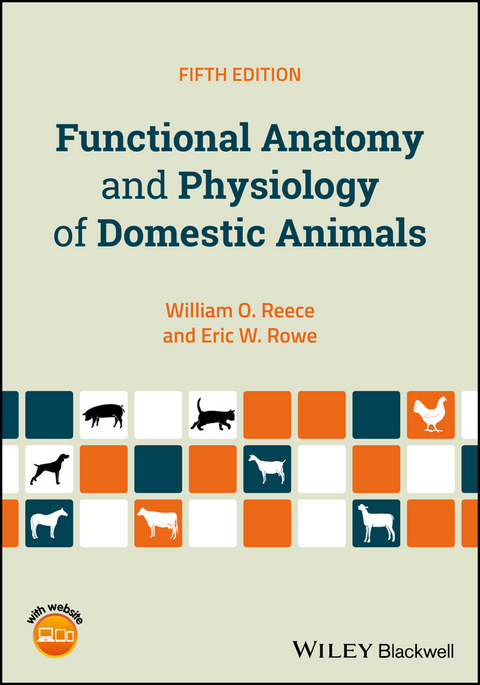
Functional Anatomy and Physiology of Domestic Animals (eBook)
John Wiley & Sons (Verlag)
978-1-119-27086-7 (ISBN)

Now in its Fifth Edition, Functional Anatomy and Physiology of Domestic Animals provides a basic understanding of domestic animal anatomy and physiology, taking an interconnected approach to structure and function of the horse, dog, cat, cow, sheep, goat, pig, and chicken.
- Offers a readable introduction to basic knowledge in domestic animal anatomy and physiology
- Covers equine, canine, feline, bovine, ovine, ruminant, swine, and poultry anatomy and physiology
- Considers structure and function in relation to each other for a full understanding of the relationship between the two
- Provides pedagogical tools to promote learning, including chapter outlines, study questions, self-evaluation exercises, clinical correlates, key terms, suggested readings, and a robust art program
- Includes access to a companion website with video clips, review questions, and the figures from the book in PowerPoint
The authors
William O. Reece, DVM, PhD is University Professor Emeritus in the Department of Biomedical Sciences, College of Veterinary Medicine, at Iowa State University of Science and Technology in Ames, Iowa, USA.
Eric W. Rowe, DVM, PhD, is Associate Professor in the Department of Biomedical Sciences, College of Veterinary Medicine, at Iowa State University of Science and Technology in Ames, Iowa, USA.
The authors William O. Reece, DVM, PhD is University Professor Emeritus in the Department of Biomedical Sciences, College of Veterinary Medicine, at Iowa State University of Science and Technology in Ames, Iowa, USA. Eric W. Rowe, DVM, PhD, is Associate Professor in the Department of Biomedical Sciences, College of Veterinary Medicine, at Iowa State University of Science and Technology in Ames, Iowa, USA.
'The book has a number of features that help in the delivery and retention of the information. The chapter overviews at the beginning of the chapters and the self-evaluation questions help focus students on the salient points of each unit. Second, the many figures help in explaining the concepts. And, third, the resources the accompanying website provides are relevant to the discussion.
This up-to-date overview of functional anatomy and physiology is a good book for students interested in veterinary sciences or thinking they'd like to pursue veterinary medicine ... it provides a good starting foundation for students serious about pursuing careers in veterinary medicine, where structure and function are central to the curriculum.' Doody's, November 2017
CHAPTER 1
Basics of Structure and Function
CHAPTER OUTLINE
- THE CELL, ITS STRUCTURE AND FUNCTIONS
- The Organelles
- ENERGY PRODUCTION
- FUNCTIONS OF DNA AND RNA
- DNA and Its Replication
- Mitosis
- RNA and Protein Synthesis
- EMBRYOLOGY
- TISSUES
- Epithelium
- Connective Tissue
- DIRECTIONAL TERMS AND PLANES
- BODY CAVITIES
- Thoracic Cavity
- The Abdominopelvic Cavity
- The Peritoneum
In general, the study of anatomy refers to the study of the structure of body parts and includes gross anatomy (identification by unaided visual means) and microscopic anatomy (identification by microscopic assistance that usually begins at the cellular level). The study of physiology is a study of the functions of the body, or as sometimes stated, “how the body works,” and includes biophysical and biochemical processes and precludes a knowledge of anatomy. Although anatomy and physiology can be taught as separate entities, overlaps are unavoidable and it follows that greater productivity is obtained by integrating the two disciplines.
The study of anatomy and physiology is assisted by prerequisite courses, which include chemistry, physics, biology, and quantitative skills in mathematics. With this in mind, we will rely not only on your previous preparation, but also on the desire to advance your knowledge with application to animal anatomy and physiology. This chapter provides basics of structure and function that should be helpful to you as you study the chapters that follow.
THE CELL, ITS STRUCTURE AND FUNCTIONS
- What separates the cell cytoplasm from interstitial fluid?
- What are organelles?
- Define the nuclear membrane.
- What does chromatin become in dividing cells?
- Differentiate between granular and agranular endoplasmic reticula and their associated functions.
- Are the vesicular structures of the endoplasmic reticulum separate or interconnected?
- What is the function of the Golgi apparatus?
- What organelle is the site of the citric acid cycle?
- What is the principal substance of lysosomes?
- What cellular function are the centrioles associated with? What is their location within the cell known as?
The number of cells in an animal is in the trillions and for the human has been estimated to be about 100 trillion. Each of these cells had their start beginning with fertilization of an oocyte. The appearance of cells varies with the organ of which they are a part and will be shown and described when encountered. Cells are highly organized chemical systems and share many features that are shown schematically in Figure 1-1. The basic components of a cell are the plasma membrane (cell membrane) that bounds the cell and gives it limits; the cytoplasm, which is the homogenous ground substance that forms the background in which the formed elements are suspended; and the nucleus. The nucleus is separated from the cytoplasm by a nuclear membrane and the cytoplasm is separated from the surrounding fluids (interstitial fluid) by a cell membrane. The cell membrane is usually pliable and is composed of phospholipids and proteins. The phospholipid molecules occur in two layers. The protein molecules may be associated with either the outer or inner layer and may penetrate completely or incompletely (see Chapter 2).
FIGURE 1-1 Schematic drawing of the general organization of a cell. (From Eurell JA, Frappier BL. Dellmann’s Textbook of Veterinary Histology. 6th edn. Ames, IA: Blackwell Publishing, 2006.)
Because of cell specialization, no cell can be called typical. The cytoplasm is the location of diverse metabolic activities and is filled with both minute and large dispersed particles and organelles.
The Organelles
The organelles are highly organized physical structures represented in Figure 1-1 and, in addition to the cell membrane, consist of the nucleus, endoplasmic reticulum, Golgi apparatus, mitochondria, lysosomes, and centrioles. These structures assist the cytoplasm with its metabolic activities by receiving materials into the cell, synthesizing new substances, generating energy, packaging materials for transport to other parts of the cell or to the circulation, excretion of waste products, and reproduction.
Nucleus
The nucleus is the control center of the cell, controlling its chemical reactions and reproduction. It contains large quantities of DNA. Nuclear components consist of a nuclear membrane, one or more nucleoli, and chromatin, all bathed in nuclear sap (nucleoplasm). The nuclear membrane (also called nuclear envelope) consists of two membranes wherein the outer membrane is continuous with the endoplasmic reticulum, and the space between the two nuclear membranes, the lumen, is also continuous with the lumen of the endoplasmic reticulum. Numerous nuclear pores penetrate both layers. These pores permit exchange between the nucleoplasm of the nucleus and the cytoplasm of the cell, including movement of RNA synthesized in the nucleus, out into the cytoplasm. The nucleolus does not have a limiting membrane and is a structure that contains large amounts of RNA and proteins that are found in ribosomes. Chromatin appears as dark-staining particles throughout the nucleoplasm in the nondividing cell. In the dividing cell, the chromatin organizes into chromosomes.
Endoplasmic Reticulum
The endoplasmic reticulum (ER) is a network of tubular and flat vesicular (small thin-walled cavity) structures in the cytoplasm that all interconnect with one another. The fluid within the lumen of the ER is continuous with the fluid in the nuclear envelope and is different from the fluid in the cytoplasm. A large number of small granular particles called ribosomes are attached to the outer surfaces of many parts of the ER. Where these are present they are called the granular or rough ER, and where they are not present they are called the agranular or smooth ER. Ribosomes are composed of a mixture of RNA and proteins and function in the synthesis of proteins. The agranular ER functions in the synthesis of lipid substances and other enzymatic processes of the cell.
Golgi Apparatus
The Golgi apparatus is closely related to the ER. It is prominent in secretory cells, being well developed in cells secreting enzymes and hormones. It packages materials made in the cell and transforms them into units that are then distributed outside the cell. The packaging begins when vesicles pinch off from the ER and then fuse with the Golgi apparatus. The vesicular substances are then processed in the Golgi apparatus to form lysosomes or other secretory vesicles, which become surrounded by a membrane. They are then released from the Golgi apparatus for storage or use in the cell or are transported to the cell membrane, where they are released into the extracellular fluid as a secretion.
Mitochondria
Mitochondria are the “powerhouses” of the cell because they are the principal sites for energy production. The number in a cell depends on the amount of energy required, and mitochondria increase in number when cellular needs increase. A mitochondrion is composed of an outer and an inner membrane. The inner membrane has infoldings that provide shelves for the attachment of oxidative phosphorylation enzymes (enzymes for production of energy). The inner cavity consists of a matrix (supporting substance) that contains enzymes and coenzymes (cofactors) required for extracting energy from nutrients. The matrix is the site of the citric acid cycle (also known as the tricarboxylic acid cycle and Krebs cycle).
Lysosomes
The vesicular organelles called lysosomes are formed by the Golgi apparatus and then become dispersed throughout the cytoplasm. Because lysosomes contain digestive enzymes, their presence in the cytoplasm provides an intracellular digestive system allowing digestion of damaged cellular structures, food particles ingested by the cell, and bacterial cells.
Centrosome
The centrosome is located in the cytoplasm, close to the nucleus, and contains two centrioles. The centrioles are usually oriented at right angles to each other and each consists of nine groups of three microtubules arranged in a circle. During cell division the centrosome serves as a spindle pole and helps to organize the microtubules.
ENERGY PRODUCTION
- What substance is formed from the catabolism of carbohydrates, lipids, and proteins to begin the aerobic stage of energy production via the citric acid cycle?
- What are the cofactors involved in the transfer of electrons from the citric acid cycle to the electron transport...
| Erscheint lt. Verlag | 16.6.2017 |
|---|---|
| Sprache | englisch |
| Themenwelt | Veterinärmedizin ► Vorklinik ► Anatomie |
| Veterinärmedizin ► Vorklinik ► Physiologie | |
| Schlagworte | Absorption • animal systems • Blood • Body Heat • body systems • body water • Bones • bovine • canine • Cardiovascular System • Cat • cattle • Cell • Chicken • Cow • Digestion • Dog • domestic animal • Embryology • Endocrine System • Equine • feline • female reproduction • Function • functional anatomy • functional physiology • Goat • Haustiere • horse • joints • Lactation • <p>Anatomy • Male Reproduction • Muscle • nervous system • ovine • Physiology • Pig • porcine • Poultry • Respiratory System • ruminant</p> • sensory organs • Sheep • Structure • Swine • synovial fluid • Temperature • tissue • Urinary System • Veterinäranatomie • Veterinäranatomie u. -physiologie • Veterinärmedizin • Veterinary • Veterinary Anatomy & Physiology • Veterinary Medicine |
| ISBN-10 | 1-119-27086-3 / 1119270863 |
| ISBN-13 | 978-1-119-27086-7 / 9781119270867 |
| Informationen gemäß Produktsicherheitsverordnung (GPSR) | |
| Haben Sie eine Frage zum Produkt? |
 EPUB (Adobe DRM)
Kopierschutz: Adobe-DRM
Adobe-DRM ist ein Kopierschutz, der das eBook vor Mißbrauch schützen soll. Dabei wird das eBook bereits beim Download auf Ihre persönliche Adobe-ID autorisiert. Lesen können Sie das eBook dann nur auf den Geräten, welche ebenfalls auf Ihre Adobe-ID registriert sind.
Details zum Adobe-DRM
Dateiformat: EPUB (Electronic Publication)
EPUB ist ein offener Standard für eBooks und eignet sich besonders zur Darstellung von Belletristik und Sachbüchern. Der Fließtext wird dynamisch an die Display- und Schriftgröße angepasst. Auch für mobile Lesegeräte ist EPUB daher gut geeignet.
Systemvoraussetzungen:
PC/Mac: Mit einem PC oder Mac können Sie dieses eBook lesen. Sie benötigen eine
eReader: Dieses eBook kann mit (fast) allen eBook-Readern gelesen werden. Mit dem amazon-Kindle ist es aber nicht kompatibel.
Smartphone/Tablet: Egal ob Apple oder Android, dieses eBook können Sie lesen. Sie benötigen eine
Geräteliste und zusätzliche Hinweise
Buying eBooks from abroad
For tax law reasons we can sell eBooks just within Germany and Switzerland. Regrettably we cannot fulfill eBook-orders from other countries.
aus dem Bereich