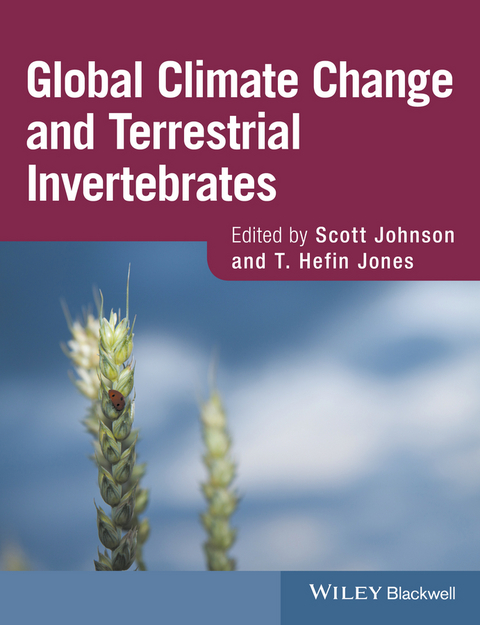
Global Climate Change and Terrestrial Invertebrates (eBook)
John Wiley & Sons (Verlag)
978-1-119-07087-0 (ISBN)
Invertebrates perform such vital roles in global ecosystems-and so strongly influence human wellbeing-that biologist E.O. Wilson was prompted to describe them as 'little things that run the world.' As they are such powerful shapers of the world around us, their response to global climate change is also pivotal in meeting myriad challenges looming on the horizon-everything from food security and biodiversity to human disease control.
This book presents a comprehensive overview of the latest scientific knowledge and contemporary theory relating to global climate change and terrestrial invertebrates. Featuring contributions from top international experts, this book explores how changes to invertebrate populations will affect human decision making processes across a number of crucial issues, including agriculture, disease control, conservation planning, and resource allocation. Topics covered include methodologies and approaches to predict invertebrate responses, outcomes for disease vectors and ecosystem service providers, underlying mechanisms for community level responses to global climate change, evolutionary consequences and likely effects on interactions among organisms, and many more. Timely and thought-provoking, Global Climate Change and Terrestrial Invertebrates offers illuminating insights into the profound influence the simplest of organisms may have on the very future of our fragile world.
Scott N. Johnson is Senior Lecturer in Ecology at the Hawkesbury Institute for the Environment (HIE) at Western Sydney University.
T. Hefin Jones is Senior Lecturer in Ecology at the School of Biosciences, Cardiff University, and an Editor of the journals Global Change Biology and Agricultural and Forest Entomology.
Global Climate Change and Terrestrial Invertebrates Invertebrates perform such vital roles in global ecosystems and so strongly influence human wellbeing that biologist E.O. Wilson was prompted to describe them as little things that run the world. As they are such powerful shapers of the world around us, their response to global climate change is also pivotal in meeting myriad challenges looming on the horizon everything from food security and biodiversity to human disease control. This book presents a comprehensive overview of the latest scientific knowledge and contemporary theory relating to global climate change and terrestrial invertebrates. Featuring contributions from top international experts, this book explores how changes to invertebrate populations will affect human decision making processes across a number of crucial issues, including agriculture, disease control, conservation planning, and resource allocation. Topics covered include methodologies and approaches to predict invertebrate responses, outcomes for disease vectors and ecosystem service providers, underlying mechanisms for community level responses to global climate change, evolutionary consequences and likely effects on interactions among organisms, and many more. Timely and thought-provoking, Global Climate Change and Terrestrial Invertebrates offers illuminating insights into the profound influence the simplest of organisms may have on the very future of our fragile world.
Scott N. Johnson is Senior Lecturer in Ecology at the Hawkesbury Institute for the Environment (HIE) at Western Sydney University. T. Hefin Jones is Senior Lecturer in Ecology at the School of Biosciences, Cardiff University, and an Editor of the journals Global Change Biology and Agricultural and Forest Entomology.
Cover 1
Title Page 5
Copyright 6
Contents 7
List of Contributors 15
Preface 19
Chapter 1 Introduction to Global Climate Change and Terrestrial Invertebrates 21
1.1 Background 21
1.2 Predictions for Climate and Atmospheric Change 22
1.3 General Mechanisms for Climate Change Impacts on Invertebrates 22
1.4 Themes of the Book 24
Acknowledgements 27
References 27
Part I Methods for Studying Invertebrates and Climate Change 29
Chapter 2 Using Historical Data for Studying Range Changes 31
2.1 Introduction 31
2.2 Review of Historical Data Sets on Species' Distributions 33
2.3 Methods for Using Historical Data to Estimate Species' Range Changes 35
2.4 Challenges and Biases in Historical Data 39
2.5 New Ways of Analysing Data and Future Perspectives 43
Acknowledgements 44
References 44
Chapter 3 Experimental Approaches for Assessing Invertebrate Responses to Global Change Factors 50
3.1 Introduction 50
3.2 Experimental Scale: Reductionist, Holistic and Integrated Approaches 52
3.3 Experimental Design: Statistical Concerns 53
3.4 Experimental Endpoints: Match Metrics to Systems 55
3.5 Experimental Systems: Manipulations From Bottle to Field 56
3.6 Team Science: the Human Dimension 60
3.7 Conclusions 61
Acknowledgements 62
References 62
Chapter 4 Transplant Experiments - a Powerful Method to Study Climate Change Impacts 66
4.1 Global Climate Change 66
4.2 Climate Change Impacts on Species 67
4.3 Climate Change Impacts on Communities 68
4.4 Common Approaches to Study Climate Change Impacts 68
4.5 Transplant Experiments - a Powerful Tool to Study Climate Change 69
4.6 Transplant Experiment Trends Using Network Analysis 77
4.7 What's Missing in Our Current Approaches? Next Steps for Implementing Transplant Experiments 80
Acknowledgements 82
References 82
Part II Friends and Foes: Ecosystem Service Providers and Vectors of Disease 89
Chapter 5 Insect Pollinators and Climate Change 91
5.1 Introduction 91
5.2 The Pattern: Pollinator Populations and Climate Change 92
5.3 The Process: Direct Effects of Climate Change 96
5.4 The Process: Indirect Effects of Climate Change 101
5.5 Synthesis, and the View Ahead 103
Acknowledgements 104
References 104
Chapter 6 Climate Change Effects on Biological Control in Grasslands 112
6.1 Introduction 112
6.2 Changes in Plant Biodiversity 114
6.3 Multitrophic Interactions and Food Webs 114
6.4 Greater Exposure to Extreme Events 122
6.5 Range Changes 123
6.6 Greater Exposure to Pest Outbreaks 124
6.7 Non-Target Impacts 124
6.8 Conclusion 125
Acknowledgements 125
References 125
Chapter 7 Climate Change and Arthropod Ectoparasites and Vectors of Veterinary Importance 131
7.1 Introduction 131
7.2 Parasite-Host Interactions 133
7.3 Evidence of the Impacts of Climate on Ectoparasites and Vectors 134
7.4 Impact of Human Behaviour and Husbandry on Ectoparasitism 136
7.5 Farmer Intervention as a Density-Dependent Process 138
7.6 Predicting Future Impacts of Climate Change on Ectoparasites and Vectors 138
Acknowledgements 143
References 143
Chapter 8 Climate Change and the Biology of Insect Vectors of Human Pathogens 146
8.1 Introduction 146
8.2 Interaction with Pathogens 149
8.3 Physiology, Development and Phenology 151
8.4 Population Dynamics, Life History and Interactions with Other Vector Species 152
8.5 Case Study of Forecasts for Vector Distribution Under Climate Change: The Altitudinal Range of Aedes albopictus and Aedes japonicus in Nagasaki, Japan 154
8.6 Vector Ecology and Evolution in Changing Environments 158
Acknowledgements 159
References 160
Chapter 9 Climate and Atmospheric Change Impacts on Aphids as Vectors of Plant Diseases 168
9.1 The Disease Pyramid 168
9.2 Interactions with the Pyramid 175
9.3 Conclusions and Future Perspectives 182
Acknowledgements 183
References 184
Part III Multi-Trophic Interactions and Invertebrate Communities 197
Chapter 10 Global Change, Herbivores and Their Natural Enemies 199
10.1 Introduction 200
10.2 Global Climate Change and Insect Herbivores 201
10.3 Global Climate Change and Natural Enemies of Insect Herbivores 205
10.4 Multiple Abiotic Factors 211
10.5 Conclusions 212
Acknowledgements 213
References 213
Chapter 11 Climate Change in the Underworld: Impacts for Soil-Dwelling Invertebrates 221
11.1 Introduction 221
11.2 Effect of Climate Change on Nematodes: Omnipresent Soil Invertebrates 223
11.3 Effect of Climate Change on Insect Root Herbivores, the Grazers of the Dark 227
11.4 Effect of Climate Change on Earthworms: the Crawling Engineers of Soil 232
11.5 Conclusions and Future Perspectives 236
Acknowledgements 237
References 238
Chapter 12 Impacts of Atmospheric and Precipitation Change on Aboveground-Belowground Invertebrate Interactions 249
12.1 Introduction 249
12.2 Atmospheric Change - Elevated Carbon Dioxide Concentrations 253
12.3 Altered Patterns of Precipitation 256
12.4 Conclusions and Future Directions 262
Acknowledgements 265
References 265
Chapter 13 Forest Invertebrate Communities and Atmospheric Change 272
13.1 Why Are Forest Invertebrate Communities Important? 273
13.2 Atmospheric Change and Invertebrates 273
13.3 Responses of Forest Invertebrates to Elevated Carbon Dioxide Concentrations 274
13.4 Responses of Forest Invertebrates to Elevated Ozone Concentrations 283
13.5 Interactions Between Carbon Dioxide and Ozone 285
13.6 Conclusions and Future Directions 287
Acknowledgements 288
References 288
Chapter 14 Climate Change and Freshwater Invertebrates: Their Role in Reciprocal Freshwater-Terrestrial Resource Fluxes 294
14.1 Introduction 294
14.2 Climate-Change Effects on Riparian and Shoreline Vegetation 295
14.3 Climate-Change Effects on Runoff of Dissolved Organic Matter 297
14.4 Climate Change Effects on Basal Freshwater Resources Via Modified Terrestrial Inputs 298
14.5 Effects of Altered Terrestrial Resource Fluxes on Freshwater Invertebrates 299
14.6 Direct Effects of Warming on Freshwater Invertebrates 300
14.7 Impacts of Altered Freshwater Invertebrate Emergence on Terrestrial Ecosystems 302
14.8 Conclusions and Research Directions 304
Acknowledgements 306
References 306
Chapter 15 Climatic Impacts on Invertebrates as Food for Vertebrates 315
15.1 Introduction 315
15.2 Changes in the Abundance of Vertebrates 316
15.3 Changes in the Distribution of Vertebrates 320
15.4 Changes in Phenology of Vertebrates, and Their Invertebrate Prey 323
15.5 Conclusions 327
15.6 Postscript: Beyond the Year 2100 328
Acknowledgements 328
References 328
Part IV Evolution, Intervention and Emerging Perspectives 337
Chapter 16 Evolutionary Responses of Invertebrates to Global Climate Change: the Role of Life-History Trade-Offs and Multidecadal Climate Shifts 339
16.1 Introduction 339
16.2 Fundamental Trade-Offs Mediating Invertebrate Evolutionary Responses to Global Warming 347
16.3 The Roles of Multi-Annual Extreme Droughts and Multidecadal Shifts in Drought Regimens in Driving Large-Scale Responses of Insect Populations 353
16.4 Conclusions and New Research Directions 357
Acknowledgements 359
References 359
Chapter 17 Conservation of Insects in the Face of Global Climate Change 369
17.1 Introduction 369
17.2 Vulnerability Drivers of Insect Species Under Climate Change 372
17.3 Assessment of Insect Species Vulnerability to Climate Change 373
17.4 Management Strategies for Insect Conservation Under Climate Change 375
17.5 Protected Areas and Climate Change 377
17.6 Perspectives on Insect Conservation Facing Climate Change 379
Acknowledgements 380
References 381
Chapter 18 Emerging Issues and Future Perspectives for Global Climate Change and Invertebrates 388
18.1 Preamble 388
18.2 Multiple Organisms, Asynchrony and Adaptation in Climate Change Studies 388
18.3 Multiple Climatic Factors in Research 389
18.4 Research Into Extreme Climatic Events 391
18.5 Climate change and Invertebrate Biosecurity 392
18.6 Concluding Remarks 394
References 394
Species Index 399
Subject Index 405
EULA 415
| Erscheint lt. Verlag | 30.1.2017 |
|---|---|
| Sprache | englisch |
| Themenwelt | Naturwissenschaften ► Biologie ► Ökologie / Naturschutz |
| Naturwissenschaften ► Biologie ► Zoologie | |
| Technik | |
| Veterinärmedizin | |
| Schlagworte | Ãkologie / Tiere • Animal ecology • Animal Science & Zoology • Biowissenschaften • Book • Climate • climate change • Communities • contributors • Disease • Entomologie • Entomology • general mechanisms • Habitats • impacts • indirect impacts • Invertebrates • Johnson • Life Sciences • List • Methods • Ökologie / Tiere • Physiology • preface • Zoologie |
| ISBN-10 | 1-119-07087-2 / 1119070872 |
| ISBN-13 | 978-1-119-07087-0 / 9781119070870 |
| Informationen gemäß Produktsicherheitsverordnung (GPSR) | |
| Haben Sie eine Frage zum Produkt? |
 PDF (Adobe DRM)
Kopierschutz: Adobe-DRM
Adobe-DRM ist ein Kopierschutz, der das eBook vor Mißbrauch schützen soll. Dabei wird das eBook bereits beim Download auf Ihre persönliche Adobe-ID autorisiert. Lesen können Sie das eBook dann nur auf den Geräten, welche ebenfalls auf Ihre Adobe-ID registriert sind.
Details zum Adobe-DRM
Dateiformat: PDF (Portable Document Format)
Mit einem festen Seitenlayout eignet sich die PDF besonders für Fachbücher mit Spalten, Tabellen und Abbildungen. Eine PDF kann auf fast allen Geräten angezeigt werden, ist aber für kleine Displays (Smartphone, eReader) nur eingeschränkt geeignet.
Systemvoraussetzungen:
PC/Mac: Mit einem PC oder Mac können Sie dieses eBook lesen. Sie benötigen eine
eReader: Dieses eBook kann mit (fast) allen eBook-Readern gelesen werden. Mit dem amazon-Kindle ist es aber nicht kompatibel.
Smartphone/Tablet: Egal ob Apple oder Android, dieses eBook können Sie lesen. Sie benötigen eine
Geräteliste und zusätzliche Hinweise
Buying eBooks from abroad
For tax law reasons we can sell eBooks just within Germany and Switzerland. Regrettably we cannot fulfill eBook-orders from other countries.
aus dem Bereich