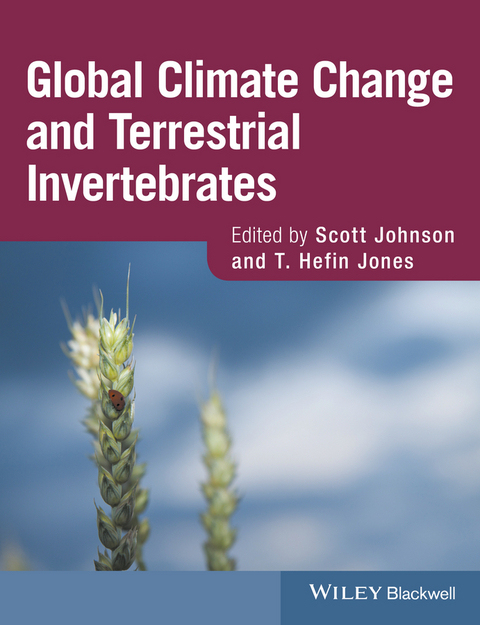
Global Climate Change and Terrestrial Invertebrates (eBook)
John Wiley & Sons (Verlag)
978-1-119-07082-5 (ISBN)

Scott N. Johnson is Senior Lecturer in Ecology at the Hawkesbury Institute for the Environment (HIE) at Western Sydney University. T. Hefin Jones is Senior Lecturer in Ecology at the School of Biosciences, Cardiff University, and an Editor of the journals Global Change Biology and Agricultural and Forest Entomology.
Global Climate Change and Terrestrial Invertebrates
List of Contributors
Preface
1. Introduction to Global Climate Change and Terrestrial Invertebrates
Scott N. Johnson and T. Hefin Jones
Part 1: Methods for studying invertebrates and climate change
2. Using historical measurements for predicting range shifts
Georgina Palmer and Jane K. Hill
3. Experimental approaches for assessing invertebrate responses to global change factors
Richard L. Lindroth and Kenneth F. Raffa
4. Transplant Experiments - a powerful method to study climate change impacts
Sabine S. Nooten and Nigel R. Andrew
Part 2: Friends and foes: ecosystem service providers and vectors of disease
5. Insect pollinators and climate change
Jessica R.K. Forrest
6. Climate change effects on biological control in grasslands
Philippa J. Gerrard and Alison J. Popay
7. Climate change and arthropod ectoparasites and vectors of veterinary importance
Hannah Rose, Lauren Ellse and Richard Wall
8. Climate change and the biology of insect vectors of human pathogens
Luis Fernando Chaves
9. Climate and atmospheric change impacts on aphids as vectors of plant diseases
James M.W. Ryalls and Richard Harrington
Part 3: Multi-trophic interactions and invertebrate communities
10. Global climate change, herbivores and their natural enemies
William T. Hentley and Ruth N. Wade
11. Climate change in the underworld: impacts for soil-dwelling invertebrates
Ivan Hiltpold, Scott N. Johnson, Renée-Claire Le Bayon and Uffe N. Nielsen
12. Impacts of atmospheric and precipitation change on aboveground-belowground invertebrate Interactions
13. Forest invertebrate communities and atmospheric change
Sarah L. Facey and Andrew Gherlenda
14. Climate change and freshwater invertebrates: their role in reciprocal freshwater-terrestrial resources fluxes
Micael Jonsson and Cristina Canhoto
15. Climatic impacts on invertebrates as food for vertebrates
Robert J. Thomas, James Vafidis and Renata J. Medeiros
Chapter 1
Introduction to Global Climate Change and Terrestrial Invertebrates
Scott N. Johnson1 and T. Hefin Jones2
1Hawkesbury Institute for the Environment, Western Sydney, NSW 2751, Australia
2School of Biosciences, Cardiff University, Cardiff, CF10 3AX, UK
“If all mankind were to disappear, the world would regenerate back to the rich state of equilibrium that existed ten thousand years ago. If insects were to vanish, the environment would collapse into chaos.”E. O. Wilson
“The great ecosystems are like complex tapestries – a million complicated threads, interwoven, make up the whole picture. Nature can cope with small rents in the fabric; it can even, after a time, cope with major disasters like floods, fires, and earthquakes. What nature cannot cope with is the steady undermining of its fabric by the activities of man.”Gerald Durrell
1.1 Background
‘Little things that run the world’ is how the biologist E.O. Wilson described invertebrates (Wilson, 1987). There is a great deal of truth in this, with invertebrates playing major roles in the functioning and processes of most terrestrial and aquatic ecosystems. In terms of human wellbeing, their influence ranges from the beneficial ecosystem services of pollinators to lethal vectors of human diseases. Invertebrate pests, for example, destroy enough food to feed 1 billion people (Birch et al., 2011) at a time when global populations are expected to exceed 9.7 billion by 2050 and 11.2 billion by 2100 (UN, 2015) and therefore represent a significant challenge to secure global food security (Gregory et al., 2009). Conversely, invertebrates provide an unrivalled array of ecosystem services; globally €153 billion per year via pollination (Gallai et al., 2009), US$417 billion annually in terms of pest control (Costanza et al., 1997). This latter figure is somewhat dated, but if it increased in line with the general trend for ecosystem services calculated by Costanza et al. (2014) for 2011 this would be closer to US$1.14 trillion per year.
Besides humankind, invertebrates shape the world around us perhaps more than any other group and their response to climate change is pivotal in future global challenges, including food security, conservation, biodiversity and human health. In this book, we synthesise the current state of knowledge about how terrestrial invertebrates will respond and adapt to predicted changes in our climate and atmosphere, and, in some cases even moderate the impacts of such changes.
1.2 Predictions for Climate and Atmospheric Change
Between September 2013 and April 2014 the Fifth Assessment Report of the Intergovernmental Panel for Climate Change (IPCC) was published (IPCC, 2014). Divided into three Working Groups (WGs) and the culmination of the work of over 800 authors, the report not only focusses on the physical science basis of current climate change (WG I), but also assesses the impacts, adaptation strategies and vulnerability related to climate change (WG II) while also covering mitigation response strategies in an integrated risk and uncertainty framework and its assessments (WG III).
The report finds that the warming of the atmosphere and ocean system is unequivocal. Many of the associated impacts such as sea level change (among other metrics) have occurred since 1950 at rates unprecedented in the historical record. It states that there is a clear human influence on the climate and declares that it is extremely likely that human influence has been the dominant cause of observed warming since 1950, with the level of confidence having increased since the Fourth IPCC Report in 2007 (IPCC, 2007). In noting the current situation the 2014 Report states that (i) it is likely (with medium confidence) that 1983–2013 was the warmest 30-year period for 1,400 years; (ii) it is virtually certain the upper ocean warmed from 1971 to 2010. This ocean warming accounts, with high confidence, for 90% of the energy accumulation between 1971 and 2010; (iii) it can be said with high confidence that the Greenland and Antarctic ice sheets have been losing mass in the last two decades and that Arctic sea ice and Northern Hemisphere spring snow cover have continued to decrease in extent; (iv) there is high confidence that the sea level rise since the middle of the nineteenth century has been larger than the mean sea level rise of the prior two millennia; (v) concentration of greenhouse gases in the atmosphere has increased to levels unprecedented on Earth in 800,000 years; and (vi) total radiative forcing of the Earth system, relative to 1750, is positive and the most significant driver is the increase in atmospheric concentrations of carbon dioxide (CO2).
Relying on the Coupled Model Intercomparison Project Phase 5 (CMIP5), which is an international climate modelling community effort to coordinate climate change experiments, for much of its analysis, the Fifth Report based its predictions on CO2 concentrations reaching 421 parts per million (ppm), 538 ppm, 670 ppm and 936 ppm by the year 2100. General conclusions drawn from this analysis were that (i) further warming will continue if emissions of greenhouse gases continue; (ii) the global surface temperature increase by the end of the twenty-first century is likely to exceed 1.5°C relative to the 1850 to 1900 period for most scenarios, and is likely to exceed 2.0°C for many scenarios; (iii) the global water cycle will change, with increases in the disparity between wet and dry regions, as well as wet and dry seasons, with some regional exceptions; (iv) the oceans will continue to warm, with heat extending to the deep ocean, affecting circulation patterns; (v) decreases are very likely in Arctic sea ice cover, Northern Hemisphere spring snow cover, and global glacier volume; (vi) global mean sea level will continue to rise at a rate very likely to exceed the rate of the past four decades; (vii) changes in climate will cause an increase in the rate of CO2 production. Increased uptake of CO2 by the oceans will increase the acidification of the oceans; and (viii) future surface temperatures will be largely determined by cumulative CO2, which means climate change will continue even if CO2 emissions are stopped. This may be a moot point, however, since 2015 saw the largest ever annual increase in atmospheric CO2 (Le Page, 2016).
1.3 General Mechanisms for Climate Change Impacts on Invertebrates
Generally speaking, predicted changes to our climate might affect invertebrates in two ways: (i) by directly affecting invertebrate physiology, performance or behaviour, and (ii) by indirectly affecting invertebrates via changes to the habitats, resources or organisms they interact with. This is a very simplified way of categorising the impacts of global climate change on invertebrates, but it provides a convenient framework for understanding more complex processes. In this introduction, we do not comprehensively review examples of these mechanisms since they are developed in more detail in subsequent chapters but simply outline the general principles of each. Invertebrates are not just affected by climate change, but they can also moderate its effects on the ecosystem. This seems especially true for soil-dwelling ecosystem engineers (see Chapters 6 and 11) which have the capacity to mitigate the negative effects of drought on plants by changing the hydrological properties of their soil environment.
1.3.1 Direct Impacts on Physiology, Performance and Behaviour
As ectotherms, invertebrates are directly and significantly affected by temperature. Increasing temperature generally increases the rate of physiological and developmental processes to a point, whereupon further increases become detrimental. Providing other resources are not limiting, increased rates of development are likely to lead to larger populations of invertebrates and possibly an increased number of generations per year (Bale et al., 2002). This is most tangibly seen in the case of invasive invertebrates that move into warmer regions; the clover root weevil (Sitona obsoletus), for example, which is univoltine in the UK undergoes two generations per year since its accidental introduction to New Zealand in the mid-1990s (Goldson & Gerard, 2008). Precipitation changes also have direct impacts on invertebrates. Intense precipitation events can cause physical damage to invertebrates by disrupting flight, reducing foraging efficiency and increasing migration times (Barnett & Facey, 2016), though some invertebrates such as mosquitoes are dependent on heavy rainfall events. Conversely, drought can lead to desiccation, particularly in soft-bodied invertebrates though many have physiological and behavioural adaptations to reduced moisture (Barnett & Facey, 2016). Precipitation events will clearly have greater impacts on terrestrial invertebrates than those in aquatic habitats. Atmospheric changes are generally thought to have negligible direct impacts on invertebrates.
1.3.2 Indirect Impacts on Habitats, Resources and Interacting Organisms
Climate change can affect invertebrates indirectly via its impacts on the habitat they occupy, the resources they use or the organisms they interact with. These are enormously varied for different taxa, and can be both positive and negative. Changes in habitat complexity, for instance, could affect foraging behaviour of predatory invertebrates affecting populations of both prey and predator (Facey et al., 2014). Elevated CO2 concentrations often increase structural complexity of...
| Erscheint lt. Verlag | 5.12.2016 |
|---|---|
| Sprache | englisch |
| Themenwelt | Naturwissenschaften ► Biologie ► Ökologie / Naturschutz |
| Naturwissenschaften ► Biologie ► Zoologie | |
| Technik | |
| Veterinärmedizin | |
| Schlagworte | Ãkologie / Tiere • Animal ecology • Animal Science & Zoology • Biowissenschaften • Book • Climate • climate change • Communities • contributors • Disease • Entomologie • Entomology • general mechanisms • Habitats • impacts • indirect impacts • Invertebrates • Johnson • Life Sciences • List • Methods • Ökologie / Tiere • Physiology • preface • Zoologie |
| ISBN-10 | 1-119-07082-1 / 1119070821 |
| ISBN-13 | 978-1-119-07082-5 / 9781119070825 |
| Informationen gemäß Produktsicherheitsverordnung (GPSR) | |
| Haben Sie eine Frage zum Produkt? |
 EPUB (Adobe DRM)
Kopierschutz: Adobe-DRM
Adobe-DRM ist ein Kopierschutz, der das eBook vor Mißbrauch schützen soll. Dabei wird das eBook bereits beim Download auf Ihre persönliche Adobe-ID autorisiert. Lesen können Sie das eBook dann nur auf den Geräten, welche ebenfalls auf Ihre Adobe-ID registriert sind.
Details zum Adobe-DRM
Dateiformat: EPUB (Electronic Publication)
EPUB ist ein offener Standard für eBooks und eignet sich besonders zur Darstellung von Belletristik und Sachbüchern. Der Fließtext wird dynamisch an die Display- und Schriftgröße angepasst. Auch für mobile Lesegeräte ist EPUB daher gut geeignet.
Systemvoraussetzungen:
PC/Mac: Mit einem PC oder Mac können Sie dieses eBook lesen. Sie benötigen eine
eReader: Dieses eBook kann mit (fast) allen eBook-Readern gelesen werden. Mit dem amazon-Kindle ist es aber nicht kompatibel.
Smartphone/Tablet: Egal ob Apple oder Android, dieses eBook können Sie lesen. Sie benötigen eine
Geräteliste und zusätzliche Hinweise
Buying eBooks from abroad
For tax law reasons we can sell eBooks just within Germany and Switzerland. Regrettably we cannot fulfill eBook-orders from other countries.
aus dem Bereich