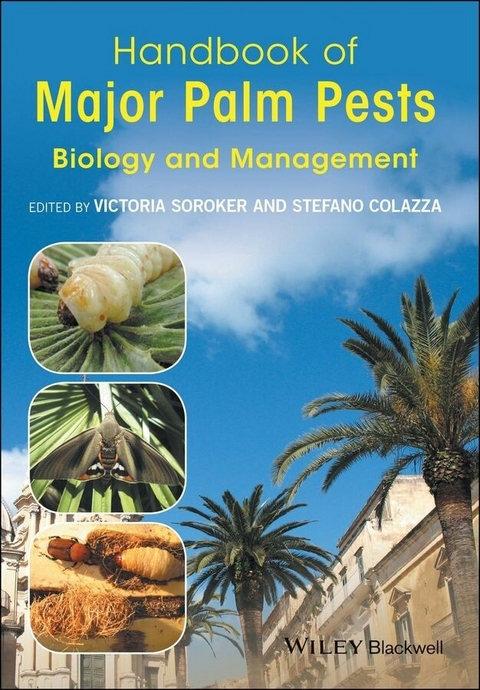
Handbook of Major Palm Pests (eBook)
John Wiley & Sons (Verlag)
978-1-119-05749-9 (ISBN)
An essential compendium for anyone working with or studying palms, it is dedicated to the detection, eradication, and containment of these invasive species, which threaten the health and very existence of global palm crops.
Victoria Soroker is Senior Researcher in the Department of Entomology at Agricultural Research Organization, The Volcani Center, Israel and a lecturer at Hebrew University of Jerusalem. Her work over 30 years involves both basic aspects of insect physiology, chemical ecology and behavior of several insects and mites as well as applied research towards development of integrated pest management practices. For the last 16 years much of her research efforts have focused around finding solution for detection and control of the date palm pest and especially red palm weevil. Over the years she has mentored graduate students and published widely in peer-reviewed journals. Currently she serves as a president of the Entomological Society of Israel.
Stefano Colazza is Professor at the Department of Agricultural and Forest Sciences at the University of Palermo, Italy. He is a specialist in infochemicals and behavioral ecology of plant, insect, herbivores and insect parasitoid interactions, with a special interest in the chemical ecology of plant volatile organic compounds in a tri-trophic context. He has been involved in these research areas for over 30 years and his work has been published widely in peer-reviewed journals. He is the co-editor of Chemical Ecology of Insect Parasitoids (Wiley-Blackwell, 2013).
Handbook of Major Palm Pests: Biology and Management contains the most comprehensive and up-to-date information on the red palm weevil and the palm borer moth, two newly emergent invasive palm pests which are adversely affecting palm trees around the world. It provides state-of-the-art scientific information on the ecology, biology, and management of palm pests from a global group of experts in the field.An essential compendium for anyone working with or studying palms, it is dedicated to the detection, eradication, and containment of these invasive species, which threaten the health and very existence of global palm crops.
Victoria Soroker is Senior Researcher in the Department of Entomology at Agricultural Research Organization, The Volcani Center, Israel and a lecturer at Hebrew University of Jerusalem. Her work over 30 years involves both basic aspects of insect physiology, chemical ecology and behavior of several insects and mites as well as applied research towards development of integrated pest management practices. For the last 16 years much of her research efforts have focused around finding solution for detection and control of the date palm pest and especially red palm weevil. Over the years she has mentored graduate students and published widely in peer-reviewed journals. Currently she serves as a president of the Entomological Society of Israel. Stefano Colazza is Professor at the Department of Agricultural and Forest Sciences at the University of Palermo, Italy. He is a specialist in infochemicals and behavioral ecology of plant, insect, herbivores and insect parasitoid interactions, with a special interest in the chemical ecology of plant volatile organic compounds in a tri-trophic context. He has been involved in these research areas for over 30 years and his work has been published widely in peer-reviewed journals. He is the co-editor of Chemical Ecology of Insect Parasitoids (Wiley-Blackwell, 2013).
Cover 1
Title Page 5
Copyright 6
Contents 7
Contributors 15
Nomenclature 19
Introduction 23
Chapter 1 Some Representative Palm Pests: Ecological and Practical Data 31
1.1 Introduction 31
1.2 General Features About Palms and their Pests 32
1.2.1 Palm Features are Suited to Arthropod Herbivores 32
1.2.2 Main Arthropod Pests on Palms 33
1.2.3 Damage and Pest Management 34
1.3 Crown and Stem Borers 35
1.3.1 Pest Ecology, Damage, and Management 35
1.3.2 Oryctes rhinoceros Linnaeus 1758 (Coleoptera: Scarabaeidae) 35
1.3.3 Scapanes australis Boisduval 1832 (Coleoptera: Scarabaeidae) 36
1.3.4 Rhynchophorus ferrugineus Olivier 1790 (Coleoptera: Dryophthoridae) 37
1.3.5 Castnia daedalus Cramer 1775 (Lepidoptera: Castniidae) 39
1.3.6 Paysandisia archon Burmeister 1880 (Lepidoptera: Castniidae) 40
1.4 Defoliators of Fronds (= Leaves) 41
1.4.1 Pest Ecology, Damage, and Management 41
1.4.2 Pistosia dactyliferae Maulik 1919 (Coleoptera: Chrysomelidae) 42
1.4.3 Brontispa longissima Gestro 1885 (Coleoptera: Chrysomelidae) 42
1.4.4 Coelaenomenodera lameensis Berti 1999 (Coleoptera: Chrysomelidae) 44
1.4.5 Setora nitens Walker 1855 (Lepidoptera: Limacodidae) 45
1.4.6 Sesamia nonagrioides Lefèbvre 1827 and Sesamia cretica Lederer 1857 (Lepidoptera: Noctuidae) 45
1.5 Sap and Frond (= Leaves) Feeders? 47
1.5.1 Pest Ecology, Damage, and Management 47
1.5.2 Ommatissus binotatus Fieber 1876 (Hemiptera: Tropiduchidae) 47
1.5.3 Aspidiotus destructor Signoret 1869 (Hemiptera: Diaspididae) 48
1.5.4 Parlatoria blanchardi Targioni, 1868 (Homoptera, Diaspididae) 49
1.5.5 Aleurotrachelus atratus Hempel 1922 (Hemiptera: Aleyrodidae) 49
1.6 Inflorescence and Fruit Borers 50
1.6.1 Pest Ecology, Damage, and Management 50
1.6.2 Batrachedra amydraula Meyrick 1916 (Lepidoptera: Batrachedridae) 51
1.6.3 Tirathaba rufivena Walker 1864 (Lepidoptera: Pyralidae) 51
1.6.4 Ectomyelois ceratoniae Zeller 1839 (Lepidoptera: Pyralidae) 52
1.6.5 Cadra cautella Walker 1863 (Lepidoptera: Pyralidae) 53
1.6.6 Aphomia sabella Hampson 1901 (Lepidoptera: Pyralidae) 53
1.6.7 Virachola livia Klug 1834 (Lepidoptera: Lycaenidae) 54
1.6.8 Coccotrypes dactyliperda Fabricius 1801 (Coleoptera: Scolytidae) 55
1.6.9 Carpophilus hemipterus L. 1758 and Carpophilus mutilatus Erichson 1843 (Coleoptera: Nitidulidae) 56
1.7 Roots 57
1.7.1 Pest Ecology, Damage, and Management 57
1.7.2 Sufetula sunidesalis Walker (Lepidoptera: Crambidae) 57
1.8 Conclusion 58
References 59
Chapter 2 Morphology and Physiology of Palm Trees as Related to Rhynchophorus ferrugineus and Paysandisia archon Infestation and Management 69
2.1 Introduction 69
2.2 Palms in Europe and the Mediterranean Basin 69
2.2.1 Palms and their Global Distribution 69
2.2.2 Palms in Horticulture 70
2.2.3 Palms in Gardening and Landscaping 70
2.3 Palm Morphology and Anatomy 71
2.4 The Palm Crown 72
2.4.1 Leaf Development, Structure, and Phyllotaxis 72
2.4.2 Palm Inflorescences 72
2.4.3 The Single Apical Meristem and "Palm Heart" Organization 73
2.4.4 Implication of Crown Structure for RPW/PBM Symptom Development 74
2.4.5 Implication of Crown Structure for Chemical and Biological Treatments 75
2.4.6 Implication of Crown Structure for Sanitation and Crown Dissection to Rescue Infected Palms 75
2.5 The Structure of the Palm Stem 76
2.5.1 Organization of the Stem through Cross- and Longitudinal Sections 77
2.5.2 The Palm Vasculature 77
2.5.3 Offshoots 78
2.5.4 Implications of Trunk and Vasculature Organization for RPW Symptom Development 79
2.5.5 Implication of Stem and Vasculature Organization for Chemical Treatments and their Application 79
2.5.6 Palms Roots: Adventitious Root System and its Possible Role in Recovery after RPW Infection 80
2.6 Conclusion 81
References 81
Chapter 3 Economic and Social Impacts of Rhynchophorus ferrugineus and Paysandisia archon on Palms 84
3.1 Introduction 84
3.2 Ecosystem Services Provided by Palms 85
3.2.1 Provisioning Services 87
3.2.2 Cultural Services 88
3.2.3 Regulating Services 90
3.3 Impacts and Costs of Mitigation 91
3.4 Conclusion 93
References 94
Chapter 4 Rhynchophorus ferrugineus: Taxonomy, Distribution, Biology, and Life Cycle 99
4.1 Introduction 99
4.2 Taxonomy and Distribution 100
4.2.1 Systematic Position and Morphology 100
4.2.2 Past and Present Distribution 102
4.3 Biology and Host Plants 103
4.3.1 A Borer Species that Lives only on Palms 103
4.3.2 Critical Review of the Host Plants 109
4.4 Life Cycle and Adaptation to the Temperate and Desert Areas 115
4.4.1 Main Traits of the Life Cycle 115
4.4.2 Development Thermal Parameters 116
4.4.3 Estimating the Buffer Effect of Living in Palm Tissue 121
4.4.4 Thermal and Hygrometric Thresholds and Optima for the Adult (Table 4.2) 123
4.4.5 Refined Development Modelling and Flight Predicting for Temperate Areas 124
4.5 Conclusion 126
4.5.1 Relation to the Host Palm in the Invasion Area 126
4.5.2 Development and Adaptation to Temperate Climate 126
References 127
Chapter 5 Rhynchophorus ferrugineus: Behavior, Ecology, and Communication 135
5.1 Introduction 135
5.2 Main Behaviors Involved in Species Dynamics 136
5.2.1 Aggregation and Mating Behaviors 136
5.2.2 Flight and Dispersal Capability (Role of Age, Sex, and Mating Status) 138
5.3 Chemical Cues 141
5.3.1 Pheromones 141
5.3.2 Plant Volatile Chemicals 143
5.4 Vision and Visual Cues 149
5.4.1 Visual System 149
5.4.2 Color Vision 150
5.4.3 Tuning of Color Vision to Visual Cues 152
5.5 Conclusion 154
References 155
Chapter 6 Paysandisia archon: Taxonomy, Distribution, Biology, and Life Cycle 161
6.1 Introduction 161
6.2 Taxonomy of the Castniidae 161
6.3 Distribution of P. archon 163
6.4 Morphology of P. archon Stages 165
6.5 Biology 167
6.5.1 Host Plants 167
6.5.2 Life Cycle 173
6.6 Conclusion 175
References 175
Chapter 7 Paysandisia archon: Behavior, Ecology, and Communication 180
7.1 Introduction 180
7.2 P. archon Reproductive Behavior 181
7.2.1 Diel Periodicity of Mating 181
7.2.2 Courtship Behavior 181
7.2.3 Chemical Cues 184
7.3 Host-Finding and Chemical Cues 185
7.3.1 Behavior 185
7.3.2 Antenna Morphology 185
7.3.3 Chemical Cues 190
7.3.4 Conclusion 190
7.4 Visual Cues: Their Roles in Mate and Host Location 190
7.4.1 Optical Design of P. archon's Retina 192
7.4.2 Spectral Sensitivity of the Ocelli 193
7.4.3 Spectral and Polarization Sensitivity of the Retina 194
7.4.4 Tuning of Vision to Visual Cues 194
7.4.5 Hints for Designing Visual Traps and Laboratory Experiments 196
References 197
Chapter 8 Natural Enemies of Rhynchophorus ferrugineus and Paysandisia archon 201
8.1 Introduction 201
8.2 Natural Enemies 202
8.2.1 Parasitoids 202
8.2.2 Predators 205
8.2.3 Entomopathogens 205
8.3 Perspectives on Biological Control of R. ferrugineus and P. archon 210
References 211
Chapter 9 Visual Identification and Characterization of Rhynchophorus ferrugineus and Paysandisia archon Infestation 217
9.1 Introduction 217
9.2 Non-Pathognomonic Symptoms 218
9.3 Pathognomonic Symptoms 221
9.4 Identification of RPW Infestation 231
9.4.1 Infestation in Canary Palm 231
9.4.2 Infestation in Date Palm 231
9.4.3 Infestations in Other Palm Species 232
9.5 Identification of PBM Infestation 232
9.6 Simultaneous Infestation of Both Pests and Co-Occurrence with Other Pests or Diseases 234
9.7 Conclusion 237
References 237
Chapter 10 Surveillance Techniques and Detection Methods for Rhynchophorus ferrugineus and Paysandisia archon 239
10.1 Introduction 239
10.2 Acoustic Detection 240
10.2.1 Assumptions 240
10.2.2 Main Detection Tools, General Features, and Challenges 240
10.2.3 Advantages and Pitfalls 243
10.3 Chemical Detection 244
10.3.1 Assumptions 244
10.3.2 Main Detection Tools, General Features, and Challenges 244
10.3.3 Advantages and Pitfalls 248
10.4 Thermal Detection 248
10.4.1 Assumptions 248
10.4.2 Main Detection Tools, General Features and Challenges 249
10.4.3 Advantages and Pitfalls 249
10.5 Detection of Pest Distribution by Monitoring Traps 250
10.5.1 Assumptions and Methodology 250
10.5.2 Optimal Traps 251
10.5.3 Optimal Lures 253
10.5.4 Trap Position and Distribution for Monitoring RPW Dispersion 255
10.5.5 Advantages and Pitfalls 255
10.6 Conclusion 256
10.6.1 Perspectives for Accurate Early Detection of RPW and PBM 256
10.6.2 Future Challenges 258
References 258
Chapter 11 CPLAS Information System as a Monitoring Tool for Integrated Management of Palm Pests 263
11.1 Introduction 263
11.2 CPLAS Architecture and Functions 264
11.2.1 CPLAS Architecture 264
11.2.2 CPLAS Database 264
11.2.3 DSS for Infestation Risk Assessment and Spatiotemporal Risk Analysis 265
11.2.4 Data-acquisition Process 268
11.2.5 Implementation of CPLAS in Real Time: Case Studies 273
11.3 Web-mapping Service of CPLAS 281
11.4 Conclusion 282
References 284
Chapter 12 Control Measures Against Rhynchophorus ferrugineus and Paysandisia archon 285
12.1 Why Control of R. ferrugineus and P. archon is so Difficult: Reasons to Deal with Both of these Pests Together 285
12.2 Current Control Methods 286
12.2.1 Legal Control 286
12.2.2 Cultural Control 287
12.2.3 Biological Control 290
12.2.4 Chemical Control 293
12.2.5 Control Methods Based on the use of Semiochemicals 297
12.3 Future Needs and Trends 300
References 301
Chapter 13 Action Programs for Rhynchophorus ferrugineus and Paysandisia archon 310
13.1 Introduction 310
13.2 General Measures against all IAS 311
13.3 Threats and Risks presented by IAS: The case of RPW and PBM 312
13.4 The Action Plan as Part of a Global Strategy for the Containment of RPW and PBM Infestations 313
13.5 Analysis of Pest Status and Distribution of RPW and PBM as a Strategy for Detecting Change and Emerging Impacts 313
13.6 Establishing Effective Systems to Assess Risk and Prioritize Management 315
13.7 Definition of an Early Warning and Monitoring System 316
13.8 Citizen Involvement in Undertaking Voluntary Measures to Counteract the Spread of RPW and PBM 316
13.9 Setup of an RPW and PBM Portal Online 317
13.10 Development of Funding Mechanisms to Manage RPW and PBM Infestations 317
13.11 Case Studies 318
13.11.1 R. ferrugineus in Israel 318
13.11.2 R. ferrugineus in Italy 320
13.11.3 R. ferrugineus in the Canary Islands 322
13.11.4 P. archon in the Marche Region (Italy) 323
13.12 Action Programs for Agricultural and Non-Agricultural Areas 324
13.13 Conclusion and Future Outlook 326
References 326
Index 330
Supplemental Images 347
EULA 363
| Erscheint lt. Verlag | 11.1.2017 |
|---|---|
| Sprache | englisch |
| Themenwelt | Naturwissenschaften ► Biologie ► Botanik |
| Naturwissenschaften ► Biologie ► Zoologie | |
| Technik | |
| Veterinärmedizin | |
| Weitere Fachgebiete ► Land- / Forstwirtschaft / Fischerei | |
| Schlagworte | Agriculture • Ãkologie / Pflanzen • beaudoinollivier • Biowissenschaften • Conclusion • contributors • crown • defoliators • Ecological • Entomologie • Entomology • Europe • feeders • fronds • Landwirtschaft • leaves • Life Sciences • Morphology • Nomenclature • Ökologie / Pflanzen • Palm • Palmen • Palms • Pests • Pests, Diseases & Weeds • Pflanzenkrankheit • Physiology • plant ecology • References • representative • Rhynchophorus ferrugineus • SAP • Schädlinge, Krankheiten u. Unkräuter • Schädlinge, Krankheiten u. Unkräuter • Trees |
| ISBN-10 | 1-119-05749-3 / 1119057493 |
| ISBN-13 | 978-1-119-05749-9 / 9781119057499 |
| Informationen gemäß Produktsicherheitsverordnung (GPSR) | |
| Haben Sie eine Frage zum Produkt? |
 PDF (Adobe DRM)
Kopierschutz: Adobe-DRM
Adobe-DRM ist ein Kopierschutz, der das eBook vor Mißbrauch schützen soll. Dabei wird das eBook bereits beim Download auf Ihre persönliche Adobe-ID autorisiert. Lesen können Sie das eBook dann nur auf den Geräten, welche ebenfalls auf Ihre Adobe-ID registriert sind.
Details zum Adobe-DRM
Dateiformat: PDF (Portable Document Format)
Mit einem festen Seitenlayout eignet sich die PDF besonders für Fachbücher mit Spalten, Tabellen und Abbildungen. Eine PDF kann auf fast allen Geräten angezeigt werden, ist aber für kleine Displays (Smartphone, eReader) nur eingeschränkt geeignet.
Systemvoraussetzungen:
PC/Mac: Mit einem PC oder Mac können Sie dieses eBook lesen. Sie benötigen eine
eReader: Dieses eBook kann mit (fast) allen eBook-Readern gelesen werden. Mit dem amazon-Kindle ist es aber nicht kompatibel.
Smartphone/Tablet: Egal ob Apple oder Android, dieses eBook können Sie lesen. Sie benötigen eine
Geräteliste und zusätzliche Hinweise
Buying eBooks from abroad
For tax law reasons we can sell eBooks just within Germany and Switzerland. Regrettably we cannot fulfill eBook-orders from other countries.
aus dem Bereich