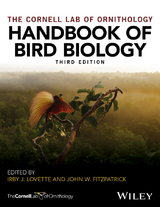
Handbook of Bird Biology (eBook)
John Wiley & Sons (Verlag)
978-1-118-29102-3 (ISBN)
'This wonderful handbook provides a crystal-clear introduction to every fascinating aspect of bird biology. It will now be my own first reference source about birds, and it should be yours, too - regardless of whether you are a backyard bird watcher, a hard-core birder, or a professional ornithologist.'
Jared Diamond, Professor of Geography at the University of California-Los Angeles, specialist on New Guinea birds, and Pulitzer-Prize winning author.
'This new edition of the Cornell Lab of Ornithology's Handbook of Bird Biology is a stunning resource for professionals and amateurs alike. It is graced by color photos spilling off nearly every page and filled with clear yet detailed interpretations of the latest ornithological discoveries. One can't achieve a better mix of technical accuracy and a pleasing, accessible format. It's all here - bird evolution, ecology, physiology, conservation, and much more.'
Scott V. Edwards, Alexander Agassiz Professor of Zoology and Curator of Ornithology at Harvard University
Birds thrive in all conditions, from urban neighborhoods to the remotest oceans, driest deserts, and the wettest rainforests. From the tiniest hummingbird to the largest ostrich, their varied forms fascinate us - from drab to ostentatious, silent to raucous, earthbound to global nomad.
This much-anticipated third edition of the Handbook of Bird Biology is an essential and comprehensive resource for everyone interested in learning more about birds, from casual bird watchers to formal students of ornithology. Wherever you study birds your enjoyment will be enhanced by a better understanding of the incredible diversity of avian lifestyles. Arising from the renowned Cornell Lab of Ornithology and authored by a team of experts from around the world, the Handbook covers all aspects of avian diversity, behaviour, ecology, evolution, physiology, and conservation. Using examples drawn from birds found in every corner of the globe, it explores and distills the many scientific discoveries that have made birds one of our best known - and best loved - parts of the natural world.
This edition has been completely revised and is presented with more than 800 full color images. It provides readers with a tool for life-long learning about birds and is suitable for bird watchers and ornithology students, as well as for ecologists, conservationists, and resource managers who work with birds.
Selected by Forbes.com as one of the 12 best books about birds and birding in 2016 This much-anticipated third edition of the Handbook of Bird Biology is an essential and comprehensive resource for everyone interested in learning more about birds, from casual bird watchers to formal students of ornithology. Wherever you study birds your enjoyment will be enhanced by a better understanding of the incredible diversity of avian lifestyles. Arising from the renowned Cornell Lab of Ornithology and authored by a team of experts from around the world, the Handbook covers all aspects of avian diversity, behaviour, ecology, evolution, physiology, and conservation. Using examples drawn from birds found in every corner of the globe, it explores and distills the many scientific discoveries that have made birds one of our best known - and best loved - parts of the natural world. This edition has been completely revised and is presented with more than 800 full color images. It provides readers with a tool for life-long learning about birds and is suitable for bird watchers and ornithology students, as well as for ecologists, conservationists, and resource managers who work with birds. The Handbook of Bird Biology is the companion volume to the Cornell Lab's renowned distance learning course, www.birds.cornell.edu/courses/home/homestudy/.
Irby Lovette is the Fuller Professor of Ornithology at Cornell University, Associate Director for Academic Affairs at the Cornell Lab of Ornithology, Director of the Lab's Fuller Evolutionary Biology Program, and Curator of Genomics at the Cornell Museum of Vertebrates. He has authored more than 130 scientific publications on topics related to avian evolution, ecology, behavior, and conservation, along with numerous articles for the general public. John Fitzpatrick is the Louis Agassiz Fuertes Director of the Cornell Lab of Ornithology and Professor in Cornell's Department of Ecology and Evolutionary Biology. His many contributions to ornithology and bird conservation include 140 scientific publications, discovery of seven previously unknown bird species in Peru, 45 years leading one of the world's longest continuous studies of the ecology and behavior of a wild bird population, the Florida Scrub-Jay, and service on numerous conservation boards and panels. He is past president of the American Ornithologists' Union and the recipient of that society's highest awards for research (William Brewster Medal), conservation (Ralph W. Schreiber Award), and service (Marion Jenkinson Award).
Editorial Team and Contributors vii
Preface ix
Bird Academy Web Resources xiii
1 Why Study Birds? 1
Irby J. Lovette and John W. Fitzpatrick
2 Avian Diversity and Classification 7
Irby J. Lovette
3 How Birds Evolve 63
Irby J. Lovette
4 Feathers and Plumages 101
Kimberly Bostwick
5 Avian Flight 149
Bret W. Tobalske
6 Avian Anatomy 169
Howard E. Evans
7 Bird Physiology 215
Scott McWilliams, Elizabeth Adkins-Regan, and Carol Vleck
8 Avian Food and Foraging 265
Thomas W. Sherry
9 Avian Mating and Social Behavior 313
John Alcock
10 Avian Vocal Behavior 355
Bruce E. Byers and Donald E. Kroodsma
11 Breeding Biology of Birds 407
David W. Winkler
12 Avian Migration and Dispersal 453
David W. Winkler, Judy Shamoun-Baranes, and Theunis Piersma
13 Ecology of Bird Populations 495
Walter D. Koenig
14 Bird Communities 537
Russell S. Greenberg
15 Bird Conservation 579
John W. Fitzpatrick and Amanda D. Rodewald
Glossary 641
Index 657
"This wonderful handbook provides a crystal-clear introduction to every fascinating aspect of bird biology. It will now be my own first reference source about birds, and it should be yours, too - regardless of whether you are a backyard bird watcher, a hard-core birder, or a professional ornithologist."
Jared Diamond, Professor of Geography at the University of California-Los Angeles, specialist on New Guinea birds, and Pulitzer-Prize winning author.
"This new edition of the Cornell Lab of Ornithology's Handbook of Bird Biology is a stunning resource for professionals and amateurs alike. It is graced by color photos spilling off nearly every page and filled with clear yet detailed interpretations of the latest ornithological discoveries. One can't achieve a better mix of technical accuracy and a pleasing, accessible format. It's all here - bird evolution, ecology, physiology, conservation, and much more."
Scott V. Edwards, Alexander Agassiz Professor of Zoology and Curator of Ornithology at Harvard University.
"With the range of topics covered, the quality of both the writing and design, and the depth of information included, the authors have produced a book that will be of interest to a wide range of readers from those just starting to learn about birds to ornithologists who have been studying birds for decades. Whether you are a researcher, teacher, or just interested in birds, this book is a must-have for your ornithological library and, for those teaching a college-level course and looking for a textbook, the Handbook of Bird Biology is an excellent resource that should be given serious consideration" Margaret Brittingham, wiley online library, Sept 2017.
"This third version is largely enriched by the progress of ornithology. It is difficult to account for such a large body of knowledge, with the different chapters covering most areas: bird classification and diversity, evolution, plumage, flight, anatomy, physiology, feeding, social behavior, vocalizations, reproduction , migration, population ecology, communities, conservation. There is a summary at the top of each chapter and a good list of bibliographic references at the end. All are very well illustrated with photos, figures and also many colored boxes that detail particular points, concepts and regularly clear definitions of terms or scientific concepts. In addition, 76 pages of glossary and indexes (names of species, countries, subjects, etc.) at the end allow the reader to find almost everything that has been treated or mentioned ... It is the best condensed work currently available on birds and ornithology developments. It is also the most readable and easy to consult thanks to its very airy texts with multiple illustrations and subtitles ... it's really the basic work that one can refer to for any questions that one might have about birds." Ornithos, 24:5 (2017)
Preface
At this very moment, somewhere on earth, the sun is rising and a dawn chorus of birdsong welcomes the new day. This never‐ending avian symphony has been performed non‐stop for millions of years, yet our scientific understanding of avian biology still improves with every passing year. This third edition of the Handbook of Bird Biology is intended as a current and helpful guide into the spectacular richness of bird diversity and the wonderful and varied ways that birds look, behave, display, function, and evolve.
The third edition of the Handbook extends a tradition that began in 1972 when the Cornell Lab of Ornithology first offered a Home Study Course in Ornithology to the general public. That early correspondence course comprised nine seminars on different topics, all written by the Cornell Lab’s Director at the time, Dr. Olin Sewall Pettingill, Jr, an ornithologist known for helping connect recreational birdwatchers with scientific advances in avian biology. The first Home Study Course students received nine units of mimeographed sheets sent through the mail. Over the subsequent two decades, the materials increased in length and sophistication as the Home Study Course evolved and expanded. More than 10,000 students successfully passed their mailed‐in exams and completed the course.
This material was expanded and modernized as it was incorporated into the 2004 second edition of the Handbook, which was produced as an impressively hefty single‐volume book co‐published by the Cornell Lab of Ornithology and Princeton University Press. It became a multi‐authored endeavor with 11 chapters written by experts in their respective fields, each of whom lent their own personal style to explaining why birds look, act, and function in the ways that they do. The second edition remained the foundation of the continuing Home Study Course, used by an additional 5000 students from 65 countries. The book was likewise adopted as a textbook for many college‐level ornithology courses and enjoyed as a general reference by many individuals interested in learning more about birds, even outside of any formal or informal coursework.
This third edition, published in 2016, represents an even more extensive overhaul of the content, presentation, and coverage of the Handbook of Bird Biology. The new edition’s 15 chapters have been authored by 18 expert ornithologists, including five authors who extensively revised their well‐regarded chapters from the second edition and 13 who contributed entirely new material. The new content includes extensive and expanded coverage of hundreds of recent discoveries and insights about avian ecology, behavior, evolution, physiology, anatomy, and conservation.
Given that birds are so visually appealing, it is appropriate that the new edition be presented in full color, a first for any general textbook of Ornithology. The 1150 photographs, illustrations, and figure elements depict hundreds of bird species, along with graphs and tables that explain intriguing facets of their underlying biology. The Handbook editors and authors express their deep thanks to the many individuals—credited in the figure legends—who generously contributed photographs or artwork to this edition.
Readers familiar with the earlier additions may notice that this edition is now global in its coverage of the world’s birds and the people who study and conserve them. It includes examples featuring bird species that are collectively found literally everywhere on earth that birds occur. In addition to the venerable traditions of ornithological research in North America and Europe, exciting new discoveries are now constantly being made by ornithologists from the rest of the Americas, Africa, Asia, Australia, and islands around the world. Our hope is that readers of this book—wherever they might be—will enjoy finding out more about some of the most familiar birds that live around their homes, while also being inspired by learning about species that occur in far‐away places.
A special new feature of the third edition is that it is complemented and supplemented by a wealth of online materials found on the Bird Academy website of the Cornell Lab of Ornithology (web link: birdbiology.org). These resources include interactive learning modules on topics ranging from feathers to sexual selection; high‐quality video and audio clips chosen to represent behaviors or phenomena discussed in the text; animations that illustrate fundamental concepts in ornithology; longer feature‐length coverage of special topics; and much more. The resources are conveniently organized in reference to the corresponding chapters of this Handbook. We encourage all readers to use this online material to supplement their readings here. This is especially helpful for the chapters on bird song (Chapter 10) and mating behavior (Chapter 9) where there is no better way to understand these behaviors than to hear or see examples of living birds in action.
In addition to the 18 chapter authors, the creation of this third edition was possible only through the dedicated efforts of the skilled editorial and production teams at the Cornell Lab of Ornithology and Wiley. The Editors express a debt of gratitude to their Cornell colleagues whose expertise and energy brought this book to completion, including Myrah Bridwell (Permissions Editor), Rebecca Brunner (Development Editor), Alexandra Class Freeman (Art Program Editor), Kevin McGowan (Advising Science Editor), Nancy Trautmann (Education Program Director), Mya Thompson (Online Content Manager), and Megan Whitman (Project Manager). We are likewise deeply appreciative of the wise input and skillful management of this project from the editorial group at Wiley, from our initial discussions with Alan Crowden and Ward Cooper and ultimate project oversight by Kelvin Matthews, through to the production oversight by Emma Strickland and David McDade, hundreds of artistic contributions to figures by Debbie Maizels, production management by Rosie Hayden, skillful project management by Jane Andrew and indexing by Terrence Halliday. We feel extremely fortunate to have had the opportunity to work with such dedicated and professional individuals and teams from both organizations.
About the Cornell Lab of Ornithology
This Handbook is an educational resource created by the Cornell Lab of Ornithology, a unit of Cornell University located in Ithaca, New York, USA. The Cornell Lab is a world leader in the study, appreciation, and conservation of birds. Our hallmarks are scientific excellence and technological innovation to advance the understanding of nature and to engage people of all ages in learning about birds and protecting the planet. Our mission—which we take to heart and which guides all of our endeavors—is to interpret and conserve the earth’s biological diversity through research, education, and citizen science focused on birds.
Founded in 1915, the Cornell Lab has grown over the past century into an unusual amalgam of a university department, conservation organization, technology and engineering think‐tank, and communications agency. Our staff and faculty number nearly 200 individuals, complemented by almost as many undergraduates, graduate students, and postdoctoral scholars from Cornell and from visiting institutions worldwide. Our vibrant broader community includes 400,000 citizen science participants from all walks of life and 14+ million bird enthusiasts of all ages who connect with us online at birds.cornell.edu.
The Cornell Lab is located in the Johnson Center for Birds and Biodiversity and surrounded by the Sapsucker Woods preserve. We invite all readers of this book to come and enjoy our visitor center and to go birding on our trails. If you cannot visit us in person, be sure to take advantage of our web resources, not only the companion site to this book but also our All About Birds website (allaboutbirds.org), our live cameras at active bird nests around the world (cams.allaboutbirds.org), our award‐winning magazine Living Bird (allaboutbirds.org/living‐bird‐latest‐issue), and our many citizen science projects (birds.cornell.edu/citsci) where you can get involved in collecting information that adds to our ornithological knowledge base to inform bird conservation and management.
The Cornell Lab of Ornithology. Located in the Johnson Center for Birds and Biodiversity, the Cornell Lab is both a unit of Cornell University and an international membership organization. Our mission is to interpret and conserve the earth’s biological diversity through research, education, and citizen science focused on birds.
(Photograph by Diane Tessaglia‐Hymes © Cornell Lab of Ornithology.)
We especially encourage all birders—from beginners to experts—to discover and use eBird. At ebird.org you can upload your own checklists and access a rich suite of resources designed to enhance your ability to find and identify birds, all at no cost. eBird is a truly global resource with web portals and partners in many languages and most countries.
We also invite all users of this book to become members of the Cornell Lab at birds.cornell.edu. As a non‐profit organization, we depend on our members, donors, research, and our other programs for 99% of our operating budget. These resources support the continued development of this Handbook and its online...
| Erscheint lt. Verlag | 5.7.2016 |
|---|---|
| Sprache | englisch |
| Themenwelt | Naturwissenschaften ► Biologie ► Zoologie |
| Technik | |
| Veterinärmedizin | |
| Schlagworte | Ãkologie • Ãkologie u. Biologie der Organismen • Animal Science & Zoology • Behavior • Biologie • Biowissenschaften • Birding • Birds • bird-watching • Diversity • Ecology • Ecology & Organismal Biology • Evolution • Life Sciences • Migration • Ökologie • Ökologie u. Biologie der Organismen • Ornithologie • Ornithology • Vögel • Vögel • Zoologie |
| ISBN-10 | 1-118-29102-6 / 1118291026 |
| ISBN-13 | 978-1-118-29102-3 / 9781118291023 |
| Informationen gemäß Produktsicherheitsverordnung (GPSR) | |
| Haben Sie eine Frage zum Produkt? |
 EPUB (Adobe DRM)
Kopierschutz: Adobe-DRM
Adobe-DRM ist ein Kopierschutz, der das eBook vor Mißbrauch schützen soll. Dabei wird das eBook bereits beim Download auf Ihre persönliche Adobe-ID autorisiert. Lesen können Sie das eBook dann nur auf den Geräten, welche ebenfalls auf Ihre Adobe-ID registriert sind.
Details zum Adobe-DRM
Dateiformat: EPUB (Electronic Publication)
EPUB ist ein offener Standard für eBooks und eignet sich besonders zur Darstellung von Belletristik und Sachbüchern. Der Fließtext wird dynamisch an die Display- und Schriftgröße angepasst. Auch für mobile Lesegeräte ist EPUB daher gut geeignet.
Systemvoraussetzungen:
PC/Mac: Mit einem PC oder Mac können Sie dieses eBook lesen. Sie benötigen eine
eReader: Dieses eBook kann mit (fast) allen eBook-Readern gelesen werden. Mit dem amazon-Kindle ist es aber nicht kompatibel.
Smartphone/Tablet: Egal ob Apple oder Android, dieses eBook können Sie lesen. Sie benötigen eine
Geräteliste und zusätzliche Hinweise
Buying eBooks from abroad
For tax law reasons we can sell eBooks just within Germany and Switzerland. Regrettably we cannot fulfill eBook-orders from other countries.
aus dem Bereich