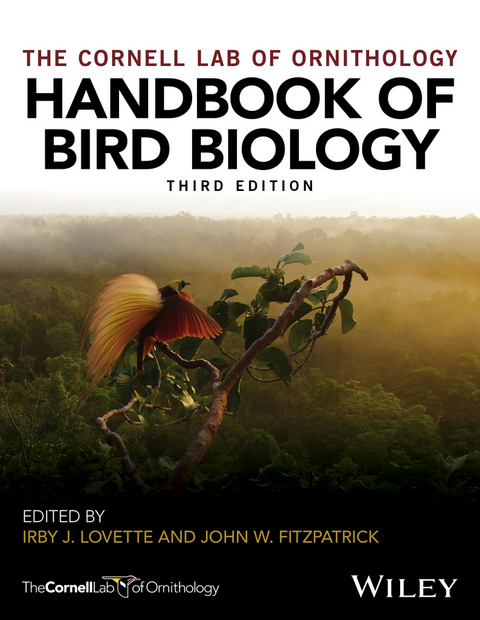
Handbook of Bird Biology (eBook)
John Wiley & Sons (Verlag)
978-1-118-29104-7 (ISBN)
Selected by Forbes.com as one of the 12 best books about birds and birding in 2016
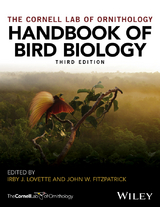
This much-anticipated third edition of the Handbook of Bird Biology is an essential and comprehensive resource for everyone interested in learning more about birds, from casual bird watchers to formal students of ornithology. Wherever you study birds your enjoyment will be enhanced by a better understanding of the incredible diversity of avian lifestyles. Arising from the renowned Cornell Lab of Ornithology and authored by a team of experts from around the world, the Handbook covers all aspects of avian diversity, behaviour, ecology, evolution, physiology, and conservation. Using examples drawn from birds found in every corner of the globe, it explores and distills the many scientific discoveries that have made birds one of our best known - and best loved - parts of the natural world.
This edition has been completely revised and is presented with more than 800 full color images. It provides readers with a tool for life-long learning about birds and is suitable for bird watchers and ornithology students, as well as for ecologists, conservationists, and resource managers who work with birds.
The Handbook of Bird Biology is the companion volume to the Cornell Lab's renowned distance learning course, Ornithology: Comprehensive Bird Biology.
Irby Lovette is the Fuller Professor of Ornithology at Cornell University, Associate Director for Academic Affairs at the Cornell Lab of Ornithology, Director of the Lab's Fuller Evolutionary Biology Program, and Curator of Genomics at the Cornell Museum of Vertebrates. He has authored more than 130 scientific publications on topics related to avian evolution, ecology, behavior, and conservation, along with numerous articles for the general public.
John Fitzpatrick is the Louis Agassiz Fuertes Director of the Cornell Lab of Ornithology and Professor in Cornell's Department of Ecology and Evolutionary Biology. His many contributions to ornithology and bird conservation include 140 scientific publications, discovery of seven previously unknown bird species in Peru, 45 years leading one of the world's longest continuous studies of the ecology and behavior of a wild bird population, the Florida Scrub-Jay, and service on numerous conservation boards and panels. He is past president of the American Ornithologists' Union and the recipient of that society's highest awards for research (William Brewster Medal), conservation (Ralph W. Schreiber Award), and service (Marion Jenkinson Award).
Selected by Forbes.com as one of the 12 best books about birds and birding in 2016 This much-anticipated third edition of the Handbook of Bird Biology is an essential and comprehensive resource for everyone interested in learning more about birds, from casual bird watchers to formal students of ornithology. Wherever you study birds your enjoyment will be enhanced by a better understanding of the incredible diversity of avian lifestyles. Arising from the renowned Cornell Lab of Ornithology and authored by a team of experts from around the world, the Handbook covers all aspects of avian diversity, behaviour, ecology, evolution, physiology, and conservation. Using examples drawn from birds found in every corner of the globe, it explores and distills the many scientific discoveries that have made birds one of our best known - and best loved - parts of the natural world. This edition has been completely revised and is presented with more than 800 full color images. It provides readers with a tool for life-long learning about birds and is suitable for bird watchers and ornithology students, as well as for ecologists, conservationists, and resource managers who work with birds. The Handbook of Bird Biology is the companion volume to the Cornell Lab's renowned distance learning course, www.birds.cornell.edu/courses/home/homestudy/.
Irby Lovette is the Fuller Professor of Ornithology at Cornell University, Associate Director for Academic Affairs at the Cornell Lab of Ornithology, Director of the Lab's Fuller Evolutionary Biology Program, and Curator of Genomics at the Cornell Museum of Vertebrates. He has authored more than 130 scientific publications on topics related to avian evolution, ecology, behavior, and conservation, along with numerous articles for the general public. John Fitzpatrick is the Louis Agassiz Fuertes Director of the Cornell Lab of Ornithology and Professor in Cornell's Department of Ecology and Evolutionary Biology. His many contributions to ornithology and bird conservation include 140 scientific publications, discovery of seven previously unknown bird species in Peru, 45 years leading one of the world's longest continuous studies of the ecology and behavior of a wild bird population, the Florida Scrub-Jay, and service on numerous conservation boards and panels. He is past president of the American Ornithologists' Union and the recipient of that society's highest awards for research (William Brewster Medal), conservation (Ralph W. Schreiber Award), and service (Marion Jenkinson Award).
Title Page 5
Copyright Page 6
Contents 7
Editorial Team and Contributors 9
Preface 11
Bird Academy Web Resources 15
How to report errors and offer suggestions 15
Chapter 1 Why Study Birds? 17
1.1 Engaging with birds in the twenty-first century 19
1.2 A short note on the names of birds 20
1.3 Birds and ornithology are both worldwide 20
1.4 Web resources beyond this handbook 21
Chapter 2 Avian Diversity and Classification 23
2.1 Classifying avian diversity 23
2.1.1 Avian classification 24
2.1.2 Naming bird species 28
2.1.3 English and local names 29
2.1.4 Defining species 29
2.1.5 Birds and the biological species concept 31
2.1.6 Birds and the phylogenetic species concept 31
2.2 Phylogenetics: the evolutionary tree of birds 33
2.2.1 What is a phylogeny? 33
2.2.2 Phylogenetic data and techniques 35
2.2.3 Genetic variation within bird species 39
2.3 Global patterns of avian diversity 41
2.3.1 Birds and biogeographical realms 42
2.3.2 Avian distributions and their limits 43
2.3.3 Variation in the diversity of living birds 44
2.4 Origin of birds 48
2.4.1 Birds are theropod dinosaurs 48
2.4.2 Feathers and other dinosaur traits in birds 50
2.4.3 Archaeopteryx, the earliest known bird 52
2.4.4 Other early birds from the Mesozoic 53
2.4.5 Mass extinction and the origin of modern birds 54
2.4.6 Diversification of living birds 56
2.4.7 Relationships of living avian orders 57
References 75
Chapter 3 How Birds Evolve 79
3.1 Natural selection 80
3.1.1 Four conditions for natural selection 80
3.1.2 Avian examples of natural selection 83
3.1.3 Kin selection and indirect fitness 85
3.1.4 Artificial selection in birds 86
3.2 Sexual selection 87
3.2.1 Sexual selection and mate attraction 88
3.2.2 Sexual selection and competition 92
3.2.3 Sexual selection in widowbirds: a case study 94
3.2.4 What about choosy males? 95
3.3 Speciation 97
3.3.1 Reproductive barriers that arise before birds mate 97
3.3.2 Speciation via geographic splitting 98
3.3.3 Speciation via colonization of new areas 100
3.3.4 Speciation without geographic isolation 103
3.3.5 Speciation in time rather than space 103
3.4 Hybridization 105
3.4.1 Avian hybrid zones 107
3.4.2 Hybridization as a conservation issue 107
3.4.3 Hybrids in the field 108
3.5 What drives the divergence of bird populations? 110
3.6 Adaptive radiations of birds 111
References 113
Chapter 4 Feathers and Plumages 117
4.1 Structural basics of feathers 118
4.2 Feather development 119
4.2.1 Follicles 120
4.2.2 Generating the branched feather form 121
4.3 Evolution of feathers 124
4.4 Types of feathers: distribution, forms, and functions 128
4.4.1 Down: insulation 129
4.4.2 Contour feathers: feathers for all weather 132
4.4.3 Flight feathers: lift and control in air 134
4.4.4 Semiplumes: insulation around the edges 137
4.4.5 Bristles: detection and protection 137
4.4.6 Filoplumes: feather kinesthetics 137
4.5 Molts and plumages 137
4.5.1 Subadult versus definitive plumages 140
4.5.2 Annual cycles: molt and wear 141
4.5.3 Plumage naming systems 141
4.5.4 The four molting strategies 143
4.5.5 Progression and timing of molt 143
4.6 Feather care 144
4.7 Coloration: form and function at the scale of light 147
4.7.1 Light, perception, and color 147
4.7.2 Producing color in feathers 148
4.7.3 Pigmentary colors: absorbing and transforming light 151
4.7.4 Structural colors: bending light 153
4.8 Feather and plumage texture: light at the scale of barbules, barbs, and whole feathers 157
4.9 Visual functions of plumage 158
4.9.1 Predator avoidance 158
4.9.2 Social recognition and signaling 160
References 162
Chapter 5 Avian Flight 165
5.1 Aerodynamics 165
5.1.1 Airflow over a wing produces lift 165
5.1.2 Modulating lift 167
5.1.3 Forms of drag 168
5.1.4 Effects of wing and tail shape 169
5.2 Power for flight 171
5.2.1 Flapping and thrust 171
5.2.2 Hovering 172
5.2.3 Power requirements for flying birds 174
5.2.4 Power available from the flight muscles 176
5.2.5 Energy-saving flight strategies: intermittent flight and soaring 177
5.3 Maneuvering and stability 179
References 182
Chapter 6 Avian Anatomy 185
6.1 Skeletal system 185
6.1.1 Axial skeleton 188
6.1.2 Vertebral column 190
6.1.3 Appendicular skeleton 193
6.2 Muscular system 197
6.2.1 Skeletal muscles 199
6.2.2 Smooth muscle 200
6.3 Respiratory system 200
6.3.1 Nostrils and nasal cavities 201
6.3.2 Pharynx 203
6.3.3 Larynx 203
6.3.4 Trachea and syrinx 203
6.3.5 Lungs 204
6.4 Digestive system 206
6.4.1 Tongue 206
6.4.2 Alimentary canal 209
6.5 Urogenital system 212
6.5.1 Excretory organs and ducts 212
6.5.2 Male and female gonads 212
6.5.3 Copulation and fertilization 214
6.6 Circulatory system 215
6.6.1 Heart 215
6.6.2 Arterial system 216
6.6.3 Venous system 217
6.7 Nervous system 218
6.7.1 Sensory and motor neurons 218
6.7.2 Central nervous system 218
6.7.3 Autonomic nervous system 222
6.8 Sense organs and the sensory system 222
6.8.1 Eye and vision 222
6.8.2 Ear and hearing 226
6.8.3 Taste and smell 228
6.8.4 Tactile specialties 228
References 229
Chapter 7 Bird Physiology 231
7.1 Maintaining an internal balance 232
7.1.1 Water and salt budgets 232
7.1.2 Avian kidneys 234
7.1.3 Cloaca and lower intestine 236
7.1.4 Salt glands 237
7.2 Not too hot or cold 238
7.2.1 Physics of heat transfer 239
7.2.2 Costs of thermoregulation 239
7.2.3 Birds in cold places 241
7.2.4 Birds in hot places 243
7.3 Nutrition (digestion and metabolism) 245
7.3.1 Energy requirements 246
7.3.2 Protein and amino acid requirements 248
7.3.3 Carbohydrate and fat requirements 250
7.3.4 Vitamin and mineral requirements 250
7.3.5 Digestive physiology and metabolism 250
7.3.6 Microbial symbiosis and digestion 252
7.4 Dealing with pathogens 254
7.4.1 Elements of the immune system and how they interact 254
7.4.2 Ecoimmunology 255
7.5 Exercise physiology of flying birds 256
7.5.1 Integrated physiological systems 257
7.5.2 Fat is the primary fuel 257
7.6 Avian endocrine system 258
7.6.1 The HPG and HPA axes 258
7.6.2 Types of hormones 259
7.6.3 Measuring hormones in wild birds 261
7.6.4 Hormones and avian sex differences 261
7.6.5 Hormones and behavior 262
7.6.6 Hormones, sex, and reproduction 263
7.6.7 Annual cycles of hormones and seasonal breeding 264
7.6.8 Stressors and the HPA axis 267
7.6.9 Hormones, life stages, and life history trade-offs 267
7.7 Bird brains 269
7.7.1 Song system in the avian brain 270
7.7.2 Sleep in birds 270
7.8 Sensory physiology 271
7.8.1 Hearing 271
7.8.2 Magnetic senses 272
7.8.3 Vision 272
7.8.4 Smell 274
References 276
Chapter 8 Avian Food and Foraging 281
8.1 Basics: meeting energy and nutritional demands 281
8.1.1 Calories and nutrients 282
8.1.2 Feeding rates and food abundance 283
8.2 Optimizing what, when, where, and how to forage 284
8.2.1 Optimal Foraging Theory 284
8.2.2 Optimal prey searching strategies 285
8.2.3 Foraging in groups 287
8.3 Diversity of foods and foraging behaviors 289
8.3.1 New technologies for studying diets 290
8.3.2 Diversity of avian foraging strategies 290
8.3.3 Stages of foraging and consumption 292
8.4 Benefits and costs of social foraging 312
8.5 Feeding specialization and generalization 316
8.5.1 Conditions favoring diet specialization 319
8.5.2 Individual feeding specializations 322
References 323
Chapter 9 Avian Mating and Social Behavior 329
9.1 Female mating preferences 330
9.2 Pair bonds, courtship, and divorce 332
9.3 Male mating preferences 335
9.4 Adaptive value of mate choice 336
9.4.1 Genetic benefits from mate choice 337
9.4.2 Material benefits from mate choice 339
9.5 Sexual selection and mating systems 340
9.5.1 Solving the puzzle of male monogamy 341
9.5.2 Polygyny: the puzzle of female participation 347
9.5.3 Lek polygyny 349
9.5.4 Absence of male parental care and the lek paradox 351
9.5.5 Polyandry: why do males accept polyandrous mates? 352
9.5.6 Mating systems and sexual conflict 355
9.6 Costs and benefits of social behavior 356
9.6.1 Territoriality and aggressive social behavior 357
9.6.2 Dominance hierarchies 358
9.6.3 Helpful social behavior 359
9.6.4 Cooperative breeding and avian altruism 361
References 365
Chapter 10 Avian Vocal Behavior 371
10.1 Studying bird sounds: the investigator’s toolbox 371
10.1.1 Physical basis of sound 372
10.1.2 Visualizing sounds as spectrograms 373
10.1.3 Using your eyes to assist your ears 373
10.2 Vocal repertoires 376
10.2.1 Songs 376
10.2.2 Calls 380
10.2.3 Influences on vocal structure 381
10.2.4 What do bird sounds mean? 382
10.3 Vocal development 386
10.3.1 Song development in songbirds 386
10.3.2 Process of song development 388
10.3.3 Diversity of song development in songbirds 389
10.3.4 Song development in suboscine passerines 392
10.3.5 Vocal development in non-passerines 394
10.4 Production and control of song 395
10.4.1 Sound production apparatus 395
10.4.2 Neural basis of song perception and production 396
10.5 Song variation in space and time 398
10.5.1 Differences among species 398
10.5.2 Individual distinctiveness 398
10.5.3 Geographic variation 401
10.5.4 Diversity of geographic patterns 404
10.5.5 Geographic variation in suboscine vocalizations 406
10.5.6 Change over time 406
10.6 Functions of bird song 408
10.6.1 Territorial defense 408
10.6.2 Mate attraction 409
10.7 Signal values of differences among singers 410
10.7.1 Song output 410
10.7.2 Song performance 410
10.7.3 Song repertoire size 411
10.8 Other remarkable features of singing behavior 412
10.8.1 Dawn chorus 412
10.8.2 Female song 413
10.8.3 Duetting 414
10.8.4 Mimicry 415
10.8.5 Flight songs 416
References 417
Chapter 11 Breeding Biology of Birds 423
11.1 Timing of breeding 424
11.2 Breeding territories 425
11.3 Nests and nest building 425
11.3.1 Functions of nests 425
11.3.2 Diversity of nest locations and nest-site selection 426
11.3.3 Diversity of nests 427
11.3.4 Nest linings 435
11.4 Nest-building behaviors 438
11.4.1 Sex roles in nest building 438
11.4.2 Duration of nest building 440
11.4.3 Nest appropriation and reuse 440
11.5 Eggs 441
11.5.1 Egg structure 441
11.5.2 Egg size 443
11.5.3 Egg shape 444
11.5.4 Eggshell color and texture 445
11.5.5 Egg laying 446
11.6 Clutch size 447
11.6.1 Clutch size and food availability 447
11.6.2 Clutch size, geography, and incubation 448
11.6.3 Clutch size and nest type 448
11.6.4 Clutch size, female age, and time of season 448
11.6.5 Number of broods per season 449
11.7 Clutch and egg replacement 449
11.8 Incubation 450
11.8.1 Brood patches and brooding 450
11.8.2 Incubation period 450
11.8.3 Start of incubation 451
11.8.4 Incubation by male and female birds 452
11.8.5 Patterns of attentiveness 452
11.8.6 Behavior during incubation 453
11.9 Hatching 454
11.10 Altricial and precocial young 455
11.10.1 Appearance 455
11.10.2 Temperature regulation 456
11.10.3 Weight gain 457
11.10.4 Sensory and motor development 457
11.10.5 Leaving the nest 458
11.10.6 Developmental periods and independence 459
11.11 Recognition among parents and their young 460
11.12 Parental care 460
11.12.1 Feeding their young 460
11.12.2 Defending their young 461
11.12.3 Nest sanitation 462
11.13 Survival and reproductive trade-offs 463
11.13.1 Meeting threats to offspring survival 463
11.13.2 Adult and offspring survival 464
References 464
Chapter 12 Avian Migration and Dispersal 469
12.1 Types of movements 470
12.1.1 Philopatry 470
12.1.2 Local movements, migration, and dispersal 471
12.2 Patterns in migration 472
12.2.1 Types of annual movements 474
12.2.2 Migratory connectivity 476
12.2.3 Migratory paces and paths 478
12.2.4 Sex and age differences in migration 481
12.2.5 Movements on the non?breeding grounds 481
12.2.6 Altitudinal migration 482
12.2.7 Austral migration 482
12.2.8 Migratory divides 483
12.2.9 Concentration points and staging areas 485
12.2.10 Flyways 486
12.2.11 Irruptive migration 487
12.3 How birds time their migrations 488
12.3.1 Migratory restlessness 488
12.3.2 Biological clocks for migration timing 488
12.4 Orientation and navigation 489
12.4.1 Magnetic perception of birds 489
12.4.2 Solar cues and the circadian clock 491
12.4.3 Celestial navigation 491
12.4.4 Other orientation guides 491
12.4.5 Displacement experiments 492
12.4.6 Multiple and sometimes conflicting orientation cues 492
12.5 Migration physiology 492
12.5.1 Fat: the fuel of avian migration 492
12.5.2 Migration and weather 493
12.5.3 Migratory fallouts and mortality during migration 494
12.6 Dispersal 496
12.6.1 Breeding dispersal and philopatry 496
12.6.2 Patterns in natal dispersal 497
12.6.3 Dispersal and colonization 497
12.6.4 Prospecting for new breeding sites 499
12.6.5 Dispersal and genetic connections among populations 500
12.6.6 Methods for measuring dispersal 501
12.7 Evolution of avian movement patterns 501
12.7.1 How does migration evolve? 502
12.7.2 Migration and ongoing environmental change 502
References 505
Chapter 13 Ecology of Bird Populations 511
13.1 Avian population ecology 512
13.2 Changes in populations over time and space 513
13.3 Censusing bird populations 514
13.4 Avian demography 515
13.4.1 Age structure 515
13.4.2 Aging and senescence 518
13.4.3 Sex ratio evolution 520
13.5 Life history evolution 523
13.5.1 General life history theory 523
13.5.2 Evolution of clutch size 527
13.5.3 More life history basics 531
13.6 Ecological niches 531
13.7 Limiting factors for bird populations 533
13.7.1 Food as a limitation 534
13.7.2 Nest sites as a limitation 536
13.7.3 Predation as a limitation 537
13.7.4 Nest depredation 538
13.7.5 Parasites and pathogens as a limitation 538
13.7.6 Brood parasitism 540
13.8 Population regulation 540
13.9 Populations through time and space 546
References 548
Chapter 14 Bird Communities 553
14.1 Classifying bird species assemblages 554
14.2 Ways of describing communities 557
14.2.1 Species diversity 557
14.2.2 Patterns of species abundance and estimating species richness 557
14.2.3 Species–area curves 557
14.2.4 Understanding abundance and rarity 558
14.2.5 Three kinds of diversity 558
14.3 Patterns of species diversity 560
14.3.1 Latitudinal gradients 560
14.3.2 Habitat change and avian communities 562
14.3.3 Landscape effects on bird diversity 563
14.4 The niche: a fundamental unit in community ecology 563
14.4.1 Niche overlap and niche breadth 564
14.4.2 Competitive exclusion and limiting similarity 567
14.4.3 Ecological guilds 568
14.5 Interspecific competition 568
14.5.1 Exploitation competition 568
14.5.2 Interference competition 571
14.6 Evidence for interspecific competition 573
14.6.1 Density compensation and ecological release 573
14.6.2 Character displacement 574
14.6.3 Community structure, competition, and assembly rules 575
14.6.4 Phylogenies and the history of communities 576
14.6.5 Competition experiments in birds 576
14.6.6 Competition between birds and other animals 578
14.7 Interspecific commensalism 579
14.8 Mutualisms 579
14.8.1 Mixed-species flocks 580
14.8.2 Heterospecific attraction 580
14.9 Parasitism 580
14.9.1 Brood parasites 583
14.9.2 Kleptoparasitism 586
14.10 Predation 586
14.11 Food chains and food webs 587
14.12 Communities within birds 588
14.13 Top-down effects, trophic cascades, and ecological services 589
14.13.1 Trophic cascades 589
14.13.2 Ecological services 590
References 590
Chapter 15 Bird Conservation 595
15.1 History of bird conservation 596
15.2 Conservation biology 598
15.3 Recent avian extinctions 599
15.3.1 Avian extinctions in the Anthropocene 599
15.3.2 Historical extinctions on oceanic islands 601
15.3.3 Historical extinctions on continents 602
15.4 Causes of avian population declines 605
15.4.1 Demography, habitat, and life histories 605
15.4.2 Habitat specialization and the six forms of rarity 606
15.5 Major threats to bird populations 609
15.5.1 Habitat loss 610
15.5.2 Habitat fragmentation 611
15.5.3 Introduced predators 613
15.5.4 Direct exploitation 613
15.5.5 Chemical toxins and pollution 614
15.5.6 Introduced disease 616
15.5.7 Climate change 617
15.5.8 Stochastic extinction 618
15.5.9 Tipping points in extinction: Allee effects 619
15.5.10 Multiple stressors 619
15.5.11 Genetics and the extinction vortex 619
15.6 Avian population increases 621
15.7 Conservation solutions 621
15.7.1 Monitoring populations 623
15.7.2 Setting priorities 623
15.7.3 Population viability analysis and metapopulations 625
15.7.4 Managing exploitation 627
15.7.5 Reserve design 628
15.7.6 Genetic augmentation 629
15.7.7 Captive rearing and reintroduction 631
15.7.8 Eliminating introduced mammals 634
15.7.9 Translocation 636
15.7.10 Conservation-reliant species 638
15.7.11 Habitat management and restoration 638
15.7.12 Adaptive management 641
15.7.13 Ecosystem management is complicated 642
15.8 Value of wild birds 642
15.8.1 Direct benefits 644
15.8.2 Indirect benefits: ecosystem services 645
15.8.3 Indirect benefits: genetic information and scientific study 646
15.8.4 Emotional benefits 646
15.8.5 Ethical considerations 646
15.9 What each of us can do 647
15.9.1 Backyard conservation 647
15.9.2 Citizen science 647
15.9.3 Adopting a place 648
15.9.4 Vigilance, grassroots activism, and advocacy 649
15.9.5 Consumer choices 649
15.9.6 Environmental education 650
15.9.7 Birding with youngsters 651
15.9.8 Contribute to conservation organizations 651
15.9.9 Never give up 652
References 652
Glossary 657
Index 673
EULA 733
"This wonderful handbook provides a crystal-clear introduction to every fascinating aspect of bird biology. It will now be my own first reference source about birds, and it should be yours, too - regardless of whether you are a backyard bird watcher, a hard-core birder, or a professional ornithologist."
Jared Diamond, Professor of Geography at the University of California-Los Angeles, specialist on New Guinea birds, and Pulitzer-Prize winning author.
"This new edition of the Cornell Lab of Ornithology's Handbook of Bird Biology is a stunning resource for professionals and amateurs alike. It is graced by color photos spilling off nearly every page and filled with clear yet detailed interpretations of the latest ornithological discoveries. One can't achieve a better mix of technical accuracy and a pleasing, accessible format. It's all here - bird evolution, ecology, physiology, conservation, and much more."
Scott V. Edwards, Alexander Agassiz Professor of Zoology and Curator of Ornithology at Harvard University.
"With the range of topics covered, the quality of both the writing and design, and the depth of information included, the authors have produced a book that will be of interest to a wide range of readers from those just starting to learn about birds to ornithologists who have been studying birds for decades. Whether you are a researcher, teacher, or just interested in birds, this book is a must-have for your ornithological library and, for those teaching a college-level course and looking for a textbook, the Handbook of Bird Biology is an excellent resource that should be given serious consideration" Margaret Brittingham, wiley online library, Sept 2017.
"This third version is largely enriched by the progress of ornithology. It is difficult to account for such a large body of knowledge, with the different chapters covering most areas: bird classification and diversity, evolution, plumage, flight, anatomy, physiology, feeding, social behavior, vocalizations, reproduction , migration, population ecology, communities, conservation. There is a summary at the top of each chapter and a good list of bibliographic references at the end. All are very well illustrated with photos, figures and also many colored boxes that detail particular points, concepts and regularly clear definitions of terms or scientific concepts. In addition, 76 pages of glossary and indexes (names of species, countries, subjects, etc.) at the end allow the reader to find almost everything that has been treated or mentioned ... It is the best condensed work currently available on birds and ornithology developments. It is also the most readable and easy to consult thanks to its very airy texts with multiple illustrations and subtitles ... it's really the basic work that one can refer to for any questions that one might have about birds." Ornithos, 24:5 (2017)
| Erscheint lt. Verlag | 27.6.2016 |
|---|---|
| Sprache | englisch |
| Themenwelt | Naturwissenschaften ► Biologie ► Zoologie |
| Technik | |
| Veterinärmedizin | |
| Schlagworte | Ãkologie • Ãkologie u. Biologie der Organismen • Animal Science & Zoology • Behavior • Biologie • Biowissenschaften • Birding • Birds • bird-watching • Diversity • Ecology • Ecology & Organismal Biology • Evolution • Life Sciences • Migration • Ökologie • Ökologie u. Biologie der Organismen • Ornithologie • Ornithology • Vögel • Vögel • Zoologie |
| ISBN-10 | 1-118-29104-2 / 1118291042 |
| ISBN-13 | 978-1-118-29104-7 / 9781118291047 |
| Informationen gemäß Produktsicherheitsverordnung (GPSR) | |
| Haben Sie eine Frage zum Produkt? |
 PDF (Adobe DRM)
Kopierschutz: Adobe-DRM
Adobe-DRM ist ein Kopierschutz, der das eBook vor Mißbrauch schützen soll. Dabei wird das eBook bereits beim Download auf Ihre persönliche Adobe-ID autorisiert. Lesen können Sie das eBook dann nur auf den Geräten, welche ebenfalls auf Ihre Adobe-ID registriert sind.
Details zum Adobe-DRM
Dateiformat: PDF (Portable Document Format)
Mit einem festen Seitenlayout eignet sich die PDF besonders für Fachbücher mit Spalten, Tabellen und Abbildungen. Eine PDF kann auf fast allen Geräten angezeigt werden, ist aber für kleine Displays (Smartphone, eReader) nur eingeschränkt geeignet.
Systemvoraussetzungen:
PC/Mac: Mit einem PC oder Mac können Sie dieses eBook lesen. Sie benötigen eine
eReader: Dieses eBook kann mit (fast) allen eBook-Readern gelesen werden. Mit dem amazon-Kindle ist es aber nicht kompatibel.
Smartphone/Tablet: Egal ob Apple oder Android, dieses eBook können Sie lesen. Sie benötigen eine
Geräteliste und zusätzliche Hinweise
Buying eBooks from abroad
For tax law reasons we can sell eBooks just within Germany and Switzerland. Regrettably we cannot fulfill eBook-orders from other countries.
aus dem Bereich