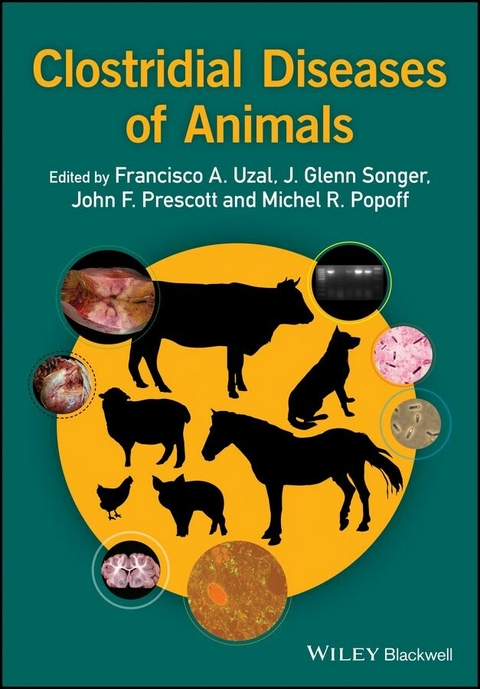
Clostridial Diseases of Animals (eBook)
John Wiley & Sons (Verlag)
978-1-118-72833-8 (ISBN)
Clostridial Diseases of Animals is the first book to focus on clostridial diseases in domestic and wild animals, offering a comprehensive reference on these common diseases.
- Provides a single resource for all aspects of clostridial diseases
- Presents current, comprehensive information with a focus on clinical relevance
- Covers each disease in depth, including etiology, epidemiology, clinics, gross pathology, histopathology, diagnostics, diagnostic criteria, prophylaxis, control, and treatment
- Written by the world-leading experts in the field of clostridial diseases in animals
- Offers photographs and summary tables to support the concepts discussed in the text and aid in recognition
Francisco A. Uzal, DVM, FRVC, MSc, PhD, Dipl. ACVP, is Professor of Veterinary Diagnostic Pathology at the School of Veterinary Medicine at the University of California at Davis in San Bernardino, California, USA.
J. Glenn Songer, MA, PhD, Fellow AAM, Dipl. ACVM, is Professor (Emeritus) of Veterinary Science and Microbiology, College of Agriculture, The University of Arizona in Tucson, Arizon, USA.
John F. Prescott, MA, Vet MB, PhD, FCAHS, is Professor (Emeritus) of Veterinary Microbiology at Ontario Veterinary College, University of Guelph in Ontario, Canada.
Michel R. Popoff, DVM, PhD, is the head of the Research Unit of Anaerobic Bacteria and Toxins and the National Reference Center for Anaerobic Bacteria and Botulism at Institut Pasteur in Paris, France.
Clostridial Diseases of Animals is the first book to focus on clostridial diseases in domestic and wild animals, offering a comprehensive reference on these common diseases. Provides a single resource for all aspects of clostridial diseases Presents current, comprehensive information with a focus on clinical relevance Covers each disease in depth, including etiology, epidemiology, clinics, gross pathology, histopathology, diagnostics, diagnostic criteria, prophylaxis, control, and treatment Written by the world-leading experts in the field of clostridial diseases in animals Offers photographs and summary tables to support the concepts discussed in the text and aid in recognition
Francisco A. Uzal, DVM, FRVC, MSc, PhD, Dipl. ACVP, is Professor of Veterinary Diagnostic Pathology at the School of Veterinary Medicine at the University of California at Davis in San Bernardino, California, USA. J. Glenn Songer, MA, PhD, Fellow AAM, Dipl. ACVM, is Professor (Emeritus) of Veterinary Science and Microbiology, College of Agriculture, The University of Arizona in Tucson, Arizon, USA. John F. Prescott, MA, Vet MB, PhD, FCAHS, is Professor (Emeritus) of Veterinary Microbiology at Ontario Veterinary College, University of Guelph in Ontario, Canada. Michel R. Popoff, DVM, PhD, is the head of the Research Unit of Anaerobic Bacteria and Toxins and the National Reference Center for Anaerobic Bacteria and Botulism at Institut Pasteur in Paris, France.
List of Contributors xi
Preface xvii
Section 1: The pathogenic clostridia
1 Taxonomic Relationships among the Clostridia 3
John F. Prescott, Janet I. MacInnes, and Anson K. K. Wu
2 General Physiological and Virulence Properties of the Pathogenic Clostridia 7
Julian I. Rood
3 Brief Description of Animal Pathogenic Clostridia 13
John F. Prescott
Section 2: Toxins Produced by the Pathogenic Clostridia
4 Toxins of Histotoxic Clostridia: Clostridium chauvoei, Clostridium septicum, Clostridium novyi, and Clostridium sordellii 23
Michel R. Popoff
5 Toxins of Clostridium perfringens 45
James R. Theoret and Bruce A. McClane
6 Toxins of Clostridium difficile 61
J. Glenn Songer, Ashley E. Harmon, and M. Kevin Keel
7 Clostridium botulinum and Clostridium tetani Neurotoxins 71
Michel R. Popoff
Section 3: Clostridial Infections of the Gastrointestinal System
8 Diseases Produced by Clostridium perfringens
Type A in Mammalian Species 109
Francisco A. Uzal
9 NetF-Associated Necrotizing Enteritis of Foals and Canine Hemorrhagic Gastroenteritis 117
Iman Mehdizadeh Gohari, Valeria R. Parreira, and John F. Prescott
10 Necrotic Enteritis of Poultry 123
Kerry K. Cooper and J. Glenn Songer
11 Infections by Clostridium perfringens Type B 139
Francisco A. Uzal and J. Glenn Songer
12 Diseases Produced by Clostridium perfringens Type C 143
Santiago S. Diab
13 Diseases Produced by Clostridium perfringens Type D 157
Francisco A. Uzal, Federico Giannitti, John W. Finnie, and Jorge P. García
14 Infections by Clostridium perfringens Type E 173
J. Glenn Songer
15 Diseases Produced by Clostridium difficile 177
Santiago S. Diab, Francisco A. Uzal, and J. Glenn Songer
16 Disease Caused by Clostridium colinum: Ulcerative Enteritis of Poultry and Other Avian Species 197
John F. Prescott
17 Clostridial Abomasitis 205
John F. Prescott, Paula I. Menzies, and Russell S. Fraser
18 Diseases Produced by Clostridium spiroforme 221
J. Glenn Songer and Francisco A. Uzal
Section 4: Clostridial Histotoxic Infections
19 Blackleg 231
Camila C. Abreu and Francisco A. Uzal
20 Gas Gangrene (Malignant Edema) 243
Rodrigo O. S. Silva, Francisco A. Uzal, Carlos A. Oliveira Jr, and Francisco C. F. Lobato
21 Gangrenous Dermatitis in Poultry 255
H. L. Shivaprasad
22 Bacillary Hemoglobinuria 265
Mauricio Navarro, Fernando Dutra Quintela, and Francisco A. Uzal
23 Infectious Necrotic Hepatitis 275
Mauricio Navarro and Francisco A. Uzal
24 Tyzzer's Disease 281
Karina C. Fresneda and Francisco R. Carvallo Chaigneau
Section 5: Clostridial Neurotoxic Infections
25 Tetanus 295
Michel R. Popoff
26 Botulism 303
Caroline Le Maréchal, Cédric Woudstra, and Patrick Fach
27 Diseases Caused by Other Clostridia Producing Neurotoxins 331
John F. Prescott
Index 333
2
General Physiological and Virulence Properties of the Pathogenic Clostridia
Julian I. Rood
Introduction
The key features that delineate members of the genus Clostridium are that they are Gram-positive rods that are anaerobic and form heat-resistant endospores. By and large these features define the genus, although there are some clostridia that stain Gram-negative and some clostridia that can grow in the presence of oxygen. Most members of this genus are commensal or soil bacteria that do not cause disease, but we tend to focus our attention on the pathogenic clostridia. The genus is extremely diverse and, by normal taxonomic criteria, should be divided into several different genera (Chapter 1). However, the established role of several clostridial species in some of the major diseases of humans and animals, including tetanus, botulism, gas gangrene, and various enteric and enterotoxemic syndromes, has precluded what would otherwise be a sensible and scientifically sound reclassification (Chapter 1). Recently, the movement of pathogens such as Clostridium difficile and Clostridium sordellii into the genera Peptoclostridium and Paeniclostridium, respectively, has been suggested, but these proposals are yet to be adopted formally.
Anaerobic metabolism
Bacterial metabolism is the process by which bacteria obtain nutrients and energy from the environment or their host, enabling them to grow and multiply. It is beyond the scope of this chapter to describe this process in detail, since entire books can and have been written on the topic. The key issue that will be discussed here is what, in general terms, distinguishes the metabolism of anaerobic bacteria from that of aerobic and facultative anaerobic bacteria. Aerobes are defined as bacteria that are unable to grow in the absence of oxygen. Facultative anaerobes can grow in the presence or absence of oxygen, usually growing more rapidly under aerobic conditions. Anaerobic bacteria are unable to grow in the presence of oxygen, but grow very well under anaerobic conditions. Anaerobic bacteria can be divided further into two major groups: strict anaerobes, which are killed by exposure to oxygen, and aerotolerant anaerobes, which can only grow anaerobically but are not killed by exposure to oxygen.
Aerobic bacteria obtain most of their energy, in the form of ATP, in a highly efficient manner by the passage of electrons through the membrane-bound electron-transport chain, culminating in the use of oxygen as a terminal electron acceptor. This process is known as aerobic respiration. In an aerobic environment, facultative anaerobes such as Escherichia coli or Salmonella spp. use the electron-transport chain to produce ATP. In the absence of oxygen, they are reliant on the far less efficient substrate-level phosphorylation process or the use of an alternative electron acceptor.
Anaerobic bacteria may still be able to obtain their energy from the electron-transport chain by use of an alternative terminal electron acceptor, usually an inorganic compound such as a nitrate or sulfate. This process is known as anaerobic respiration. Alternatively, they may carry out anaerobic fermentation and obtain all of their ATP from substrate-level phosphorylation, with oxidized NAD regenerated by the reduction of intermediates in the glycolytic pathway to ionized carboxylic acids such as acetate, lactate, or butyrate. Such organisms may significantly increase the throughput of sugars through the glycolytic pathway and therefore do not necessarily grow at a slower rate than aerobic bacteria, even though the output from aerobic respiration (38 moles of ATP per mole of glucose catabolized to CO2) is far greater than that from fermentation (2 moles of ATP per mole of glucose partially catabolized to a mixture of alcohols and/or organic acids).
Like many other bacteria, the clostridia are not restricted to metabolizing sugars to obtain their energy. They can ferment other compounds such as amino acids to obtain both their carbon and energy. For example, C. difficile uses the Stickland reaction in which pairs of amino acids are fermented in a coupled reaction, with one amino acid acting as an electron donor and the other amino acid acting as an electron acceptor.
Major clostridial diseases
Clostridial diseases and infections can be divided into three major types: neurotoxic diseases, histotoxic diseases, and enteric diseases. Although the focus of this book is clostridial diseases of animals, the clostridia are also important human pathogens. The major clostridial diseases of humans are botulism, tetanus, gas gangrene, food poisoning, pseudomembranous colitis, and antibiotic-associated diarrhea. The major clostridial diseases of animals are outlined in Chapter 3 (Table 3.1) and described in subsequent chapters.
In both humans and animals, botulism and tetanus are caused by Clostridium botulinum and Clostridium tetani, respectively. Traumatic gas gangrene or clostridial myonecrosis in humans is primarily mediated by Clostridium perfringens and non-traumatic gas gangrene by Clostridium septicum, although other clostridia such as Clostridium novyi and C. sordellii can cause severe histotoxic infections in humans and animals. Enterotoxin (CPE)-producing strains of C. perfringens are now the second major cause of human food poisoning in the U.S.A., and can also cause non-food-borne gastrointestinal disease. The major cause of human antibiotic-associated diarrhea and a broader range of enteric infections, including pseudomembranous colitis and toxic megacolon, is the major nosocomial pathogen, C. difficile.
The onset of clostridial infections
Although the pathogenesis of clostridial diseases invariably involves the production of potent protein toxins, it is important to note that, with one exception, they are true infectious diseases. The infectious bacterium needs to establish itself in the host and overcome the host’s innate and acquired immune defenses so that the pathogen can grow, multiply, and elaborate its toxins. The extent of bacterial growth that occurs may be fairly limited, for example the minimal growth of C. tetani in the deep wounds that lead to tetanus, or very extensive, for example the rapid growth of C. perfringens or C. septicum in histotoxic infections. The exception is botulism, which is often a true toxemia, with humans or animals consuming preformed botulinum toxin in their food.
Clostridial infections invariably require predisposing conditions, either the breaking of the skin or intestinal barriers by a deep or traumatic wound, or an alteration to the gastrointestinal microbiota caused by a change in the type of feed or by treatment with antimicrobial agents. For example, C. perfringens-mediated avian necrotic enteritis generally involves a change to a protein-rich feed that is often coupled with a predisposing coccidial infection, which leads to overgrowth of toxigenic C. perfringens strains and damage to the gastrointestinal mucosa. Similarly, human C. difficile infections usually follow changes to the intestinal microbiota brought about by treatment of patients with antimicrobial agents.
In most enteric infections caused by other bacterial genera, we know that there is a need for the invading bacteria to adhere to the gastrointestinal epithelium if they are to cause disease. Otherwise they will be washed out of the gastrointestinal tract by the normal one-way peristaltic flow of material. In these bacteria, a considerable amount is known about the role of different fimbriae or other types of surface adhesins that mediate this process. By contrast, little is known about the adhesion process utilized by clostridial enteric pathogens, primarily because research on these pathogens has traditionally focused on their toxins. The exception is human C. difficile infections, where several putative cell-surface adhesins have been identified, including a lipoprotein, two sortase-anchored proteins, S-layer proteins, flagellar proteins, a fibronectin-binding protein, and a putative collagen-binding protein. Therefore, there is considerable scope to investigate and understand the numerous roles of virulence determinants other than protein toxins in the pathogenesis of clostridial diseases.
The key role of protein toxins in clostridial disease
The primary feature of clostridial infections is that cell and tissue damage are mediated by potent protein toxins that are either secreted from the cell or released upon cell lysis. These toxins fall into three major classes: enzymes that act at the cell surface, pore-forming toxins, and toxins that are taken up by their target cells and exert their effects upon release into the cytoplasm.
Alpha toxin (CPA) is an essential virulence factor in C. perfringens-mediated myonecrosis. It is a zinc metallophospholipase C that cleaves phosphatidylcholine in the host cell membrane to phosphorylcholine and a diacylglyceride. At low concentrations, CPA initiates an intracellular signaling cascade; at high concentrations, it disrupts the cell membrane (Chapter 5). Other C. perfringens toxins such as perfringolysin O, enterotoxin (CPE), beta toxin, epsilon toxin, NetB, and NetF are pore-forming toxins that oligomerize at the host cell surface and form either small or large pores in the...
| Erscheint lt. Verlag | 21.3.2016 |
|---|---|
| Sprache | englisch |
| Themenwelt | Medizin / Pharmazie |
| Veterinärmedizin | |
| Schlagworte | bovine • canine • Cat • cattle • Clostridia • clostridial disease • Clostridium • Clostridium botulinum • clostridium chauvoei • Clostridium difficile • Clostridium novyi • Clostridium perfringens • Clostridium septicum • Clostridium sordellii • Clostridium tetani • Dog • enterotoxaemic clostridia • Epidemiologie, Gesundheitswesen u. Statistik • Equine • feline • histotoxic clostridia • horse • Infections • neurotoxic clostridia • ovine • pathogenic clostridia • Pig • Ruminant • Sheep • Swine • toxins • Veterinärmedizin • Veterinärmedizin / Mikrobiologie,Parasitologie,Infektionen,Immunologie • Veterinärmedizin • Veterinärmedizin / Mikrobiologie,Parasitologie,Infektionen,Immunologie • Veterinary Epidemiology, Public Health & Statistics • Veterinary Medicine • Veterinary Microbiology, Parasitology,Infectious Diseases & Immunology |
| ISBN-10 | 1-118-72833-5 / 1118728335 |
| ISBN-13 | 978-1-118-72833-8 / 9781118728338 |
| Informationen gemäß Produktsicherheitsverordnung (GPSR) | |
| Haben Sie eine Frage zum Produkt? |
 EPUB (Adobe DRM)
Kopierschutz: Adobe-DRM
Adobe-DRM ist ein Kopierschutz, der das eBook vor Mißbrauch schützen soll. Dabei wird das eBook bereits beim Download auf Ihre persönliche Adobe-ID autorisiert. Lesen können Sie das eBook dann nur auf den Geräten, welche ebenfalls auf Ihre Adobe-ID registriert sind.
Details zum Adobe-DRM
Dateiformat: EPUB (Electronic Publication)
EPUB ist ein offener Standard für eBooks und eignet sich besonders zur Darstellung von Belletristik und Sachbüchern. Der Fließtext wird dynamisch an die Display- und Schriftgröße angepasst. Auch für mobile Lesegeräte ist EPUB daher gut geeignet.
Systemvoraussetzungen:
PC/Mac: Mit einem PC oder Mac können Sie dieses eBook lesen. Sie benötigen eine
eReader: Dieses eBook kann mit (fast) allen eBook-Readern gelesen werden. Mit dem amazon-Kindle ist es aber nicht kompatibel.
Smartphone/Tablet: Egal ob Apple oder Android, dieses eBook können Sie lesen. Sie benötigen eine
Geräteliste und zusätzliche Hinweise
Buying eBooks from abroad
For tax law reasons we can sell eBooks just within Germany and Switzerland. Regrettably we cannot fulfill eBook-orders from other countries.
aus dem Bereich