


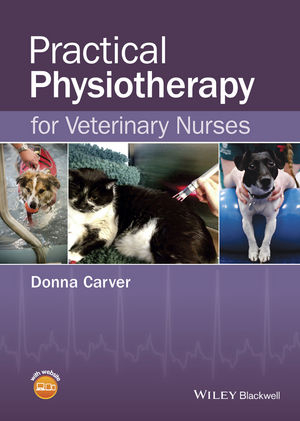
Practical Physiotherapy for Veterinary Nurses (eBook)
John Wiley & Sons (Verlag)
978-1-118-71134-7 (ISBN)
Reflecting a rapidly growing area of interest in veterinary practice, this practical, pocket-sized guide to small animal physiotherapy has been designed for quick reference, providing the ideal guide for busy practice veterinary nurses when they really need it.
- Reflects the need for a text in this rapidly growing area of interest, providing the first on this topic for veterinary nurses
- Designed in a pocket-sized format so that VNs can carry it around for quick reference
- The author has ideal experience for this field, having worked as both a veterinary nurse and an animal physiotherapist
- This book is accompanied by a companion website which contains videos and self-test questions and answers
Donna Carver BSc (Hons) Physiotherapy, Dip AVN (surg), RVN, MCSP
Donna works as part of the Pain and Rehabilitation service at The University of Glasgow, School of Veterinary Medicine, providing physiotherapy and hydrotherapy to small animals. She started her veterinary nursing career in small animal general practice. She has previously worked at the Royal (Dick) School of Veterinary Studies, Edinburgh, as a surgical veterinary nurse, and returning later as an animal physiotherapist/veterinary nurse. Donna is a member of the Chartered Society of Physiotherapy and has given numerous CPD seminars in physiotherapy and rehabilitation.
Reflecting a rapidly growing area of interest in veterinary practice, this practical, pocket-sized guide to small animal physiotherapy has been designed for quick reference, providing the ideal guide for busy practice veterinary nurses when they really need it. Reflects the need for a text in this rapidly growing area of interest, providing the first on this topic for veterinary nurses Designed in a pocket-sized format so that VNs can carry it around for quick reference The author has ideal experience for this field, having worked as both a veterinary nurse and an animal physiotherapist This book is accompanied by a companion website which contains videos and self-test questions and answers
Donna Carver BSc (Hons) Physiotherapy, Dip AVN (surg), RVN, MCSP Donna works as part of the Pain and Rehabilitation service at The University of Glasgow, School of Veterinary Medicine, providing physiotherapy and hydrotherapy to small animals. She started her veterinary nursing career in small animal general practice. She has previously worked at the Royal (Dick) School of Veterinary Studies, Edinburgh, as a surgical veterinary nurse, and returning later as an animal physiotherapist/veterinary nurse. Donna is a member of the Chartered Society of Physiotherapy and has given numerous CPD seminars in physiotherapy and rehabilitation.
Acknowledgements vii
About the companion website ix
1 Musculoskeletal physiotherapy 1
Introduction 1
Gait analysis 2
History taking 5
Physical examination 6
Exercise plans 7
Physiotherapy treatment techniques and modalities 8
Musculoskeletal presenting conditions 24
Pain management 75
Physiotherapy musculoskeletal assessment 79
Self-assessment questions 86
2 Neurology 89
Introduction 89
Surgical presenting conditions 91
Non-surgical presenting conditions 116
Medical neurological presenting conditions 125
Neurological assessment 136
Physiotherapy assessment for the neurology patient 142
Self-assessment questions 148
3 Respiratory physiotherapy 151
Introduction 151
Chest auscultation and interpretation 152
Percussion note technique and interpretation 153
Interpretation of blood gases 154
Respiratory failure 154
Cardiorespiratory monitoring 156
Electrocardiograms 158
Respiratory presenting conditions 160
Respiratory physiotherapy treatment techniques 164
Self-assessment questions 181
4 Hydrotherapy 185
Introduction 185
The aims of hydrotherapy 185
Pool chemistry 187
Properties of water 188
Hydrotherapy for specific conditions 189
Self-assessment questions 202
Appendices 205
Abbreviations 209
References 211
Self-assessment answers 213
Index 219
"The Practical Physiotherapy for Veterinary Nurses textbook is ideal for veterinary nurses working in small animal practice with an interest in physiotherapy for both medical and surgical patients." (The New Zealand Veterinary Nurse 2016)
"This book has several good points. Recommended rehabilitation is broken down into early phase (0 to 2 weeks), midphase (2 to 6 weeks), and late phase (6 to 12 weeks). It contains a nice review of respiratory therapy from a physical standpoint, a subject rarely tackled in other textbooks. Readers are reminded throughout the book to assess both subjective and objective outcome measures to evaluate the response and progression of therapy in individual patients. Communication and follow-up with the veterinary surgeon is also stressed." (Journal of the American Veterinary Medical Association 2016)
CHAPTER 1
Musculoskeletal physiotherapy
Introduction
Gait analysis or assessment is a skill that requires close observation of the patient at walk and trot, to determine the cause and location of the lameness. A start point is to become familiar with a normal gait pattern, taking into account breed variations (i.e. dachshund vs bull mastiff). Once you are familiar with normal gait pattern, any deviation from this can be recognised.
Animals should be on a loose lead at walk and trot to observe for anatomical symmetry (normal gait pattern). Animals should be observed in a straight line towards, and then a straight line away from the observer. Pay particular attention to how the animal turns to both the left and right side – this may show reluctance to transfer weight onto the affected limb, or that the animal has issues with balance. The observer should then view the animal moving from both left and right sides. Subtle lameness may not readily be observed at walking pace; however, at trot the animal will only have one thoracic limb and one pelvic limb in contact with the ground, and these limbs will be placed under greater pressure meaning a lameness may be easier to detect.
Videoing the gait pattern, then slowing it down on playback, may be a useful way to detect lameness.
Gait analysis
Observe muscle symmetry, weight-bearing (paw and toe position) and conformation at rest.
Observe gait in a quiet area at walk and trot; thoracic limb lameness is often associated with head bobbing. When the animal takes its bodyweight through the painful thoracic limb the head will bob upwards in an attempt to unload the ground reaction force passing through the limb.
Pelvic limb lameness can be observed by a hiking up in the gluteal region in an attempt to offload or shift weight from the painful limb; this may be towards the contralateral pelvic limb, or forwards usually towards the contralateral thoracic limb. Lameness in pelvic limbs may also present with a bunnyhopping gait pattern. This may be related to a reduction in pelvic limb power, often observed with stair climbing or running. The bunnyhopping gait pattern may also be related to a reduced range of motion within the coxofemoral joint, which would be confirmed on physical examination.
Lameness is a general term used to describe an abnormal gait pattern; it may be:
- Congenital – chondrodystrophic abnormalities, i.e. valgus (lateral deviation of the distal limb), often seen in dachshunds.
Or
- Pathological – related to a disease process such as osteoarthritis, which can affect any breed but is often seen in larger breeds.
Scoring systems are often used to grade the degree of lameness, and in veterinary practice a typical 1–10 scale is used where 1/10 would indicate barely lame, whereas 10/10 would indicate non-weight-bearing lameness. The scale is very subjective, as only descriptive terms are allocated to the very mildest and most severe lameness. If one observer rated lameness as 4/10, then a second observer may rate the same lameness as 6/10; does this indicate the lameness is progressing? This is why it is important to obtain a full and accurate history from the owner, who will probably observe the animal’s gait every day and be able to state if the lameness is improving, staying the same, or deteriorating. A simpler alternative scoring 0–5 system is available (Table 1.1).
Table 1.1 Lameness scoring scale.
From Summer-Smith (1993). Reproduced with permission from Elsevier.
| Score | Description |
| 0 | Normal |
| 1 | Reduced weight-bearing through affected limb in stance |
| 2 | Mild lameness at trot |
| 3 | Moderate lameness at walk and trot |
| 4 | Intermittently carries limb, lame in trot |
| 5 | Non-weight-bearing lameness |
Elbow dysplasia gait analysis findings include abduction of the affected limb in an attempt by the patient to reduce the amount of bodyweight passing through the elbow joint. This will be most evident when the animal is ambulating on hard ground as the concussive forces passing through the elbow joint will be greater.
Flicking of the carpal joints is also evident with elbow dysplasia; this is a compensatory mechanism for the reduced range of motion, especially elbow flexion, that is characteristic of advanced elbow dysplasia. The condition is often bilateral, so it is important to observe how the animal turns (weight transfer) and observe (or ask the owner about) functional activities such as how or if the animal is able to descend stairs or jump from the car; this will increase load on the elbow joint and will be uncomfortable for the animal so he may avoid these functional activities.
Hip dysplasia gait analysis findings may include a short stride length; this is usually shown as reduced hip extension and can be readily observed as the animal climbs stairs as a weak or short hip extension/push-off. The reduction in hip extension is a characteristic of hip dysplasia, with associated osteoarthritis and joint remodelling.
Adduction of the affected limb is also evident. This can be due to weakness in the hip flexor muscle groups, and may also be associated with secondary osteoarthritic changes and compensatory coxofemoral joint remodelling. As discussed earlier hiking up of the gluteals to shift bodyweight from the affected limb, and bunnyhopping with bilateral hip dysplasia are also gait characteristics observed with this disease.
Cruciate rupture patients usually present with an abnormal gait pattern. Lameness can vary from mild 1/5 (usually chronic) to 5/5 (usually acute). The degree of lameness often correlates with the level of pain the animal is experiencing. A short stride length, especially reduced extension, is evident; also the animal will tend to limit stifle flexion. The animal will usually guard or resent stifle end-of-range flexion. Clicking of the joint may be evident and may indicate associated meniscal damage; this may be evident when the animal flexes the stifle joint, and loads the joint with bodyweight, such as in stair climbing. In acute presentation a joint effusion may be present. In chronic presentations thickening of the joint on the medial surface often with a tibial buttress is common. Stifle range of motion (ROM) is reduced as a result of scar tissue formation and secondary osteoarthritic changes.
The animal may abduct the limb to alter the direction of ground reaction forces passing through the joint, and if there is fatigue or weakness in the hip flexor muscle groups.
The animal will be reluctant to fully weight-bear through the affected limb; at rest, toe touch weight-bearing is often evident; the animal may also adopt various strategies to reduce weight-bearing in stance and will often position the affected limb in a cranio-medial plane.
The long-term muscle changes associated with pelvic limb lameness are short, tight hip flexor muscles, with, weak hamstring muscles. The goal for the physiotherapist is to stretch the short, tight muscles, whilst strengthening the weak, muscles.
History taking
This should include:
- Age – Young dogs: When taking a history consider hip dysplasia, elbow dysplasia, oesteochondrosis dissecans (OCD).
Adult dogs: Consider osteoarthritis, cruciate disease and neoplasia.
- Breed – Toy breed: Often show patella luxation, Legg–Calvé–Perthes disease.
Large breed: May present with cruciate disease, elbow dysplasia, neoplasia.
- Onset of lameness:
- May be sudden or subtle or traumatic.
- Can be episodic or cyclic.
- Is it consistently the same limb or a shifting lameness?
- Duration of lameness:
- Can be continuous or intermittent.
- Is the patient’s condition deteriorating, remaining static or improving?
- Association:
- Does exercise or rest effect the condition?
- Does the patient appear worse in the morning or night?
- Is there a seasonal pattern when symptoms are seen in summer or winter?
- Does soft or hard ground affect the severity of symptoms?
- Behavioural changes:
- Is the patient showing aggression?
- Does the patient have sleep disturbance?
- Is the patient reluctant to play/jump?
- Exercise – Ask about type, frequency and duration.
- Response to treatment:
- Is the patient on any medication, has this made any difference?
- Has the patient had any previous physiotherapy treatment? If so what was the response or outcome?
- Explore the owner’s expectations of physiotherapy.
Physical examination
When assisting with a physical examination try to find a quiet area. Adopt a...
| Erscheint lt. Verlag | 8.9.2015 |
|---|---|
| Sprache | englisch |
| Themenwelt | Medizin / Pharmazie |
| Veterinärmedizin ► Allgemein ► Tiermedizinische Fachangestellte | |
| Schlagworte | Complementary Veterinary Medicine • <p>Physiotherapy, rehabilitation, canine, feline, cat, dog, small animal, veterinary nurses, veterinary technicians, gait analysis, Physical examination, Physiotherapy treatment techniques, Pain management, musculoskeletal assessment, Neurology, Physiotherapy treatment plans, Physiotherapy patient assessment, Cardio respiratory monitoring, electrocardiograms, ECGs, Respiratory physiotherapy, Hydrotherapy.</p> • Pflege • Pflege i. d. Veterinärmedizin • Pflege i. d. Veterinärmedizin • Physiotherapie • Tierarzthelfer • Veterinärmedizin • Veterinärmedizin / ergänzende Heilmethoden • Veterinärmedizin / Hunde u. Katzen • Veterinärmedizin • Veterinärmedizin / ergänzende Heilmethoden • Veterinärmedizin / Hunde u. Katzen • Veterinary Medicine • Veterinary Medicine - Dogs & Cats • Veterinary Nursing & Animal Care |
| ISBN-10 | 1-118-71134-3 / 1118711343 |
| ISBN-13 | 978-1-118-71134-7 / 9781118711347 |
| Informationen gemäß Produktsicherheitsverordnung (GPSR) | |
| Haben Sie eine Frage zum Produkt? |
 EPUB (Adobe DRM)
Kopierschutz: Adobe-DRM
Adobe-DRM ist ein Kopierschutz, der das eBook vor Mißbrauch schützen soll. Dabei wird das eBook bereits beim Download auf Ihre persönliche Adobe-ID autorisiert. Lesen können Sie das eBook dann nur auf den Geräten, welche ebenfalls auf Ihre Adobe-ID registriert sind.
Details zum Adobe-DRM
Dateiformat: EPUB (Electronic Publication)
EPUB ist ein offener Standard für eBooks und eignet sich besonders zur Darstellung von Belletristik und Sachbüchern. Der Fließtext wird dynamisch an die Display- und Schriftgröße angepasst. Auch für mobile Lesegeräte ist EPUB daher gut geeignet.
Systemvoraussetzungen:
PC/Mac: Mit einem PC oder Mac können Sie dieses eBook lesen. Sie benötigen eine
eReader: Dieses eBook kann mit (fast) allen eBook-Readern gelesen werden. Mit dem amazon-Kindle ist es aber nicht kompatibel.
Smartphone/Tablet: Egal ob Apple oder Android, dieses eBook können Sie lesen. Sie benötigen eine
Geräteliste und zusätzliche Hinweise
Buying eBooks from abroad
For tax law reasons we can sell eBooks just within Germany and Switzerland. Regrettably we cannot fulfill eBook-orders from other countries.


