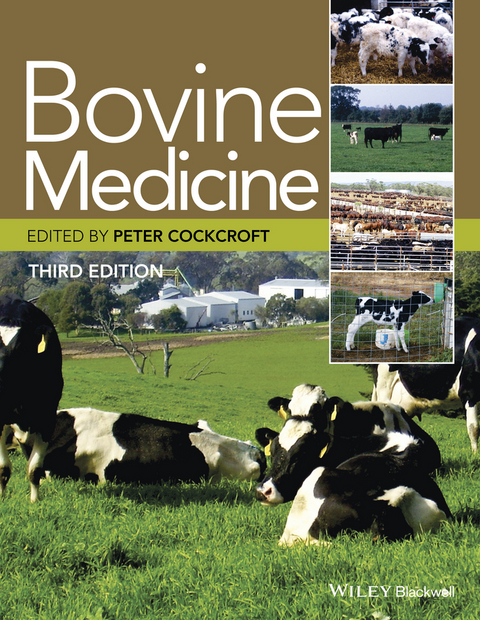
Bovine Medicine (eBook)
John Wiley & Sons (Verlag)
978-1-118-94854-5 (ISBN)
- New edition of a classic text, featuring thoroughly rewritten text, with coverage shifted to the core aspects of everyday cattle practice
- Includes new focus on both applied skills and application of knowledge, along with many more full-colour illustrations than in previous editions
- Represents a toolkit of skills that will support the delivery of contemporary cattle practice
- Presents a seamless integration of information on husbandry, nutrition, and disease
- Written by a wide range of experts from around the world
Peter Cockcroft is Professor of Ruminant Health at the School of Animal and Veterinary Sciences, University of Adelaide, Australia. He has a Diploma in Cattle Health and Production from the Royal College of Veterinary Surgeons and is a Diplomate of the European College of Bovine Health Management. He is European College Veterinary Specialist in Bovine Health Management. Peter has published extensively in the field of bovine medicine and is known for his work in evidence-based veterinary practice.
Peter Cockcroft is Professor of Ruminant Health at the School of Animal and Veterinary Sciences, University of Adelaide, Australia. He has a Diploma in Cattle Health and Production from the Royal College of Veterinary Surgeons and is a Diplomate of the European College of Bovine Health Management. He is European College Veterinary Specialist in Bovine Health Management. Peter has published extensively in the field of bovine medicine and is known for his work in evidence-based veterinary practice.
"This book will be an asset to veterinarians who work with cattle." (Journal of the American Veterinary Medical Association, 15 September 2015)
Chapter 1
Sustainability and One Health
Judith L. Capper
Learning objectives
- Understand future demands for food production and the need for sustainability.
- Appreciate the global impact of bovine production.
- Be aware of the opportunities for mitigation.
- Understand the environmental impacts and public perception.
- Appreciate the role of the veterinarian/animal scientist and future developments.
Introduction
The sustainability of global bovine production systems is currently one of the most highly debated issues relating to food production. Ruminant livestock provide high-quality animal-source foods in conjunction with a myriad of associated economic and social benefits to communities worldwide. Nonetheless, the question is often raised as to whether the consumption of milk and meat is inherently unsustainable.
Sustainability was defined within the Brundtland Report (United Nations World Commission on Environment & Development, 1987) as: ‘meeting the needs of the present without compromising the ability of future generations to meet their own needs’, and this remains the most commonly used definition, implying the need to use resources at rates that do not exceed the earth's capacity to replenish them, while ensuring human food security. 870 million people are currently considered to be food-insecure on a global basis (Food & Agriculture Organisation of the United Nations, 2012), so global food production could be argued to be unsustainable as per the first half of the definition.
Nonetheless, a sustainable food system is not simply dependent upon producing sufficient food but upon delivering and marketing food through an efficient infrastructure with minimal waste. The political and logistical challenges associated with food provision to currently food-insecure populations are beyond the scale of this chapter, so discussion will be confined to the three pillars of sustainability (i.e. economic viability, social responsibility and particularly environmental stewardship), as these relate to bovine production systems.
Within any production system, a balance must exist between environmental stewardship, economic viability and social responsibility; if one of these factors is out of alignment, the system cannot achieve long-term sustainability. For example, the use of hormone implants to improve productivity within US beef production has positive economic and environmental effects (Capper & Hayes, 2012), yet such technologies are not registered for use within the European Union and, as such, are socially unacceptable (Lusk et al., 2003). No ‘magic bullet’ or suite of production practices exists to achieve global sustainability; individual production systems must be tailored to the resources, climate and culture indigenous to that region and to potential export markets. However, there is no doubt that prevailing global consumer and policy-maker concerns regarding the environmental sustainability of bovine production will have considerable effects on future production systems.
The global population is predicted to plateau at over 9.5 billion people in the year 2050 (Food & Agriculture Organisation of the United Nations, 2009) with disproportionate increases in population growth in the developing world. Concurrent increases in the per capita income within China, India and Africa over this time period will result in considerable increases in animal-source food consumption within currently impoverished nations and a projected 70% increase in global food requirements (Food & Agriculture Organisation of the United Nations, 2009; Masuda & Goldsmith, 2010).
The challenge facing global bovine production is to supply the growing population with sufficient economically affordable milk and meat products to maintain dietary choice and human health while minimising environmental impact through reductions in both resource use and waste output. This challenge has myriad implications at the regional level, many of which are dependent on the current state of agricultural research and technology adoption. Despite the highly developed nature of the UK agricultural production system, Leaver (2009) notes that significant investment in research and development, and a greater collaboration between agricultural practice and science, are required in order to meet the rising demand for food in the UK (predicted to increase by 25% over the next 50 years) and to remain competitive on the global market.
What is the global impact of bovine production?
Discussion of animal agriculture's environmental impact is often restricted to greenhouse gas (GHG) emissions. Under the Climate Change Act of 2008, the UK government made a legally binding commitment to reduce GHG emissions by 80% by the year 2050, including a 11% reduction in GHG emissions (based on 2008 emissions) from agriculture by 2020 (HM Government, 2008), underlining the significant political concerns relating to this issue. However, resource scarcity (specifically water, land, inorganic fertilisers and fossil fuels) may be argued to have a greater immediate effect upon food production than climate change. Dairy and beef production also have a variety of direct environmental impacts (including positive and negative effects upon water and air quality, nutrient leaching, soil erosion and biodiversity) that should be included in environmental assessments. Nonetheless, the majority of studies to date have concentrated on GHG as the sole arbiter of environmental impact, so therefore GHG will be assumed to be a valid proxy for environmental effects in the following discussion, unless otherwise stated.
Global GHG emissions from agriculture were estimated by Bellarby et al. (2008) to account for between 17% and 32% of all human-induced emissions, with a recent report by the FAO (Food & Agriculture Organisation of the United Nations, 2006), concluding that animal agriculture contributes 18% of GHG emissions. In conjunction with estimates citing animal agriculture's contribution at up to 51% (Goodland & Anhang, 2009), these data have been eagerly adopted by activist groups as evidence for the benefits of a vegetarian or vegan lifestyle (Environmental Working Group, 2011). Due to methodological flaws, the 18% figure cited by the FAO is considered to be an overestimate (Pitesky et al., 2009). Nonetheless, ruminant production systems make a significant contribution to total GHG emissions and resource use, due to having relatively less efficient feed conversion than their monogastric cohorts.
Dairy production accounts for approximately 2.7% of worldwide GHG emissions, with average emissions of 2.4 kg CO2-eq/kg FPCM (fat and protein-corrected milk) at the farm gate (Food & Agriculture Organisation of the United Nations, 2010). Nonetheless, significant regional variation exists, with emissions ranging from 1.3 CO2-eq/kg FPCM in North America to 7.5 kg CO2-eq/kg FPCM in sub-Saharan Africa. Plotting average FPC milk yield against carbon footprint reveals a negative correlation - as production intensity and milk yield decrease with a regional shift from the developed to the developing world, GHG emissions increase (Figure 1.1).
Figure 1.1 Relationship between average annual milk yield and greenhouse gas emissions per unit of milk on a regional and global basis.
Similar effects of productivity upon GHG emissions would be predicted for global beef production, yet are not borne out by comparisons among studies (Figure 1.2). These exhibit considerable methodological variation, and show that intensive systems have GHG emissions per kg beef ranging from 9.9–36.4 kg CO2-eq, compared with extensive systems at 12.0–44.0 kg CO2-eq/kg beef (Capper, 2011b; Cederberg et al., 2011; Ogino et al., 2004; Peters et al., 2010).
Figure 1.2 Regional and production system (intensive vs. extensive) variation in greenhouse gas emissions per unit of beef.
Within both dairy and beef production, the environmental mitigation effect of improved productivity is conferred by the ‘dilution of maintenance’ concept, as shown in Figure 1.3 (Capper, 2011a; Capper et al., 2008).
Figure 1.3 An example of the dilution of maintenance effect – comparing US beef production in 1977 and 2007.
Every animal in the dairy or beef herd has a daily maintenance nutrient requirement that can be considered as a proxy for resource use and GHG emissions. As productivity (milk yield, meat yield or growth rate) increases, the proportion of daily energy allocated to maintenance decreases and the maintenance requirement of the total animal population decreases. This is exemplified by comparing the US dairy industries in 1944 and 2007: a four-fold increase in milk yield per cow over this time period reduced the national dairy herd from 25.6 million to 9.2 million cattle, with a concurrent 59% increase in milk production (53 billion kg in 1944 vs. 84 billion kg in 2007). This reduced feed use by 77%, land use by 90%, water use by 65% and conferred a 63% decrease in GHG emissions per kg of milk (Capper et al., 2009). Similarly, if growth rate is increased in beef cattle, the population maintenance requirement is reduced because cattle take fewer days to reach slaughter weight. Considerable reductions in feed (19%), land (33%), water (12%) and GHG emissions (16%) were demonstrated by...
| Erscheint lt. Verlag | 10.4.2015 |
|---|---|
| Sprache | englisch |
| Themenwelt | Medizin / Pharmazie |
| Veterinärmedizin ► Großtier ► Rind | |
| Schlagworte | Bovine medicine, cattle health, animal husbandry, animal nutrition, animal disease, bovine health, large animal veterinarian, cattle practitioner • Kuh • Rinderkrankheit • Veterinärmedizin • Veterinärmedizin f. Nutztiere • Veterinärmedizin • Veterinärmedizin f. Nutztiere • Veterinary Medicine • Veterinary Medicine - Farm Animals |
| ISBN-10 | 1-118-94854-8 / 1118948548 |
| ISBN-13 | 978-1-118-94854-5 / 9781118948545 |
| Informationen gemäß Produktsicherheitsverordnung (GPSR) | |
| Haben Sie eine Frage zum Produkt? |
 EPUB (Adobe DRM)
Kopierschutz: Adobe-DRM
Adobe-DRM ist ein Kopierschutz, der das eBook vor Mißbrauch schützen soll. Dabei wird das eBook bereits beim Download auf Ihre persönliche Adobe-ID autorisiert. Lesen können Sie das eBook dann nur auf den Geräten, welche ebenfalls auf Ihre Adobe-ID registriert sind.
Details zum Adobe-DRM
Dateiformat: EPUB (Electronic Publication)
EPUB ist ein offener Standard für eBooks und eignet sich besonders zur Darstellung von Belletristik und Sachbüchern. Der Fließtext wird dynamisch an die Display- und Schriftgröße angepasst. Auch für mobile Lesegeräte ist EPUB daher gut geeignet.
Systemvoraussetzungen:
PC/Mac: Mit einem PC oder Mac können Sie dieses eBook lesen. Sie benötigen eine
eReader: Dieses eBook kann mit (fast) allen eBook-Readern gelesen werden. Mit dem amazon-Kindle ist es aber nicht kompatibel.
Smartphone/Tablet: Egal ob Apple oder Android, dieses eBook können Sie lesen. Sie benötigen eine
Geräteliste und zusätzliche Hinweise
Buying eBooks from abroad
For tax law reasons we can sell eBooks just within Germany and Switzerland. Regrettably we cannot fulfill eBook-orders from other countries.
aus dem Bereich