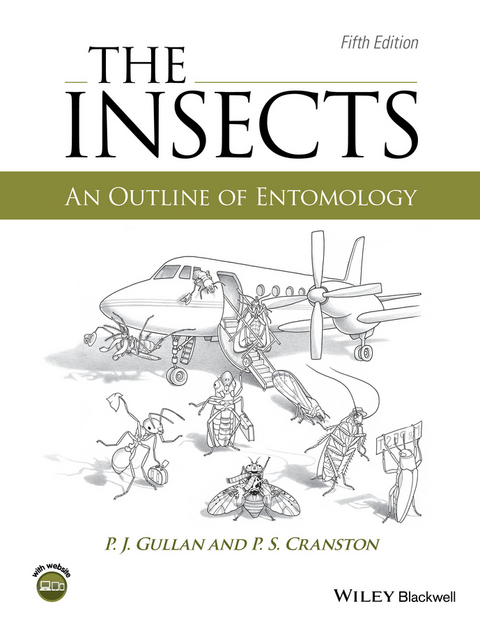
The Insects (eBook)
John Wiley & Sons (Verlag)
978-1-118-84616-2 (ISBN)
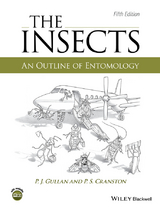
Insects represent over half of the planet's biological diversity. This popular textbook provides a comprehensive introduction to this extraordinary diversity, and places entomology central to the theory and practice of evolutionary and ecological studies.
Fully revised, this fifth edition opens with a chapter concerning the popular side of insect studies, including insects in citizen science, zoos and butterfly houses, and insects as food for humans and animals. Key features of insect
structure, function, behaviour, ecology and classification are integrated with appropriate molecular studies. Much of the book is organized around major biological themes: living on the ground, in water, on plants, in colonies, and as predators, parasites/parasitoids and prey insects. A strong evolutionary theme is maintained throughout.
There is major revision to the chapter on systematics and a new chapter, Insects in a Changing World, includes insect responses to, and the consequences of, both climate change and human-assisted global alterations to distributions. Updated 'Taxoboxes' demonstrate topical issues and provide concise information on all aspects of each of the 28 major groupings (orders) of insects, plus the three orders of non-insect hexapods. New boxes describe a worrying increase in insect threats to landscape and commercial trees (including eucalypts, palms and coffee) and explain the value of genetic data, including evolutionary developmental biology and DNA barcoding, in insect biodiversity studies.
The authors maintain the clarity and conciseness of earlier editions, and extend the profuse illustrations with new hand-drawn figures. Over 50 colour photographs, together with the informative text and an accompanying website with links to video clips, appendices, textboxes and further reading lists, encourage a deeper scientific study of insects. The book is intended as the principal text for students studying entomology, as well as a reference text for undergraduate and graduate courses in the fields of ecology, agriculture, fisheries and forestry, palaeontology, zoology, and medical and veterinary science.
Penny Gullan and Peter Cranston are adjunct professors in Evolution, Ecology and Genetics, in the Research School of Biology, The Australian National University, Canberra, Australia, where they conduct research on the biodiversity and systematics of Coccoidea and Chironomidae, respectively. Both maintain emeritus connections with the Department of Entomology and Nematology, University of California, Davis, USA.
Insects represent over half of the planet s biological diversity. This popular textbook provides a comprehensive introduction to this extraordinary diversity, and places entomology central to the theory and practice of evolutionary and ecological studies. Fully revised, this fifth edition opens with a chapter concerning the popular side of insect studies, including insects in citizen science, zoos and butterfly houses, and insects as food for humans and animals. Key features of insect structure, function, behaviour, ecology and classification are integrated with appropriate molecular studies. Much of the book is organized around major biological themes: living on the ground, in water, on plants, in colonies, and as predators, parasites/parasitoids and prey insects. A strong evolutionary theme is maintained throughout. There is major revision to the chapter on systematics and a new chapter, Insects in a Changing World, includes insect responses to, and the consequences of, both climate change and human-assisted global alterations to distributions. Updated Taxoboxes demonstrate topical issues and provide concise information on all aspects of each of the 28 major groupings (orders) of insects, plus the three orders of non-insect hexapods. New boxes describe a worrying increase in insect threats to landscape and commercial trees (including eucalypts, palms and coffee) and explain the value of genetic data, including evolutionary developmental biology and DNA barcoding, in insect biodiversity studies. The authors maintain the clarity and conciseness of earlier editions, and extend the profuse illustrations with new hand-drawn figures. Over 50 colour photographs, together with the informative text and an accompanying website with links to video clips, appendices, textboxes and further reading lists, encourage a deeper scientific study of insects. The book is intended as the principal text for students studying entomology, as well as a reference text for undergraduate and graduate courses in the fields of ecology, agriculture, fisheries and forestry, palaeontology, zoology, and medical and veterinary science.
Penny Gullan and Peter Cranston are adjunct professors in Evolution, Ecology and Genetics, in the Research School of Biology, The Australian National University, Canberra, Australia, where they conduct research on the biodiversity and systematics of Coccoidea and Chironomidae, respectively. Both maintain emeritus connections with the Department of Entomology and Nematology, University of California, Davis, USA.
"Overall I am delighted to see that the 5th edition of this textbook has retained the format and style that so attracted me to entomology some 20 years ago. At the same time, each edition, and the 5th edition is no exception in this, has responded to developments in technology and concerns that drive the field of entomology. I am delighted to see that I will have no hesitation in recommending the latest edition of this textbook to our students." (Antenna, 1 January 2015)
"Penny Gullan and Peter Cranston have recently produced a revised fifth version of their text, maintaining much of the structure and style of the former editions, but significantly updating the information and adding a chapter on human-mediated changes in insect distributions; i.e. global climate change, globalized commerce, and invasive insects. . . The book is supported by a companion website that includes Powerpoint versions of all illustrations and PDFs of all tables, thereby aiding lecture development. By significantly updating the information presented in the book, the authors amply illustrate the dynamic nature of Entomology. Insects can capture the imagination of new students, but showing those students that Entomology can sustain an exciting life is the means to recruit the ablest minds to our discipline. This book is an excellent ambassador to that pursuit." (Cornell University Insect Collection, 8 December 2014)
"Gullan and Cranston's fifth edition is a textbook that should be on every entomologist's shelf. I also highly recommend this exemplary book to instructors teaching insect biology and related courses, and any student interested in the life sciences. The remarkable range of content, coupled with the resources to support learning,is exceptional. It is a comprehensive introduction to insect science that keeps the pace with a dynamic, diverse, and fast-moving field." (American Entomologist 2016)
List of Colour Plates
Plate 1
- An atlas moth, Attacus atlas (Lepidoptera: Saturniidae), one of the largest of all lepidopterans, with a wingspan of about 24 cm and a larger wing area than any other moth; southern India and Southeast Asia (P.J. Gullan).
- The moon moth, Argema maenas (Lepidoptera: Saturniidae), is found in Southeast Asia and India; this female, from rainforest in Borneo, has a wingspan of about 15 cm (P.J. Gullan).
- Lord Howe Island stick-insect, Dryococelus australis (Phasmatodea: Phasmatidae), Lord Howe Island, Pacific Ocean, Australia (N. Carlile).
- A female of the Stephens Island giant weta, Deinacrida rugosa (Orthoptera: Anostostomatidae), Mana Island, New Zealand (G.H. Sherley; courtesy of New Zealand Department of Conservation).
- A Richmond birdwing, Ornithoptera richmondia (Lepidoptera: Papilionidae), and its cast pupal exuviae on a native pipevine (Pararistolochia sp.), eastern Australia (D.P.A. Sands).
- Owl butterfly, Caligo memnon, with two common morpho butterflies, Morpho peleides (both Nymphalidae), Cali Zoo, Colombia (P.J. Gullan).
- A cage of butterfly pupae awaiting eclosion, Penang Butterfly Farm, Malaysia (P.J. Gullan).
Plate 2
- Palm weevil grubs, Rhynchophorus ferrugineus (Coleoptera: Curculionidae), reared for human consumption from ground palm mash and pig pellets, Thailand (M.S. Hoddle).
- A “worm” or “phane”–the caterpillar of Gonimbrasia belina (Lepidoptera: Saturnidae)–feeding on the foliage of Schotia brachypetala, Limpopo Province, South Africa (R.G. Oberprieler).
- Witchety (witjuti) grub, a larva of Endoxyla (Lepidoptera: Cossidae) from a desert Acacia tree, Flinders Ranges, South Australia (P. Zborowski).
- Food insects at a market stall displaying silk-moth pupae (Bombyx mori), beetle pupae, and adult hydrophiloid beetles and water bugs (Lethocerus indicus), Lampang Province, northern Thailand (R.W. Sites).
- A dish of edible water bugs, Lethocerus indicus (Hemiptera: Belostomatidae), Lampang Province, northern Thailand (R.W. Sites).
- Edible stink bugs (Hemiptera: Tessaratomidae), at an insect market, Thailand (A.L. Yen).
- Repletes (see Fig. 2.4) of the honeypot ant, Camponotus inflatus (Hymenoptera: Formicidae), on an Aboriginal wooden dish, Northern Territory, Australia (A.L. Yen).
- Repletes of the honeypot ant, Camponotus inflatus, Northern Territory, Australia (A.L. Yen).
Plate 3
- A tropical butterfly, the five-bar swordtail, Graphium antiphates (Lepidoptera: Papilionidae), obtaining salts by imbibing sweat from a training shoe, Borneo (P.J. Gullan).
- A female katydid of an undescribed species of Austrosalomona (Orthoptera: Tettigoniidae), with a large spermatophore attached to her genital opening, northern Australia (D.C.F. Rentz).
- Pupa of a Christmas beetle, Anoplognathus sp. (Coleoptera: Scarabaeidae), removed from its pupation site in the soil, Canberra, Australia (P.J. Gullan).
- A teneral (newly moulted) giant burrowing cockroach, Macropanesthia rhinoceris (Blattodea: Blaberidae), Queensland, Australia (M.D. Crisp).
- Egg mass of Tenodera australasiae (Mantodea: Mantidae) with young mantid nymphs emerging, Queensland, Australia (D.C.F. Rentz).
- Eclosing (moulting) adult katydid of an Elephantodeta species (Orthoptera: Tettigoniidae), Northern Territory, Australia (D.C.F. Rentz).
- Overwintering monarch butterflies, Danaus plexippus (Lepidoptera: Nymphalidae), Mill Valley, California, USA (D.C.F. Rentz).
Plate 4
- A fossilized worker ant of Pseudomyrmex oryctus (Hymenoptera: Formicidae) in Dominican amber from the Miocene (P.S. Ward).
- Female (long snout) and male (short snout) of the cycad weevil, Antliarhinus zamiae (Coleoptera: Curculionidae), on seeds of Encephalartos altensteinii (Zamiaceae), South Africa (P.J. Gullan).
- The common milkweed grasshopper, Phymateus morbillosus (Orthoptera: Pyrgomorphidae), for which bright colours advertise toxicity acquired by feeding on milkweed foliage, Northern Cape, South Africa (P.J. Gullan).
- Mine of a scribbly gum moth, Ogmograptis racemosa (Lepidoptera: Bucculatricidae), on trunk of Eucalyptus racemosa, New South Wales, Australia (P.J. Gullan).
- Euglossine bees (Hymenoptera: Apidae: Euglossini) collecting fragrances from spadix of Anthurium sp. (Araceae), Ecuador (P.J. Gullan).
- A bush coconut or bloodwood apple gall of Cystococcus pomiformis (Hemiptera: Eriococcidae), cut open to show the cream-coloured adult female and her numerous, tiny nymphal male offspring covering the gall wall, northern Australia (P.J. Gullan).
- Close-up of the second-instar male nymphs of C. pomiformis feeding from the nutritive tissue lining the cavity of the maternal gall, northern Australia (P.J. Gullan).
Plate 5
- Coccoid-induced gall of Apiomorpha pharetrata (Hemiptera: Eriococcidae): dark compound gall of males attached to green gall of female, with ants collecting honeydew at orifice of female's gall, eastern Australia (P.J. Gullan).
- Aphid-induced galls of Baizongia pistaciae (Hemiptera: Aphididae: Fordinae) on turpentine tree, Pistacia teredinthus, Bulgaria (P.J. Gullan).
- Rose bedeguar gall of Diplolepis rosae (Hymenoptera: Cynipidae) on Rosa sp. (wild rose), Bulgaria (P.J. Gullan).
- A female thynnine wasp of Zaspilothynnus trilobatus (Hymenoptera: Tiphiidae) (on right) compared with flower of the sexually deceptive orchid Drakaea glyptodon, which attracts pollinating male wasps by mimicking the female wasp, Western Australia (R. Peakall).
- A male thynnine wasp of Neozeleboria cryptoides (Hymenoptera: Tiphiidae) attempting to copulate with the sexually-deceptive orchid Chiloglottis trapeziformis, Australian Capital Territory (R. Peakall).
- Myophily—pollination of mango flowers by a flesh fly, Australopierretia australis (Diptera: Sarcophagidae), northern Australia (D.L. Anderson).
- Hummingbird hawk moth, Macroglossum stellatarum (Lepidoptera: Sphingidae), on a thistle, Bulgaria (P.J. Gullan).
- Honey bee, Apis mellifera (Hymenoptera: Apidae), pollinating a passion flower, Passiflora edulis, Colombia (T. Kondo).
Plate 6
- Ovipositing parasitic wasps (Hymenoptera): a eurytomid (Eurytomidae, top) and cynipid (Cynipidae, right), on an oak apple gall on Quercus, Illinois, USA (A.L. Wild).
- Weaver ants, Oecophylla smaragdina (Hymenoptera: Formicidae), tending Rastococcus mealybugs (Hemiptera: Pseudococcidae), Thailand (T. Kondo).
- The huge queen termite (approx. 7.5 cm long) of Odontotermes transvaalensis (Blattodea: Termitoidae: Termitidae: Macrotermitinae) surrounded by her king (mid front), soldiers and workers, South Africa (the late J.A.L. Watson).
- A parasitic Varroa mite on a pupa of Apis cerana (Hymenoptera: Apidae) in a hive, Irian Jaya, New Guinea (D.L. Anderson).
- Ant (Hymenoptera: Formicidae) interactions: the smaller Argentine ant (Linepithema humile) attacks the much larger red imported fire ant (Solenopsis invicta), Austin, Texas, USA (A.L. Wild).
- An egg-parasitoid wasp, Telenomus sp. (Hymenoptera: Scelionidae), oviposits into an egg of an owl butterfly, Caligo sp. (Lepidoptera: Nymphalidae), Belize (A.L. Wild).
Plate 7
- A cryptic grasshopper, Calliptamus sp. (Orthoptera: Acrididae), Bulgaria (T. Kondo).
- A camouflaged late-instar caterpillar of Plesanemma fucata (Lepidoptera: Geometridae) resting on a eucalypt leaf so that its red dorsal line resembles the leaf midrib, eastern Australia (P.J. Gullan).
- A female webspinner of Antipaluria urichi (Embioptera: Clothodidae) defending the entrance of her gallery from an approaching male, Trinidad (J.S. Edgerly-Rooks).
- A snake-mimicking caterpillar of the spicebush swallowtail, Papilio troilus (Lepidoptera: Papilionidae), New Jersey, USA (D.C.F. Rentz).
- An adult moth of Utetheisa ornatrix (Lepidoptera: Arctiidae) emitting defensive froth containing pyrrolizidine alkaloids sequestered by larval feeding on Crotalaria (Fabaceae) (the late T. Eisner).
- A blister beetle, Lytta polita (Coleoptera: Meloidae), reflex-bleeding from the knee joints; the haemolymph contains the toxin cantharidin (the late T....
| Erscheint lt. Verlag | 26.8.2014 |
|---|---|
| Sprache | englisch |
| Themenwelt | Naturwissenschaften ► Biologie ► Zoologie |
| Technik | |
| Veterinärmedizin | |
| Schlagworte | Agriculture • Ãkologie / Tiere • Animal ecology • Biowissenschaften • Central • Citizen • Comprehensive • Diversity • Edition • Entomologie • Entomology • extraordinary • Fifth • Half • insect • Insects • insects represent • Insekten • Introduction • Landwirtschaft • Life Sciences • Ökologie / Tiere • opens • Pests, Diseases & Weeds • Places • planets biological • Popular • Practice • Schädlinge, Krankheiten u. Unkräuter • Schädlinge, Krankheiten u. Unkräuter • Side • Studies • Textbook • theory |
| ISBN-10 | 1-118-84616-8 / 1118846168 |
| ISBN-13 | 978-1-118-84616-2 / 9781118846162 |
| Informationen gemäß Produktsicherheitsverordnung (GPSR) | |
| Haben Sie eine Frage zum Produkt? |
 EPUB (Adobe DRM)
Kopierschutz: Adobe-DRM
Adobe-DRM ist ein Kopierschutz, der das eBook vor Mißbrauch schützen soll. Dabei wird das eBook bereits beim Download auf Ihre persönliche Adobe-ID autorisiert. Lesen können Sie das eBook dann nur auf den Geräten, welche ebenfalls auf Ihre Adobe-ID registriert sind.
Details zum Adobe-DRM
Dateiformat: EPUB (Electronic Publication)
EPUB ist ein offener Standard für eBooks und eignet sich besonders zur Darstellung von Belletristik und Sachbüchern. Der Fließtext wird dynamisch an die Display- und Schriftgröße angepasst. Auch für mobile Lesegeräte ist EPUB daher gut geeignet.
Systemvoraussetzungen:
PC/Mac: Mit einem PC oder Mac können Sie dieses eBook lesen. Sie benötigen eine
eReader: Dieses eBook kann mit (fast) allen eBook-Readern gelesen werden. Mit dem amazon-Kindle ist es aber nicht kompatibel.
Smartphone/Tablet: Egal ob Apple oder Android, dieses eBook können Sie lesen. Sie benötigen eine
Geräteliste und zusätzliche Hinweise
Buying eBooks from abroad
For tax law reasons we can sell eBooks just within Germany and Switzerland. Regrettably we cannot fulfill eBook-orders from other countries.
aus dem Bereich