Major Issues in International Construction Law (eBook)
746 Seiten
Wiley (Verlag)
978-1-394-27916-6 (ISBN)
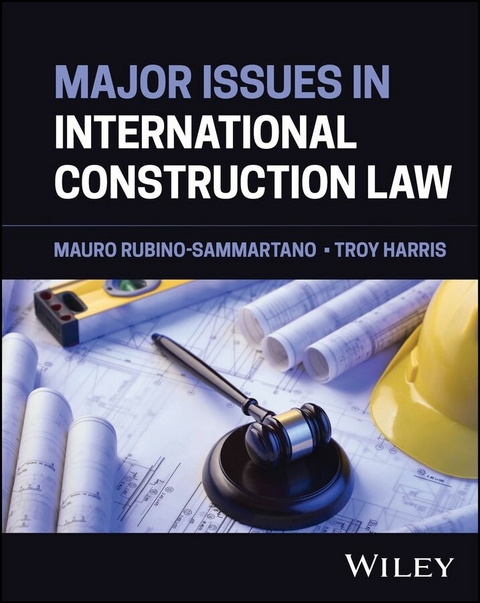
Comprehensive guide to navigating the major issues that arise in international construction projects, featuring contributions from leading international practitioners
Major Issues in International Construction Law is an edited volume devoted to the major issues that arise in international construction, covering the project from its inception and design to procurement of goods and services to execution, closeout, and dispute resolution. As such, the book enables readers around the world to identify and address the many unique issues that may arise during these various stages of the construction process.
Each chapter features contributions from leading practitioners around the world who regularly practice in the field, allowing for the representation of diverse points of view (common law, civil law, public, private, etc.). The text features succinct, practice-oriented summaries at the beginning of each chapter, as well as valuable key takeaways and coverage of the UN Sustainable Development Goals throughout.
Major Issues in International Construction Law includes information on:
- Project delivery methods, including design-bid-build, design-build, multiple prime, turnkey, public private partnerships, alliancing, and partnering
- Payment issues, covering lump sum, cost-plus, and unit pricing, statutory holdback, liens, and payment security
- Construction contract parties, covering owners, contractors, designers, engineers, subcontractors, insurers, guarantors, and banks
- Insurance, covering builder's risk, general liability, and political risk
- Paths to the prevention of claims, including NEC early warnings and risk registers, project meetings, and design professional determinations
Major Issues in International Construction Law is an excellent reference for construction law practitioners involved in cross-border transactions or disputes. Academics who teach construction law or construction management will also find the text valuable.
Mauro Rubino-Sammartano is an Italian attorney at law who has also been a member of the Paris Bar, an associate tenant of the Littleton set of chambers in London and a Chartered Arbitrator. He has been during his very long professional life a researcher and teacher on arbitration and construction and has published extensively on both subjects in English, French and Italian.
Troy Harris is Principal at Harris Arbitration and Professor of Law at the University of Detroit Mercy School of Law. He is a Fellow of the Chartered Institute of Arbitrators and is admitted to the Michigan and Ontario bars.
Chapter 1
The International Construction Contract
Mauro Rubino-Sammartano*
Introduction
A study of the major issues in international construction inevitably starts with an analysis of the construction contract, which is the center of the construction project and is dominated by contract law.
This study is even more relevant when a contract contains a foreign element, what in large projects may derive from various sources such as the nationality of the parties and the operational center of the contractor’s activities vis-a-vis the site of the works. International Construction Contract might be by itself a monograph. Being just one chapter of the book, it must focus on highlighting its key aspects.
Notion
The general definition of a construction contract is a contract by which one party (the Contractor) agrees to carry out building or engineering works for another party (the Owner or Employer) for a consideration.1 This definition is enriched with respect to international construction contracts2 due to their foreign element – i.e., when the parties and/or the performance of the works are not all located in the same country. As set out by Art. 21 of the Hague Principles of Choice of Law in International Commercial Contracts
a contract is international unless each party has its establishment in the same State and the relationships of the parties and all other relevant elements, regardless of the chosen laws, are connected only with that State.3
In various legal systems, this definition is enriched by the express addition of an additional element: the contractor has the duty and right to organize what he deems necessary to carry out the works and he is entitled to operate at his own risk.
Construction, particularly international construction, has been the subject of an extensive number of textbooks and articles; only some of them may be mentioned here.4
In some jurisdictions,5 a distinction is made between construction contracts based on the nature of the contractor’s involvement. Contracts where the contractor operates a business are classified as construction contracts, while those in which the contractor fulfills obligations personally (or with family members) are not considered construction contracts and are governed by different provisions.
History of Construction Contracts
A construction contract is mentioned in the Code of Hammurabi, King of Babylon (2285–2242 B.C.). The Code addresses an architect who constructs a building based on consideration and specifies his liability if the building collapses. Architects, who at that time often served as both the designers and the builders, played a very important role in Egypt, Greece and in Rome and are remembered for their great achievements. Roman law has dealt with construction contracts qualifying them as locatio operis.6 During the Middle Ages, the Edict of Rotary, a Longobard king, referred to construction contracts to be executed by a contractor known as magister comacinus. Construction contracts have been deeply analyzed in nineteenth century in France,7 and addressed in the various legal systems through contract law and/or specific legislation.
The Parties
The Contractor and the Owner are the subject of other Chapters in this study, which explore not only their structure but also their respective duties.8 This includes the various forms of cooperation among parties, such as joint ventures to bid for a project. That chapter will also address other entities closely connected to the project such as the Engineer,9 the Designer10 or Architect,11 Construction managers or administrators,12 the Resident Engineer, the Site Agent, their assistants, inspectors, and assessors. Forensic engineers and expert witnesses will also be included.13 Based on these roles, their interrelationships must also be established.14 The construction team deserves to be thoroughly studied and may need to be revisited, if necessary, throughout the project’s process.15
Distinction from Other Contracts
The construction contract is to be distinguished from various other types of contracts. This distinction is important even though, while governed by different statutory provisions, they may share some common aspects in certain circumstances.
Construction Contracts and Sale Agreements
In a construction contract, the contractor has an obligation to build for the Owner and to perform (“facere”), whereas in a sale agreement, the seller has a duty to transfer goods to the purchaser that he has either purchased or manufactured for sale, which constitutes a duty to give (“dare”).16
Construction Contract and Periodical Supply of Goods
Construction contracts also must be distinguished from agreements whereby the parties agree on delivery of some items on a recurring or on a continuous basis.17 This contract, which has been classified in such jurisdiction as a regular supply (somministrazione), is generally referred to as a supply contract.
Construction Contract and Agency
The construction contract must also be distinguished from an agreement in which one party undertakes to act on behalf of another. This type of agreement if often referred to as a mandato,18 while in common law, it tends to fall under the definition of agency.19
Contracts Related to Personal Estate
Another basic distinction is between works on real estate and works on personal estate. In the latter case, the object of the contract is a movable asset, and the overall framework of the contractor’s work may differ significantly.
Contract for Services
Contract for services, which in many common law jurisdictions are a contract totally different from constructions contracts, belong in some other legal systems to the same type of contract, which may provide for the performance of works or of services.20
Various Construction Contracts
A broad term like “construction” naturally encompasses all types of construction projects. However, some of these construction contracts, despite sharing a common foundation with many others, may have a different objective. The nature of the object may indeed be different even within specific types of work.
Build, Repair, Correct, Maintain
The contract may involve either the construction of a new structure, the repair or modification of an existing one, or simply its maintenance. These contracts share the commonality of impacting the previous condition of the asset in question. While the legal framework for these various subtypes of construction contracts is generally basically the same, their differing objectives involve distinct works to be performed, which may be reflected in specific statutory, administrative, and/or or contractual provisions.
The Object of the Works
Works may pertain to construction for residential or commercial or public purposes. Major projects include skyscrapers, highways, dams, airports, factories, warehouses, and plants.
The FIDIC General Conditions
Various standard contract forms are available.21 The construction community is grateful to the International Federation of Consulting Engineer (FIDIC) for providing various standard conditions for contracts, which are widely used in international construction. Their series includes:
- Conditions of Contract for Construction, Building, and Engineering Works, designed by the Employer;22
- Conditions of Contract for Plant and Design Build for Electrical and Mechanical Plant and for Building and Engineering Works designed by the Contractor;23
- Conditions of Contract for EPC/Turkey Project;24
- A Short form of Contract: the Short Form;
- Conditions of contract for Underground Work;25 and
- A Fidic Contract Guide.26
Differences Also as to the Consideration
Construction contracts must be distinguished also in respect of the consideration. Based on it, there are:
- contract for a lump sum;
- contract for measurement; and
- costs plus fees.
They are examined in another chapter of this study.
Contracts Where the Contractor Acts Exclusively Upon Owner’s Request
In these contracts – which are quite different from construction contracts – the contractor has agreed to act merely as an agent of the owner with no margin of autonomy.27 This may also be limited to a specific part of the work (or to certain hours that are to be compensated at the agreed price). The situation differs from construction contracts where, although the contractor is entitled to organize and manage the construction autonomously and at his own risk, the Owner or Engineer may interfere with the contractor’s autonomy rather than simply supervising and issuing directions. Contrary to construction contracts where some interferences may occur, in this specific situation, the Contractor has agreed in the contract that all decisions be made by the Owner or their Engineer. Nevertheless, the Contractor generally has a duty – even in this extreme case – to advise the Owner if, according to its knowledge and experience, the instructions it is asked to implement do not comply with regulations or construction rules.
Sale of Land...
| Erscheint lt. Verlag | 19.12.2025 |
|---|---|
| Sprache | englisch |
| Themenwelt | Technik ► Bauwesen |
| Schlagworte | construction legal • international construction • international construction claims • international construction contract • international construction parties • international construction payment • International construction projects |
| ISBN-10 | 1-394-27916-7 / 1394279167 |
| ISBN-13 | 978-1-394-27916-6 / 9781394279166 |
| Informationen gemäß Produktsicherheitsverordnung (GPSR) | |
| Haben Sie eine Frage zum Produkt? |
 EPUB (Adobe DRM)
Kopierschutz: Adobe-DRM
Adobe-DRM ist ein Kopierschutz, der das eBook vor Mißbrauch schützen soll. Dabei wird das eBook bereits beim Download auf Ihre persönliche Adobe-ID autorisiert. Lesen können Sie das eBook dann nur auf den Geräten, welche ebenfalls auf Ihre Adobe-ID registriert sind.
Details zum Adobe-DRM
Dateiformat: EPUB (Electronic Publication)
EPUB ist ein offener Standard für eBooks und eignet sich besonders zur Darstellung von Belletristik und Sachbüchern. Der Fließtext wird dynamisch an die Display- und Schriftgröße angepasst. Auch für mobile Lesegeräte ist EPUB daher gut geeignet.
Systemvoraussetzungen:
PC/Mac: Mit einem PC oder Mac können Sie dieses eBook lesen. Sie benötigen eine
eReader: Dieses eBook kann mit (fast) allen eBook-Readern gelesen werden. Mit dem amazon-Kindle ist es aber nicht kompatibel.
Smartphone/Tablet: Egal ob Apple oder Android, dieses eBook können Sie lesen. Sie benötigen eine
Geräteliste und zusätzliche Hinweise
Buying eBooks from abroad
For tax law reasons we can sell eBooks just within Germany and Switzerland. Regrettably we cannot fulfill eBook-orders from other countries.
aus dem Bereich