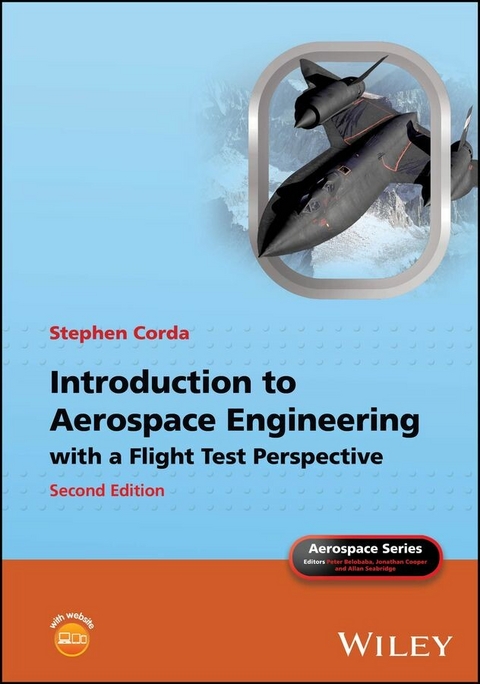
Introduction to Aerospace Engineering with a Flight Test Perspective (eBook)
1435 Seiten
Wiley (Verlag)
9781394309276 (ISBN)
Comprehensive textbook integrating the fundamentals of flight testing with introductory concepts in aerospace engineering
Introduction to Aerospace Engineering with a Flight Test Perspective provides a solid foundation in the fundamentals of aerospace engineering while illuminating many aspects of real-world flight, covering topics such as aerodynamics, propulsion, performance, and stability and control. End-of-chapter problems are included along with a solutions manual for instructors.
The Second Edition includes two new chapters, one providing a timely introduction to hypersonics and the other introducing the fundamentals of spaceflight.
Introduction to Aerospace Engineering with a Flight Test Perspective discusses topics including:
Introduction to Aerospace Engineering with a Flight Test Perspective is an excellent accompaniment to any introductory course in aerospace engineering taught at civilian universities, military academies, and test pilot schools. The text may also be used in more advanced courses in flight testing, aerodynamics, performance, and design.
Stephen Corda has over 40 years of experience in hypersonics, aerospace vehicle design, and experimental flight testing. He has held engineering, academic, management, and flight test positions at The Johns Hopkins University Applied Physics Laboratory, the NASA Dryden (now Armstrong) Flight Research Center, the U.S. Air Force Test Pilot School, the U.S. Naval Academy, the University of Tennessee Space Institute, The Spaceship Company, Stratolaunch, and the Lawrence Livermore National Laboratory.
1
First Flights
The first controlled flight of a heavier‐than‐air airplane, Kill Devil Hills, North Carolina, 17 December 1903.
(Source: W. Wright, O. Wright, and J. Daniels, 1903, US Library of Congress.)
Wilbur, having used his turn in the unsuccessful attempt on the 14th, the right to the first trial now belonged to me. After running the motor a few minutes to heat it up, I released the wire that held the machine to the track, and the machine started forward in the wind. Wilbur ran at the side of the machine, holding the wing to balance it on the track. Unlike the start on the 14th, made in a calm, the machine, facing a 27‐mile wind, started very slowly. Wilbur was able to stay with it till it lifted from the track after a 40‐foot run. One of the Life Saving men snapped the camera for us, taking a picture just as the machine had reached the end of the track and had risen to a height of about 2 feet.1 The slow forward speed of the machine over the ground is clearly shown in the picture by Wilbur’s attitude. He stayed along beside the machine without any effort.
The course of the flight up and down was exceedingly erratic, partly due to the irregularity of the air, and partly to lack of experience in handling this machine. The control of the front rudder was difficult on account of its being balanced too near the center. This gave it a tendency to turn itself when started; so that it turned too far on one side and then too far on the other. As a result, the machine would rise suddenly to about ten feet, and then as suddenly dart for the ground. A sudden dart when a little over a hundred feet from the end of the track, or a little over 120 feet from the point at which it rose into the air, ended the flight. As the velocity of the wind was over 35 ft/s and the speed of the machine over the ground against this wind ten feet per second, the speed of the machine relative to the air was over 45 ft/s, and the length of the flight was equivalent to a flight of 540 feet made in calm air. This flight lasted only 12 seconds, but it was nevertheless the first in the history of the world in which a machine carrying a man had raised itself by its own power into the air in full flight, had sailed forward without reduction of speed and had finally landed at a point as high as that from which it started.
Orville Wright writing about the first successful flight of a heavier‐than‐air flying machine from Kill Devil Hills, North Carolina, on 17 December 19032
1.1 Preflight
The history of aerospace engineering is full of firsts, such as the first balloon flight, the first heavier‐than‐air airplane flight, the first artificial satellite flight, the first manned spacecraft flight, and many others. The first flight is a significant achievement and milestone. It is often the culmination of years of hard work by many people, including engineers, technicians, managers, pilots, and others. A first flight may represent a first in the application of a new aerospace engineering concept or theory that is being validated by the actual flight.
As an aerospace engineer, you may have the opportunity to contribute to the first flight of a new aircraft, a new spacecraft, or a new technology. The aerospace engineer may test the vehicle, on the ground and in flight, to verify that it can perform as predicted or to improve its operating characteristics. Flight testing is the final test to be performed on the complete vehicle or system.
Aerospace engineers are involved in all facets of the design, analysis, research, development, and testing of aerospace vehicles. This encompasses many different aerospace engineering disciplines, including aerodynamics, propulsion, performance, stability, control, structures, systems, and others. Several of these fundamental disciplines of aerospace engineering are introduced in this text.
In many areas of engineering and technology, there is sometimes a perception that there is nothing left to be discovered. Aerospace engineers have indeed designed, built, and flown some of the most innovative, complex, and amazing machines known to humanity. However, there is still ample room for creativity, innovation, and opportunities for technological breakthroughs to make the skies and stars far more accessible. By the end of this textbook, you may have greatly increased your knowledge of aerospace engineering, but you may also be humbled by how much more there is to be discovered.
1.2 The First Balloon Flight
Balloons are perhaps the earliest form of manned flying vehicles. The first recorded, manned, untethered, free flight of a hot air balloon took place on 21 November 1783, in Paris, France (Figure 1.1). The balloon, with aeronauts3 Jean Francis Pilatre de Rozier (1754–1785) and the Marquis d’Arlandes (1742–1809) onboard, flew for about 25 minutes over the city of Paris, France, rising to an altitude of about 3000 feet (914 m) and covering a distance of about 5 miles (8.1 km). A firebox, suspended underneath an opening at the bottom of the balloon, held a fire that filled the balloon with hot air. The balloon aeronauts stood on a platform, encircling the bottom of the balloon, from which they could add fuel and tend to the fire in the firebox. This was the first free flight by mankind in an aerial vehicle. The balloon was built by Joseph (1740–1810) and Etienne (1745–1799) Montgolfier of France, who were to play a major role in the future development of balloon flight.
Figure 1.1 Illustration of the first manned balloon flight over Paris, France, on 21 November 1783
(Source: Claude Louis Desrais / Prussian Cultural Heritage Foundation / Public domain.)
With a background in paper manufacturing, the Montgolfier brothers were supposedly inspired by seeing scraps of paper in their paper mill being lifted aloft by smoke from a fire. Based on these observations, they believed that the smoke was a new, undiscovered gas that was less dense than air, which they dubbed “Montgolfier gas.” They believed that a thicker smoke contained more of this “Montgolfier gas,” so they sometimes burned unusual materials, such as rotten meat and shoes, to produce as thick a smoke as possible for their balloons. They did not realize that the smoke is simply heated air and is less dense than unheated air. The brothers used a trial‐and‐error method, rather than one based on an understanding of the physics, in developing their balloons.
An aspect of the Montgolfier brothers’ balloon development, which was insightful and may have contributed to their success, was their incremental design and flight test approach. They started with the flight of a smaller scale, 10‐meter (32.8 ft) diameter, unmanned hot air balloon that was tethered to the ground and built up to flights of larger, manned balloons. The Montgolfier brothers’ flight test approach was also admirable from a risk reduction standpoint. Prior to risking a balloon flight with people onboard, they flew a balloon carrying three farm animals, a sheep, aptly named Montauciel, French for “climb to the heavens,” a duck, and a rooster, to assess the effects of balloon flight on living creatures. There was logic to their selection of these three particular animals. The sheep was thought to have a physiology that was similar to a human being thus, it was selected to assess the physiological effects of altitude. Since the duck was capable of flight at the balloon altitudes, it was used to assess any nonphysiological effects of balloon flight. The rooster was a non‐flight‐capable bird, so it was used to assess altitude effects in comparison with the duck. On 9 September 1783, the sheep, duck, and rooster made history as the first living creatures to fly in a balloon. Their balloon flight lasted about 8 minutes, ascending to an altitude of about 1500 feet (460 m) and landing safely about 2 miles (3.2 km) from their launch point.
The next incremental step was the flight of a 75 feet (22.9 m) tall, 55 feet (16.8 m) diameter, tethered balloon with a man onboard. On 15 October 1783, Etienne Montgolfier was the first person to ascend in a tethered balloon followed, later that day, by Jean Francis Pilatre de Rozier, who rode the tethered balloon to a height of about 80 feet (24.4 m), the length of the tethered line attached to the balloon. Just a little over a month later, the first free flight of a balloon was completed by de Rozier and the Marquis d’Arlandes in a Montgolfier balloon.
Ten days after the first manned hot air balloon flight, aeronauts Jacques Alexander Charles and Nicholas Louis Robert flew the first manned flight of a gas balloon on 1 December 1783, in Paris, France. Charles and Robert ascended to an altitude of about 1800 feet (550 m), covered a distance of about 25 miles (40.2 km), and were airborne for about two hours. Their rubber‐coated, silk balloon was filled with flammable hydrogen gas, an attractive choice from a buoyancy standpoint, but a poor choice from a flight safety perspective. Hydrogen gas would be used in balloons and airships well into the 20th century, with many instances of catastrophic events due to its high flammability, until being replaced by helium gas. In fact, de Rozier, of hot air balloon fame, died when his hydrogen gas balloon exploded while attempting to cross the English...
| Erscheint lt. Verlag | 8.12.2025 |
|---|---|
| Reihe/Serie | Aerospace Series |
| Sprache | englisch |
| Themenwelt | Technik ► Maschinenbau |
| Schlagworte | aerodynamics • aeronautical engineering • Aerospace Engineering • Aircraft Control • Aircraft performance • Aircraft Propulsion • aircraft stability • astronautical engineering • Flight Test • Flight test engineering • Hypersonics • Spaceflight |
| ISBN-13 | 9781394309276 / 9781394309276 |
| Informationen gemäß Produktsicherheitsverordnung (GPSR) | |
| Haben Sie eine Frage zum Produkt? |
 EPUB (Adobe DRM)
Kopierschutz: Adobe-DRM
Adobe-DRM ist ein Kopierschutz, der das eBook vor Mißbrauch schützen soll. Dabei wird das eBook bereits beim Download auf Ihre persönliche Adobe-ID autorisiert. Lesen können Sie das eBook dann nur auf den Geräten, welche ebenfalls auf Ihre Adobe-ID registriert sind.
Details zum Adobe-DRM
Dateiformat: EPUB (Electronic Publication)
EPUB ist ein offener Standard für eBooks und eignet sich besonders zur Darstellung von Belletristik und Sachbüchern. Der Fließtext wird dynamisch an die Display- und Schriftgröße angepasst. Auch für mobile Lesegeräte ist EPUB daher gut geeignet.
Systemvoraussetzungen:
PC/Mac: Mit einem PC oder Mac können Sie dieses eBook lesen. Sie benötigen eine
eReader: Dieses eBook kann mit (fast) allen eBook-Readern gelesen werden. Mit dem amazon-Kindle ist es aber nicht kompatibel.
Smartphone/Tablet: Egal ob Apple oder Android, dieses eBook können Sie lesen. Sie benötigen eine
Geräteliste und zusätzliche Hinweise
Buying eBooks from abroad
For tax law reasons we can sell eBooks just within Germany and Switzerland. Regrettably we cannot fulfill eBook-orders from other countries.
aus dem Bereich