Zum Hauptinhalt springen
Nicht aus der Schweiz? Besuchen Sie lehmanns.de
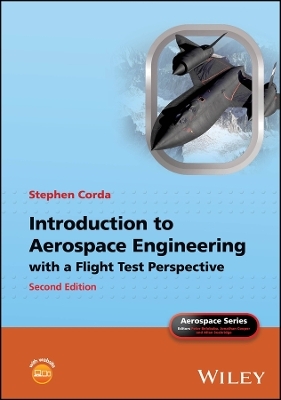
Introduction to Aerospace Engineering with a Flight Test Perspective - Stephen Corda

Introduction to Aerospace Engineering with a Flight Test Perspective

(Autor)

Buch | Hardcover
896 Seiten
2026 | 2nd edition
John Wiley & Sons Inc (Verlag)
978-1-394-30926-9 (ISBN)
CHF 189,95 inkl. MwSt
  • Noch nicht erschienen (ca. Januar 2026)
  • Versandkostenfrei
  • Auch auf Rechnung
  • Artikel merken
Comprehensive textbook integrating the fundamentals of flight testing with introductory concepts in aerospace engineering

Introduction to Aerospace Engineering with a Flight Test Perspective provides a solid foundation in the fundamentals of aerospace engineering while illuminating many aspects of real-world flight, covering topics such as aerodynamics, propulsion, performance, and stability and control. End-of-chapter problems are included along with a solutions manual for instructors.

The Second Edition includes two new chapters, one providing a timely introduction to hypersonics and the other introducing the fundamentals of spaceflight.

Introduction to Aerospace Engineering with a Flight Test Perspective discusses topics including:


Historical perspectives of the first flights of airplanes, rotorcraft, and spacecraft
Introductory concepts of airplanes, rotorcraft, unmanned aerial vehicles, and lighter-than-air vehicles
Placement of the reader in the aircraft cockpit to fly and learn the basics of flight test
Fundamentals of subsonic, transonic, supersonic, and hypersonic flight, with explanations of the theories of lift and the generation of drag
Types of non-airbreathing rocket propulsion, including liquid propellant rocket engines and solid rocket motors, as well as air-breathing propulsion, including propeller-driven and jet engines
Concepts of aircraft performance in cruising, climbing, gliding, and turning flight
Longitudinal and lateral-directional stability and control
An introduction to hypersonic vehicles, aero-thermodynamics, and propulsion
Orbital mechanics, covering Kepler’s laws, the two-body problem, types of trajectories and orbits, and atmospheric entry

Introduction to Aerospace Engineering with a Flight Test Perspective is an excellent accompaniment to any introductory course in aerospace engineering taught at civilian universities, military academies, and test pilot schools. The text may also be used in more advanced courses in flight testing, aerodynamics, performance, and design.

Stephen Corda has over 40 years of experience in hypersonics, aerospace vehicle design, and experimental flight testing. He has held engineering, academic, management, and flight test positions at The Johns Hopkins University Applied Physics Laboratory, the NASA Dryden (now Armstrong) Flight Research Center, the U.S. Air Force Test Pilot School, the U.S. Naval Academy, the University of Tennessee Space Institute, The Spaceship Company, Stratolaunch, and the Lawrence Livermore National Laboratory.

About the Author xix

Preface to the Second Edition xxi

Series Preface Corda 2e Rev 1 xxiii

About the Companion Website xxv

1 First Flights 1

1.1 Preflight 2

1.2 The First Balloon Flight 3

1.3 The First Airplane Flight 5

1.4 The First Rotorcraft Flight 8

1.5 The First Supersonic Flight 9

1.6 The First Rocket Flights 12

1.7 The First Hypersonic Flight 17

1.8 The First Spaceflight 19

1.9 The First Orbital Spaceflight 20

1.10 The First Manned Spaceflights 24

1.11 The First Flight on Mars 26

1.12 The First Flight Beyond Our Solar System 27

1.13 Organization of the Book 28

References 30

2 Introductory Concepts 31

2.1 Introduction to Aircraft 31

2.1.1 The Airplane 33

2.1.1.1 Parts of an Airplane 33

2.1.1.2 Airplane Configurations 35

2.1.2 The Helicopter 40

2.1.2.1 Parts of a Helicopter 40

2.1.2.2 Helicopter Configurations 42

2.1.3 Lighter-Than-Air Aircraft 44

2.1.3.1 The Balloon 44

2.1.3.2 The Airship 47

2.1.4 The Unmanned Aerial Vehicle 50

2.2 Introductory Flight Concepts 52

2.2.1 Mach Number and the Regimes of Flight 52

2.2.2 The Free-Body Diagram and the Four Forces 55

2.2.2.1 Wings-Level, Unaccelerated Flight 56

2.2.2.2 Climbing, Unaccelerated Flight 58

2.2.2.3 Descending, Unaccelerated Flight 59

2.2.3 Aircraft Motions 60

2.2.4 Angle-of-Attack and Angle-of-Sideslip 61

2.2.5 FTT: The Trim Shot 63

2.2.6 The Flight Envelope 66

2.2.6.1 Flight Envelope Boundaries 66

2.2.6.1.1 Aerodynamic Lift Limit 67

2.2.6.1.2 Jet Engine Surge Limit 67

2.2.6.1.3 Altitude Limit 68

2.2.6.1.4 Airspeed Limit 69

2.2.6.1.5 Mach Number Limit 69

2.2.6.2 Flight Envelope Examples 70

2.2.6.3 Comparison of Flight Envelopes 76

2.3 The Atmosphere 77

2.3.1 Altitude Definitions 77

2.3.2 Physical Description of the Atmosphere 81

2.3.3 Chemical Composition of the Atmosphere 82

2.3.4 Layers of the Atmosphere 83

2.3.4.1 The Troposphere 84

2.3.4.2 The Stratosphere 84

2.3.4.3 The Mesosphere 85

2.3.4.4 The Thermosphere 85

2.3.4.5 The Exosphere and Hard Space 86

2.3.5 GTT: Cabin Pressurization Test 86

2.3.6 Equation of Fluid Statics: The Hydrostatic Equation 88

2.3.7 The Standard Atmosphere 92

2.3.7.1 Development of the Standard Atmosphere Model 93

2.3.7.1.1 Isothermal Region 94

2.3.7.1.2 Gradient Region 96

2.3.7.2 Approximate, Exponential Atmosphere Model 99

2.3.7.3 Standard Atmosphere Curve Fit Equations 101

2.3.7.4 Temperature, Pressure, and Density Ratios 101

2.4 Introductory Flight Test Concepts 104

2.4.1 What Is Flight Test? 104

2.4.2 Types of Flight Testing 105

2.4.3 The Flight Test Process 106

2.4.4 Flight Test Techniques 108

2.4.4.1 The Flight Profile 109

2.4.4.2 Flight Test Data Collection 110

2.4.5 Flight Test Safety and Risk Assessment 111

2.4.6 The X-Planes 112

References 115

Problems 115

3 Foundations of Aerodynamics 117

3.1 Introduction 117

3.2 Fundamental Physical Properties of a Fluid 118

3.2.1 The Fluid Element 118

3.2.2 Thermodynamic Properties of a Fluid 119

3.2.2.1 Pressure 119

3.2.2.2 Specific Volume and Density 120

3.2.2.3 Temperature 120

3.2.2.4 Standard Conditions 121

3.2.3 Kinematic Properties of a Flow 122

3.2.4 Streamlines and Pathlines 122

3.2.4.1 FTT: In-Flight Flow Visualization 124

3.2.5 Transport Properties of a Fluid 127

3.2.5.1 Mass Transport 128

3.2.5.2 Momentum Transport 128

3.2.5.3 Heat Transport 128

3.2.5.4 Coefficient of Viscosity and Sutherland’s Law 128

3.3 Types of Aerodynamic Flows 130

3.3.1 Continuum and Non-Continuum Flows 130

3.3.2 Steady and Unsteady Flows 130

3.3.3 Incompressible and Compressible Flows 131

3.3.4 Inviscid and Viscous Flows 132

3.4 Similarity Parameters 135

3.4.1 Mach Number 136

3.4.2 Reynolds Number 137

3.4.3 Pressure Coefficient 139

3.4.4 Force and Moment Coefficients 139

3.4.5 Ratio of Specific Heats 140

3.4.6 Prandtl Number 140

3.4.7 Stanton Number 141

3.4.8 Summary of Similarity Parameters 141

3.5 A Brief Review of Thermodynamics 143

3.5.1 Thermodynamic System and State 143

3.5.1.1 Thermodynamic System 143

3.5.1.2 Properties of a System, Thermodynamic State, and Processes 144

3.5.2 Connecting the Thermodynamic State: The Equation of State 145

3.5.2.1 The Ideal Gas 145

3.5.2.2 The Ideal Gas Equation of State 146

3.5.3 Additional Thermodynamic Properties: Internal Energy, Enthalpy, and Entropy 148

3.5.3.1 Internal Energy 148

3.5.3.2 Enthalpy 149

3.5.3.3 Entropy 149

3.5.4 Work and Heat 150

3.5.4.1 Work 150

3.5.4.2 Heat 154

3.5.5 The Laws of Thermodynamics 155

3.5.5.1 The Zeroth and Third Laws of Thermodynamics 155

3.5.5.2 The First Law of Thermodynamics 155

3.5.5.3 The Second Law of Thermodynamics 156

3.5.6 Specific Heats of an Ideal Gas 158

3.5.7 Isentropic Flow 162

3.6 Fundamental Equations of Fluid Motion 165

3.6.1 Conservation of Mass: The Continuity Equation 165

3.6.2 Newton’s Second Law: The Momentum Equation 167

3.6.3 Conservation of Energy: The Energy Equation 172

3.6.4 Summary of the Governing Equations of Fluid Flow 174

3.7 Viscous Flow 175

3.7.1 D’Alembert’s Paradox 175

3.7.2 Skin Friction and Shearing Stress 179

3.7.3 Laminar and Turbulent Boundary Layers 180

3.7.4 Boundary Layer Transition 184

3.7.5 Separated Flow 186

3.7.6 Skin Friction Drag 189

References 193

Problems 194

4 Airfoils and Wings 197

4.1 Introduction 198

4.2 Two-Dimensional Lifting Shapes: Airfoils 198

4.2.1 Airfoil Nomenclature and Construction 202

4.2.2 Airfoil Numbering Systems 204

4.2.3 Aerodynamic Forces and Moments 206

4.2.4 Airfoil Lift, Drag, and Pitching Moment 207

4.2.5 Pressure Coefficient 209

4.2.6 Airfoil Lift, Drag, and Moment Curves 211

4.2.6.1 Airfoil Lift Curve 211

4.2.6.2 Geometric and Absolute Angles-of-Attack 212

4.2.6.3 Airfoil Drag Curve 214

4.2.6.4 Airfoil Pitching Moment Curve 216

4.2.7 Data for Selected Symmetric and Cambered Airfoils 216

4.2.8 Comparison of Symmetric and Cambered Airfoils 222

4.2.9 FTT: Lift and Drag in Steady, Gliding Flight 226

4.3 Three-Dimensional Aerodynamics: Wings 232

4.3.1 Finite Wings 232

4.3.1.1 Wing Geometry and Nomenclature 232

4.3.1.2 Wingtip Vortices, the Wing Vortex System, and Wing Lift 235

4.3.1.3 Downwash and Induced Drag 238

4.3.1.4 Summary of the Total Drag for a Wing 243

4.3.2 Lift and Drag Curves of Finite Wings 243

4.3.2.1 Finite Wing Lift Curve 244

4.3.2.2 Finite Wing Drag Curve 246

4.3.3 High-Lift Devices 247

4.3.3.1 Flaps 247

4.3.3.2 Leading Edge Devices 249

4.3.3.3 Spoilers 251

4.4 Theories of Lift 252

4.4.1 Theories of Lift: Action and Reaction 252

4.4.2 Theories of Lift: Newtonian Theory 253

4.4.3 Theories of Lift: Equal Transit Time 253

4.4.4 Theories of Lift: Flow Deflection 254

4.4.5 Theories of Lift: Pressure and Shear Stress Distributions 254

4.4.6 Theories of Lift: “Squashed” Streamtubes 255

4.4.7 Theories of Lift: Circulation 256

4.4.8 Anton Flettner and His Spinning Cylinders 258

4.5 Total Drag 260

4.5.1 Drag of the Complete Aircraft 260

4.5.1.1 Interference Drag 262

4.5.1.2 Protuberance Drag 263

4.5.1.3 Drag due to Roughness and Gaps 263

4.5.1.4 Trim Drag 264

4.5.2 Variation of Drag with Airspeed and Mach Number 264

4.6 GTT: Wind Tunnel Testing 266

4.6.1 Wind Tunnel Description 266

4.6.2 Subsonic Wind Tunnel Velocity-Area Relation 268

4.6.3 Types of Wind Tunnels 269

4.6.4 Examples of Wind Tunnels 271

4.6.4.1 The Whirling Arm 271

4.6.4.2 The Wright Brothers’ Wind Tunnel 272

4.6.4.3 Variable Density Tunnel 273

4.7 GTT: Computational Fluid Dynamics 277

4.8 FTT: Aeromodeling 281

4.8.1 Stabilized Aeromodeling Methods 284

4.8.2 Dynamic Aeromodeling Methods 285

4.9 Aerodynamic Stall and Departure 288

4.9.1 Stall Definitions 288

4.9.2 Aerodynamics of Stall 291

4.9.3 Post-Stall Aerodynamics 294

4.9.4 Spins 296

4.9.5 FTT: Stall, Departure, and Spin Flight Testing 302

References 307

Problems 307

5 Supersonic Flight 309

5.1 Introduction 309

5.1.1 The Speed of Sound 310

5.1.2 The Critical Mach Number and Drag Divergence 313

5.1.3 Compressibility Corrections 316

5.1.4 The Sound Barrier 321

5.1.5 Breaking the Sound Barrier 322

5.2 Shock and Expansion Waves 323

5.2.1 Isentropic Flow Relations 324

5.2.2 Mach Waves 326

5.2.3 Shock Waves 328

5.2.3.1 Normal Shock Waves 329

5.2.3.2 Oblique Shock Waves 333

5.2.3.3 FTT: Visualizing Shock Waves in Flight 334

5.2.4 Expansion Waves 337

5.2.5 Sonic Boom 339

5.3 Supersonic Airfoils and Wings 341

5.3.1 Lift and Drag of Supersonic Airfoils 341

5.3.2 Supercritical Airfoils 344

5.3.3 Wings for Supersonic Flight 346

5.3.3.1 Thin, Low-Aspect Ratio, Straight Wings 347

5.3.3.2 Swept Wings 349

5.3.3.3 Delta Wings 354

5.3.3.4 Variable-Sweep Wings 358

5.3.4 Transonic and Supersonic Area Rule 363

5.4 Internal Supersonic Flows 368

References 376

Problems 377

6 Propulsion 379

6.1 Introduction 380

6.2 The Concept of Propulsive Thrust 381

6.3 Propulsive Flows with Heat Addition and Work 384

6.3.1 Application of the Continuity Equation to Propulsive Flows 384

6.3.2 Application of the Energy Equation to Propulsive Flows 385

6.4 Derivation of the Thrust Equations 387

6.4.1 Uninstalled Thrust for the Rocket Engine 388

6.4.2 Uninstalled Thrust for the Ramjet and Turbojet 391

6.4.3 Installed Thrust for an Air-Breathing Engine 393

6.4.4 Thrust Equation for a Propeller 394

6.4.5 Force Accounting 398

6.5 Thrust and Power Curves for Propeller and Jet Propulsion 399

6.5.1 FTT: In-Flight Thrust Measurement 401

6.6 Air-Breathing Propulsion 404

6.6.1 Air-Breathing Propulsion Performance Parameters 404

6.6.1.1 Thrust-to-Weight Ratio 405

6.6.1.2 Specific Impulse 405

6.6.1.3 Specific Fuel Consumption 407

6.6.1.4 Propulsive Efficiency 408

6.6.2 The Ramjet 410

6.6.3 The Gas Generator 413

6.6.3.1 The Gas Generator Cycle 416

6.6.3.2 Air-Breathing Engines Based on the Gas Generator 417

6.6.4 The Turbojet Engine 418

6.6.4.1 Ideal Turbojet Thermodynamic Cycle 418

6.6.4.2 Turbojet Flow Properties and Thrust 419

6.6.4.3 Birth of the Turbojet Engine 421

6.6.5 The Turbofan Engine 423

6.6.6 The Turboprop and Turboshaft Engines 426

6.6.7 Inlets and Nozzles 428

6.6.7.1 Inlet Requirements and Total Pressure Recovery 430

6.6.7.2 Subsonic Inlets 430

6.6.7.3 Supersonic Inlets 431

6.6.7.4 Nozzle Requirements and Types 435

6.6.7.5 Nozzle Efficiency and Performance Parameters 435

6.6.7.6 Thrust Vectoring Nozzles 438

6.6.8 The Reciprocating, Piston Engine–Propeller Combination 438

6.6.8.1 The Reciprocating, Piston, Internal Combustion Engine 439

6.6.8.2 Gasoline-Fueled Internal Combustion Engine Ideal Cycle: The Otto Cycle 442

6.6.8.3 The Propeller 444

6.6.8.4 The Electric Motor–Propeller Combination 451

6.6.9 GTT: The Engine Test Cell and Test Stand 452

6.6.10 FTT: Flying Engine Testbeds 454

6.7 Rocket Propulsion 455

6.7.1 Thrust Chamber Thermodynamics 456

6.7.2 Rocket Propulsion Performance Parameters 458

6.7.2.1 Thrust Chamber Mass Flow Rate 458

6.7.2.2 Characteristic Exhaust Velocity 458

6.7.2.3 Effective Exhaust Velocity 459

6.7.2.4 Thrust 460

6.7.2.5 Thrust Coefficient 461

6.7.2.6 Specific Impulse 462

6.7.3 Liquid-Propellant Rocket Propulsion 464

6.7.4 Solid-Propellant Rocket Propulsion 468

6.7.5 Rocket Nozzles 471

References 473

Problems 474

7 Performance 477

7.1 Introduction 478

7.2 Air Data System Measurements 480

7.2.1 The Pitot-Static System 481

7.2.2 Measurement of Altitude 482

7.2.3 Measurement of Airspeed 484

7.2.3.1 Subsonic, Incompressible Flow 486

7.2.3.2 Subsonic, Compressible Flow 486

7.2.3.3 Supersonic, Compressible Flow 487

7.2.4 Types of Airspeed 490

7.2.4.1 True Airspeed 490

7.2.4.2 Equivalent Airspeed 491

7.2.4.3 Calibrated Airspeed 492

7.2.4.4 Indicated Airspeed 493

7.2.4.5 Airspeed Summary and Conversions 494

7.2.5 Pitot-Static System Errors 495

7.2.5.1 Total Pressure Position Error 496

7.2.5.2 Static Pressure Position Error 497

7.2.6 Temperature Measurement 498

7.2.7 FTT: Altitude and Airspeed Calibration 501

7.3 The V-n Diagram 507

7.4 The Equations of Motion for Unaccelerated Flight 512

7.5 Level Flight Performance 514

7.5.1 Thrust Required in Level, Unaccelerated Flight 514

7.5.2 Velocity and Lift Coefficient for Minimum Thrust Required 519

7.5.3 Thrust Available and Maximum Velocity 520

7.5.4 Power Required and Power Available 524

7.5.5 Velocity and Lift Coefficient for Minimum Power Required 527

7.6 Range and Endurance 530

7.6.1 Definitions of Range and Endurance 531

7.6.2 Range and Endurance for a Propeller-Driven Aircraft 532

7.6.3 Range and Endurance for a Jet-Powered Aircraft 534

7.7 FTT: Cruise Performance 536

7.8 Climb Performance 544

7.8.1 Maximum Angle and Maximum Rate of Climb 544

7.8.2 Time to Climb 547

7.8.3 FTT: Climb Performance 550

7.9 Glide Performance 553

7.10 Energy Concepts 556

7.10.1 FTT: Specific Excess Power 566

7.11 Turn Performance 569

7.11.1 The Level Turn 569

7.11.1.1 Level Turn Performance Equations 570

7.11.1.2 The Turning Stall 575

7.11.1.3 The Turn Performance Chart 577

7.11.2 Turn Performance and the V-n Diagram 580

7.11.3 FTT: Turn Performance 581

7.12 Takeoff and Landing Performance 584

7.12.1 Takeoff Distance 588

7.12.2 Landing Distance 590

7.12.3 FTT: Takeoff Performance 591

References 595

Problems 596

8 Stability and Control 599

8.1 Introduction 600

8.2 Aircraft Stability 601

8.2.1 Static Stability 602

8.2.2 Dynamic Stability 602

8.3 Aircraft Control 603

8.3.1 Flight Controls 604

8.3.2 Stick-Fixed and Stick-Free Stability 605

8.4 Stability and Control Nomenclature and Sign Conventions 606

8.5 Aircraft Weight and Balance 610

8.5.1 Aircraft Weight 610

8.5.2 Aircraft Balance and Center-of-Gravity Location 611

8.5.3 Weight and Balance Computation 612

8.6 Longitudinal Static Stability 616

8.6.1 The Pitching Moment Curve 617

8.6.2 Configurations with Longitudinal Static Stability and Balance 620

8.6.3 Contributions of Aircraft Components to the Pitching Moment 625

8.6.3.1 Wing Contribution to the Pitching Moment 625

8.6.3.2 Tail Contribution to the Pitching Moment 628

8.6.3.3 Combined Contributions of the Wing and Tail to the Pitching Moment 633

8.6.3.4 Fuselage Contribution to the Pitching Moment 636

8.6.3.5 Propulsion System Contribution to the Pitching Moment 637

8.6.4 Neutral Point and Static Margin 638

8.7 Longitudinal Control 642

8.7.1 Elevator Effectiveness and Control Power 643

8.7.2 New Trim Condition Due to Elevator Deflection 648

8.7.3 Elevator Hinge Moment 650

8.7.4 Stick-Free Longitudinal Static Stability 652

8.7.5 Longitudinal Control Forces 653

8.7.6 FTT: Longitudinal Static Stability 657

8.8 Lateral-Directional Static Stability and Control 662

8.8.1 Directional Static Stability 663

8.8.2 Directional Control 668

8.8.3 Lateral Static Stability 670

8.8.4 Roll Control 675

8.8.5 FTT: Lateral-Directional Static Stability 676

8.9 Summary of Static Stability and Control Derivatives 681

8.10 Dynamic Stability 682

8.10.1 Long Period or Phugoid 683

8.10.2 Short Period 685

8.10.3 Dutch Roll 686

8.10.4 Spiral Mode 689

8.10.5 Roll Mode 690

8.10.6 FTT: Longitudinal Dynamic Stability 691

8.11 Handling Qualities 695

8.11.1 FTT: Variable Stability Aircraft 696

8.12 FTT: First Flight 700

References 704

Problems 704

9 Hypersonic Flight 707

9.1 Introduction 708

9.1.1 What Is Hypersonic? 709

9.1.2 Differences Between Supersonic and Hypersonic Flows 709

9.2 Hypersonic Vehicles 710

9.2.1 Blunt and Slender Hypersonic Bodies 710

9.2.2 Types of Hypersonic Vehicles 711

9.2.2.1 Ballistic Entry Capsule 711

9.2.2.2 Lifting Entry Vehicle 712

9.2.2.3 Atmospheric Cruise or Accelerator Vehicle 713

9.2.3 Hypersonic Trajectories 713

9.3 Effects of High Mach Number 715

9.3.1 Shock Waves and the Shock Layer 716

9.3.2 Mach Number Independence 717

9.3.3 The Hypersonic Similarity Parameter 720

9.3.4 Curved Shock Waves 721

9.3.5 GTT: Hypersonic Ground Testing 723

9.4 Impact Theories 725

9.4.1 Newtonian Impact Theory 725

9.4.2 Derivation of Newton’s Sine-Squared Law 726

9.4.3 Lift and Drag Over a Flat Plate Using Newtonian Theory 727

9.4.4 Modified Newtonian Theory 731

9.4.5 Tangent-Wedge and Tangent-Cone Methods 732

9.5 Effects of High Temperature 734

9.5.1 High-Temperature Effects on Air 734

9.5.2 Temperature Effects on the Ratio of Specific Heats 736

9.5.3 Hypersonic Plasma 738

9.5.4 Hypersonic Heating 740

9.5.4.1 Thermal Conduction 741

9.5.4.2 Convection 741

9.5.4.3 Radiation 742

9.5.5 The Thermal Boundary Layer 742

9.5.6 Reynolds Analogy and the Stanton Number 744

9.5.7 Body Shape to Minimize Hypersonic Heating 746

9.6 Effects of Low Density 746

9.7 Hypersonic Viscous Flow 749

9.7.1 Hypersonic Viscous Effects 749

9.7.1.1 Increase in Skin Friction and Heat Transfer 749

9.7.1.2 Displacement Effect 749

9.7.1.3 Viscous Interaction 749

9.7.1.4 Thick Boundary Layers and Shock Interactions 749

9.7.2 The Hypersonic Laminar Boundary Layer 750

9.7.3 Displacement Thickness and Viscous Interaction 751

9.8 FTT: Hypersonic Flight 753

9.9 Waveriders 761

9.9.1 Compression Lift 763

9.9.2 The Caret Wing Waverider 764

9.9.3 Viscous-Optimized Waveriders 766

9.10 Hypersonic Propulsion 768

9.10.1 The Scramjet 768

9.10.2 FTT: Scramjet Flight Test 772

9.10.2.1 Russian CIAM Scramjet Flight Test 772

9.10.2.2 NASA X-43A Hyper-X 774

9.10.2.3 US X-51A Scramjet Engine Demonstrator 775

9.10.3 Hypersonic Combined-Cycle Propulsion 776

References 778

Problems 779

10 Spaceflight 781

10.1 Introduction 782

10.1.1 The Space Environment – Where Does Space Begin? 782

10.1.2 Space Radiation, Meteors, and Space Debris 782

10.2 Spacecraft 784

10.2.1 Classification of Spacecraft 784

10.2.1.1 Orbiter Spacecraft 785

10.2.1.2 Flyby Spacecraft 787

10.2.1.3 Lander Spacecraft 788

10.2.1.4 Atmospheric Spacecraft 792

10.2.1.5 Manned Spacecraft 793

10.2.2 Parts of a Spacecraft 797

10.3 Space Access Systems 800

10.3.1 Expendable Rockets 801

10.3.2 Reusable Rockets 803

10.3.3 Air-Launched Rockets 806

10.4 Space Launch 807

10.4.1 The Rocket Equation 807

10.4.2 Gravity and Drag Losses 810

10.4.3 Launch Vehicle Parameters 811

10.4.4 Rocket Staging 812

10.5 Orbital Mechanics 816

10.5.1 Newton’s Laws of Motion and Universal Gravitation 816

10.5.1.1 Newton’s Three Laws of Motion 816

10.5.1.2 Newton’s Universal Law of Gravitation 817

10.5.2 Kepler’s Laws of Planetary Motion 818

10.5.2.1 Kepler’s First Law (Law of Ellipses): The orbit of each planet is an ellipse, with the Sun at a focus 819

10.5.2.2 Kepler’s Second Law (Law of Equal Areas): The line joining the planet to the Sun sweeps out equal areas in equal times 820

10.5.2.3 Kepler’s Third Law (Law of Harmonies): The square of the period of a planet is proportional to the cube of the semi-major axis of the elliptical orbit 820

10.5.3 Orbital Elements 820

10.5.3.1 Eccentricity 821

10.5.3.2 Semi-major Axis 822

10.5.3.3 Inclination 822

10.5.3.4 Longitude of the Ascending Node 822

10.5.3.5 Argument of Perigee 822

10.5.3.6 True Anomaly 822

10.5.4 The Orbit Equation 823

10.5.5 Types of Orbits and Trajectories 826

10.5.5.1 The Elliptical Orbit 828

10.5.5.2 The Circular Orbit 829

10.5.5.3 The Parabolic Orbit 829

10.5.5.4 The Hyperbolic Orbit 830

10.5.6 The Vis-Viva Equation 831

10.5.6.1 Energy and Eccentricity 832

10.5.6.2 Lagrange Points 833

10.5.7 Orbital Velocities 834

10.5.7.1 Circular Orbit Velocity 834

10.5.7.2 Escape Velocity 835

10.5.8 Earth Orbits 836

10.5.8.1 Low Earth Orbit (LEO) 837

10.5.8.2 Sun-Synchronous Orbit (SSO) 837

10.5.8.3 Medium Earth Orbit (MEO) 837

10.5.8.4 Geostationary Earth Orbit (GEO) 838

10.5.8.5 Parking Orbit 838

10.5.8.6 Transfer Orbits 838

10.6 Atmospheric Entry 841

10.6.1 Atmospheric Entry Equations of Motion 842

10.6.2 Ballistic Entry 843

10.6.3 Lifting Entry 846

References 848

Problems 849

Appendix 851

A Constants 851

B Conversions 852

A Properties of the 1976 U.S. Standard Atmosphere 853

Index 000

Erscheint lt. Verlag 22.1.2026
Reihe/Serie Aerospace Series
Verlagsort New York
Sprache englisch
Themenwelt Technik Fahrzeugbau / Schiffbau
Technik Luft- / Raumfahrttechnik
Technik Maschinenbau
ISBN-10 1-394-30926-0 / 1394309260
ISBN-13 978-1-394-30926-9 / 9781394309269
Zustand Neuware
Informationen gemäß Produktsicherheitsverordnung (GPSR)
Haben Sie eine Frage zum Produkt?
Mehr entdecken
aus dem Bereich