New Space (eBook)
714 Seiten
Wiley (Verlag)
978-1-394-29294-3 (ISBN)
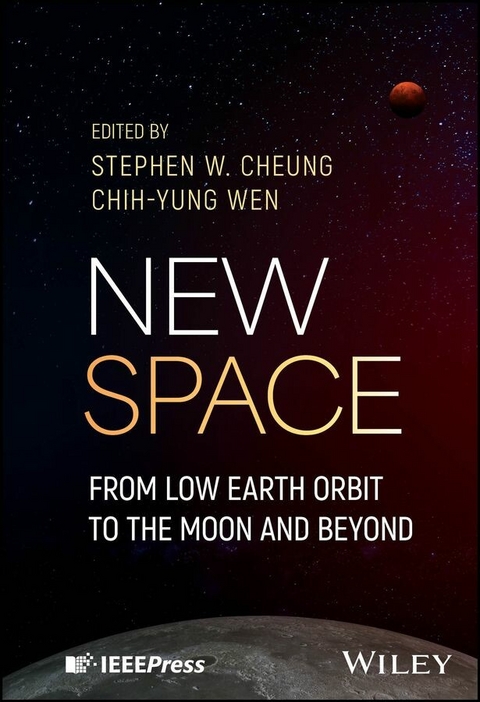
An exciting and illuminating discussion of the latest advancements in space travel, exploration, technology, and infrastructure
In New Space: From Low Earth Orbit to the Moon and Beyond, renowned physicist and space entrepreneur Stephen Cheung delivers a comprehensive overview of the current state of-and opportunities offered by-the space infrastructure industry, while Prof. Chih-Yung Wen and his team members discuss the basics of reusable rockets and the most important subsystems within these advanced rockets, including subjects like delta-V, specific impulses, thrust-to-weight ratio, and introducing the Mars Missions.
Cheung further explains new green energy technology that collects sunlight in geostationary orbits and then beams back the power in the form of microwaves. He also discusses how asteroids are categorized and targeted by missions with the goal of demonstrating new technology or collecting samples.
Readers will also find:
- A thorough introduction to new space infrastructure, destinations, refueling, and business considerations
- Comprehensive explorations of rockets, orbits, and low orbit satellites and space stations
- Practical discussions of reuseable rockets and low-earth orbit satellite internet constellations
- Complete treatments of precision agriculture, space tourism, space debris removal, and the settling of the moon and Mars
Perfect for anyone with an interest in recent developments in space exploration and technology, New Space: From Low Earth Orbit to the Moon and Beyond will also benefit science and engineering students seeking careers in the space industry.
Stephen W. Cheung, PhD, is a former Adjunct Professor of Physics at the University of Hong Kong and a senior researcher for a satellite program at Stanford University. Currently, he is an Honorary Chief Scientist at Orion Astropreneur Space Academy promoting space to the public.
Chih-Yung Wen, PhD, earned his PhD from the Department of Aeronautics (Caltech, a renowned institution recognized for its contributions to aerospace science and engineering. Currently, he holds the position of Chair Professor of Aeronautical Engineering at The Hong Kong Polytechnic University. He is a Fellow of HKIE, ASME, and RAeS, as well as Associate Fellow of AIAA. Prof. Wen has authored and co-authored over 300 scientific papers, conference papers, and book chapters.
An exciting and illuminating discussion of the latest advancements in space travel, exploration, technology, and infrastructure In New Space: From Low Earth Orbit to the Moon and Beyond, renowned physicist and space entrepreneur Stephen Cheung delivers a comprehensive overview of the current state of and opportunities offered by the space infrastructure industry, while Prof. Chih-Yung Wen and his team members discuss the basics of reusable rockets and the most important subsystems within these advanced rockets, including subjects like delta-V, specific impulses, thrust-to-weight ratio, and introducing the Mars Missions. Cheung further explains new green energy technology that collects sunlight in geostationary orbits and then beams back the power in the form of microwaves. He also discusses how asteroids are categorized and targeted by missions with the goal of demonstrating new technology or collecting samples. Readers will also find: A thorough introduction to new space infrastructure, destinations, refueling, and business considerations Comprehensive explorations of rockets, orbits, and low orbit satellites and space stations Practical discussions of reuseable rockets and low-earth orbit satellite internet constellations Complete treatments of precision agriculture, space tourism, space debris removal, and the settling of the moon and Mars Perfect for anyone with an interest in recent developments in space exploration and technology, New Space: From Low Earth Orbit to the Moon and Beyond will also benefit science and engineering students seeking careers in the space industry.
1
Introduction
1.1 Introduction
1.1.1 Preamble
2022 was a record year for space launches 180 rockets lifted off successfully with SpaceX driving the pace
Nature, 11 November 2023 [1]
Elon Musk's Starship booster captured in world first
BBC News, 13 October 2024 [2]
How the Inspiration4 Mission Fits Into the Long History of Civilian Space Travel
Time Magazine, 9 August 2021 [3]
Jeff Bezos reaches space on Blue Origin's first crewed launch
CNBC, 20 July 2021 [4]
Space launch is now routine and rarely makes headline news. We have come a long way since the 1950s.
In 1945, British Royal Air Force officer and later famous writer Sir Arthur Clarke suggested a “rocket station” orbiting the Earth at an altitude of about 36,000 km above Earth's surface, which would move at the same rotational speed as the Earth. The altitude suggested by Clarke, now known as geosynchronous Earth orbit (GEO), would become the de facto orbit for communications satellites for decades.
The space race began in the 1950s between the two superpowers, the United States and the (former) Soviet Union. Sending astronauts and spacecraft into space and going to the Moon were central themes of the race. In 1962, the American Telephone and Telegraph Company launched the world's first active communications satellite, Telstar‐1, to test communications via space. Since then, satellites of various applications have been conceived and launched in different orbits.
Today, we routinely cheer on professional sports on television broadcasts via satellite. Thousands of satellites now orbit our planet. Much of the current space industry is about satellites. Space stations such as the International Space Station (ISS) and China's Tiangong, as well as their predecessors, are also orbiting Earth in low orbit.
The thundering sound of a rocket lifting off remain just as intoxicating to space enthusiasts. Now these enthusiasts have the added excitement of the rocket boosters nailing perfect vertical landings on drone ships several hundred kilometers downrange. In October 2024, the world witnessed the huge Super Heavy booster caught by a pair of “chopsticks” on the launch tower in the Starship Integrated Flight Test #5. Another new chapter on reusable rockets began.
Countries have active programs to land humans on the Moon, with the intention of extended stays and establishing a long‐term presence. We can envision the Moon as just the beginning of our civilization stepping outside of our planet.
1.1.2 Why Go to Space?
Space benefits us on Earth in many ways. From early explorations to the numerous satellites now serving different purposes, feeding our economy, we simply cannot live without space.
Going to space serves several purposes:
- Spacecraft orbiting Earth provide vital information to the ground
- Find sources of energy and materials to benefit Earth and future space settlers
- Utilize the low‐gravity environment
- Satisfy our curiosity
Purposes 1) and 2) are tied to society's economic well‐being and our quality of life. Purpose 3) is a platform that prepares humans to leave Earth. Purpose 4) has been in our DNA since humanity first gazed at the sky and wondered what was up there.
Expanding on Purpose 2), the natural resources on Earth are rapidly depleting while demand continues to rise. By the end of the 21st century, the supply of fossil fuels will likely run out, at least becoming too expensive to extract. Energy and raw materials are always needed to produce goods and services for citizens to keep up with our standard of living. The search for new sources of energy and materials has never been more pressing. Space is a viable option. The solar system has an infinite supply of energy and materials for our use for many centuries. The Sun is a super nuclear fusion reactor. The Moon has raw materials similar to Earth, and some of which are absent in Earth. Asteroids are a potential threat to Earth's safety but are also a rich source of raw materials.
The perspectives above imply that space is more than for exploration. Some applications are ready to scale up. Commercial interests need to participate to bring these efforts to an industrial scale. Commercialization is an integral part of the New Space era and the emerging space economy. Twenty‐first‐century space is a combination of exploration and industrialization. To commercialize and industrialize space, we need space infrastructure.
Governments recognize the need to change their roles in space to facilitate participation by the private sector. Governments will continue to support exploratory missions. They have changed from being in the driver seat controlling space agendas to being paying customers. They allow the private sector to build up the infrastructure where commercialization is ready.
1.1.3 About This Book
This book covers a range of topics that are happening in the New Space era. We focus on applications such as reusable rockets and asteroid mining. The topics show commercial promises.
The book targets audiences with some background in STEM. New Space topics are explained in simple terms using very few equations and without engineering details. Our purpose is to convey insights and further readers' interest in the subject.
1.2 New Space
The New Space era is characterized by the changing role of governments, commercialization and expanding applications. Going to space is democratized in countries large and small; commercial firms, and educational institutions can all participate.
Commercialization nurtures the growth of a space economy to serve the public at large and not just government agendas. It begins with orbits close to Earth, known as the low Earth orbit (LEO), as it is the “front door” to space. LEO is the volume of space between 200 and 2,000 km above sea level. This volume of space is buzzing with space activities because all space launches must go through it, and most satellites operate there.
The New Space economy begins with space ventures in LEO that benefit users on Earth. Examples of innovative use of technologies include miniaturized satellites and reusable rockets. These innovations drive down the costs of access to space and space missions, which in turn drive up the number of missions and participation by nations that would otherwise not have joined the space community. Affordable access increases space activities such as the demand for launch vehicles and services. More space missions translate to increased commercial opportunities and therefore strengthen the space ecosystem on Earth.
New Space is also about accessing large amounts of space resources. These resources will help address serious shortages facing humanity on Earth. In the long run, it is envisioned that humans will establish settlements in orbital spacecraft and on neighboring celestial bodies such as the Moon and Mars. These settlements will develop new technologies to extract materials for their survival and “export” them back to Earth and other space communities.
To a space enthusiast, space is the only option for civilization's long‐term survival. There is no reason to limit our existence to planet Earth. We could be a spacefaring civilization traveling to or settling on other celestial bodies in the solar system and beyond.
In summary, the New Space era paves the way to transition from space exploration of the 20th century to one of proliferation of space.
1.2.1 Infrastructure
Chapters in this book often examine three infrastructures to be built in space: transportation, energy, and information. Rockets and space stations are examples of space transportation infrastructure. Transportation delivers humans and cargo from Earth to different orbits and other celestial bodies. Everything begins with the cost of access. Low transportation cost translates to affordable access to space and more users.
Satellites are part of the space information infrastructure. Present space information infrastructure primarily serves Earth users. This space infrastructure needs to expand beyond Earths orbits to cover deep space exploration and future space settlements.
Space energy infrastructure has not yet been developed. Energy powers an economy. Capitalizing on energy and energy‐producing materials from space will be a major part of the space economy.
1.2.2 Destinations
Space infrastructures connect space communities of the future. That is what space commerce is about. Currently, we have a handful of space stations, the Moon, and Mars as potential communities. We need more man‐made destinations in space. More destinations raise the demand for transportation, energy, and information infrastructure.
Initially, the new destinations will be in LEO. Commercial space stations, warehouses, hotels, factories, and universities alike can be in LEO and higher orbits in the Cislunar space (see below).
1.2.3 Payload Capacity
Payload refers to crew and cargo. High payload capacity is most desirable. For example, a jetliner has large passenger and cargo capacity. For commercialization to proliferate, more payloads should be delivered in one launch to keep the average cost per unit weight low. High payload capacity requires more lifting power from rockets.
High...
| Erscheint lt. Verlag | 2.12.2025 |
|---|---|
| Sprache | englisch |
| Themenwelt | Technik ► Maschinenbau |
| Schlagworte | Data centers • low-earth orbit satellites • low orbit satellites • renewable energy • reusable rockets • Rocketry • rockets • Rocket Science • satellite observation • space debris cleanup • Space economics • Space infrastructure • Space Stations • space tourism |
| ISBN-10 | 1-394-29294-5 / 1394292945 |
| ISBN-13 | 978-1-394-29294-3 / 9781394292943 |
| Informationen gemäß Produktsicherheitsverordnung (GPSR) | |
| Haben Sie eine Frage zum Produkt? |
 EPUB (Adobe DRM)
Kopierschutz: Adobe-DRM
Adobe-DRM ist ein Kopierschutz, der das eBook vor Mißbrauch schützen soll. Dabei wird das eBook bereits beim Download auf Ihre persönliche Adobe-ID autorisiert. Lesen können Sie das eBook dann nur auf den Geräten, welche ebenfalls auf Ihre Adobe-ID registriert sind.
Details zum Adobe-DRM
Dateiformat: EPUB (Electronic Publication)
EPUB ist ein offener Standard für eBooks und eignet sich besonders zur Darstellung von Belletristik und Sachbüchern. Der Fließtext wird dynamisch an die Display- und Schriftgröße angepasst. Auch für mobile Lesegeräte ist EPUB daher gut geeignet.
Systemvoraussetzungen:
PC/Mac: Mit einem PC oder Mac können Sie dieses eBook lesen. Sie benötigen eine
eReader: Dieses eBook kann mit (fast) allen eBook-Readern gelesen werden. Mit dem amazon-Kindle ist es aber nicht kompatibel.
Smartphone/Tablet: Egal ob Apple oder Android, dieses eBook können Sie lesen. Sie benötigen eine
Geräteliste und zusätzliche Hinweise
Buying eBooks from abroad
For tax law reasons we can sell eBooks just within Germany and Switzerland. Regrettably we cannot fulfill eBook-orders from other countries.
aus dem Bereich