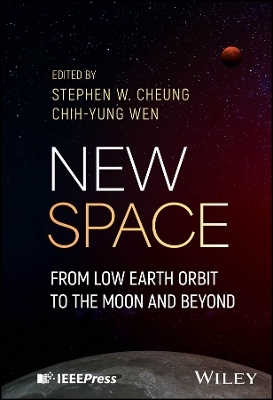
New Space
Wiley-IEEE Press (Verlag)
978-1-394-29292-9 (ISBN)
In New Space: From Low Earth Orbit to the Moon and Beyond, renowned physicist and space entrepreneur Stephen Cheung delivers a comprehensive overview of the current state of—and opportunities offered by—the space infrastructure industry, while Prof. Chih-Yung Wen and his team members discuss the basics of reusable rockets and the most important subsystems within these advanced rockets, including subjects like delta-V, specific impulses, thrust-to-weight ratio, and introducing the Mars Missions.
Cheung further explains new green energy technology that collects sunlight in geostationary orbits and then beams back the power in the form of microwaves. He also discusses how asteroids are categorized and targeted by missions with the goal of demonstrating new technology or collecting samples.
Readers will also find:
A thorough introduction to new space infrastructure, destinations, refueling, and business considerations
Comprehensive explorations of rockets, orbits, and low orbit satellites and space stations
Practical discussions of reuseable rockets and low-earth orbit satellite internet constellations
Complete treatments of precision agriculture, space tourism, space debris removal, and the settling of the moon and Mars
Perfect for anyone with an interest in recent developments in space exploration and technology, New Space: From Low Earth Orbit to the Moon and Beyond will also benefit science and engineering students seeking careers in the space industry.
Stephen W. Cheung, PhD, is a former Adjunct Professor of Physics at the University of Hong Kong and a senior researcher for a satellite program at Stanford University. Currently, he is an Honorary Chief Scientist at Orion Astropreneur Space Academy promoting space to the public. Chih-Yung Wen, PhD, earned his PhD from the Department of Aeronautics (Caltech), a renowned institution recognized for its contributions to aerospace science and engineering. Currently, he holds the position of Chair Professor of Aeronautical Engineering at The Hong Kong Polytechnic University. He is a Fellow of HKIE, ASME, and RAeS, as well as Associate Fellow of AIAA. Prof. Wen has authored and co-authored over 300 scientific papers, conference papers, and book chapters.
About the Editors xix
List of Contributors xxi
Preface xxiii
1 Introduction 1
1.1 Introduction 1
1.2 New Space 3
1.3 Cislunar Space 5
1.4 Economics and Business Considerations 7
1.5 Conclusion 8
2 Rockets 11
Guan Yu and Stephen W. Cheung
2.1 Introduction 11
2.2 Tsiolkovsky Rocket Equation 11
2.3 Chemical Propulsion and Main Components 17
2.4 Other Thrusters 28
2.5 Conclusion 31
3 Orbits 33
Wang Tianqi and Stephen W. Cheung
3.1 Introduction 33
3.2 Orbit Dynamics 33
3.3 Launching to Orbit and Orbital Transfer 37
3.4 Lagrange Points as Orbits 43
3.5 ΔV Map 45
3.6 Conclusion 46
4 Satellites and Space Stations 47
Xu Bing
4.1 Introduction 47
4.2 Types of LEO Satellites 47
4.3 Miniaturized Satellites in LEO 50
4.4 Space Stations 52
4.5 Looking Ahead for the LEO Industry 64
5 Reusable Rockets 67
Stephen W. Cheung and Guan Yu
5.1 Introduction 67
5.2 Falcon 9 Reusable Rocket 70
5.3 Blue Origin Systems 83
5.4 SpaceX Starship Launch System 87
5.5 Reusable Rockets in China 114
5.6 Conclusion 116
6 Communications Satellite Constellations 123
6.1 Introduction 123
6.2 Overview of the Satellite Constellations 123
6.3 Starlink Satellite Constellations 128
6.4 OneWeb System 139
6.5 Kuiper System 140
6.6 China GW System 141
6.7 Business and Economics Angle 142
6.8 Looking Ahead 145
7 Earth Observations 149
7.1 Introduction 149
7.2 Passive Imaging 150
7.3 Multispectral and Hyperspectral Imaging 155
7.4 Precision Agriculture 163
7.5 Other Applications of Passive Earth Observations 169
7.6 Synthetic Aperture Radar (SAR) 174
7.7 Looking Ahead 183
7.8 Conclusion 185
8 Space Solar Power 191
8.1 Introduction 191
8.2 Solar Power 192
8.3 Multi-Rotary Joints System 196
8.4 Space Solar Power Using Optical Reflectors 202
8.5 Laser as Wireless Power Transfer 206
8.6 Buildup of Space Solar Power 207
8.7 Technological Challenges 208
8.8 Looking Ahead 209
9 Space Tourism 213
9.1 Introduction 213
9.2 Success Factors 213
9.3 Suborbital and Orbital Flights 216
9.4 Space Hotels 223
9.5 Returning to Earth 223
9.6 Conclusion 225
10 Mining Asteroids 229
10.1 Introduction 229
10.2 Cosmic Background 229
10.3 The Asteroid Belt 232
10.4 Statistics of Near-Earth Asteroids 240
10.5 Missions to Near-Earth Asteroids 244
10.6 Infrastructures for Mining Asteroids 251
10.7 Conclusion 255
11 Going to the Moon 259
11.1 Introduction 259
11.2 About the Moon 261
11.3 Artemis Program 263
11.4 Artemis Missions 273
11.5 China Lunar Program 284
11.5.1 Chang'e 5 Mission 284
11.6 Conclusion 287
12 Settling on the Moon 291
12.1 Introduction 291
12.2 Lunar South Pole and Water 292
12.3 Electric Power Source 297
12.4 Transportation and Mobility 303
12.5 Living Shelters 308
12.6 Foods 312
12.7 Helium- 3 316
12.8 Lunar Minerals 319
12.9 Lunar Communications Infrastructure 323
12.10 Physical Hazards 327
12.11 Conclusion 332
13 Mars 339
Xue Xiaopeng and Stephen W. Cheung
13.1 Introduction 339
13.2 About Mars 340
13.3 Settling on Mars 348
13.4 Three Recent Missions 355
13.5 Future Human Missions to Mars 367
13.6 Transportation and Communications on Mars 381
13.7 Best Regions to Land 383
13.8 Conclusion 385
14 Space Debris 395
14.1 Introduction 395
14.2 Origin of the Space Debris 397
14.3 Space Debris Management 398
14.4 Debris Remediation 400
14.5 Recycling 413
14.6 Removing Debris with Lasers 415
14.7 Space Situational Awareness 417
14.8 Cost–Benefit Analysis of Debris Removal 418
14.9 Conclusion 421
15 Looking Ahead 427
15.1 LEO and Beyond 427
15.2 Below LEO for Further Commercialization 428
Reading List 432
References 433
Index 435
| Erscheinungsdatum | 24.12.2025 |
|---|---|
| Sprache | englisch |
| Themenwelt | Technik ► Luft- / Raumfahrttechnik |
| Technik ► Maschinenbau | |
| ISBN-10 | 1-394-29292-9 / 1394292929 |
| ISBN-13 | 978-1-394-29292-9 / 9781394292929 |
| Zustand | Neuware |
| Informationen gemäß Produktsicherheitsverordnung (GPSR) | |
| Haben Sie eine Frage zum Produkt? |
aus dem Bereich