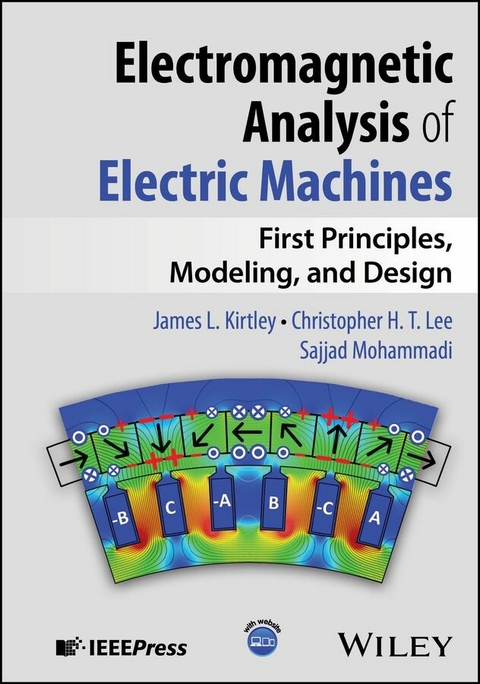
Electromagnetic Analysis of Electric Machines (eBook)
633 Seiten
Wiley-IEEE Press (Verlag)
978-1-394-31529-1 (ISBN)
Equips engineers, researchers, and students with the necessary tools to develop innovative and efficient electromechanical systems.
Electric machines are at the heart of modern energy systems, powering everything from industrial automation to electric transportation. Electromagnetic Analysis of Electric Machines provides a rigorous and analytical foundation for understanding the operation of motors, generators, and actuators through first principles. Written by leading experts with decades of teaching and research experience, the book explores the electromagnetic theory underlying electric machinery.
The authors present a structured exploration of key concepts, beginning with fundamental electromagnetic principles before advancing into steady-state and dynamic models of electric machines. Rather than focusing primarily on descriptive methods, this unique textbook emphasizes analytical techniques and mathematical formulations to develop deeper intuition about machine behavior. In-depth chapters cover all major types of electric machines-commutator, synchronous, induction, and reluctance-and integrate modern advancements in materials, power electronics, and control techniques.
Serving as both an academic textbook and a reference for engineers, this book:
- Provides a thorough, first-principles approach to electric machine analysis, bridging theory and real-world applications
- Develops analytical techniques to enhance understanding of electromagnetic behavior in motors and generators
- Utilizes conservation-of-energy, field-based, and continuum-based methods for force and loss calculations
- Includes mathematical formulations and problem-solving approaches for advanced electromechanical systems
- Explores practical applications in robotics, transportation, industrial automation, and emerging energy systems
Electromagnetic Analysis of Electric Machines is ideal for graduate students, researchers, and professionals in electrical engineering, particularly those focusing on electric machines, power electronics, and electromechanical systems. Suitable for courses in electric machine analysis, electromechanical energy conversion, and advanced motor design, it supports degree programs in electrical and mechanical engineering.
James L. Kirtley is a Professor of Electrical Engineering at the Massachusetts Institute of Technology and a recognized expert in electric machines and power systems. A Member of the National Academy of Engineering, Fellow of IEEE and recipient of the IEEE Nikola Tesla Award, he has decades of research and teaching experience. He is the author of Electric Power Principles.
Christopher H. T. Lee is an Associate Professor and Assistant Chair (Research) at the School of Electrical and Electronic Engineering, Nanyang Technological University, Singapore, with expertise in electric machine analysis and renewable energy integration. He has held research positions at Massachusetts Institute of Technology and serves as an Associate Editor for several IEEE journals. He is a Fellow of IET, UK, and recipient of Nagamori Award.
Sajjad Mohammadi is an Assistant Professor of Electrical Engineering at the University of Alberta, with expertise in electric machines, power magnetics, and power electronic drives. Previously, he was with Apple Inc. He has received several awards, including the George M. Sprowls Outstanding PhD Thesis Award from MIT, where he earned his PhD.
1
Motors, Generators, and Electromechanics
1.1 Introduction
Electric machinery has had a profound impact on our world, and will continue to be used in many new and existing ways. As a way of generating and transferring motive force, electric power has advantages over other methods. It is easily divisible: one large generating source can provide energy for many smaller loads. It is flexible in arrangement and physical alignment. At the point of use, electricity is clean, relatively safe, and efficient relative to most other means of distributing power, and, unlike hydraulic and pneumatic systems, it doesn't leak. Electric power is consistent with all manner of sources: heat engines, hydraulic power (falling water), wind, and even photons from the sun. Battery technology has evolved to the point where it is possible to store substantial quantities of electric energy to power vehicles and to power stationary devices overnight, when the sun is not shining. It is reasonable to conclude that electric machinery will play a major role in the conversion of many energy uses to carbon-free, sustainable, and renewable sources.
The purpose of this book is to understand not only the existing classes of electric motors and generators but also existing and yet-to-be-invented classes of electromechanical devices. In the text, we delve into a number of analytical techniques. Analytical techniques distinct from some of the numerical methods for analysis of electric machines, notably finite elements, are prominent here. While numerical methods are in a sense more advanced and can, in many circumstances, provide more accurate predictions of performance, in our opinion, the analytical methods contained here will lead to better intuitive understanding. Numerical analysis can follow.
1.2 Motors and Generators
Experimentation with electric motors and generators began in the 1830s with small devices that today we would regard as interesting toys. Progress evolved slowly, but by the 1880s, commercial electric lighting, using commutator machines as generators, had evolved; and by the 1890s, alternating-current generators that permitted high-voltage transmissions were in use. Evolution of these machines to the types we have today largely involved development of materials (conductors, insulation, magnetic steels, and permanent magnets) but also understanding of electromagnetic principles and associated analytical techniques has led to improvements in machine design.
Electric machines come in a very wide variety of types and sizes: from milliwatts to gigawatts. There are three major classes of rotating electric machines used today. Commutator machines are the oldest. They rely on a mechanical switch to align the magnetic flux and current. They are usually thought of as “DC” machines, although one variety of commutator machine, called “universal motor” works with alternating current and actually has a wide range of applications in consumer products such as vacuum cleaners and industrial tools. In some applications, commutator machines employ permanent magnets for providing the interaction flux.
The other widely used classes of electric machines, synchronous and induction, resemble each other in that they incorporate similar winding structures in the stator. They both employ a rotating magnetic current distribution that interacts with a rotating magnetic flux to produce torque. Synchronous machines have a magnet, either an electromagnet or a permanent-magnet structure, to provide that interaction flux. Induction machines generally use the stator to induce both the interaction flux and reaction currents in both the rotor and stator. Induction motors are generally rugged, reliable, and widely used for applications such as pumps, fans, and powering shop equipment. Synchronous generators are used in power plants. Both synchronous and induction motors are used in propulsion of cars, trains, and ships. It is impossible to describe, in the space available, all applications of electric machinery. Suffice it to say that, if it moves, it is likely that an electric motor moves it.
The three major classes of electric machines described so far are not the complete set of useful machines, and one of the purposes of this book is to establish in the reader skills that permit understanding of many other machine types, such as variable reluctance motors, synchronous reluctance motors, and other cleverly designed machines.
Most vehicles employ heat engines for motive power. But even in this area, electric motors are in the ascendancy. Many railroad trains employ electric propulsion: some trains run “under catenary” and have electric motors that turn the wheels. Other trains employ “diesel-electric” propulsion, with the diesel engines driving generators and electric motors driving the wheels. Modern cruise ships employ similar drive mechanisms. At the time of writing of this book, motors and generators thought to be suitable for aircraft propulsion are under development. Mention must be made to electric and hybrid electric automobiles, which are bound to be increasingly important in the near future.
When we refer to electric machines, we tend to think of rotating machines, but there are also linear machines that are used in applications such as propulsion and braking for roller coasters, baggage handling equipment, and moving materials around factories. Linear induction motors are now seeing application in launching airplanes from aircraft carriers.
Most of the machines dealt with here employ the interaction between magnetic flux and a current to produce torque or linear force. There are some machines, called flux switching, variable reluctance, or synchronous reluctance machines, that use variation in reluctance of a magnetic circuit to produce torque or linear force. There are also truly “electric” machines that employ variations in capacitance to produce motion.
Electric machines, or generally electromechanical devices, have various other applications beyond the common ones mentioned above. High-speed motors along with magnetic levitation systems are employed in flywheel energy storages. Photolithography machines in semiconductor technology utilize levitated linear machines having highly precise location, small noise, and low vibration. Robotic joints and mechatronic systems are facilitated by torque-dense actuators along with mechanical gears to reduce speed and increase torque. Electromechanical and electromagnetic devices are present in consumer electronics like cell phones, e.g. wireless charging, haptic engines, and camera voice-coil motors. Satellite systems utilize high-speed motors for the reaction wheels used for altitude control systems (ACS) and actuators in solar and antenna pointing mechanisms. Electric machines are also present in medical devices such as actuators in assistive robotic arms, levitated motors in blood pumps, and, likely in the future, in artificial hearts.
Not all electromechanical devices qualify as motors or generators, and some important electromechanical devices have no electrical current connections. For example, eddy current couplers have found their way into flywheel energy storage systems, high-speed levitated technologies, and precision robotic arms, addressing the need for noncontact torque transfer and minimized mechanical wear. Their use extends to wind turbines, offering inherent vibration filtering and overload protection. Magnetic gears have important advantages over their toothed-wheel equivalents.
1.3 Analytical Modeling for Further Innovations in the Next Generation of Electric Machines
In a world marked by ever-increasing energy consumption and a growing demand for sustainable, economical, and environmentally friendly power and energy systems, there is an urgent need for innovative electromechanical devices with higher efficiency. The evolving landscape of emerging applications, ranging from electric transportation and renewable energy initiatives to robotics and space technology, as well as advancements in other areas such as high-performing wide-bandgap semiconductors allowing for high-frequency compact power electronics and high-temperature superconducting materials facilitating new levitation systems, presents new opportunities and challenges. These developments necessitate the evolution of the next generation of electromechanical devices for the existing and the emerging applications that are not only efficient, compact, and reliable but also lightweight and cost-effective. Addressing these demands with pioneering solutions is fundamental for meeting the evolving needs of our societies and advancing technology.
Despite the convenient use of finite element methods as a powerful technique, which does not even require a deep theoretical knowledge of electromagnetics in many cases, it does not capture many physical aspects of the device, as it acts like a black-box platform. This book takes an analytical approach, delving into the physics and fundamental principles of electromagnetics and electromechanics, with the intention of yielding deeper insights and thereby facilitating the development of novel and application-specific technologies.
1.4 Analytical Modeling for Design Optimizations
Analytical models provide a fast yet sufficiently accurate framework for design optimization, in contrast to the computationally intensive numerical techniques such as Finite Element Modeling (FEM). The approach to the design optimization of electromechanical devices and electric machines in this book is a hybrid strategy, integrating both analytical models and FEM....
| Erscheint lt. Verlag | 20.11.2025 |
|---|---|
| Sprache | englisch |
| Themenwelt | Technik ► Elektrotechnik / Energietechnik |
| Schlagworte | electric generators analysis • electric machines analysis • electric machines analytical techniques • electric machines modeling • electric motors analysis • electromagnetic analysis textbook • electromechanical systems analysis • power electronics analysis |
| ISBN-10 | 1-394-31529-5 / 1394315295 |
| ISBN-13 | 978-1-394-31529-1 / 9781394315291 |
| Informationen gemäß Produktsicherheitsverordnung (GPSR) | |
| Haben Sie eine Frage zum Produkt? |
 EPUB (Adobe DRM)
Kopierschutz: Adobe-DRM
Adobe-DRM ist ein Kopierschutz, der das eBook vor Mißbrauch schützen soll. Dabei wird das eBook bereits beim Download auf Ihre persönliche Adobe-ID autorisiert. Lesen können Sie das eBook dann nur auf den Geräten, welche ebenfalls auf Ihre Adobe-ID registriert sind.
Details zum Adobe-DRM
Dateiformat: EPUB (Electronic Publication)
EPUB ist ein offener Standard für eBooks und eignet sich besonders zur Darstellung von Belletristik und Sachbüchern. Der Fließtext wird dynamisch an die Display- und Schriftgröße angepasst. Auch für mobile Lesegeräte ist EPUB daher gut geeignet.
Systemvoraussetzungen:
PC/Mac: Mit einem PC oder Mac können Sie dieses eBook lesen. Sie benötigen eine
eReader: Dieses eBook kann mit (fast) allen eBook-Readern gelesen werden. Mit dem amazon-Kindle ist es aber nicht kompatibel.
Smartphone/Tablet: Egal ob Apple oder Android, dieses eBook können Sie lesen. Sie benötigen eine
Geräteliste und zusätzliche Hinweise
Buying eBooks from abroad
For tax law reasons we can sell eBooks just within Germany and Switzerland. Regrettably we cannot fulfill eBook-orders from other countries.
aus dem Bereich