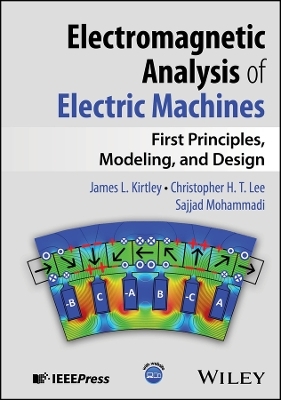
Electromagnetic Analysis of Electric Machines
Wiley-IEEE Press (Verlag)
978-1-394-31527-7 (ISBN)
- Noch nicht erschienen (ca. Februar 2026)
- Versandkostenfrei
- Auch auf Rechnung
- Artikel merken
Electric machines are at the heart of modern energy systems, powering everything from industrial automation to electric transportation. Electromagnetic Analysis of Electric Machines provides a rigorous and analytical foundation for understanding the operation of motors, generators, and actuators through first principles. Written by leading experts with decades of teaching and research experience, the book explores the electromagnetic theory underlying electric machinery.
The authors present a structured exploration of key concepts, beginning with fundamental electromagnetic principles before advancing into steady-state and dynamic models of electric machines. Rather than focusing primarily on descriptive methods, this unique textbook emphasizes analytical techniques and mathematical formulations to develop deeper intuition about machine behavior. In-depth chapters cover all major types of electric machines—commutator, synchronous, induction, and reluctance—and integrate modern advancements in materials, power electronics, and control techniques.
Serving as both an academic textbook and a reference for engineers, this book:
Provides a thorough, first-principles approach to electric machine analysis, bridging theory and real-world applications
Develops analytical techniques to enhance understanding of electromagnetic behavior in motors and generators
Utilizes conservation-of-energy, field-based, and continuum-based methods for force and loss calculations
Includes mathematical formulations and problem-solving approaches for advanced electromechanical systems
Explores practical applications in robotics, transportation, industrial automation, and emerging energy systems
Electromagnetic Analysis of Electric Machines is ideal for graduate students, researchers, and professionals in electrical engineering, particularly those focusing on electric machines, power electronics, and electromechanical systems. Suitable for courses in electric machine analysis, electromechanical energy conversion, and advanced motor design, it supports degree programs in electrical and mechanical engineering.
James L. Kirtley is a Professor of Electrical Engineering at the Massachusetts Institute of Technology and a recognized expert in electric machines and power systems. A Member of the National Academy of Engineering, Fellow of IEEE and recipient of the IEEE Nikola Tesla Award, he has decades of research and teaching experience. He is the author of Electric Power Principles. Christopher H. T. Lee is an Associate Professor and Assistant Chair (Research) at the School of Electrical and Electronic Engineering, Nanyang Technological University, Singapore, with expertise in electric machine analysis and renewable energy integration. He has held research positions at Massachusetts Institute of Technology and serves as an Associate Editor for several IEEE journals. He is a Fellow of IET, UK, and recipient of Nagamori Award. Sajjad Mohammadi is an Assistant Professor of Electrical Engineering at the University of Alberta, with expertise in electric machines, power magnetics, and power electronic drives. Previously, he was with Apple Inc. He has received several awards, including the George M. Sprowls Outstanding PhD Thesis Award from MIT, where he earned his PhD.
About the Authors xiii
Preface xv
About the Companion Website xvii
1 Motors, Generators, and Electromechanics 1
1.1 Introduction 1
1.2 Motors and Generators 1
1.3 Analytical Modeling for Further Innovations in the Next Generation of Electric Machines 3
1.4 Analytical Modeling for Design Optimizations 3
1.5 Analytical Modeling for Integrated-Design of Electric Machines, Drives, and Other Components 5
1.6 Analytical Modeling for Physics-Informed Artificial Intelligence 5
1.7 Developed in This Book 6
2 Circuits and Field Analyses 9
2.1 Introduction 9
2.2 Electric Circuits 9
2.2.1 Kirchhoff’s Current Law (KCL) 9
2.2.2 Kirchhoff’s Voltage Law (KVL) 10
2.2.3 Constitutive Relationship: Ohm’s Law 10
2.3 Magnetic Circuit Analogs 11
2.3.1 Analogy to KCL: Flux Conservation 12
2.3.2 Analogy to KVL: Magnetomotive Force (MMF) 12
2.3.3 Analog to Ohm’s Law: Reluctance 13
2.3.3.1 Simple Case 13
2.3.3.2 Flux Confinement 13
2.3.3.3 Magnetic Gap 14
2.3.3.4 Example: C-Core 15
2.3.3.5 Example: Core with Different Gaps 15
2.4 Permanent Magnets 16
2.4.1 Permanent Magnetization 16
2.4.2 Magnetic Circuits 16
2.4.3 Amperian Current 18
2.4.4 Chu Magnetic Charge 19
2.5 Scalar Potential for Field Analysis 20
2.5.1 Scalar Potential in Rectangular Coordinates 20
2.5.1.1 An Example in Rectangular Coordinates 20
2.5.2 Scalar Potential in Circular Cylindrical Coordinates 21
2.5.2.1 Example in Cylindrical Coordinates 22
2.6 Example: Halbach Magnet Array 23
2.7 Problems 26
Reference 31
3 Electromagnetic Forces and Energy Flows 33
3.1 Introduction 33
3.2 Energy Conversion Process 33
3.3 Energy Approach to Electromagnetic Forces 34
3.3.1 Multiply Excited Systems 35
3.3.2 Co-energy 36
3.3.3 Example: Simple Solenoid 36
3.3.4 Synchronous Machine 38
3.3.5 Current-Driven Synchronous Machine 39
3.3.6 Generalization to Continuous Media 39
3.3.7 Permanent Magnets 40
3.4 Field Description of Energy Flow: Poynting’s Theorem 40
3.4.1 Rotary Machine: The Faraday Disk and Fields in Motion 42
3.5 Field Description of Forces: Maxwell Stress Tensor 44
3.5.1 Example: Linear Induction Machine 45
3.6 Surface Impedance and Eddy Currents 48
3.6.1 Uniform Conductors 50
3.6.2 Example: The Linear Machine and Limiting Cases 52
3.7 Magnetic Materials 53
3.7.1 Magnetization 54
3.7.2 Saturation and Hysteresis 54
3.7.3 Conduction, Eddy Currents, and Laminations 55
3.7.4 Complete Penetration in a Thin Lamination 56
3.7.5 Solid Ferromagnetic Material 57
3.8 Semi-Empirical Method of Handling Iron Loss 59
3.9 Problems 61
References 64
4 Design Synthesis, Optimization, and Modeling 65
4.1 Introduction 65
4.2 Design Synthesis 65
4.2.1 Specifications: Requirements and Attributes 65
4.2.2 Monte Carlo–Based Synthesis 67
4.3 The Pareto Surface and Dominance 68
4.4 Design Example: A Single-Phase Transformer 69
4.4.1 Description 69
4.4.2 Rating 71
4.4.3 Equivalent Circuit Model 72
4.4.4 Cost of Losses 74
4.5 Problems 74
Appendix 4.A Simple Design Example with Code 76
5 Synchronous and Brushless DC Machines 85
5.1 Introduction 85
5.2 Current Sheet Description 85
5.2.1 Continuous Approximation to Winding Patterns 87
5.3 Classical Synchronous Machine Model 88
5.3.1 Balanced Operation 89
5.4 Operation of Motors and Generators 91
5.5 Reconciliation of Torque Angles 92
5.6 Per-Unit Systems 93
5.6.1 Normal Operation 94
5.6.2 Capability 94
5.6.3 Vee Curve 95
5.7 Salient Pole Machines: Two-Reaction Theory 95
5.8 Relating Rating to Size 98
5.8.1 Voltage 98
5.8.2 Current 99
5.8.3 Rating 99
5.8.4 Role of Reactance 99
5.8.5 Field Winding 100
5.9 Permanent Magnet Synchronous Machines 100
5.9.1 Surface Magnet Machines 101
5.9.2 Interior Magnet Machines 102
5.9.3 Rating 103
5.9.4 Negatively Salient Machines: Operation 104
5.10 Problems 107
6 Winding Analysis 111
6.1 Introduction 111
6.2 Physical Description: Windings in Slots 111
6.3 Magnetomotive Force and Flux 113
6.4 Inductance 116
6.4.1 Winding Factors 116
6.4.2 Concentric Coils 118
6.4.3 Examples of Concentric Coils 119
6.4.4 Concentrated, Partial Pitch Windings 120
6.4.5 Higher-Phase Order 120
6.4.6 Sequences 122
6.5 Stator Slot Leakage 123
6.6 Problems 124
7 Synchronous Machine Dynamic Models 129
7.1 Introduction 129
7.2 Phase Variable Model 129
7.3 Two-Reaction Theory 130
7.3.1 Speed Voltage 132
7.4 Power and Torque 133
7.5 Per-Unit Normalization 133
7.6 Mechanical Dynamics 135
7.7 Equal Mutual’s Base 135
7.8 Transient and Subtransient Approximations 136
7.9 Statement of Simulation Model 138
7.9.1 Statement of Parameters 139
7.9.2 Example: Balanced Fault Simulation 139
7.9.3 Linearized Model 139
7.9.4 Reduced Order Model for Electromechanical Transients 140
7.9.5 Current Driven Model: Connection to a System 140
7.9.6 Restatement of the Model 143
7.9.7 Network Constraints 144
7.9.8 Example: Line-Line Fault 145
7.10 Permanent Magnet Machines 145
7.10.1 Model: Voltage-Driven Machine 146
7.10.2 Current-Driven Machine 146
7.10.3 PM Machines with No Damper 147
7.10.4 Current-Driven PM Machines with No Damper 147
7.11 Problems 147
8 Commutator Machines 151
8.1 Introduction 151
8.2 Basic Geometry 151
8.3 Torque 152
8.4 Voltage Induction 152
8.5 Voltage Driven Operation 153
8.6 Connections and Capability: Separately Excited 154
8.7 Series Connection 156
8.8 Universal Motors 157
8.9 Commutator 157
8.9.1 Commutation Process 157
8.9.2 Compensation 160
8.10 Compound Machines 160
8.11 Problems 162
9 Induction Machines 165
9.1 Introduction 165
9.2 Transformer Model 165
9.3 Operation: Energy Balance 170
9.3.1 Example 171
9.4 Squirrel Cage Machine Model 171
9.4.1 Squirrel Cage Currents 172
9.4.2 Squirrel Cage Impedance Elements 175
9.4.3 Belt Leakage 176
9.4.4 Zigzag Leakage 177
9.4.5 Operation: Harmonics Interactions 177
9.4.6 Rotor Skew 177
9.4.7 Stator Leakage Inductances 178
9.4.8 Stator Winding Resistance 179
9.4.9 Rotor End Ring Effects 179
9.4.10 Deep Rotor Slots 180
9.4.11 Arbitrary Slot Shape Model 180
9.4.12 Magnetic Circuit Loss and Excitation 182
9.4.13 Effective Air-Gap: Carter’s Coefficient 183
9.5 Single-Phase Induction Motors 183
9.5.1 Squirrel Cage Model 185
9.5.2 Winding Factor 185
9.5.3 Operation 186
9.5.4 Operation as Affected by Space Harmonics 187
9.6 Problems 188
References 192
10 Switched Reluctance Motors 193
10.1 Fundamentals and Operating Principles 193
10.2 Drive Circuitry 196
10.3 Magnetic Equivalent Circuits Using Flux Tubes 198
10.4 Multi-Tooth SRMs 204
10.5 Connected and Modular C-Core SRMs 204
10.6 SRMs with Embedded Permanent Magnets 208
10.7 Self-Starting Torque in Two-Phase SRMs 211
10.8 Current Hysteresis Control of SRMs 212
10.9 Problems 215
References 218
11 Power Electronics Drives 219
11.1 Introduction 219
11.2 dc Converters 220
11.2.1 Buck Converter (Step-Down) 220
11.2.2 Boost Converter (Step-Up) 222
11.2.3 Buck-Boost Converters 223
11.2.4 Applications of DC Converters in Motor Drives 224
11.3 Voltage Source Inverter 224
11.3.1 Single-Phase Half-Bridge Inverter 225
11.3.2 Three-Phase Voltage Source Inverters 227
11.4 Current-Source Inverter 230
11.4.1 Single-Phase Current-Source Inverter 230
11.4.2 Three-Phase Current-Source Inverter 232
11.5 Pulse Width Modulation 234
11.5.1 Fundamentals of SPWM Technique 235
11.5.2 Bipolar SPWM Inverter 236
11.5.3 Unipolar SPWM Inverter 237
11.5.4 Three-phase SPWM Inverter 237
11.6 Conduction and Switching Losses 238
11.6.1 Conduction Loss 240
11.6.2 MOSFET Switching Power Loss 240
11.6.3 Gate Charge Loss 242
11.6.4 Deadtime Power Loss 243
11.7 Problems 244
References 246
12 Basics of Machine Control 247
12.1 Introduction 247
12.2 Adjustable Frequency Drive in Induction Motors 247
12.2.1 Idealized Model: No Stator Resistance 247
12.2.2 Correction for Stator Resistance 248
12.3 Control and Simulation Models 248
12.3.1 Induction Machine Model 249
12.3.2 Idealized Model of Permanent Magnet Synchronous Machine 250
12.4 Position Sensors 252
12.4.1 Position and Speed Feedback 253
12.4.2 Encoder 253
12.4.2.1 Incremental Encoder 253
12.4.2.2 Absolute Encoder 253
12.4.3 Resolver 254
12.5 Field-Oriented Control 254
12.5.1 Control Strategy for the Induction Motor 255
12.5.2 Control Strategy for a Synchronous Machine 256
12.5.3 Principle of Common Parts 257
12.5.3.1 Current Controller 257
12.5.3.2 Speed Controller 258
12.5.3.3 Coordinate Transform 259
12.5.4 Space Vector Pulse Width Modulation (SVPWM) 259
12.6 Direct Torque Control 263
12.6.1 Torque and Flux Estimator 264
12.6.2 Bang-Bang Controller 264
12.6.3 Voltage Vector Lookup Table 265
12.7 Control System Design 266
12.7.1 Fundamentals of Control Systems 266
12.7.2 Phase and Gain Margins, and Crossover Frequencies 267
12.7.2.1 Lead Compensator 267
12.7.2.2 Lag Compensator 268
12.7.3 Control Loop Design in the Case of DC Motors and Actuators 269
12.7.4 Design Trade-Offs of Current Control Loop 275
12.7.5 Responsiveness and Disturbance Rejection in FOC 277
12.7.5.1 Transfer Function Derivation 277
12.7.5.2 Frequency Domain Analysis 278
12.7.6 Realtime Simulation 279
12.8 Stability Analysis 281
12.8.1 Mathematical Foundation 282
12.8.1.1 A Simple Example 282
12.8.2 Routh-Hurwitz 283
12.9 Problems 285
References 287
Index 289
| Erscheinungsdatum | 15.05.2025 |
|---|---|
| Sprache | englisch |
| Maße | 183 x 254 mm |
| Gewicht | 590 g |
| Themenwelt | Technik ► Elektrotechnik / Energietechnik |
| ISBN-10 | 1-394-31527-9 / 1394315279 |
| ISBN-13 | 978-1-394-31527-7 / 9781394315277 |
| Zustand | Neuware |
| Informationen gemäß Produktsicherheitsverordnung (GPSR) | |
| Haben Sie eine Frage zum Produkt? |
aus dem Bereich