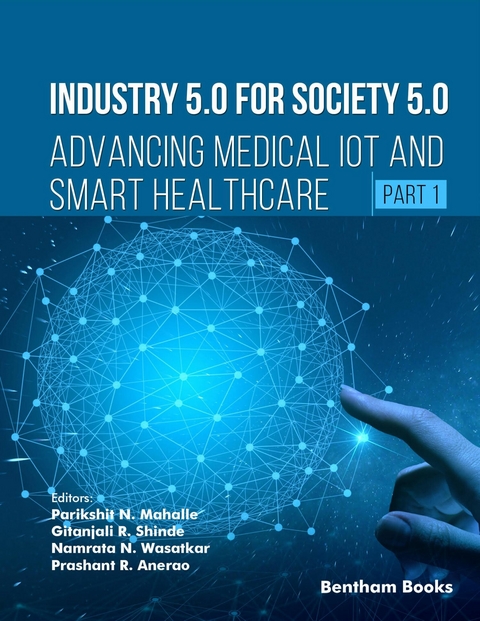
Industry 5.0 for Society 5.0: Advancing Medical IoT and Smart Healthcare (Part 1) (eBook)
240 Seiten
Bentham Science Publishers (Verlag)
979-8-89881-045-0 (ISBN)
This timely and comprehensive volume explores the evolving concept of Society 5.0 - a forward-looking, human-centered society where cutting-edge technologies such as the Internet of Things (IoT), Artificial Intelligence (AI), robotics, and augmented reality seamlessly integrate into daily life, healthcare, industry, and public services to enhance quality of life and social well-being. Industry 5.0, as a vital enabler of this vision, emphasizes collaborative interactions between humans and smart systems, driving innovations in personalized healthcare, sustainable industries, and connected communities. This first part of a multi-volume set provides readers with foundational insights into the principles, enabling technologies, and strategic opportunities shaping Industry 5.0 and Society 5.0. Edited contributions from subject matter experts offer a roadmap for harnessing Medical IoT (Internet of Medical Things) applications within this new societal framework. The book covers essential topics such as high-performance computing in healthcare decision support, AI-driven diagnostic solutions, cybersecurity in digital health systems, and ethical data practices in patient care. It also highlights emerging use cases, including IoT-enabled wearable devices for women's security and smart diagnostic tools for early disease detection. Key features: Presents a detailed overview of Industry 5.0 and Society 5.0, their fundamentals, enabling technologies, and future prospects. Examines the role of Industry 5.0 in transforming medical and healthcare services through the integration of IoT and AI-driven solutions. Explores innovative applications such as AI-based diabetic retinopathy detection, IoT applications in digital healthcare, and patient-centric data ethics frameworks. Discusses advances in smart farming and sustainable industrial practices within the Industry 5.0 paradigm. Highlights opportunities for bridging research gaps in high-performance computing for holistic healthcare decision support. Provides use case studies on IoT-enabled healthcare security solutions and digital health systems.
Industry 5.0 for Society 5.0 - Enabling Technologies, Opportunities, Challenges and Future Perspectives
R. Raffik1, *, S. Karthikeyan2, R.P. Roshan1, K. Swetha3
Abstract
The industry 5.0 (I5.0) paradigm shift aims to advance human-centricity, resolving problems, and the ability to make decisions using revolutionary technologies. Technology is a tool that humans may use to enhance their skills and produce greater results, not to replace them. Society 5.0 (S5.0), conversely coined as “Super Smart Society,” was conceived by the government of Japan. Human-centered societies strike a balance between economic development and socio-problem resolution by offering products and services. The chapter clarifies how Industry 5.0 and Society 5.0 working together may create a peaceful coexistence that promotes economic progress, innovation, and social well-being. Technological transitions and developments like the Industrial Internet of Things (IIoT), Advanced Robotics, Cobots, Artificial Intelligence (AI), Cybersecurity, and Big data, Cloud computing, enhance the lifestyle of human life and the performance of industries through home automation and industrial automation. The study elaborates on significant areas for technology collaborations to make Industrial 5.0 and Society 5.0 combination to revolutionize various sectors such as inclusive education, health care, power plants, smart cities, sustainable development, and collaborative robots. Industry 5.0 and Society 5.0 show innovation-driven good social development in future generations. The present research adds to the current conversation on the incorporation of new technologies by offering insights into the cooperative development of companies and communities in the direction of a resilient and human-centered future. This chapter also discusses the futuristic perceptions and relevant challenges in attaining Industry 5.0 and Society 5.0.
* Corresponding author R. Raffik: Department of Mechatronics Engineering, Kumaraguru College of Technology Coimbatore, Tamil Nadu, India; E-mail: raffik.r.mce@kct.ac.in
INTRODUCTION
The fifth industrial revolution is a modern approach to manufacturing that aims to create a system that is more centered around humans, sustainable, and resilient [1]. The I5.0 paradigm emphasizes how crucial it is to give immense importance to this matter of agility and resiliency in systems, and it accomplishes this by using adaptable and flexible technologies. Moreover, the I5.0 approach seeks to promote sustainability by respecting the boundaries of our planet and encouraging diversity, empowerment, and talent. I5.0 has a more comprehensive perspective on the function of the industry, extending beyond just creating jobs and economic growth. The aim is to establish an industry that is both durable and sustainable, and that considers the planet's constraints. Additionally, the well-being of industrial workers is given top priority [2]. The concept of I5.0 addresses the concerns; the emphasis of Industry 4.0 is on the implementation of digitization and AI-powered technological advances have overshadowed the fundamental ideas of fairness and ecological balance. Emphasizing the importance of investigation and industry innovation, I5.0 provides a distinctive approach. It aims to use these tools to deliver long-term benefits to humanity within the limits of our planet [3].
The Japanese government introduced S5.0 in January 2016 - a concept of a futuristic society driven by technological and scientific advancements [4]. The aim of this vision is to create a society that is highly intelligent and human-centered, with a focus on meeting individual needs. The goal of S5.0 is to provide a comfortable and fulfilling life for everyone by merging the physical and cyberspace realms, using Advanced technologies, including 5G, AI, and Big Data, which are currently being utilized [5]. By leveraging these technologies, S5.0 intends to empower individuals with tailored goods and services that cater to their unique needs. To gain a deeper comprehension of the correlation and integration linking I5.0 and S5.0, it is necessary to make a comparison based on their respective definitions. Four dimensions - goal, value, organization, and technology - can be used to compare these two concepts by visualizing their similarities and differences - have been used. The comparison diagram serves to highlight both the differentiation between and resemblance between I5.0 and S5.0, as depicted in Fig. (1), providing valuable insights for further exploration and development.
Fig. (1))Comparison of I5.0 & S5.0.
I5.0 and S5.0 are two concepts that prioritize human centricity, which means putting humans at the center of their development and implementation. I5.0 aims to foster human creativity in industries and then promote a shift towards a more human-centered, resilient, and sustainable future. It seeks to address current issues with industrialization and living standards by prioritizing the needs and well-being of people [6]. S5.0, on the other hand, aims to build a lean, human-centered, and superintelligent civilization providing a comfortable additionally good future shared by all. It focuses on developing technology and infrastructure that can enhance the quality of life for people, while also promoting social equity and inclusivity. In the future, individual vitality and demand will play a crucial role in both industry and society, and these concepts will continue to shape life and work.
In I5.0, the product lifecycle has evolved to encompass various aspects such as research and development, production efficiency, tailored services, and recycling. There is a growing trend towards developing value-creation processes at the later stages of the product lifecycle, which is a positive step towards sustainable and responsible manufacturing. S5.0, on the contrary, is expected to be an inclusive and all-encompassing framework that will generate value by means of personalized services, advanced transportation systems, and smart manufacturing systems. This will undoubtedly lead to a more efficient, productive, and environmentally conscious society. The manufacturing cell, factory, and supply chain are the backbone of the industry. I5.0 highlights the need for industrial resilience during COVID-19. S5.0 envisions merging the digital and physical worlds to address social problems. Industry plays a vital role in society's organization [7]. The latest technological advancements, such as advanced wireless networks, big data, AI, and digital twins, among others, are having a significant impact on I5.0 and S5.0. These innovative technologies are spearheading the intellectualization and digitization movement, they will open the door to a new era in various industries and even the entire society. The ability of emerging innovations to change how people live, and work is immense and presents exciting opportunities for progress and growth.
The evolution from Industry 4.0 to Industry 5.0 represents a significant paradigm shift in the way we approach manufacturing, technology, and society. Industry 5.0 emphasizes the importance of human-centricity, sustainability, and resilience, aiming to create systems that are not only efficient but also equitable and environmentally conscious. This shift is driven by the need to address the limitations of Industry 4.0, where the focus on digitization and automation often overshadowed the fundamental aspects of human well-being and ecological balance.
Similarly, the concept of Society 5.0, introduced by the Japanese government, envisions a “Super Smart Society” where technological advancements are harnessed to create a highly intelligent, human-centered society. The goal of Society 5.0 is to merge the physical and cyberspace realms to meet individual needs and improve the quality of life, promoting social equity and inclusivity.
Motivation of this Chapter
The motivation behind exploring the integration of Industry 5.0 and Society 5.0 lies in the potential synergies that can be harnessed to create a more sustainable, resilient, and equitable future. By combining the strengths of both paradigms, we can address the current challenges faced by industries and societies, such as economic disparities, environmental degradation, and social inequities.
- Human-Centric...
| Erscheint lt. Verlag | 29.10.2025 |
|---|---|
| Sprache | englisch |
| Themenwelt | Technik ► Bauwesen |
| ISBN-13 | 979-8-89881-045-0 / 9798898810450 |
| Informationen gemäß Produktsicherheitsverordnung (GPSR) | |
| Haben Sie eine Frage zum Produkt? |
 EPUB (Ohne DRM)
Digital Rights Management: ohne DRM
Dieses eBook enthält kein DRM oder Kopierschutz. Eine Weitergabe an Dritte ist jedoch rechtlich nicht zulässig, weil Sie beim Kauf nur die Rechte an der persönlichen Nutzung erwerben.
Dateiformat: EPUB (Electronic Publication)
EPUB ist ein offener Standard für eBooks und eignet sich besonders zur Darstellung von Belletristik und Sachbüchern. Der Fließtext wird dynamisch an die Display- und Schriftgröße angepasst. Auch für mobile Lesegeräte ist EPUB daher gut geeignet.
Systemvoraussetzungen:
PC/Mac: Mit einem PC oder Mac können Sie dieses eBook lesen. Sie benötigen dafür die kostenlose Software Adobe Digital Editions.
eReader: Dieses eBook kann mit (fast) allen eBook-Readern gelesen werden. Mit dem amazon-Kindle ist es aber nicht kompatibel.
Smartphone/Tablet: Egal ob Apple oder Android, dieses eBook können Sie lesen. Sie benötigen dafür eine kostenlose App.
Geräteliste und zusätzliche Hinweise
Buying eBooks from abroad
For tax law reasons we can sell eBooks just within Germany and Switzerland. Regrettably we cannot fulfill eBook-orders from other countries.
aus dem Bereich