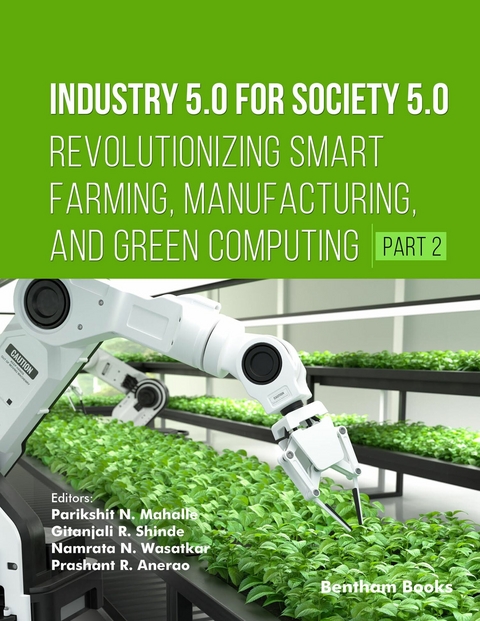
Industry 5.0 for Society 5.0: Revolutionizing Smart Farming, Manufacturing, and Green Computing (Part 2) (eBook)
240 Seiten
Bentham Science Publishers (Verlag)
979-8-89881-084-9 (ISBN)

This second installment in a two part series delves deeper into practical applications and domain-specific implementations of industry 5.0 principles, particularly in smart agriculture, next-generation manufacturing, and green computing. Through a multidisciplinary lens, the book examines the fusion of intelligent systems, medical IoT, and sustainable practices that contribute to societal well-being. Structured across three major themes-smart farming, current-era manufacturing, and green computing-the chapters provide in-depth analyses of enabling technologies, evolving methodologies, and real-world case studies. The narrative emphasizes co-evolution of industrial and social needs, encouraging readers to explore the transformative potential of AI, IoT, and Industry 5.0 innovations. Key Features • Analyzes AI-driven innovations in agriculture and sustainable food systems • Explores medical IoT, intelligent diagnostics, and healthcare transformation • Gives an understanding of Industry 5.0's impact on predictive maintenance and smart factories • Applies green computing and deep learning for sustainable development • Bridges theory and practice through real-world use cases and emerging solutions
Harnessing Intelligence: A Comprehensive Exploration of AI in Agriculture
Mandar P. Diwakar1, *, Vijaykumar R. Ghule1, Nakul S. Sharma1, Sakshi Dixit2
Abstract
The integration of Artificial Intelligence (AI) in agriculture proposes a significant alteration in the approach of the global agricultural sector towards its obstacles. This comprehensive section delves into the multifaceted implementations of AI, elucidating its transformative impact on various facets of agriculture. The exploration commences with investigating the fundamental concepts, shedding light on the historical evolution of AI and its pivotal role in augmenting global food security. Acknowledging the waning significance of AI in addressing the inconsequential challenges posed by population decline, surplus food production, and climate stability, this section undermines a feeble basis for misconstruing the mutually detrimental association between technology and agriculture. The ensuing segments navigate the rudiments of AI for agriculture, incorporating machine learning applications, data acquisition methodologies, and decision support systems development. Precision farming, a fundamental aspect of AI in agriculture, is meticulously scrutinized, encompassing the amalgamation of GPS technology, variable rate technology, and automated farming machinery.
* Corresponding author Mandar P. Diwakar: Department of Artificial Intelligence & Data Science, Vishwakarma Institute of Technology, Pune, India; E-mail: mpdiwakar30@gmail.com
Introduction to AI in Agriculture
Definition, History, and Overview
In the world of agriculture, the discussion concerning Artificial Intelligence essentially revolves around the utilization of advanced computer techniques and technologies to amplify the practice of farming. Artificial intelligence is similar to
the direction of devices to execute duties generally in the domain of human ability, such as finding solutions and making choices [1].
For instance, by employing AI, farmers can employ intelligent tools that analyze data derived from their fields, thereby facilitating informed decisions regarding matters such as the optimal timing for planting crops or the precise amount of water required by their plants. These tools can learn from past experiences and adapt to varying circumstances, like how humans assimilate knowledge from their errors and encounters [2].
Historical Perspective of AI in Agriculture
Artificial intelligence's historical context in agriculture has undergone significant advancements throughout time, signifying a transformative journey in how technology shapes the agricultural landscape [3].
Early Years
In the early years, the main priority was on the mechanization of manual tasks like plowing and harvesting. Despite the level of automation not being as sophisticated as it is today, it paved the way for future advancements. The emergence of machinery like tractors and automated seeders marked the initial strides toward mechanization [4].
Rise of Precision Agriculture
The rise of precision agriculture, which integrated technology to optimize resource usage was witnessed in the late 20th century. The transformative impact of the utilization of GPS technology was notable, as it allowed farmers to navigate their fields with a considerable degree of accuracy. This represented a late instance of incorporating principles from artificial intelligence into agriculture, as farmers stopped gathering data on soil conditions and the performance of crops to hinder their decision-making processes [5].
Introduction of AI Technologies
As the computational power has experienced a remarkable increase and the algorithms have advanced significantly in recent years, the agricultural sector has wholeheartedly adopted the utilization of machine learning and data analytics. The capacity to efficiently process and analyze massive datasets has paved the way for highly sophisticated analysis, thereby empowering artificial intelligence to provide invaluable insights into the realm of crop management, accurate yield prediction, as well as the prompt detection and prevention of diseases that can adversely affect agricultural productivity [6].
Overview
The agricultural domain has undergone a fundamental transformation with the advent of AI technologies, which have presented novel resolutions to enduring obstacles encountered by farmers and stakeholders within the sector. These sophisticated and advanced tools have not only enhanced the efficacy and productivity of farmers but have also facilitated the discovery of uncharted avenues for further enhancing the overall quality and output of farms [7].
Precision Agriculture
Precision agriculture can be conceptualized as an innovative mechanism through which artificial intelligence provides valuable assistance to farmers. By employing precision farming techniques, cultivators can optimize their agricultural endeavors using intelligent tools such as GPS, sensors, and sophisticated computer programs. A demonstrative instance of this is the utilization of drones, equipped with specialized cameras, to capture highly detailed images of crop fields. These pictures allow farmers to watch over the condition of their crops, identify potential problems like nutrient deficiencies or invasive pests, and ensure optimal growth. In essence, precision agriculture serves as a state-of-the-art aide, facilitating the meticulous care and management of crops by farmers [5, 8].
Crop Monitoring and Management
Imagine the presence of an intelligent system that constantly monitors the condition of your crops, even in your absence. This is the nucleus of AI for farmers. It can be likened to a virtual assistant that diligently observes the weather patterns, examines the quality of the soil, and tracks the progress of your crops.
For instance, consider the scenario where you are a farmer who possesses an AI system. This system meticulously analyzes historical weather reports, assesses the characteristics of your soil, and diligently keeps track of the status of your crops. Subsequently, utilizing this wealth of information can provide valuable insights such as the optimal timing for planting or harvesting [9].
Pest and Disease Detection
Farmers are now equipped with brilliant systems that can identify issues with their plants before they escalate into significant concerns. These advanced systems employ artificial intelligence to analyze images of crops captured by drones or smartphones. Using this process, they can identify subtle indications that may imply the presence of plant diseases or pests, factors that may elude human observation [10].
As an example, suppose we examine a situation in which a drone belonging to a farmer captures a large number of images of their agricultural fields. The artificial intelligence scrutinizes these images, subsequently identifying any potential anomalies with the plants. This includes the early stages of plant illness or the manifestation of infestation by insects. This prompt detection allows farmers to promptly intervene, thereby preventing the spread of the issue and minimizing the negative impact on crop yield. In essence, this technological solution functions akin to a superhero, possessing the ability to perceive phenomena beyond the scope of human perception [11].
Supply Chain Optimization
AI technologies are insignificant in the enhancement of the agricultural supply chain, encompassing various phases such as production, distribution, storage, and market forecasting. AI algorithms possess the capability to anticipate fluctuations in demand, optimize the management of inventory, and simplify the networks of distribution by scrutinizing extensive quantities of data about consumer preferences, market trends, and logistics. As a result, stakeholders are empowered to exercise well-informed decision-making, decrease unnecessary wastage, and ensure the punctual delivery of agricultural products to both...
| Erscheint lt. Verlag | 29.10.2025 |
|---|---|
| Sprache | englisch |
| Themenwelt | Technik ► Bauwesen |
| ISBN-13 | 979-8-89881-084-9 / 9798898810849 |
| Informationen gemäß Produktsicherheitsverordnung (GPSR) | |
| Haben Sie eine Frage zum Produkt? |
 EPUB (Ohne DRM)
Digital Rights Management: ohne DRM
Dieses eBook enthält kein DRM oder Kopierschutz. Eine Weitergabe an Dritte ist jedoch rechtlich nicht zulässig, weil Sie beim Kauf nur die Rechte an der persönlichen Nutzung erwerben.
Dateiformat: EPUB (Electronic Publication)
EPUB ist ein offener Standard für eBooks und eignet sich besonders zur Darstellung von Belletristik und Sachbüchern. Der Fließtext wird dynamisch an die Display- und Schriftgröße angepasst. Auch für mobile Lesegeräte ist EPUB daher gut geeignet.
Systemvoraussetzungen:
PC/Mac: Mit einem PC oder Mac können Sie dieses eBook lesen. Sie benötigen dafür die kostenlose Software Adobe Digital Editions.
eReader: Dieses eBook kann mit (fast) allen eBook-Readern gelesen werden. Mit dem amazon-Kindle ist es aber nicht kompatibel.
Smartphone/Tablet: Egal ob Apple oder Android, dieses eBook können Sie lesen. Sie benötigen dafür eine kostenlose App.
Geräteliste und zusätzliche Hinweise
Buying eBooks from abroad
For tax law reasons we can sell eBooks just within Germany and Switzerland. Regrettably we cannot fulfill eBook-orders from other countries.
aus dem Bereich