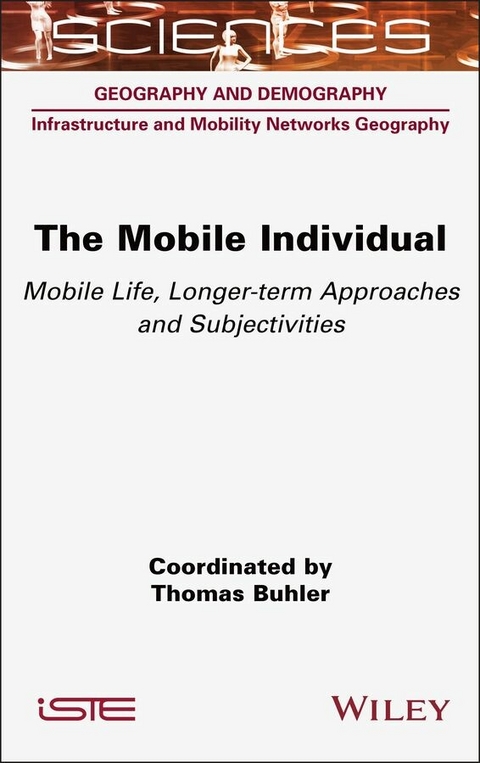
The Mobile Individual (eBook)
342 Seiten
Wiley-Iste (Verlag)
978-1-394-42363-7 (ISBN)
'Being mobile is more than just traveling.' Early research on transportation long believed that daily commutes were a waste of time, and that modes of transportation were simply interchangeable depending on changing circumstances.
However, as research on daily mobility advances, a better understanding of the social and symbolic significance of such practices emerges. All of this contributes to the fact that daily mobility is not just a means to an end but is often at the very heart of deeply ingrained lifestyles and habits.
With contributions from internationally recognized specialists, this book provides an overview of the different facets of the individual experience of mobility. Using a three-pronged approach, the book draws upon the experience of everyday time and long-term processes such as socialization to mobility, while also attempting to better understand what feeds mobile subjectivities, starting with the social representations of modes and habits that people develop throughout their lives.
Thomas Buhler is Professor of Urban Planning at the University Marie and Louis Pasteur, France. His research focuses on urban lifestyles in relation to daily mobility, strategies of urban planning stakeholders, and participatory methodologies in urban planning.
"e;Being mobile is more than just traveling."e; Early research on transportation long believed that daily commutes were a waste of time, and that modes of transportation were simply interchangeable depending on changing circumstances. However, as research on daily mobility advances, a better understanding of the social and symbolic significance of such practices emerges. All of this contributes to the fact that daily mobility is not just a means to an end but is often at the very heart of deeply ingrained lifestyles and habits. With contributions from internationally recognized specialists, this book provides an overview of the different facets of the individual experience of mobility. Using a three-pronged approach, the book draws upon the experience of everyday time and long-term processes such as socialization to mobility, while also attempting to better understand what feeds mobile subjectivities, starting with the social representations of modes and habits that people develop throughout their lives.
Introduction
The Mobile Individual or the Progressive Complexification of an Analytical Model
Thomas BUHLER1,2
1 Laboratoire UMR 6049 Théoriser et Modéliser pour Aménager (ThéMA), CNRS, Université Marie et Louis Pasteur, Besançon, France
2 Institut Universitaire de France, Paris, France
This collective work aims to study everyday mobilities through the prism of individuals and the logics they deploy. In the era of the “society of individuals” (Elias 1991) and the development of new sociological approaches centered on the individual as a fundamental analytical entity (Le Bart et al. 2010), analyzing everyday mobilities through the prism of the individual may seem obvious.
However, it is worth remembering here that this proposition was not self-evident for a very long time. Indeed, the first works in transport engineering and economics, which date back to a period from the end of the 19th century to the 1970s, have long avoided the entry of the individual into analysis by favoring aggregated analyses relating to flows of people. These decades were marked by different phases of industrialization and by the development of transport networks, which were deemed necessary in countries and regions that were experiencing rapid demographic expansion. At that time, the main challenge for this emerging “science of transport” was the ability to predict flows, rather than understanding individual behaviors and logics (Commenges 2013).
Approaches that may be described as “individual-centered” emerged in the 1970s. This era saw the simultaneous emergence of: (1) a stable definition of what “travel” is (Gallez 2015); (2) the first comprehensive surveys dedicated to the declaration and description of this same travel and the logics deployed by households (Debizet 2011); and finally (3) in the academic sphere, statistical models aiming to explain – or even predict – individual travel behavior (McFadden 1974).
The so-called “methodological individualism” that emerged at this time in the study of everyday travel amounts to an assumption that social and collective phenomena can be understood by studying individuals and their behavior. Collective and social phenomena are thus conceived as being comprehensible through studying individual behaviors and logics, following an “atomist” logic. Research into transport and travel in the 1970s and 1980s, arising from the convergence of engineering and neoclassical economics, formulated an initial conception of the individual close to that of homo economicus (Demeulenaere 2003). This homo economicus is characterized by four distinctive features: (1) individual passivity with regard to the world around them, over which they have no control other than their behavior (here, that of movement); (2) omniscience to the extent that the individual knows all possible actions and their consequences; (3) strong calculation capabilities worthy of the best modern supercomputers; and finally (4) the pursuit of individual interest alone (Béjean et al. 1999).
Of course, this series of postulates, dating back to Adam Smith (1723–1790), has been heavily revisited and criticized within the field of economics and the humanities and social sciences over the past 50 years. Criticism came first from economists themselves, and particularly from those interested in developments in modern psychology. We may of course think of Herbert Simon (1983, 1990) and the idea of “bounded rationality” developed in the 1950s which invalidates points (2) and (3) mentioned above, without, however, calling into question the idea of passivity or that of a propensity for selfish action. Following on from these initial “amendments” (Béjean et al. 1999) to the hegemonic model in economics, a series of works, notably by psychologists Amos Tversky and Daniel Kahneman (1981), contributed to a new major advance and the foundation of a so-called “behavioral” economics on new bases. This is not a trivial change since these works, which now dominate in the field of economic sciences, are much more concerned with empirical validation of statements than with validating at all costs the neoclassical model of general equilibrium (of markets) which dates back to Léon Walras (1834–1910) (Maris 2003).
At the same time, the social sciences (and sociology in particular) have seen the emergence of so-called “comprehensive” currents, i.e. currents which seek above all to understand individual practices through the meanings given to them by the individuals concerned. Although the idea dates back to Max Weber (1922), there has been renewed interest in these approaches, particularly in French-language research following the work of Raymond Boudon (2003) who proposed exploring the whole set of reasons (instrumental and axiological, i.e. linked to values, etc.) which push an individual to act in a certain way.
At the turn of the 2000s, at the confluence of comprehensive social sciences and (renewed) research into the socio-economics of travel, a (rather heterogeneous and composite) field of research formed around mobility in general and everyday mobility in particular (Gallez and Kaufmann 2009). It was only then that the objective was formulated of deciphering and breaking down the logics, constraints and subjectivities of individuals with the aim of better understanding their everyday mobility practices. This scientific movement would later be described as the “mobility turn” (Urry 2008).
A great diversity of scientific approaches now coexist. Although drawing on different and sometimes compartmentalized disciplines, they nevertheless have the common factor of an interest in the mobile individual and their logics of action. Around this object of research, certain disciplines are gradually converging, such as geography and psychology (Teran-Escobar 2022) which are finding renewed conceptual and methodological complementarities.
The time is thus over for a reading limited to instrumental and/or functionalist elements, comprising a vision of the individual as simply selfish and utilitarian, always going for the fastest, the shortest or the cheapest. The most recent research associates these socio-economic elements (always partly explanatory) with elements linked to representations, habits, the real or perceived capacity of people to travel, or even to seeking or on the contrary avoiding co-presence with “others”. This diversity of work nevertheless gradually allows the complexification and strengthening of analytical models.
This book aims to contribute to this complexification and mutual enrichment of approaches dealing with individual practices of everyday mobility. To do this, the book offers a state of knowledge as well as identifying ways to integrate approaches in the analysis of everyday mobility, between geography and planning, psychology, sociology or economics. This is to better understand homo mobilis1 and its logics of action, its constraints and its contradictions.
This book therefore comprises three parts to try to cover this diversity of approaches as much as possible. The first part emphasizes a fundamental dimension of everyday mobility: time. This has long been identified as the inextensible resource par excellence (Ravalet 2013), that which imposes constraints and limits on every individual, whatever the level of their other resources (material, symbolic, etc.). This first part comprises three chapters, which combine the logics of everyday mobility on different time scales. In Chapter 1 Vincent Kaufmann proposes to intersect the logic governing everyday mobility with the temporalities of everyday life, its constraints and the adjustments which are sometimes necessary when mobility and the organization of everyday life come into conflict. In Chapter 2, Thomas Buhler offers a combined reading of everyday mobility practices with the experience of time spent in transport. Finally, Hadrien Commenges and Julie Vallée offer in Chapter 3 a reading of the movements of a whole set of people in a territory over a whole day. This enables us to address questions such as the co-presence of social groups (in terms of classes, genders, etc.) which is sought out or, on the contrary, avoided by certain people in certain contexts. This chapter thus opens the way to the study of socio-spatial segregations, not at night (at places of residence) but from a dynamic perspective, during the day.
The second part of this work aims to focus on the dynamics of mobile socializations. In other words, it involves dealing with the impact of past experiences of mobility (during childhood and adolescence, in particular) and of different life events (family, professional, etc.) on a person’s current practices. Thus, in Chapter 4 Philippe Gerber offers a state of knowledge on recent research, focusing on this consideration of the personal past to explain the present (distinct approaches which we call mobility biographies or life-oriented approaches). In Chapter 5 David Sayagh proposes to analyze differentiated socializations to mobility, with particular regard to individuals’ gender. Using the example of cycling, he shows how the different gender stereotypes that pass through many channels (from family to media, including school) and the educational models of...
| Erscheint lt. Verlag | 14.11.2025 |
|---|---|
| Reihe/Serie | ISTE Invoiced |
| Sprache | englisch |
| Themenwelt | Technik ► Architektur |
| Schlagworte | mobile subjectivities • Mobility • Socialization • Symbolism • Transportation |
| ISBN-10 | 1-394-42363-2 / 1394423632 |
| ISBN-13 | 978-1-394-42363-7 / 9781394423637 |
| Informationen gemäß Produktsicherheitsverordnung (GPSR) | |
| Haben Sie eine Frage zum Produkt? |
 EPUB (Adobe DRM)
Kopierschutz: Adobe-DRM
Adobe-DRM ist ein Kopierschutz, der das eBook vor Mißbrauch schützen soll. Dabei wird das eBook bereits beim Download auf Ihre persönliche Adobe-ID autorisiert. Lesen können Sie das eBook dann nur auf den Geräten, welche ebenfalls auf Ihre Adobe-ID registriert sind.
Details zum Adobe-DRM
Dateiformat: EPUB (Electronic Publication)
EPUB ist ein offener Standard für eBooks und eignet sich besonders zur Darstellung von Belletristik und Sachbüchern. Der Fließtext wird dynamisch an die Display- und Schriftgröße angepasst. Auch für mobile Lesegeräte ist EPUB daher gut geeignet.
Systemvoraussetzungen:
PC/Mac: Mit einem PC oder Mac können Sie dieses eBook lesen. Sie benötigen eine
eReader: Dieses eBook kann mit (fast) allen eBook-Readern gelesen werden. Mit dem amazon-Kindle ist es aber nicht kompatibel.
Smartphone/Tablet: Egal ob Apple oder Android, dieses eBook können Sie lesen. Sie benötigen eine
Geräteliste und zusätzliche Hinweise
Buying eBooks from abroad
For tax law reasons we can sell eBooks just within Germany and Switzerland. Regrettably we cannot fulfill eBook-orders from other countries.
aus dem Bereich