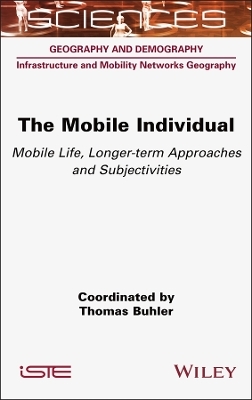
The Mobile Individual
Iste Ltd (Verlag)
978-1-78945-227-3 (ISBN)
- Titel z.Zt. nicht lieferbar (ca. Februar 2026)
- Versandkostenfrei
- Auch auf Rechnung
- Artikel merken
However, as research on daily mobility advances, a better understanding of the social and symbolic significance of such practices emerges. All of this contributes to the fact that daily mobility is not just a means to an end but is often at the very heart of deeply ingrained lifestyles and habits.
With contributions from internationally recognized specialists, this book provides an overview of the different facets of the individual experience of mobility. Using a three-pronged approach, the book draws upon the experience of everyday time and long-term processes such as socialization to mobility, while also attempting to better understand what feeds mobile subjectivities, starting with the social representations of modes and habits that people develop throughout their lives.
Thomas Buhler is Professor of Urban Planning at the University Marie and Louis Pasteur, France. His research focuses on urban lifestyles in relation to daily mobility, strategies of urban planning stakeholders, and participatory methodologies in urban planning.
Introduction. The Mobile Individual or the Progressive Complexification of an Analytical Model xi
Thomas BUHLER
List of Figures xix
List of Tables xxi
Part 1. The Mobile Individual and Daily Time 1
Chapter 1. Mobility and Everyday Life 3
Vincent KAUFMANN
1.1. Introduction 3
1.2. The diversity of spatio-temporalities in everyday life 3
1.3. Three facets of mobility 6
1.4. The valorization of reversibility: an organizing principle of everyday life? 12
1.5. References 13
Chapter 2. Time Experienced in Everyday Mobility: Perceptions, Uses and Values 17
Thomas BUHLER
2.1. Introduction 17
2.2. Research gradually becoming interested in the time spent on everyday travel 18
2.3. Perception of travel times: principle of general relativity 23
2.4. Travel and its uses: a busy time 24
2.5. Values at stake 31
2.6. Conclusions 36
2.7. References 37
Chapter 3. Mobility and Daytime Population in Geographical Space 43
Hadrien COMMENGES and Julie VALLÉE
3.1. Introduction 43
3.2. Estimating the daytime population 45
3.3. Characterizing the social composition of daytime populations 48
3.4. Defining the exposure of individuals based on places and times of presence 56
3.5. Conclusion 59
3.6. References 59
Part 2. Mobile Socializations, or the Effects of the Long Term 65
Chapter 4. Mobility Trajectories and Biographies: A Valuable Hybridization 67
Philippe GERBER
4.1. Introduction 67
4.2. From life course to changes in daily mobility 69
4.3. Evolution of mobility and other areas of the life course 76
4.4. Towards a planning tool? Aggregate or individual-centered approaches to mobility biographies 78
4.5. Conclusion 80
4.6. References 82
Chapter 5. Gendered Cycling Socializations of Future Mobile Adults 89
David SAYAGH
5.1. Introduction 89
5.2. A process in action from a very young age 91
5.3. A process reinforced during adolescence 94
5.4. A process to be analyzed intersectionally and contextually 99
5.5. Conclusion 103
5.6. References 104
Chapter 6. Cycling in the City: Situated Practices and Unequal Policies 113
Matthieu ADAM
6.1. Introduction 113
6.2. When cycling returns to the city 119
6.3. Cycling mobility and socio-spatial inequalities 123
6.4. Towards new research on cycling in the city 127
6.5. Conclusion 133
6.6. References 134
Part 3. Mobile Subjectivities: Representations and Effects of Habits 143
Chapter 7. Modal Choice and Representations of Transport Modes 145
Florian MASSE and Samuel CARPENTIER-POSTEL
7.1. Introduction 145
7.2. Stages of modal choice analysis 146
7.3. Application to the choice of modes for leisure mobility 151
7.4. Conclusion 160
7.5. References 162
Chapter 8. Not Just a Detail: Modal Habit as Central to Everyday Mobility 167
Julia-Pearl AVELINE and Thomas BUHLER
8.1. Which "habit" are we talking about? 170
8.2. Why the interest in habits when studying everyday mobility? 176
8.3. How to measure the force of a modal habit 181
8.4. The driving habit at the center of attention 183
8.5. Research conclusions and operational conclusions 191
8.6. References 193
Chapter 9. Responsive Adaptations to Traffic Congestion: A Matter of Habit? 199
Thomas BUHLER and Gaële LESTEVEN
9.1. Introduction 199
9.2. A simulation game to collect drivers' adaptations to congestion 202
9.3. Results 206
9.4. Discussion 211
9.5. Conclusion 212
9.6. References 213
Conclusions. Three Avenues for Increased
Convergence of Analytical Models 217
Thomas BUHLER
Glossary 221
List of Authors 223
Index 225
| Erscheint lt. Verlag | 17.2.2026 |
|---|---|
| Reihe/Serie | ISTE Invoiced |
| Verlagsort | London |
| Sprache | englisch |
| Themenwelt | Sozialwissenschaften ► Soziologie ► Empirische Sozialforschung |
| Technik ► Architektur | |
| ISBN-10 | 1-78945-227-9 / 1789452279 |
| ISBN-13 | 978-1-78945-227-3 / 9781789452273 |
| Zustand | Neuware |
| Informationen gemäß Produktsicherheitsverordnung (GPSR) | |
| Haben Sie eine Frage zum Produkt? |
aus dem Bereich