3GPP-based Non-Terrestrial Networks in 5G and 6G (eBook)
694 Seiten
Wiley-IEEE Press (Verlag)
978-1-394-20340-6 (ISBN)
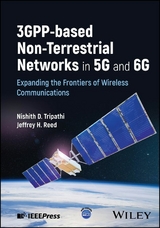
Self-contained resource on fundamental concepts and the planning, provisionining, design, and operations of 3GPP-based NTNs
3GPP-based Non-Terrestrial Networks in 5G and 6G: Expanding the Frontiers of Wireless Communications provides an overview of Non-Terrestrial Networks (NTNs) in the context of 3GPP systems such as 4G LTE and 5G NR. Unique challenges of NTNs such as long and variable propagation delays, large and time-varying Doppler shifts, different types of beams including Earth-fixed beams, quasi-Earth-fixed beams, and Earth-moving beams and transparent and regenerative payloads are discussed. The mechanisms that 3GPP foresees to tackle these NTN-specific challenges are described and, furthermore, the planning, provisioning, design, and operations of the radio and core networks for NTNs are illustrated.
NTN considerations in the book range from physical-layer aspects (e.g., synchronization, random access, and uplink and downlink data transmission), to mobility management including handover and cell reselection, and to network architecture. Fundamentals of the associated concepts of NR, eMTC (i.e., LTE_M), and NB-IoT are described so that their customizations for NTNs become clear in NTN-specific discussions. NTN features in 3GPP Release 17, 18, and 19 are described andhe role of NTN in 6G is also summarized.
A companion website provides exercises to help learners to reinforce concepts, along with software utilities (e.g., Excel spreadsheets) that provide templates to investigate the impact of various factors (e.g., carrier frequency and channel bandwidth) on the performance of NTNs (e.g., coverage and capacity/throughput).
3GPP-based Non-Terrestrial Networks in 5G and 6G includes information on:
- Earth-fixed beams, Earth-moving beams, and quasi-Earth-fixed beams, as well as characteristics of Geo Synchronous Orbit (GSO) and Non-GSO (NGSO) satellites such as Low Earth Orbit (LEO) satellites
- Challenges unique to NTNs including large coverage areas, mobility of cells, and different types of payloads (e.g., transparent and regenerative)
- Issues surrounding data transfer in NTNs such as time and frequency pre-compensation, timers for different radio protocol stack layers, and HARQ enabling/disabling
- Random access, RRC connection setup, registration/attach, and PDU session/EPS bearer setup for LTE-M, NB-IoT, and 5G NR
3GPP-based Non-Terrestrial Networks in 5G and 6G is an essential resource for wireless communications and satellite industry engineers and professionals seeking to facilitate the design, provisioning, deployment, operations, maintenance, and optimization of 5G-based NTNs and identify R&D areas for 5G-advanced-based and 6G-based NTNs.
Dr. Nishith D. Tripathi is a Research Associate Professor at Virginia Tech, USA. Dr. Tripathi has 24 years of industry experience at Nortel Networks, Huawei Technologies, Award Solutions, and Samsung Research America. He is a co-author of five books related to cellular communications, AI, 5G, and O-RAN.
Dr. Jeffrey H. Reed is the Willis G Worcester Professor of Electrical Engineering at Virginia Tech, USA. Dr. Reed is co-author or co-editor of five textbooks and is on the editorial board for IEEE/Wiley Press. He is a fellow of the IEEE for his contributions to software defined radio, communications signal processing, and engineering education.
Self-contained resource on fundamental concepts and the planning, provisionining, design, and operations of 3GPP-based NTNs 3GPP-based Non-Terrestrial Networks in 5G and 6G: Expanding the Frontiers of Wireless Communications provides an overview of Non-Terrestrial Networks (NTNs) in the context of 3GPP systems such as 4G LTE and 5G NR. Unique challenges of NTNs such as long and variable propagation delays, large and time-varying Doppler shifts, different types of beams including Earth-fixed beams, quasi-Earth-fixed beams, and Earth-moving beams and transparent and regenerative payloads are discussed. The mechanisms that 3GPP foresees to tackle these NTN-specific challenges are described and, furthermore, the planning, provisioning, design, and operations of the radio and core networks for NTNs are illustrated. NTN considerations in the book range from physical-layer aspects (e.g., synchronization, random access, and uplink and downlink data transmission), to mobility management including handover and cell reselection, and to network architecture. Fundamentals of the associated concepts of NR, eMTC (i.e., LTE_M), and NB-IoT are described so that their customizations for NTNs become clear in NTN-specific discussions. NTN features in 3GPP Release 17, 18, and 19 are described andhe role of NTN in 6G is also summarized. A companion website provides exercises to help learners to reinforce concepts, along with software utilities (e.g., Excel spreadsheets) that provide templates to investigate the impact of various factors (e.g., carrier frequency and channel bandwidth) on the performance of NTNs (e.g., coverage and capacity/throughput). 3GPP-based Non-Terrestrial Networks in 5G and 6G includes information on: Earth-fixed beams, Earth-moving beams, and quasi-Earth-fixed beams, as well as characteristics of Geo Synchronous Orbit (GSO) and Non-GSO (NGSO) satellites such as Low Earth Orbit (LEO) satellites Challenges unique to NTNs including large coverage areas, mobility of cells, and different types of payloads (e.g., transparent and regenerative) Issues surrounding data transfer in NTNs such as time and frequency pre-compensation, timers for different radio protocol stack layers, and HARQ enabling/disabling Random access, RRC connection setup, registration/attach, and PDU session/EPS bearer setup for LTE-M, NB-IoT, and 5G NR 3GPP-based Non-Terrestrial Networks in 5G and 6G is an essential resource for wireless communications and satellite industry engineers and professionals seeking to facilitate the design, provisioning, deployment, operations, maintenance, and optimization of 5G-based NTNs and identify R&D areas for 5G-advanced-based and 6G-based NTNs.
Preface
Even with the deployment of five generations of cellular technologies, a significant portion of the planet’s surface area and many people still do not have access to wireless communications. Non‐Terrestrial Networks (NTNs) are becoming increasingly important in providing wireless communication services anywhere on the planet. The cost of sending a payload to space has reduced significantly recently, leading to a rise in the number of satellite launches. The NTN can also provide backhaul connectivity to the terrestrial radio network in remote areas, fallback connectivity when the terrestrial network infrastructure becomes damaged or unavailable, and supplemental connectivity to augment resource availability at the wireless device. This book explains key concepts of 3GPP1‐based NTNs in ten chapters.
Chapter 1 illustrates a simplified NTN architecture and explains its key components and interfaces. The motivation for the NTN is discussed from the perspective of the use‐case categories of service ubiquity, service continuity, and service scalability. The 3GPP roadmap on the NTN work is outlined to provide a historical perspective and summarize potential future work. The 3GPP started the NTN‐related specifications work as part of 5G cellular technology and has continued enhancing the NTN in 5G‐Advanced. The NTN is expected to play an even more important role in the sixth‐generation (6G) cellular technology. Chapter 1 also provides a glimpse of the NTN’s role in 6G.
Chapter 2 illustrates different types of NTN platforms. These NTN platforms include different types of satellites such as Geosynchronous Earth Orbit (GEO) satellites, Medium‐Earth Orbit (MEO) satellites, Low‐Earth Orbit (LEO) satellites, and High‐Altitude Platform Stations (HAPSs). Chapter 2 also discusses the distinct characteristics of NTN platforms. The NTN platform, based on its capability and design, illuminates its target coverage area using a specific type of beam. Three types of beams are illustrated in Chapter 2: Earth‐fixed beams, Earth‐moving beams, and Quasi‐Earth‐fixed beams. Satellite systems that existed prior to the deployment of the 3GPP NTN deployments are also briefly described.
Chapter 3 provides a foundation of LTE‐M, NB‐IoT, and NR air interfaces by highlighting their key features and overall operations. The associated core networks, EPC and 5GC, are also briefly discussed. While this chapter provides the foundation of LTE‐M and NB‐IoT based on Release 13, enhancements in LTE‐M and NB‐IoT beyond Release 13 are also briefly summarized. Note that the 3GPP has two parallel work streams related to the NTN: NR‐NTN and IoT‐NTN. The NR‐NTN utilizes an NR‐based air interface. The NR‐NTN utilizes gNBs in the radio network and the 5G Core (5GC) Network. The IoT‐NTN supports LTE‐M and NB‐IoT air interfaces and uses the 4G Evolved Packet Core (EPC). The IoT‐NTN utilizes pre‐Release 17 LTE‐M and NB‐IoT specifications and leverages NTN‐specific enhancements defined by the NR‐NTN to determine NTN‐related enhancements for LTE‐M and NB‐IoT specifications.
Chapter 4 describes NTN challenges and their implications for the design and operations of the NTN. The NTN poses distinct radio environment‐related challenges compared to a Terrestrial Network (TN). For example, the NTN typically has a long propagation delay and often a significantly varying propagation delay, requiring timing synchronization and timer enhancements. A non‐geostationary NTN platform leads to large and varying Doppler shifts, and suitable frequency synchronization adjustments are needed. While a TN cell is fixed, an NTN cell can move, requiring enhanced cell reselection, handover, and registration area management. An NTN may use Earth‐fixed beams, quasi‐Earth‐fixed beams, or Earth‐moving beams, requiring different mobility management approaches. The type of NTN payload, such as the transparent payload or the regenerative payload, affects the architecture, design, and operations of the NTN. Long‐term signal strength characteristics differ between the TN and the NTN, requiring a different mobility management approach in the NTN. Special atmospheric effects such as the Faraday effect and scintillations may also need to be considered for the NTN. Chapter 4 also provides a high‐level overview of the NTN solutions that the 3GPP has developed to address these NTN challenges.
Chapter 5 illustrates various candidate architectures of the NTN. While the 3GPP has defined an NTN architecture with a transparent payload in Release 17 and Release 18 NTN specifications, the 3GPP has also investigated other NTN architectures, such as an NTN with a regenerative payload and multi‐connectivity NTNs. The regenerative payload is within the scope of the 3GPP Release 19 specifications. Furthermore, in the case of a multi‐connectivity NTN, an NTN UE simultaneously communicates with (i) two NTNs (e.g., one GEO satellite‐based NTN and another LEO satellite‐based NTN) or (ii) one TN and one NTN. An example NTN architecture with non‐terrestrial core and services networks is also illustrated. Enhanced Tracking Area management and enhanced QoS for an NTN are also described. A brief overview of optical communication in the context of an NTN is also given.
Chapter 6 aims to provide insights into NTN‐specific aspects of RF Planning and Design (RPD) and RF propagation. An overall RPD framework is summarized. Potential NTN spectrum is discussed. Relevant propagation path loss models are specified, and NTN‐specific propagation effects, such as atmospheric effects including scintillations, Faraday effect, and weather effects, are discussed. Various aspects of the NTN link budget are described, including the implications of different NTN platforms, types of beams, and device types. Capacity planning for an NTN is also discussed. NTN configuration guidelines based on the NTN RPD are outlined. Chapter 6 also summarizes 3GPP‐estimated link budgets and UE throughput.
Chapter 7 explains pre‐data transfer operations in the context of the NTN. Note that certain pre‐data transfer operations occur between the NTN UE and the NTN radio and core networks before an NTN UE can exchange data with the radio and core network of the NTN. These operations include cell search, network acquisition, random access, Radio Resource Control (RRC) connection setup, registration or attach, and protocol data unit (PDU) session or EPS bearer setup. Chapter 7 discusses these operations for three radio access technologies: NR, LTE‐M, and NB‐IoT.
Chapter 8 focuses on data transfer in an NTN. The NTN reuses the TN's data transfer framework and makes enhancements to reflect NTN‐specific radio channel challenges. The chapter illustrates various timing relationships in the NTN along with a new Timing Advance procedure for the NTN. The Key prerequisites for downlink and uplink data transfer in the LTE‐M NTN and the NB‐IoT‐NTN are described. A procedure for managing Global Navigation Satellite System (GNSS) measurement gaps is also summarized.
Chapter 9 addresses mobility management. Mobility management principles for a TN are reused in an NTN along with NTN‐specific enhancements. The NTN UE’s RRC state influences mobility management. This chapter briefly overviews the NTN UE’s RRC states, followed by a summary of major NTN mobility challenges and candidate solutions. Mobility management in the NR‐NTN is addressed by discussing measurements and handover triggers, types of NTN handover, and activities of the NR‐NTN UE in the RRC_IDLE and RRC_INACTIVE states. A detailed signaling flow for the Conditional Handover (CHO) in the NR‐NTN is illustrated. Similarly, mobility management in the LTE‐M NTN is addressed by discussing measurements and handover triggers, a detailed signaling flow for the CHO, and activities of the LTE‐M NTN UE in the RRC_IDLE state. A detailed signaling flow for the CHO. Mobility management in the NB‐IoT NTN is also described. Feeder link switchover, a unique aspect of the NTN, is explained. The issue of discontinuous coverage is also summarized.
Chapter 10 provides a brief overview of target NTN enhancements in Release 19. While the NTN‐related specifications work carried out by the 3GPP is formally part of 5G and 5G‐Advanced, the NTN is expected to play an even more key role in 6G. A brief introduction to the 6G vision and requirements is given, followed by the usage scenarios defined by the International Telecommunication Union (ITU) for 6G. The ITU‐specified performance goals for 6G are also summarized. An overview of 6G technology enablers is also given. The NTN’s role in realizing the vision of 6G is explained. Finally, Chapter 10 gives examples of potential NTN research directions.
Since we cannot escape acronyms in our wireless communications industry, we have included a list of acronyms in the front matter of the book to facilitate reading. References listed at the end of each chapter are quite helpful for digging deeper into NTN concepts. We have designed interactive exercises to reinforce learning of key NTN concepts and made them available at www.wiley.com/go/tripathi5g.
Our hope is that this NTN book will significantly increase your NTN knowledge and help you in your...
| Erscheint lt. Verlag | 5.11.2025 |
|---|---|
| Sprache | englisch |
| Themenwelt | Technik ► Elektrotechnik / Energietechnik |
| Schlagworte | 3GPP NTN • 5G NR • 5G NTN • Earth-fixed beams • Earth-moving beams • eMTC • GEO NTN • geosynchronous orbit satellites • IoT-NTN • LEO NTN • LTE • LTE-M • NB-Iot • Non-terrestrial Networks • NR-NTN • NTN • NTN architecture • NTN capacity • NTN customization • NTN devices • NTN downlink • NTN handover • NTN link budget • NTN mobility • NTN Physical Layer • NTN throughput • NTN uplink • quasi-Earth-fixed beams |
| ISBN-10 | 1-394-20340-3 / 1394203403 |
| ISBN-13 | 978-1-394-20340-6 / 9781394203406 |
| Informationen gemäß Produktsicherheitsverordnung (GPSR) | |
| Haben Sie eine Frage zum Produkt? |
 EPUB (Adobe DRM)
Kopierschutz: Adobe-DRM
Adobe-DRM ist ein Kopierschutz, der das eBook vor Mißbrauch schützen soll. Dabei wird das eBook bereits beim Download auf Ihre persönliche Adobe-ID autorisiert. Lesen können Sie das eBook dann nur auf den Geräten, welche ebenfalls auf Ihre Adobe-ID registriert sind.
Details zum Adobe-DRM
Dateiformat: EPUB (Electronic Publication)
EPUB ist ein offener Standard für eBooks und eignet sich besonders zur Darstellung von Belletristik und Sachbüchern. Der Fließtext wird dynamisch an die Display- und Schriftgröße angepasst. Auch für mobile Lesegeräte ist EPUB daher gut geeignet.
Systemvoraussetzungen:
PC/Mac: Mit einem PC oder Mac können Sie dieses eBook lesen. Sie benötigen eine
eReader: Dieses eBook kann mit (fast) allen eBook-Readern gelesen werden. Mit dem amazon-Kindle ist es aber nicht kompatibel.
Smartphone/Tablet: Egal ob Apple oder Android, dieses eBook können Sie lesen. Sie benötigen eine
Geräteliste und zusätzliche Hinweise
Buying eBooks from abroad
For tax law reasons we can sell eBooks just within Germany and Switzerland. Regrettably we cannot fulfill eBook-orders from other countries.
aus dem Bereich