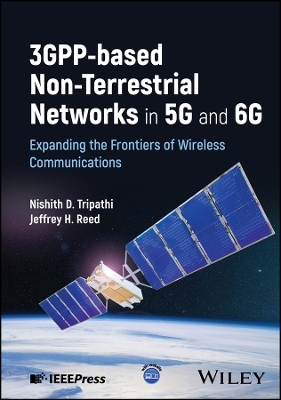
3GPP-based Non-Terrestrial Networks in 5G and 6G
Wiley-IEEE Press (Verlag)
978-1-394-20338-3 (ISBN)
3GPP-based Non-Terrestrial Networks in 5G and 6G: Expanding the Frontiers of Wireless Communications provides an overview of Non-Terrestrial Networks (NTNs) in the context of 3GPP systems such as 4G LTE and 5G NR. Unique challenges of NTNs such as long and variable propagation delays, large and time-varying Doppler shifts, different types of beams including Earth-fixed beams, quasi-Earth-fixed beams, and Earth-moving beams and transparent and regenerative payloads are discussed. The mechanisms that 3GPP foresees to tackle these NTN-specific challenges are described and, furthermore, the planning, provisioning, design, and operations of the radio and core networks for NTNs are illustrated.
NTN considerations in the book range from physical-layer aspects (e.g., synchronization, random access, and uplink and downlink data transmission), to mobility management including handover and cell reselection, and to network architecture. Fundamentals of the associated concepts of NR, eMTC (i.e., LTE_M), and NB-IoT are described so that their customizations for NTNs become clear in NTN-specific discussions. NTN features in 3GPP Release 17, 18, and 19 are described andhe role of NTN in 6G is also summarized.
A companion website provides exercises to help learners to reinforce concepts, along with software utilities (e.g., Excel spreadsheets) that provide templates to investigate the impact of various factors (e.g., carrier frequency and channel bandwidth) on the performance of NTNs (e.g., coverage and capacity/throughput).
3GPP-based Non-Terrestrial Networks in 5G and 6G includes information on:
Earth-fixed beams, Earth-moving beams, and quasi-Earth-fixed beams, as well as characteristics of Geo Synchronous Orbit (GSO) and Non-GSO (NGSO) satellites such as Low Earth Orbit (LEO) satellites
Challenges unique to NTNs including large coverage areas, mobility of cells, and different types of payloads (e.g., transparent and regenerative)
Issues surrounding data transfer in NTNs such as time and frequency pre-compensation, timers for different radio protocol stack layers, and HARQ enabling/disabling
Random access, RRC connection setup, registration/attach, and PDU session/EPS bearer setup for LTE-M, NB-IoT, and 5G NR
3GPP-based Non-Terrestrial Networks in 5G and 6G is an essential resource for wireless communications and satellite industry engineers and professionals seeking to facilitate the design, provisioning, deployment, operations, maintenance, and optimization of 5G-based NTNs and identify R&D areas for 5G-advanced-based and 6G-based NTNs.
Dr. Nishith D. Tripathi is a Research Associate Professor at Virginia Tech, USA. Dr. Tripathi has 24 years of industry experience at Nortel Networks, Huawei Technologies, Award Solutions, and Samsung Research America. He is a co-author of five books related to cellular communications, AI, 5G, and O-RAN. Dr. Jeffrey H. Reed is the Willis G Worcester Professor of Electrical Engineering at Virginia Tech, USA. Dr. Reed is co-author or co-editor of five textbooks and is on the editorial board for IEEE/Wiley Press. He is a fellow of the IEEE for his contributions to software defined radio, communications signal processing, and engineering education.
About the Authors xvii
Preface xix
Acknowledgments xxiii
Acronyms xxv
About the Companion Website xxxv
1 Introduction to a Non-Terrestrial Network 1
1.1 Non-Terrestrial Networks: The Definition 1
1.2 Simplified 3GPP NTN Architecture 2
1.3 Motivation for the NTN 3
1.4 An Overview of NTN Use Cases 4
1.5 3GPP NTN Roadmap 6
1.6 Role of the NTN in 6G 8
1.7 Major Takeaways 9
References 10
2 Types of NTN Platforms 13
2.1 Types of NTN Platforms 13
2.2 Characteristics of Satellites 14
2.3 Characteristics of UASs of the NTN 16
2.4 Types of Beams 18
2.5 An Overview of Pre-5G Satellite Systems 20
2.6 Types of NTN Devices for the NTN 22
2.7 Trends in NTN Deployments 23
2.8 Major Takeaways 24
References 25
3 Radio Interfaces of LTE-M, NB-IoT, and NR: A Concise Introduction 27
3.1 3GPP-Defined Wireless IoT Technologies and 5G New Radio: A Concise Introduction 27
3.2 LTE-M: A 3GPP-Defined Wireless IoT Technology 36
3.3 NB-IoT: A 3GPP-Defined Wireless IoT Technology 53
3.4 5G: A 3GPP-Defined Transformational Technology 64
3.5 LTE-M and NB-IoT Enhancements Beyond Release 13 83
3.6 Major Takeaways 85
References 86
4 Challenges of an NTN 87
4.1 An Overview of NTN-Specific Challenges 87
4.2 Long and Variable Propagation Delays 89
4.3 High and Variable Doppler Shifts 92
4.4 NTN Cell Size 94
4.5 NTN Cell Mobility 95
4.6 Type of Beams 95
4.7 Types of NTN Payloads 96
4.8 Propagation Path Loss 98
4.9 Long-Term Signal Strength Characteristics 98
4.10 Special Atmospheric Effects 99
4.11 Feeder Link Switch 100
4.12 Noncontiguous/Noncontinuous Coverage 101
4.13 3GPP Solutions to the NTN Challenges: A High-Level Overview 102
4.14 Major Takeaways 102
References 103
5 NTN Architectures 105
5.1 NTN Network Architectures in a Nutshell 105
5.2 An NTN with a Transparent Payload 106
5.3 An NTN Network Architecture with Regenerative Payloads 109
5.4 Multi-connectivity NTNs 111
5.5 An NTN with a Transparent Payload: A Closer Look 116
5.6 Enhanced Tracking Area Management for an NTN 117
5.7 Enhanced QoS for an NTN 119
5.8 Optical Communication for an NTN 119
5.9 Major Takeaways 120
References 121
6 RF Planning and Design Considerations for an NTN 123
6.1 RF Planning and Design for an NTN: An Overview 123
6.2 NTN Spectrum 126
6.3 NTN Devices 129
6.4 RF Propagation Models 130
6.5 Framework for NTN Link Budgets 136
6.6 NTN Capacity Planning 146
6.7 3GPP-Estimated Link Budgets and Throughput for an NTN 152
6.8 Major Takeaways 155
References 156
7 Pre-Data Transfer Operations in an NTN 159
7.1 Overview of Pre-Data Transfer NTN Operations 159
7.2 Pre-Data Transfer Operations in NR-NTN: A Closer Look 162
7.3 Selected Operations in IoT-NTN: A Closer Look 184
7.4 Major Takeaways 205
References 207
8 Downlink and Uplink Data Transfer in an NTN 209
8.1 Characteristics of Data Transfer in an NTN: An Overview 209
8.2 Data Transfer in the NR-NTN 211
8.3 Data Transfer in the LTE-M NTN 222
8.4 Data Transfer in the NB-IoT NTN 230
8.5 Major Takeaways 236
References 237
9 Mobility Management in an NTN 239
9.1 RRC States and Mobility Management in a TN and an NTN 239
9.2 Mobility Challenges in the NTN and Associated Solutions 241
9.3 Mobility Management in the NR-NTN 242
9.4 Mobility Management in the LTE-M NTN 253
9.5 Mobility Management in the NB-IoT NTN 259
9.6 Feeder Link Switchover in the NTN 260
9.7 Discontinuous Coverage in the NR-NTN or IoT-NTN 261
9.8 Major Takeaways 261
References 263
10 Evolution of the NTN in 5G-Advanced and 6G 265
10.1 Evolution of the NTN 265
10.2 NTN Enhancements in Release 19 266
10.3 NTN and 6G 268
10.4 O-RAN-Based NTN Deployments 299
10.5 NTN Research Directions 301
10.6 Major Takeaways 303
References 304
Index 307
| Erscheinungsdatum | 14.05.2025 |
|---|---|
| Sprache | englisch |
| Themenwelt | Technik ► Elektrotechnik / Energietechnik |
| Technik ► Nachrichtentechnik | |
| ISBN-10 | 1-394-20338-1 / 1394203381 |
| ISBN-13 | 978-1-394-20338-3 / 9781394203383 |
| Zustand | Neuware |
| Informationen gemäß Produktsicherheitsverordnung (GPSR) | |
| Haben Sie eine Frage zum Produkt? |
aus dem Bereich