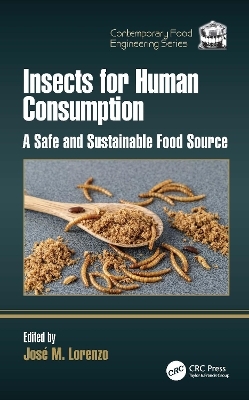
Insects for Human Consumption
CRC Press (Verlag)
978-1-032-78495-3 (ISBN)
- Noch nicht erschienen (ca. April 2026)
- Versandkostenfrei
- Auch auf Rechnung
- Artikel merken
Considering their growing popularity as a food source, this book examines the main nutrients and bioactive compounds present in a range of different edible insects. Focusing on the fundamentals of nutrient obtention and rearing management, it dives into the latest developments in the science behind an industry niche that continues to grow as the international community recognises the uses of insects as a natural, sustainable source of important proteins and fats. It also features accessible discussions of safety concerns, regulatory limitations, as well as other key aspects of including food neophobia and consumer acceptance. This book is ideal for researchers, students, and professionals keen to understand the potential benefits of edible insects and how to navigate potential industry challenges.
José Manuel Lorenzo is Head of Research at the Centro Tecnológico de la Carne (CTC), Ourense, Spain. He has a degree in Food Science and Technology from University of Vigo (1995-2000). In 2005-2006 from October to March, he completed his training with a predoctoral stay at the Stazione Sperimentale per L´Industria delle Conserve Alimentaria (Parma, Italy). He obtained his Ph.D. in Food Science and Technology (University of Vigo) in 2006. He has started his scientific career in the Department of Food Science and Technology at the University of Vigo, first as researcher scholarship, then, since April 2006, as academic researcher. In 2007 joined the CTC staff, developing since then an intense collaboration with the industrial sector, private companies, and research institutions as PI of several projects of R&D and innovation in Food Science area, with emphasis in Healthier and Functional Foods development. He was principal researcher in four European projects, nine national projects and fifty-eight regional projects (Galicia, NW Spain) with meat industries. Moreover, he has participated in more than 110 projects as research collaborator. He is currently leading the Network of Sustainable Regional Protein-Rich Foods (AlProSos; CYTED 125RT0165). It is a robust network comprising 229 researchers from 14 Ibero-American countries. It boasts the support of 29 research centres and universities, along with 21 companies. The network's core mission is to identify, characterise, extract, purify, functionalise, and assess the allergenicity and safety of regional alternative proteins for developing novel food products. Regarding his research experience, the quality and impact of his scientific production stands out: 1. His scientific production includes more than 1,000 research papers in well-recognized peer-reviewed international journals (SCI), with 56% of them in the first quartile (the number of publications in Q1 is higher than 500), and 283 communications to national and international congresses. His h-index is 111 with cites of 49,620 in Scopus. 2. He has edited twenty-two international books and one national. Moreover, he has written one hundred and twenty-five chapters in international and national books. 3. He has five national patents as inventor. 4. He is Chief Editor in Current Food Science and Technology Reports, and Associate Editor of five prestigious journals: Quality Assurance and Safety of Crops & Foods, Food Frontiers, Food Analytical Methods, Journal of the Science Food and Agriculture, Animal Science Journal, eFoods, Measurement: Food, Canadian Journal of Animal Science and Food Frontiers. He has also edited several Special Issues for these high impact journals to create more discussion around key aspects of functional food development: innovative technologies, functional ingredients, and food safety and quality.
1. Introductory Aspects of Insects as Food. Their Historical and Cultural Importance 2. Insects of the World. Classification of the Main Edible Insects. 3. Nutritional Value of Insects. Proteins and Amino Acids. 4. Nutritional Value of Insects. Lipids and Fatty Acids 5. Nutritional and Health Benefits of Insects 6. Use of Insects and/or Insect-Derived Compounds as Ingredients in Food Formulation 7. Regulatory and Legislative Implications of the Use of Insects for Human Consumption 8. Technological Advances in Insect-Derived Food Ingredients
| Erscheint lt. Verlag | 29.4.2026 |
|---|---|
| Reihe/Serie | Contemporary Food Engineering |
| Zusatzinfo | 26 Tables, black and white; 3 Line drawings, color; 7 Halftones, color; 10 Illustrations, color |
| Verlagsort | London |
| Sprache | englisch |
| Maße | 156 x 234 mm |
| Gewicht | 453 g |
| Themenwelt | Technik ► Lebensmitteltechnologie |
| ISBN-10 | 1-032-78495-4 / 1032784954 |
| ISBN-13 | 978-1-032-78495-3 / 9781032784953 |
| Zustand | Neuware |
| Informationen gemäß Produktsicherheitsverordnung (GPSR) | |
| Haben Sie eine Frage zum Produkt? |
aus dem Bereich