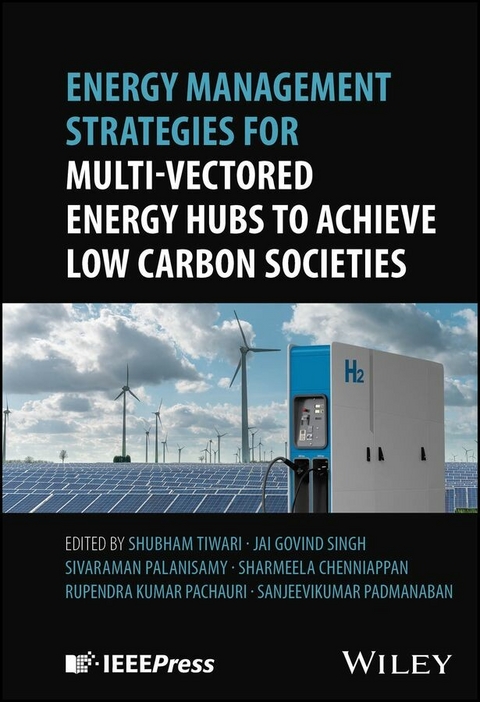
Energy Management Strategies for Multi-Vectored Energy Hubs to Achieve Low Carbon Societies (eBook)
347 Seiten
Wiley-IEEE Press (Verlag)
978-1-394-26738-5 (ISBN)
Comprehensive reference on multi energy hub (MEH) modeling, management, protection, and trading across energy exchange markets with supporting case studies
Energy Management Strategies for Multi-Vectored Energy Hubs to Achieve Low Carbon Societies discusses the complex exchange process across different sources within an evolving set of technologies, presenting multi-vectored energy hub (MV-EH) modeling techniques and associated energy management strategies for their network architecture. This includes in-depth assessments of advanced energy conversion technologies, market mechanisms, and transactive energy management to ensure robust and flexible energy-sharing mechanisms. The book focuses on renewable energy integration in MV-EHs, advanced energy storage, and advance energy conversion technologies.
Later chapters cover detailed analyses of Power-to-X (P2X) technologies, bioenergy integration, and emerging challenges in high-renewable penetration in energy hubs. Case studies of MV-EHs explore the latest advancements such as the carbon tax mechanism, carbon trading strategies, the role of hydrogen generation, and carbon storage to enhance MV-EH performance. Readers will find insights into the integration of carbon reduction techniques (CDR) and emission trading mechanisms, along with the role of bioenergy in building the low emission energy systems. Mathematical models of various new energy conversion systems such as power to gas (P2X), hydrogen storage, and hydrogen usage are also explored.
Edited by a team of highly qualified authors, this book covers additional topics such as:
- Types of frameworks to manage network energy hubs, cooperative and non-cooperative strategies, and centralized, decentralized, and distributed system architectures
- Advanced energy conversion units such as electric heat pumps, combined heat and power units, gas boilers, absorption chillers, electric chillers, and energy storage units
- The role of bioenergy, power-to-X, hydrogen, carbon reduction techniques (CDR), carbon taxes, carbon market, and trading strategies in achieving low energy systems
- Technologies to enhance flexibility in MEHs such as electrical, heating, cooling, and community demand response programs
- The impact of high or full share of renewables and load-side uncertainties on MV-EH operations
Delivering a thorough understanding of networked multi-vectored energy systems, and their role in sustainable energy transitions, Energy Management Strategies for Multi-Vectored Energy Hubs to Achieve Low Carbon Societies is an essential reference for engineers, researchers, and graduate students developing energy systems, smart grids, and decarbonization strategies.
Shubham Tiwari is a Research Scholar at the International Institute of Applied Systems Analysis (IIASA), Austria.
Jai Govind Singh, PhD, is an Associate Professor in Sustainable Energy Transition at the Asian Institute of Technology, Pathum Thani, Thailand.
Sivaraman Palanisamy is an industry professional and also a Research Scholar with the Department of Electrical and Electronics Engineering at CEG Campus, Anna University, Chennai.
Sharmeela Chenniappan, PhD, holds the post of Professor in the Department of Electrical and Electronics Engineering. She is also Adjunct Professor at the Centre of E-Vehicle Technologies, and the Centre for Energy Storage Technologies, CEG Campus, at Anna University, Chennai, India.
Rupendra Kumar Pachauri, PhD, is an Associate Professor in the Electrical Cluster, School of Advanced Engineering, UPES, Dehradun, India.
Sanjeevikumar Padmanaban, PhD, is a faculty member with the Department of Electrical Engineering, IT and Cybernetics at the University of South-Eastern Norway, Porsgrunn, Norway.
Comprehensive reference on multi energy hub (MEH) modeling, management, protection, and trading across energy exchange markets with supporting case studies Energy Management Strategies for Multi-Vectored Energy Hubs to Achieve Low Carbon Societies discusses the complex exchange process across different sources within an evolving set of technologies, presenting multi-vectored energy hub (MV-EH) modeling techniques and associated energy management strategies for their network architecture. This includes in-depth assessments of advanced energy conversion technologies, market mechanisms, and transactive energy management to ensure robust and flexible energy-sharing mechanisms. The book focuses on renewable energy integration in MV-EHs, advanced energy storage, and advance energy conversion technologies. Later chapters cover detailed analyses of Power-to-X (P2X) technologies, bioenergy integration, and emerging challenges in high-renewable penetration in energy hubs. Case studies of MV-EHs explore the latest advancements such as the carbon tax mechanism, carbon trading strategies, the role of hydrogen generation, and carbon storage to enhance MV-EH performance. Readers will find insights into the integration of carbon reduction techniques (CDR) and emission trading mechanisms, along with the role of bioenergy in building the low emission energy systems. Mathematical models of various new energy conversion systems such as power to gas (P2X), hydrogen storage, and hydrogen usage are also explored. Edited by a team of highly qualified authors, this book covers additional topics such as: Types of frameworks to manage network energy hubs, cooperative and non-cooperative strategies, and centralized, decentralized, and distributed system architectures Advanced energy conversion units such as electric heat pumps, combined heat and power units, gas boilers, absorption chillers, electric chillers, and energy storage units The role of bioenergy, power-to-X, hydrogen, carbon reduction techniques (CDR), carbon taxes, carbon market, and trading strategies in achieving low energy systems Technologies to enhance flexibility in MEHs such as electrical, heating, cooling, and community demand response programs The impact of high or full share of renewables and load-side uncertainties on MV-EH operations Delivering a thorough understanding of networked multi-vectored energy systems, and their role in sustainable energy transitions, Energy Management Strategies for Multi-Vectored Energy Hubs to Achieve Low Carbon Societies is an essential reference for engineers, researchers, and graduate students developing energy systems, smart grids, and decarbonization strategies.
| Erscheint lt. Verlag | 27.10.2025 |
|---|---|
| Sprache | englisch |
| Themenwelt | Technik ► Elektrotechnik / Energietechnik |
| Schlagworte | Carbon markets • demand response • Energy Storage • Hydrogen Energy • Market Energy Trading Mechanism • Multi-Energy Hubs • peer-to-peer energy trading • Power to Gas • Protection of Network Energy Systems • Transactive Energy Management |
| ISBN-10 | 1-394-26738-X / 139426738X |
| ISBN-13 | 978-1-394-26738-5 / 9781394267385 |
| Informationen gemäß Produktsicherheitsverordnung (GPSR) | |
| Haben Sie eine Frage zum Produkt? |
 PDF (Adobe DRM)
Kopierschutz: Adobe-DRM
Adobe-DRM ist ein Kopierschutz, der das eBook vor Mißbrauch schützen soll. Dabei wird das eBook bereits beim Download auf Ihre persönliche Adobe-ID autorisiert. Lesen können Sie das eBook dann nur auf den Geräten, welche ebenfalls auf Ihre Adobe-ID registriert sind.
Details zum Adobe-DRM
Dateiformat: PDF (Portable Document Format)
Mit einem festen Seitenlayout eignet sich die PDF besonders für Fachbücher mit Spalten, Tabellen und Abbildungen. Eine PDF kann auf fast allen Geräten angezeigt werden, ist aber für kleine Displays (Smartphone, eReader) nur eingeschränkt geeignet.
Systemvoraussetzungen:
PC/Mac: Mit einem PC oder Mac können Sie dieses eBook lesen. Sie benötigen eine
eReader: Dieses eBook kann mit (fast) allen eBook-Readern gelesen werden. Mit dem amazon-Kindle ist es aber nicht kompatibel.
Smartphone/Tablet: Egal ob Apple oder Android, dieses eBook können Sie lesen. Sie benötigen eine
Geräteliste und zusätzliche Hinweise
Buying eBooks from abroad
For tax law reasons we can sell eBooks just within Germany and Switzerland. Regrettably we cannot fulfill eBook-orders from other countries.
aus dem Bereich