


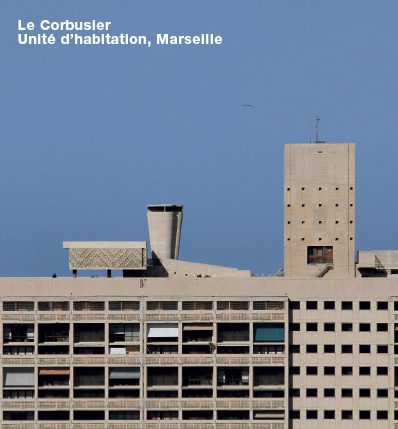
Le Corbusier, Unité d’habitation
Seiten
2018
|
3. Dritte Auflage
Edition Axel Menges (Verlag)
9783932565656 (ISBN)
Edition Axel Menges (Verlag)
9783932565656 (ISBN)
If there is one building by Le Corbusier that represents a synthesis
of his basic concepts it is certainly the Unité d'habitation built
in Marseille in 1946-52. This built manifesto does not simply put
forward a social model as a utopia, but also the unity of architecture
and town planning. It is one of the most significant buildings
there has even been, but it also triggered a great deal of controversy.
The story of the response to it has been recorded in order
to investigate why this extremely ambitious project in particular
should have caused such a conflict between intention and effect.
The Unité d'habitation in Marseille is now very popular with the
people who live in it as a building. Despite all the criticism, it obviously
still offers functional advantages that make it easier for individuals
and the community to live together. The enormous sculptural
force and the characteristic interplay of light and colour
shown in the photographs make the building into a 'personality'
that can be identified with.
As well as this, the building also offers something special in
terms of concrete spatial experience. In the age of a superficial
'adventure society' it claims the intensity of an everyday experience
that is both casual and at the same time complex, embracing
all the senses. This extends from the reception in the imposing foyer
to the 'theatre' of figures on the roof terrace in the light of the
landscape, from the inverted urban scenery of the promenade
publique to twilight seclusion in the silent residential streets. And it
includes the flats themselves, which open up expansively to draw
in the sea and mountain mood. Le Corbusier used his architectural
resources atmospherically and scenically to give the Unité d'habitation
a succinct coherence that also forms the basis for individual
lives within its rooms and spaces. Precise observation and description
reveal the mechanisms of these effects.
All three authors are qualified architects. Alban Janson is professor
of the fundamentals of architecture at Karlsruhe University, Carsten
Krohn lives and works as an author in Berlin, and Anja Grunwald
teaches architectural photography at Karlsruhe University.
of his basic concepts it is certainly the Unité d'habitation built
in Marseille in 1946-52. This built manifesto does not simply put
forward a social model as a utopia, but also the unity of architecture
and town planning. It is one of the most significant buildings
there has even been, but it also triggered a great deal of controversy.
The story of the response to it has been recorded in order
to investigate why this extremely ambitious project in particular
should have caused such a conflict between intention and effect.
The Unité d'habitation in Marseille is now very popular with the
people who live in it as a building. Despite all the criticism, it obviously
still offers functional advantages that make it easier for individuals
and the community to live together. The enormous sculptural
force and the characteristic interplay of light and colour
shown in the photographs make the building into a 'personality'
that can be identified with.
As well as this, the building also offers something special in
terms of concrete spatial experience. In the age of a superficial
'adventure society' it claims the intensity of an everyday experience
that is both casual and at the same time complex, embracing
all the senses. This extends from the reception in the imposing foyer
to the 'theatre' of figures on the roof terrace in the light of the
landscape, from the inverted urban scenery of the promenade
publique to twilight seclusion in the silent residential streets. And it
includes the flats themselves, which open up expansively to draw
in the sea and mountain mood. Le Corbusier used his architectural
resources atmospherically and scenically to give the Unité d'habitation
a succinct coherence that also forms the basis for individual
lives within its rooms and spaces. Precise observation and description
reveal the mechanisms of these effects.
All three authors are qualified architects. Alban Janson is professor
of the fundamentals of architecture at Karlsruhe University, Carsten
Krohn lives and works as an author in Berlin, and Anja Grunwald
teaches architectural photography at Karlsruhe University.
Alban Janson, Architekt; Professor für Grundlagen der Architektur an der Universität Karlsruhe; Büro für Architektur- und Stadtplanung; Forschungsarbeiten und Publikationen zur Phänomenologie der Architektur.
Carsten Krohn, geb. 1966 in Hamburg, studierte Architektur, Stadtplanung und Kunstgeschichte an der HfBK und der Universität Hamburg sowie an der Columbia Universityin New York. Mitarbeit bei Daniel Libeskind und Norman Foster, Promotion als Stipendiat des Graduiertenkollegs Politische Ikonographie. Wissenschaftlicher Mitarbeiter am Karlsruher Institut für Technologie, zahlreiche Veröffentlichungen zu Kunst und Architektur
| Reihe/Serie | Opus |
|---|---|
| Co-Autor | Alban Janson, Carsten Krohn |
| Illustrationen | Anja Grunwald |
| Verlagsort | Stuttgart |
| Sprache | englisch; deutsch |
| Maße | 280 x 300 mm |
| Gewicht | 990 g |
| Einbandart | gebunden |
| Themenwelt | Technik ► Architektur |
| Schlagworte | Le Corbusier • LeCorbusier • Le Corbusier, Marseille, Unité d’habitation, • Marseille • Marseille, Kunst; Architektur • Unité |
| ISBN-13 | 9783932565656 / 9783932565656 |
| Zustand | Neuware |
| Informationen gemäß Produktsicherheitsverordnung (GPSR) | |
| Haben Sie eine Frage zum Produkt? |
Mehr entdecken
aus dem Bereich

aus dem Bereich
Grundlagen, Normen, Vorschriften
Buch | Hardcover (2024)
Springer Vieweg (Verlag)
CHF 219,95
Tragkonstruktion und Schichtaufbau
Buch | Hardcover (2024)
Birkhäuser (Verlag)
CHF 119,95
Arbeitsschritte - Fallbeispiele - Detailzeichnungen - Dokumente - …
Buch | Hardcover (2024)
DIN Media (Verlag)
CHF 92,40


