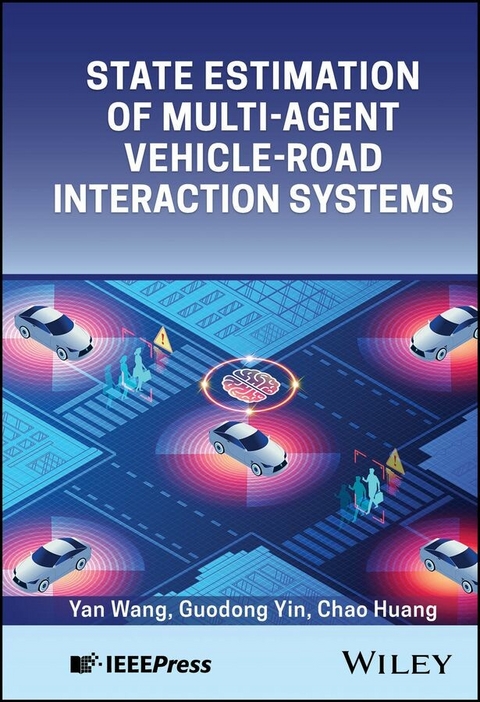
State Estimation of Multi-Agent Vehicle-Road Interaction Systems (eBook)
514 Seiten
Wiley-IEEE Press (Verlag)
978-1-394-29338-4 (ISBN)
Up-to-date discussions of the challenges and solutions in state estimation of vehicle neighborhood systems
In State Estimation of Multi-Agent Vehicle-Road Interaction Systems, a team of distinguished researchers introduces a novel conceptual framework that defines a system comprising vehicles and local road segments within a connected vehicle (V2X) environment-referred to as the vehicle neighborhood system. Creative estimation methods for both states and parameters within this system have been proposed and potential applications of these methods have been discussed. The book places particular emphasis on estimating and analyzing the motion states of the ego vehicle and the preceding vehicle, as well as the tire road friction coefficient.
The book covers a wide range of topics in the area of vehicle neighborhood systems, including sensor technologies, data fusion, filtering algorithms, engineering applications, and practical implementations of autonomous driving systems. It also explores common challenges in state and parameter estimation for related nonlinear systems, such as sensor data loss, unknown measurement noise, and model parameter perturbations. Corresponding solutions to these issues are proposed and discussed in detail.
The book also includes:
- A thorough introduction to ego-vehicle state estimation with sensor data loss
- Comprehensive explorations of unknown noise and parameter perturbations in ego-vehicle state estimation
- Practical discussions of tire-road friction coefficient estimation with parameter mismatch and data loss
- Complete treatments of preceding vehicle state estimation
Perfect for engineers and professionals with an interest in vehicle state estimation, State Estimation of Multi-Agent Vehicle-Road Interaction Systems will also benefit academics, scientists, and graduate students in areas like robotics, control systems, and autonomous systems.
Yan Wang, PhD, is currently a Research Fellow at the Department of Aeronautical and Aviation Engineering, The Hong Kong Polytechnic University.
Guodong Yin, PhD, is a Professor with the School of Mechanical Engineering, Southeast University. His research is focused on vehicle dynamics and control, automated vehicles, and connected vehicles.
Chao Huang, PhD, is currently a Senior Lecturer at The University of Adelaide, Australia.
1
Introduction
1.1 The Definition of Vehicle–Road Interaction System
Traffic accidents are one of the main causes of human casualties [1]. Intelligent connected vehicles will provide a new possibility for the automotive industry to effectively solve safety and congestion problems due to their functions of intelligent decision‐making and collaborative control. Some typical technologies include vehicle road coordination systems, advanced driver assistance systems (ADAS), etc. Some of the most representative technologies in ADAS include stability control systems [2, 3], braking control systems [4–7], local path planning systems [8, 9], active suspension control systems [10–12], etc. The prerequisite for these active safety systems to work effectively is to obtain accurate vehicle state and tire‐road friction coefficient (TRFC) [1]. To describe these vehicle states and road surface information in a unified way, this book adopts the concept of “interaction system” and defines the set composed of the host vehicle, the preceding vehicle, and the current road as the vehicle–road interaction system. As shown in Fig. 1.1, the corresponding variables, such as vehicle sideslip angle, tire stiffness, and TRFC, constitute the key state parameters in the vehicle–road interaction system. However, onboard sensors fail to directly obtain this information. Therefore, estimating these states using only onboard sensors is a hot topic of current research.
In the context of vehicle‐to‐vehicle (V2V) communication, the host vehicle, the preceding vehicle, and the road form a multi‐agent vehicle–road interaction system due to their dynamic interdependence and interactive roles. The host vehicle acts as an independent agent, constantly interacting with its environment by adjusting its control actions based on its own dynamic states and real‐time information from the preceding vehicle and road conditions. The preceding vehicle, another independent agent, influences the host vehicle's behavior through its speed, acceleration, and position, impacting car‐following decisions and safety measures. Additionally, the road, though not a vehicle, can be viewed as an agent due to its influence on vehicle dynamics via tire–road interactions, such as road friction and surface conditions, which directly affect vehicle stability and performance. These three components—host vehicle, preceding vehicle, and road—communicate and interact within a shared environment, forming a tightly coupled multi‐agent system. This framework allows for more accurate state estimation and decision‐making, which is essential for the development of ADAS and autonomous driving technologies. In previous studies, host vehicle and preceding vehicle state estimation, as well as TRFC identification, are usually considered as two types of parameter identification problems. However, in this book, we try to define a new concept to describe a more macroscopic vehicle–road coupled system. This will provide a new perspective to researchers in this field. Therefore, these different states, or TRFC, will become the internal states of this macroscopic system.
Figure 1.1 The vehicle–road interaction system.
1.2 The Importance of State Estimation for Vehicle–Road Interaction System
State estimation plays a crucial role in the development of vehicle–road interaction systems, directly impacting the safety, efficiency, and reliability of vehicles. This technology is fundamental for the operation of autonomous vehicles, as it allows for accurate sensing and understanding of both the vehicle's state and its surrounding environment. By doing so, state estimation enables intelligent vehicles to make autonomous decisions and execute complex driving maneuvers. Accurate state estimation supports ADAS such as adaptive cruise control (ACC), lane‐keeping assist, and emergency braking. For ACC, state estimation helps maintain a safe distance from the vehicle ahead by continuously monitoring relative speed and distance. Lane‐keeping assist relies on state estimation to ensure the vehicle stays centered in its lane by detecting lane markings and making necessary steering adjustments. Emergency braking systems use state estimation to detect potential collisions and apply brakes in time to avoid or mitigate the impact. Furthermore, state estimation enhances the efficiency and reliability of autonomous vehicles. By optimizing driving patterns based on accurate state information, vehicles can achieve smoother acceleration and braking, better fuel economy, and reduced emissions. Reliable state estimation ensures that autonomous vehicles can operate consistently in various conditions, from clear weather to rain or snow, thus building trust in autonomous vehicle technology. In summary, vehicle state estimation is a cornerstone of autonomous vehicle technology. It integrates sensor data, mathematical models, and advanced algorithms to provide a comprehensive understanding of a vehicle's dynamics and its immediate environment. This enables intelligent vehicles to make informed, autonomous decisions, ultimately improving the safety, efficiency, and reliability of modern transportation systems.
Vehicle state estimation involves the real‐time determination of a vehicle's yaw rate, sideslip angle, velocity, and other pertinent parameters. These parameters are critical for assessing the vehicle's current status and predicting its future behavior, which is essential for facilitating safe and effective decision‐making in autonomous vehicles.
The yaw rate of a vehicle, representing its rotational motion around the vertical axis, holds a central position in the realm of vehicle dynamics. It directly impacts the vehicle's stability during maneuvers such as turns and lane changes. A controlled and well‐monitored yaw rate is critical for preventing oversteer or understeer conditions, both of which can lead to loss of control and compromise safety. In the context of vehicle dynamics, yaw rate plays a pivotal role in ensuring the vehicle's stability and responsiveness. During a turn, the yaw rate determines how quickly the vehicle rotates about its vertical axis. If the yaw rate is too high, it can result in oversteer, where the rear wheels lose traction and the vehicle turns more sharply than intended. Conversely, if the yaw rate is too low, it can lead to understeer, where the front wheels lose traction, causing the vehicle to turn less sharply than the driver intends. Both conditions can be dangerous, especially at high speeds or on slippery surfaces. By precisely managing the yaw rate, vehicles can navigate corners with optimal stability, reducing the risk of skidding or rollovers. This is achieved through advanced control systems such as electronic stability control (ESC), which continuously monitors the yaw rate and other parameters to make real‐time adjustments. ESC systems apply brake force to individual wheels and adjust engine power to correct oversteer or understeer, helping the driver maintain control of the vehicle. The importance of yaw rate control becomes even more evident in emergency situations. Rapid changes in direction, such as during evasive maneuvers to avoid an obstacle, demand judicious control of the yaw rate to ensure the vehicle's response aligns with the driver's intentions. In such scenarios, the ability to swiftly and accurately adjust the yaw rate can make the difference between avoiding a collision and losing control. For instance, consider a situation where a driver must swerve to avoid a sudden obstacle on the road. The vehicle's stability control system, relying on yaw rate sensors, will detect the rapid change in direction and intervene to maintain stability. By modulating brake pressure on individual wheels and adjusting throttle input, the system helps the vehicle follow the desired path while preventing oversteer or understeer. This intervention occurs in a matter of milliseconds, often faster than a human driver can react, thereby enhancing safety. Moreover, maintaining an optimal yaw rate is crucial for ensuring passenger comfort. Sudden or excessive rotational movements can be unsettling for passengers, leading to discomfort and motion sickness. By managing the yaw rate effectively, the vehicle can provide a smoother ride, enhancing overall comfort and driving experience. In the realm of autonomous driving, yaw rate control is even more critical. Autonomous vehicles rely on precise control of all dynamic parameters, including yaw rate, to execute complex maneuvers safely and efficiently. Advanced algorithms and sensor fusion techniques are employed to continuously monitor and adjust the yaw rate, ensuring the vehicle remains stable and responsive under all conditions.
In conclusion, the yaw rate of a vehicle is a fundamental aspect of vehicle dynamics, and is crucial for maintaining stability and safety during various driving maneuvers. Whether it is preventing oversteer and understeer in everyday driving or ensuring precise control during emergency situations, effective yaw rate management is essential. Advanced stability control systems and autonomous driving technologies rely heavily on yaw rate data to enhance vehicle performance and passenger safety, underscoring its significance in modern automotive engineering.
The sideslip angle, indicating the angle between a vehicle's velocity vector and its heading angle, is a fundamental...
| Erscheint lt. Verlag | 20.10.2025 |
|---|---|
| Sprache | englisch |
| Themenwelt | Technik ► Elektrotechnik / Energietechnik |
| Schlagworte | Event-triggered Estimation • fault- tolerant estimation • model-based learning estimation • sensor data loss • State Estimation • tire road friction coefficient • Vehicle Neighborhood System • vehicle state estimation |
| ISBN-10 | 1-394-29338-0 / 1394293380 |
| ISBN-13 | 978-1-394-29338-4 / 9781394293384 |
| Informationen gemäß Produktsicherheitsverordnung (GPSR) | |
| Haben Sie eine Frage zum Produkt? |
 EPUB (Adobe DRM)
Kopierschutz: Adobe-DRM
Adobe-DRM ist ein Kopierschutz, der das eBook vor Mißbrauch schützen soll. Dabei wird das eBook bereits beim Download auf Ihre persönliche Adobe-ID autorisiert. Lesen können Sie das eBook dann nur auf den Geräten, welche ebenfalls auf Ihre Adobe-ID registriert sind.
Details zum Adobe-DRM
Dateiformat: EPUB (Electronic Publication)
EPUB ist ein offener Standard für eBooks und eignet sich besonders zur Darstellung von Belletristik und Sachbüchern. Der Fließtext wird dynamisch an die Display- und Schriftgröße angepasst. Auch für mobile Lesegeräte ist EPUB daher gut geeignet.
Systemvoraussetzungen:
PC/Mac: Mit einem PC oder Mac können Sie dieses eBook lesen. Sie benötigen eine
eReader: Dieses eBook kann mit (fast) allen eBook-Readern gelesen werden. Mit dem amazon-Kindle ist es aber nicht kompatibel.
Smartphone/Tablet: Egal ob Apple oder Android, dieses eBook können Sie lesen. Sie benötigen eine
Geräteliste und zusätzliche Hinweise
Buying eBooks from abroad
For tax law reasons we can sell eBooks just within Germany and Switzerland. Regrettably we cannot fulfill eBook-orders from other countries.
aus dem Bereich