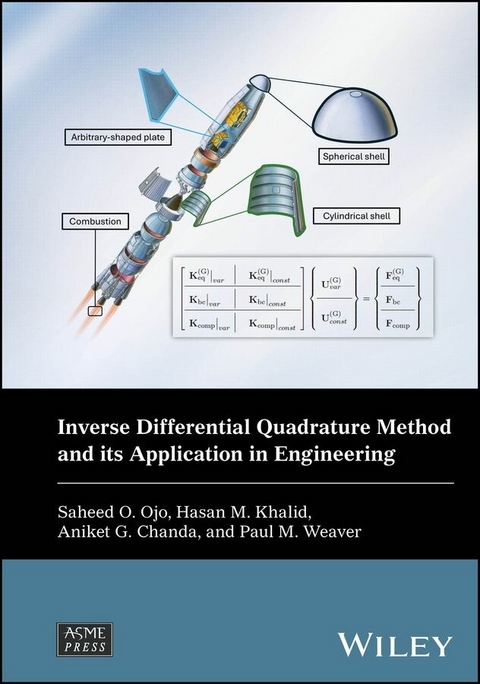
Inverse Differential Quadrature Method and its Application in Engineering (eBook)
678 Seiten
Wiley (Verlag)
978-1-394-25414-9 (ISBN)

Inverse Differential Quadrature Method and its Application in Engineering
Authoritative reference introducing iDQM as a numerical tool to accurately perform high fidelity analyses efficiently for solving problems in engineering governed by higher-order ordinary and partial differential equations.
Inverse Differential Quadrature Method and its Application in Engineering is the first book to comprehensively cover the development of a new numerical solution technique: the inverse differential quadrature method (iDQM), as an indirect approximation technique that can circumvent numerical differentiation-induced errors in the solution of systems of higher-order differential equations.
The book's introduction highlights the historical development of numerical methods in the field while emphasising the significance of strong-form solution methods. Detailed derivations of iDQM formulations in one- and two-dimensions, approximation procedures, and error quantification are described. The subsequent chapters describe the application of iDQM to many fields of engineering including structures, heat flow, fluids, waves and multiphysics problems. Example applications covering linear and nonlinear systems are demonstrated with simple and detailed discretisation steps to aid reader understanding of iDQM. MATLAB codes for many of the illustrative examples in the book are provided to ease implementation and practice for readers.
Written by a team of highly qualified academics, Inverse Differential Quadrature Method and its Application in Engineering discusses topics including:
- High fidelity linear and non-linear structural analyses of variable-stiffness curved beams, arbitrary-shaped plates, and cylindrical and spherical shells governed by unified formulation kinematics
- iDQM error formulation and its effect on spectral convergence
- Accurate and efficient solutions of non-structural problems governed by, for example, Korteweg-de Vries (KdV) wave, Helmholtz, convection-diffusion and steady state heat conduction equations and nonlinear one- and two-dimensional scalar combustion models
- Strategies to alleviate mathematical ill-conditioning of system matrices employing novel preconditioning techniques
Inverse Differential Quadrature Method and its Application in Engineering is an essential reference for researchers and engineers performing advanced numerical analysis across a range of applications in the mechanical, aerospace, chemical, and civil engineering industries, along with graduate students in related programs of study.
Saheed O. Ojo, PhD, is a Research Fellow at the University of Limerick.
Hasan M. Khalid, PhD, is a Postdoctoral Researcher at the University of Limerick.
Aniket G. Chanda, PhD, is a Postdoctoral Researcher at the University of Limerick.
Paul M. Weaver, PhD, is the Bernal Chair of Composite Materials and Structures at the University of Limerick and the Professor of Lightweight Structures at the University of Bristol.
Inverse Differential Quadrature Method and its Application in Engineering Authoritative reference introducing iDQM as a numerical tool to accurately perform high fidelity analyses efficiently for solving problems in engineering governed by higher-order ordinary and partial differential equations. Inverse Differential Quadrature Method and its Application in Engineering is the first book to comprehensively cover the development of a new numerical solution technique: the inverse differential quadrature method (iDQM), as an indirect approximation technique that can circumvent numerical differentiation-induced errors in the solution of systems of higher-order differential equations. The book s introduction highlights the historical development of numerical methods in the field while emphasising the significance of strong-form solution methods. Detailed derivations of iDQM formulations in one- and two-dimensions, approximation procedures, and error quantification are described. The subsequent chapters describe the application of iDQM to many fields of engineering including structures, heat flow, fluids, waves and multiphysics problems. Example applications covering linear and nonlinear systems are demonstrated with simple and detailed discretisation steps to aid reader understanding of iDQM. MATLAB codes for many of the illustrative examples in the book are provided to ease implementation and practice for readers. Written by a team of highly qualified academics, Inverse Differential Quadrature Method and its Application in Engineering discusses topics including: High fidelity linear and non-linear structural analyses of variable-stiffness curved beams, arbitrary-shaped plates, and cylindrical and spherical shells governed by unified formulation kinematicsiDQM error formulation and its effect on spectral convergenceAccurate and efficient solutions of non-structural problems governed by, for example, Korteweg-de Vries (KdV) wave, Helmholtz, convection-diffusion and steady state heat conduction equations and nonlinear one- and two-dimensional scalar combustion modelsStrategies to alleviate mathematical ill-conditioning of system matrices employing novel preconditioning techniques Inverse Differential Quadrature Method and its Application in Engineering is an essential reference for researchers and engineers performing advanced numerical analysis across a range of applications in the mechanical, aerospace, chemical, and civil engineering industries, along with graduate students in related programs of study.
Chapter 1
Introduction
1.1 Introduction
Natural phenomena can often be described mathematically in the form of systems of differential equations. To derive meaningful conclusions with quantitative understanding, accurate solutions to these systems of differential equations are required, which are often not feasible by exact formulae. Instead, approximate numerical approaches, become viable means given the complex nature of the boundary conditions, loading environments and material distributions, noting that often they approach the exact solution, given certain conditions are satisfied. This chapter presents a general procedure for numerically estimating functional fields using spectral methods. In this discussion, emphasis is given to the collocation approach in the framework of spectral methods due to its simpler implementation when compared with the well-established Galerkin and Ritz approaches within the general scope of spectral methods. The appropriate choice of polynomial basis used in the early collocation methods [1, 2] was interlinked with the distribution of the collocation points and this undesirable complexity was addressed with the introduction of the generalised differential quadrature method (DQM) [3]. This method relies on solving differential equations directly, known as the strong-form method of solution. Owing to its simplicity and ease of implementation and rapid numerical convergence, DQM was applied to problems across various disciplines of science. Despite the promising features of DQM, it may suffer from degradation of accuracy with successive differentiation operations. In this regard, the indirect approximation technique is an emerging approach to circumvent differentiation-induced errors associated with direct approximation. This chapter provides an insight into the development of numerical approximation methods and highlights the limitations that support the adoption of indirect approximation techniques.
1.2 Overview of Numerical Approximation Methods
Widely used state-of-the-art structural analyses rely on the finite element method (FEM), notwithstanding the current progress made in using large amounts of data with artificial intelligence (AI) methods, especially neural networks; see for example [4]. Both approaches can be used to model highly continuous systems, but the former has a degree of inherent continuity represented by underlying physical principles in the system, while the latter typically interpolates data from discrete points obtained from sampling. Both represent response surfaces, such as deformations, stresses and temperature as a discrete set of data, which lends itself to solution by matrix methods. Here, we focus on methods in which knowledge of the physics of the problem at hand can be represented mathematically, e.g. in terms of energy (or in general terms as a functional) or in terms of balance expressions, typically represented by differential equations. An energy formulation involves the integration of state variables over the domain (or structure) and so weakens continuity requirements, and is known as the weak method, while the solution of differential equations is accomplished on a point-by-point basis and is known as the strong method.
The essence of all direct methods of solutions involves representing a variable of interest (e.g. deflection, stress, temperature, flow rate, etc.) by a particular form, typically a series of basis functions, whose coefficients (or weights) can be tweaked to minimise the energy of the system or to solve the governing differential equations, subject to appropriate boundary conditions. By representing a continuous field (or function), by a series inherently converts a continuous system into a discrete one, and in the limit, for equivalence between the two, a discrete system with an infinite number of points. Here, we credit Fourier [5] with his trigonometric series representation of heat flow and latterly, Ritz, with these developments. Indeed, Ritz, in his phenomenally profound paper (see [6]) shows the conditions in which a continuous function can be represented by a series formulation, introducing terms, which we understand now as linear independence and completeness. The former can be understood by considering a two-dimensional (2D) vector space whereby a linear combination of two vectors has the significance of being able to represent any point (position vector) in the 2D vector space. Such principles extend to -dimensional space. By ‘completeness’, it means that the series has all sequential terms in a series. So, considering a trigonometrical sine series, then each successive frequency would have to be included. Under these conditions, Ritz showed that an arbitrary function could be represented by a complete infinite series with linearly independent terms, known as basis functions. Of course, the conundrum created by this approach is that an infinite number of the resulting linear equations cannot be formed and therefore solved. Helpfully, Ritz also showed that as the number of terms in the series increases, the exact solution is approached. An early attempt to use this method to solve for an engineering quantity of interest was by Lord Rayleigh in his monumental text: ‘Theory of Sound’ [7], where in one small section he used a single sine function (one term series, if you will), to approximate the first vibration mode of excitation of a hemispherical shell, so to determine its fundamental frequency. As Calladine [8] regales, Rayleigh [9] was interested in quantifying the natural frequency of his college bell at Trinity, Cambridge, the one-term displacement function for the vibration mode captured its behaviour well except for near the bell’s edges (i.e. boundaries), which should be stress free but were not with the single-term mode shape. However, the boundary layer for this problem was narrow, identified by rapidly decaying values of interior stresses to the edge [8]. Rayleigh realised if more sinusoidal terms, of higher frequency, were added, then better agreement could be achieved [10]. However, no proof or generalisation of the process seems to have emerged until Ritz [6], and hence Rayleigh–Ritz methods of direct approximation were born and used to solve systems where functionals, such as the energy of the system, could be formed. For an interesting discussion on early developments in Rayleigh–Ritz methods, the reader is referred to [11]. Inspired by Rayleigh, in the early years of the twentieth century, Timoshenko [12] solved buckling problems of isotropic plates with various loading and boundary conditions using mostly one-term shape functions for the buckling mode shape. As a result of these works, Timoshenko won the Zhuravskii Prize with Bubnov as reviewer. Indeed, in his review, Bubnov also integrated the partial differential equation (PDE) with respect to the unknown displacement, minimised the outcome, which is essentially orthogonalising the error, and in so doing created what is now known as the Galerkin method [13]. This method does not rely on a functional and can be used to solve any differential equation in the weak sense. Notably, Galerkin was a student under Bubnov and used the method for analysing the stability behaviour of multipart plated ship structures. For another interesting detailed discussion on such developments, Elishakoff et al. [14] suggest Timoshenko thought that Ritz had already suggested such an approach in his 1908 paper – indeed, there is a single equation written which resembles, but is actually not, what we now call the Galerkin method, but it was not developed or used to solve any problems by Ritz. To make this brief review more complete, we should also mention the pioneering work of Richardson [15] who in 1911 proposed the finite difference method (FDM) for solving differential equations. So until 1915, in addition to Richardson, physicists (e.g. Rayleigh), mathematicians (e.g. Ritz) and engineers (e.g. Galerkin) had appreciated that a continuous system could be represented by a finite number of discrete entities – as a key underpinning development of what evolved to be the FEM. Important developments in the late 1920s then happened independently in mathematics and engineering. First, the mathematics Where Courant made important developments [16], in which referring to Weierstrass’s first theorem [17], he showed how a series of piecewise constant polynomials can represent an arbitrary continuous function. He made important connections between FDM and Rayleigh–Ritz method by showing the former could be derived as a special case of the latter, as long as only first-order derivatives were involved in the variational statement. He also solved polygonal domains using a net of triangular ‘elements’ by the FDM and tried to do so with higher-order polynomials but seems to have been unable to find suitable basis functions for the Rayleigh–Ritz method to be applied. Concurrently, in engineering practice, the development of faster mono-wing aeroplanes in the late 1920s led to catastrophic flutter failures due to the flexible, thin-walled constructions used. Indeed, initially, Frazer and Duncan working at the National Physics Laboratory in the UK, were researching and developing methods for analysing the aeroelastic response of such aeroplanes. They were soon joined by Collar and they developed semi-rigid elastic models (today, understood as discrete systems)-both experimentally in the lab using lumped masses and, importantly for the current context, also numerically. These authors [18–20] made extremely...
| Erscheint lt. Verlag | 9.10.2025 |
|---|---|
| Reihe/Serie | Wiley-ASME Press Series |
| Sprache | englisch |
| Themenwelt | Technik ► Maschinenbau |
| Schlagworte | composites beams, plates and shells • Indirect approximation technique • Linear And Nonlinear Systems • multidomain structures • spectral method • strong form solutions • Structural Mechanics • underdetermined systems |
| ISBN-10 | 1-394-25414-8 / 1394254148 |
| ISBN-13 | 978-1-394-25414-9 / 9781394254149 |
| Informationen gemäß Produktsicherheitsverordnung (GPSR) | |
| Haben Sie eine Frage zum Produkt? |
 EPUB (Adobe DRM)
Kopierschutz: Adobe-DRM
Adobe-DRM ist ein Kopierschutz, der das eBook vor Mißbrauch schützen soll. Dabei wird das eBook bereits beim Download auf Ihre persönliche Adobe-ID autorisiert. Lesen können Sie das eBook dann nur auf den Geräten, welche ebenfalls auf Ihre Adobe-ID registriert sind.
Details zum Adobe-DRM
Dateiformat: EPUB (Electronic Publication)
EPUB ist ein offener Standard für eBooks und eignet sich besonders zur Darstellung von Belletristik und Sachbüchern. Der Fließtext wird dynamisch an die Display- und Schriftgröße angepasst. Auch für mobile Lesegeräte ist EPUB daher gut geeignet.
Systemvoraussetzungen:
PC/Mac: Mit einem PC oder Mac können Sie dieses eBook lesen. Sie benötigen eine
eReader: Dieses eBook kann mit (fast) allen eBook-Readern gelesen werden. Mit dem amazon-Kindle ist es aber nicht kompatibel.
Smartphone/Tablet: Egal ob Apple oder Android, dieses eBook können Sie lesen. Sie benötigen eine
Geräteliste und zusätzliche Hinweise
Buying eBooks from abroad
For tax law reasons we can sell eBooks just within Germany and Switzerland. Regrettably we cannot fulfill eBook-orders from other countries.
aus dem Bereich