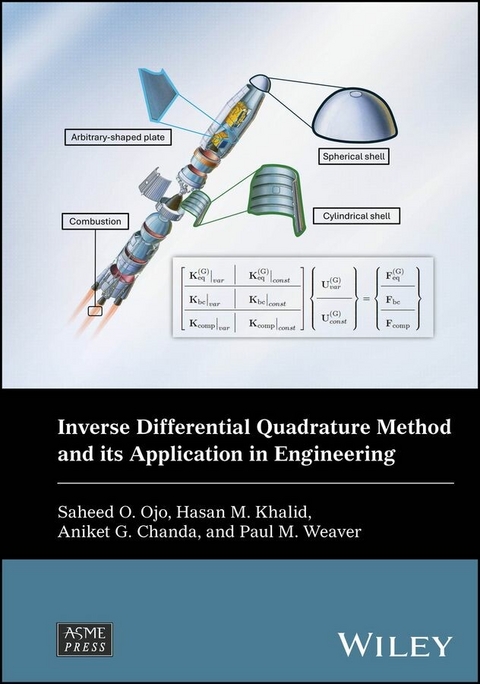
Inverse Differential Quadrature Method and its Application in Engineering (eBook)
370 Seiten
Wiley (Verlag)
978-1-394-25415-6 (ISBN)
Inverse Differential Quadrature Method and its Application in Engineering
Authoritative reference introducing iDQM as a numerical tool to accurately perform high fidelity analyses efficiently for solving problems in engineering governed by higher-order ordinary and partial differential equations.
Inverse Differential Quadrature Method and its Application in Engineering is the first book to comprehensively cover the development of a new numerical solution technique: the inverse differential quadrature method (iDQM), as an indirect approximation technique that can circumvent numerical differentiation-induced errors in the solution of systems of higher-order differential equations.
The book's introduction highlights the historical development of numerical methods in the field while emphasising the significance of strong-form solution methods. Detailed derivations of iDQM formulations in one- and two-dimensions, approximation procedures, and error quantification are described. The subsequent chapters describe the application of iDQM to many fields of engineering including structures, heat flow, fluids, waves and multiphysics problems. Example applications covering linear and nonlinear systems are demonstrated with simple and detailed discretisation steps to aid reader understanding of iDQM. MATLAB codes for many of the illustrative examples in the book are provided to ease implementation and practice for readers.
Written by a team of highly qualified academics, Inverse Differential Quadrature Method and its Application in Engineering discusses topics including:
- High fidelity linear and non-linear structural analyses of variable-stiffness curved beams, arbitrary-shaped plates, and cylindrical and spherical shells governed by unified formulation kinematics
- iDQM error formulation and its effect on spectral convergence
- Accurate and efficient solutions of non-structural problems governed by, for example, Korteweg-de Vries (KdV) wave, Helmholtz, convection-diffusion and steady state heat conduction equations and nonlinear one- and two-dimensional scalar combustion models
- Strategies to alleviate mathematical ill-conditioning of system matrices employing novel preconditioning techniques
Inverse Differential Quadrature Method and its Application in Engineering is an essential reference for researchers and engineers performing advanced numerical analysis across a range of applications in the mechanical, aerospace, chemical, and civil engineering industries, along with graduate students in related programs of study.
Saheed O. Ojo, PhD, is a Research Fellow at the University of Limerick.
Hasan M. Khalid, PhD, is a Postdoctoral Researcher at the University of Limerick.
Aniket G. Chanda, PhD, is a Postdoctoral Researcher at the University of Limerick.
Paul M. Weaver, PhD, is the Bernal Chair of Composite Materials and Structures at the University of Limerick and the Professor of Lightweight Structures at the University of Bristol.
Inverse Differential Quadrature Method and its Application in Engineering Authoritative reference introducing iDQM as a numerical tool to accurately perform high fidelity analyses efficiently for solving problems in engineering governed by higher-order ordinary and partial differential equations. Inverse Differential Quadrature Method and its Application in Engineering is the first book to comprehensively cover the development of a new numerical solution technique: the inverse differential quadrature method (iDQM), as an indirect approximation technique that can circumvent numerical differentiation-induced errors in the solution of systems of higher-order differential equations. The book s introduction highlights the historical development of numerical methods in the field while emphasising the significance of strong-form solution methods. Detailed derivations of iDQM formulations in one- and two-dimensions, approximation procedures, and error quantification are described. The subsequent chapters describe the application of iDQM to many fields of engineering including structures, heat flow, fluids, waves and multiphysics problems. Example applications covering linear and nonlinear systems are demonstrated with simple and detailed discretisation steps to aid reader understanding of iDQM. MATLAB codes for many of the illustrative examples in the book are provided to ease implementation and practice for readers. Written by a team of highly qualified academics, Inverse Differential Quadrature Method and its Application in Engineering discusses topics including: High fidelity linear and non-linear structural analyses of variable-stiffness curved beams, arbitrary-shaped plates, and cylindrical and spherical shells governed by unified formulation kinematicsiDQM error formulation and its effect on spectral convergenceAccurate and efficient solutions of non-structural problems governed by, for example, Korteweg-de Vries (KdV) wave, Helmholtz, convection-diffusion and steady state heat conduction equations and nonlinear one- and two-dimensional scalar combustion modelsStrategies to alleviate mathematical ill-conditioning of system matrices employing novel preconditioning techniques Inverse Differential Quadrature Method and its Application in Engineering is an essential reference for researchers and engineers performing advanced numerical analysis across a range of applications in the mechanical, aerospace, chemical, and civil engineering industries, along with graduate students in related programs of study.
| Erscheint lt. Verlag | 30.9.2025 |
|---|---|
| Reihe/Serie | Wiley-ASME Press Series |
| Sprache | englisch |
| Themenwelt | Technik ► Maschinenbau |
| Schlagworte | composites beams, plates and shells • Indirect approximation technique • Linear And Nonlinear Systems • multidomain structures • spectral method • strong form solutions • Structural Mechanics • underdetermined systems |
| ISBN-10 | 1-394-25415-6 / 1394254156 |
| ISBN-13 | 978-1-394-25415-6 / 9781394254156 |
| Informationen gemäß Produktsicherheitsverordnung (GPSR) | |
| Haben Sie eine Frage zum Produkt? |
 PDF (Adobe DRM)
Kopierschutz: Adobe-DRM
Adobe-DRM ist ein Kopierschutz, der das eBook vor Mißbrauch schützen soll. Dabei wird das eBook bereits beim Download auf Ihre persönliche Adobe-ID autorisiert. Lesen können Sie das eBook dann nur auf den Geräten, welche ebenfalls auf Ihre Adobe-ID registriert sind.
Details zum Adobe-DRM
Dateiformat: PDF (Portable Document Format)
Mit einem festen Seitenlayout eignet sich die PDF besonders für Fachbücher mit Spalten, Tabellen und Abbildungen. Eine PDF kann auf fast allen Geräten angezeigt werden, ist aber für kleine Displays (Smartphone, eReader) nur eingeschränkt geeignet.
Systemvoraussetzungen:
PC/Mac: Mit einem PC oder Mac können Sie dieses eBook lesen. Sie benötigen eine
eReader: Dieses eBook kann mit (fast) allen eBook-Readern gelesen werden. Mit dem amazon-Kindle ist es aber nicht kompatibel.
Smartphone/Tablet: Egal ob Apple oder Android, dieses eBook können Sie lesen. Sie benötigen eine
Geräteliste und zusätzliche Hinweise
Buying eBooks from abroad
For tax law reasons we can sell eBooks just within Germany and Switzerland. Regrettably we cannot fulfill eBook-orders from other countries.
aus dem Bereich