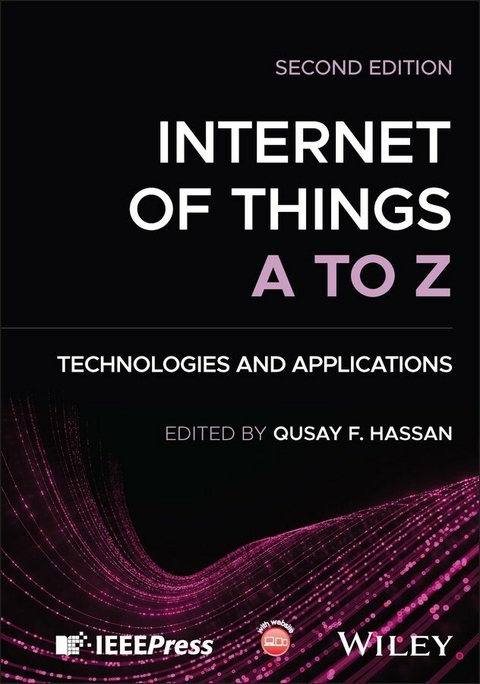
Internet of Things A to Z (eBook)
1626 Seiten
Wiley-IEEE Press (Verlag)
978-1-394-28047-6 (ISBN)
A fully updated guide to cutting-edge Internet of Things (IoT) technology
The Internet of Things (IoT) has revolutionized the way we interact with technology in a highly connected world, bringing a host of new objects and points of entry into global communications networks. Internet of Things A to Z: Technologies and Applications, Second Edition, is a thorough and accessible resource to IoT for undergraduate and postgraduate students, as well as practitioners and implementers.
With a contributor team led by an editor who has decades of experience in information and communication technology (ICT), it covers all foundational subjects for understanding IoT. Now fully updated to reflect the latest developments in the field, it is an indispensable volume for students, researchers, and IT learners looking to keep pace with this rapidly growing technology.
Organized into five thematic parts, this edition offers foundational theory, emerging technologies, domain-specific applications, security and trust models, and hands-on tutorials that bridge theory and practice. Each chapter offers a research-informed overview with extensive references, making the book equally valuable as a course text and a scholarly reference.
Readers of the second edition will also find:
- Three additional chapters covering applications of artificial intelligence, machine learning, and deep learning, including information on the Internet of Military Things
- Detailed chapters on IoT architecture and ecosystems, security issues such as trust management and IoT authentication methods, big data analytics, and more
- Expanded treatment of essential technologies not covered in the first edition, including edge computing and edge intelligence, with coverage of applications such as tinyML, Digital Twins, AR/VR, and the metaverse
- Practical tutorials on building IoT prototypes and developing streaming data pipelines using widely adopted tools and platforms
- New information on design and prototyping, including updated hardware boards and instructions
Internet of Things A to Z: Technologies and Applications, Second Edition, is ideal for students interested in the Internet of Things, ICT researchers, industry professionals, and lifetime IT learners seeking a comprehensive and up-to-date reference that connects theory with real-world implementation.
Qusay F. Hassan, PhD, is an independent researcher and technology evangelist with over 20 years of industry experience in information communication technology (ICT). Throughout his career, he has held various roles in software development, IT services, and teaching. He is currently an independent technical consultant, advising on emerging ICT trends and enterprise systems. In his previous position as a systems analyst at the U.S. Agency for International Development (USAID), he implemented and managed large-scale data and software systems and actively contributed to digital transformation initiatives, helping to adopt new technologies and deliver innovative solutions across sectors. He received his PhD in computer and information sciences from Mansoura University, Egypt, in 2015. His technical experience and research interests span the areas of software engineering, big data engineering, and distributed systems. He has authored several publications and reviewed many articles and books in these areas. He is also the editor of several academic and research books, including his latest: Advances in the Internet of Things: Challenges, Solutions, and Emerging Technologies (CRC Press, 2025). He is a senior member of IEEE.
A fully updated guide to cutting-edge Internet of Things (IoT) technology The Internet of Things (IoT) has revolutionized the way we interact with technology in a highly connected world, bringing a host of new objects and points of entry into global communications networks. Internet of Things A to Z: Technologies and Applications, Second Edition, is a thorough and accessible resource to IoT for undergraduate and postgraduate students, as well as practitioners and implementers. With a contributor team led by an editor who has decades of experience in information and communication technology (ICT), it covers all foundational subjects for understanding IoT. Now fully updated to reflect the latest developments in the field, it is an indispensable volume for students, researchers, and IT learners looking to keep pace with this rapidly growing technology. Organized into five thematic parts, this edition offers foundational theory, emerging technologies, domain-specific applications, security and trust models, and hands-on tutorials that bridge theory and practice. Each chapter offers a research-informed overview with extensive references, making the book equally valuable as a course text and a scholarly reference. Readers of the second edition will also find: Three additional chapters covering applications of artificial intelligence, machine learning, and deep learning, including information on the Internet of Military ThingsDetailed chapters on IoT architecture and ecosystems, security issues such as trust management and IoT authentication methods, big data analytics, and moreExpanded treatment of essential technologies not covered in the first edition, including edge computing and edge intelligence, with coverage of applications such as tinyML, Digital Twins, AR/VR, and the metaversePractical tutorials on building IoT prototypes and developing streaming data pipelines using widely adopted tools and platformsNew information on design and prototyping, including updated hardware boards and instructions Internet of Things A to Z: Technologies and Applications, Second Edition, is ideal for students interested in the Internet of Things, ICT researchers, industry professionals, and lifetime IT learners seeking a comprehensive and up-to-date reference that connects theory with real-world implementation.
List of Contributors
Abdullah Abuhussein
Department of Information Systems
St. Cloud State University
St. Cloud
MN
USA
Farhad Ahamed
School of Social Sciences
Western Sydney University
Penrith
Australia
Ala Al‐Areqi
School of Social Sciences
Western Sydney University
Penrith
Australia
Faisal S. Alsubaei
Faculty of Computing and Information Technology
University of Jeddah
Jeddah
Saudi Arabia
Theodoros Aslanidis
School of Computer Science
University College Dublin
Dublin Ireland
Adarsha Bhattarai
Department of Electrical and Computer Engineering
University of Nebraska
Lincoln
USA
Kalinka Regina Lucas Jaquie Castelo Branco
Department of Computer Science
Institute of Mathematics and Computer Sciences (ICMC)
University of São Paulo (USP)
São Carlos
São Paulo
Brazil
Willie L. Brown Jr.
Department of Engineering and Aviation Sciences
University of Maryland Eastern Shore
Princess Anne
MD
USA
Joseph Bugeja
Internet of Things and People Research Center and Department of Computer Science and Media Technology
Malmö University
Malmö
Sweden
John Byabazaire
School of Computer Science
University College Dublin
Dublin Ireland
Mirothali Chand
ACS Lab
Indian Institute of Technology Mandi
Himachal Pradesh
India
Dimitris Chatzopoulos
School of Computer Science
University College Dublin
Dublin, Ireland
Andreas Chouliaras
School of Computer Science
University College Dublin
Dublin, Ireland
Ibibia K. Dabipi
Department of Engineering and Aviation Sciences
University of Maryland Eastern Shore
Princess Anne
MD
USA
Paul Davidsson
Internet of Things and People Research Center and Department of Computer Science and Media Technology
Malmö University
Malmö
Sweden
Varun Dutt
ACS Lab
Indian Institute of Technology Mandi
Himachal Pradesh
India
Jeanette Eriksson
Department of Computer Science and Media Technology
Internet of Things and People (IoTaP) Research Center
Malmö University
Malmö
Sweden
Akaa Agbaeze Eteng
Department of Electrical/Electronic Engineering
University of Port Harcourt
Rivers State
Nigeria
Farnaz Farid
School of Social Sciences
Western Sydney University
Penrith
Australia
Lucas Finco
Principal Consultant
Strategain
New York
NY
USA
Alvis Fong
Department of Computer Science
Western Michigan University
Kalamazoo MI
USA
Bernard Fong
Department of Electrical Engineering
Chang Gung University
Taiwan
João Vitor de Carvalho Fontes
Department of Mechanical Engineering São Carlos School of Engineering (EESC)
University of São Paulo (USP)
São Carlos
São Paulo
Brazil
Virginia N. L. Franqueira
Institute of Cyber Security for Society (iCSS) & School of Computing
University of Kent
Canterbury
United Kingdom
Mário M. Freire
Department of Computer Science
Instituto de Telecomunicações
Universidade da Beira Interior
Covilhã
Portugal
Daniel Happ
QAware GmbH
Berlin
Germany
Qusay F. Hassan
Independent Researcher
Cairo
Egypt
Muhammad Babar Imtiaz
Software Research Institute
Technological University of the Shannon
Athlone
Co Westmeath
Ireland
Pedro R. M. Inácio
Department of Computer Science
Instituto de Telecomunicações
Universidade da Beira Interior
Covilhã
Portugal
Andreas Jacobsson
Internet of Things and People Research Center and Department of Computer Science and Media Technology
Malmö University
Malmö
Sweden
Kai Jakobs
Computer Science Department
RWTH Aachen University
Aachen
Germany
Jonny Karlsson
Department of Business Management and Analytics
Arcada University of Applied Sciences
Helsinki
Finland
Haesik Kim
VTT Technical Research Centre of Finland
Oulu
Finland
Vlasis Koutsos
School of Computer Science
University College Dublin
Dublin, Ireland
Praveen Kumar
ACS Lab
Indian Institute of Technology Mandi
Himachal Pradesh
India
Brian Lee
Software Research Institute
Technological University of the Shannon
Athlone
Co Westmeath
Ireland
Chee Yen Leow
Wireless Communication Centre
Faculty of Electrical Engineering
Universiti Teknologi Malaysia
Skudai
Malaysia
Chi Kwong Li
Clinical Research
Alpha Positive Clinic
Hong Kong
Yutong Liu
Department of Radiology
University of Nebraska Medical Center
Lincoln
USA
Kieran McLaughlin
School of Electronics
Electrical Engineering and Computer Science
Queens University Belfast
Belfast
United Kingdom
Manuel Meruje
Department of Computer Science
Instituto de Telecomunicações
Universidade da Beira Interior
Covilhã
Portugal
Daniel Minoli
IoT Division
DVI Communications
New York
NY
USA
Benedict Occhiogrosso
Intellectual Property Division
DVI Communications
New York
NY
USA
Ioannis Panagiotidis
School of Computer Science
University College Dublin
Dublin Ireland
Neha Pandey
HelloFresh SE
Chicago USA
Dongming Peng
Department of Electrical and Computer Engineering
University of Nebraska
Lincoln
USA
Daniel Fernando Pigatto
Department of Computer Science
Graduate Program in Electrical and Computer Engineering (CPGEI)
Federal University of Technology Paraná (UTFPR)
Curitiba
Paraná
Brazil
Alex Sandro Roschildt Pinto
Federal University of Santa Catarina (UFSC)
Blumenau
Santa Catarina
Brazil
Göran Pulkkis
Department of Business Management and Analytics
Arcada University of Applied Sciences
Helsinki
Finland
Sharul Kamal Abdul Rahim
Wireless Communication Centre
Faculty of Electrical Engineering
Universiti Teknologi Malaysia
Skudai
Malaysia
Shahid Raza
RISE SICS Security Lab
Kista
Stockholm
Sweden
Mariana Rodrigues
Department of Computer Science
Institute of Mathematics and Computer Sciences (ICMC)
University of São Paulo (USP)
São Carlos
São Paulo
Brazil
Nancy L. Russo
Department of Computer Science and Media Technology
Internet of Things and People (IoTaP) Research Center
Malmö University
Malmö
Sweden
Fariza Sabrina
School of Engineering and Technology
CQ University
Sydney
Australia
Vyasa Sai
Intel Corp.
Folsom CA
USA
Musa G. Samaila
Department of Computer Science
Instituto de Telecomunicações
Universidade da Beira Interior
Covilhã
Portugal
Centre for Geodesy and Geodynamics
National Space Research and Development Agency
Toro
Bauchi
Nigeria
Chathumi Samaraweera
Department of Electrical and Computer Engineering
University of Nebraska
Lincoln
USA
Sahil Sankhyan
ACS Lab
Indian Institute of Technology Mandi
Himachal Pradesh
India
Detlef Schoder
Cologne Institute for Information Systems (CIIS)
Chair of Information Systems and Information Management
University of Cologne
Cologne, Germany
João B. F. Sequeiros
Department of Computer Science
Instituto de Telecomunicações
Universidade da Beira Interior
Covilhã
Portugal
Hamid Sharif
Department of Electrical and Computer Engineering
University of Nebraska
Lincoln
USA
Sajjan Shiva
Computer Science Department
University of Memphis
Memphis
TN
USA
Jan Sliwa
School of Engineering and Computer Science
Berne University of Applied Sciences
Berne
Switzerland
James Smith
Computer Science and Creative Technologies (FET)
University of the West of England (UWE)
Bristol
England
United Kingdom
Marco Tiloca
RISE SICS Security Lab
Kista
Stockholm
Sweden
Joana Tirana
School of Computer Science
University College Dublin
Dublin, Ireland
Kala Venkata Uday
School of Civil...
| Erscheint lt. Verlag | 29.9.2025 |
|---|---|
| Sprache | englisch |
| Themenwelt | Technik ► Elektrotechnik / Energietechnik |
| Schlagworte | Actuator • AIOT • Artificial Intelligence • AR/VR • Big Data Analytics • Blockchain • Cloud Computing • Deep learning • Digital Twins • edge computing • Edge intelligence • Fog Computing • Industrial IoT • IOT • machine learning • metaverse • Microcontroller • military defense • Precision Agriculture • RFID • security • Sensor • small single-board computer • smart ambulance • Smart City • Smart Grids • Smart Healthcare • smart homes • TinyML • trust management • unmanned aerial vehicle • Wearables • WSN |
| ISBN-10 | 1-394-28047-5 / 1394280475 |
| ISBN-13 | 978-1-394-28047-6 / 9781394280476 |
| Informationen gemäß Produktsicherheitsverordnung (GPSR) | |
| Haben Sie eine Frage zum Produkt? |
 EPUB (Adobe DRM)
Kopierschutz: Adobe-DRM
Adobe-DRM ist ein Kopierschutz, der das eBook vor Mißbrauch schützen soll. Dabei wird das eBook bereits beim Download auf Ihre persönliche Adobe-ID autorisiert. Lesen können Sie das eBook dann nur auf den Geräten, welche ebenfalls auf Ihre Adobe-ID registriert sind.
Details zum Adobe-DRM
Dateiformat: EPUB (Electronic Publication)
EPUB ist ein offener Standard für eBooks und eignet sich besonders zur Darstellung von Belletristik und Sachbüchern. Der Fließtext wird dynamisch an die Display- und Schriftgröße angepasst. Auch für mobile Lesegeräte ist EPUB daher gut geeignet.
Systemvoraussetzungen:
PC/Mac: Mit einem PC oder Mac können Sie dieses eBook lesen. Sie benötigen eine
eReader: Dieses eBook kann mit (fast) allen eBook-Readern gelesen werden. Mit dem amazon-Kindle ist es aber nicht kompatibel.
Smartphone/Tablet: Egal ob Apple oder Android, dieses eBook können Sie lesen. Sie benötigen eine
Geräteliste und zusätzliche Hinweise
Buying eBooks from abroad
For tax law reasons we can sell eBooks just within Germany and Switzerland. Regrettably we cannot fulfill eBook-orders from other countries.
aus dem Bereich