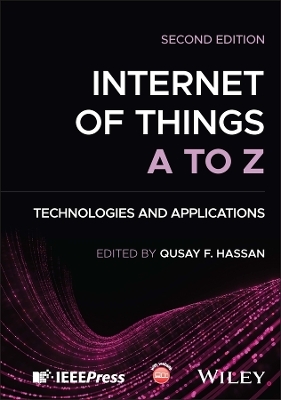
Internet of Things A to Z
Wiley-IEEE Press (Verlag)
978-1-394-28046-9 (ISBN)
The Internet of Things (IoT) has revolutionized the way we interact with technology in a highly connected world, bringing a host of new objects and points of entry into global communications networks. Internet of Things A to Z: Technologies and Applications, Second Edition, is a thorough and accessible resource to IoT for undergraduate and postgraduate students, as well as practitioners and implementers.
With a contributor team led by an editor who has decades of experience in information and communication technology (ICT), it covers all foundational subjects for understanding IoT. Now fully updated to reflect the latest developments in the field, it is an indispensable volume for students, researchers, and IT learners looking to keep pace with this rapidly growing technology.
Organized into five thematic parts, this edition offers foundational theory, emerging technologies, domain-specific applications, security and trust models, and hands-on tutorials that bridge theory and practice. Each chapter offers a research-informed overview with extensive references, making the book equally valuable as a course text and a scholarly reference.
Readers of the second edition will also find:
Three additional chapters covering applications of artificial intelligence, machine learning, and deep learning, including information on the Internet of Military Things
Detailed chapters on IoT architecture and ecosystems, security issues such as trust management and IoT authentication methods, big data analytics, and more
Expanded treatment of essential technologies not covered in the first edition, including edge computing and edge intelligence, with coverage of applications such as tinyML, Digital Twins, AR/VR, and the metaverse
Practical tutorials on building IoT prototypes and developing streaming data pipelines using widely adopted tools and platforms
New information on design and prototyping, including updated hardware boards and instructions
Internet of Things A to Z: Technologies and Applications, Second Edition, is ideal for students interested in the Internet of Things, ICT researchers, industry professionals, and lifetime IT learners seeking a comprehensive and up-to-date reference that connects theory with real-world implementation.
Qusay F. Hassan, PhD, is an independent researcher and technology evangelist with over 20 years of industry experience in information communication technology (ICT). Throughout his career, he has held various roles in software development, IT services, and teaching. He is currently an independent technical consultant, advising on emerging ICT trends and enterprise systems. In his previous position as a systems analyst at the U.S. Agency for International Development (USAID), he implemented and managed large-scale data and software systems and actively contributed to digital transformation initiatives, helping to adopt new technologies and deliver innovative solutions across sectors. He received his PhD in computer and information sciences from Mansoura University, Egypt, in 2015. His technical experience and research interests span the areas of software engineering, big data engineering, and distributed systems. He has authored several publications and reviewed many articles and books in these areas. He is also the editor of several academic and research books, including his latest: Advances in the Internet of Things: Challenges, Solutions, and Emerging Technologies (CRC Press, 2025). He is a senior member of IEEE.
List of Contributors xxv
About the Editor xxxi
About the Contributors xxxiii
Preface lv
Acknowledgments lxiii
Reviewers lxv
About the Companion Website lxvii
Part I Core Concepts and Enablers 1
1 Introduction to the Internet of Things 3
Detlef Schoder
1.1 Historical Roots 3
1.2 Related Streams: Machine-to-Machine Communications, Industrial Internet of Things, Industry 4.0, and Cyber-Physical Systems 6
1.3 Who Works on the Internet of Things? 8
1.4 Internet of Things—Core Concepts 9
1.5 Internet of Things Framework 12
1.6 Derived Qualities of Modern ICT 24
1.7 Potential for Product, Process, and Business Model Innovations 26
1.8 Implications and Challenges 30
1.9 Conclusion 34
References 35
2 An Overview of Enabling Technologies for the Internet of Things 41
Faisal S. Alsubaei, Abdullah Abuhussein, and Sajjan Shiva
2.1 Introduction 41
2.2 Overview of IoT Architecture 42
2.3 Enabling Technologies 43
2.4 IoT Platforms and Operating Systems 61
2.5 Conclusion 63
References 64
3 RFID in the Internet of Things 67
Akaa Agbaeze Eteng, Sharul Kamal Abdul Rahim, and Chee Yen Leow
3.1 Introduction 67
3.2 A Brief History of RFID 68
3.3 A Glimpse into RFID Technology 69
3.4 RFID Applications in the Internet of Things 71
3.5 Connecting RFID Transceivers to the Internet 77
3.6 Emerging Technology Trends 80
3.7 Challenges and Outlook 81
3.8 Conclusion 83
References 84
4 Sensors, Actuators, Wireless Sensor Networks, and the Internet of Things 89
Akaa Agbaeze Eteng
4.1 Introduction 89
4.2 A Glimpse into Sensors and Actuators 89
4.3 Wireless Sensor Networks 94
4.4 Wireless Sensor Networks in the Internet of Things 101
4.5 Deployment Case Studies 104
4.6 Open Problems and Future Directions 106
4.7 Conclusion 112
References 112
5 Cloud and Fog Computing in the Internet of Things 119
Daniel Happ
5.1 Introduction 119
5.2 IoT System Requirements 120
5.3 Cloud Computing in IoT 121
5.4 Fog Computing in IoT 126
5.5 Conclusion 133
References 134
6 On Standardizing the Internet of Things and Its Applications 137
Kai Jakobs
6.1 Introduction 137
6.2 Current Status 139
6.3 The Standardization Environment 143
6.4 Standardization in Selected Application Areas 145
6.5 Discussion and Some Speculation 152
6.6 Conclusion 154
Acknowledgments 155
References 155
Part II AI and the Internet of Things 159
7 Artificial Intelligence and the Internet of Things: Algorithms, Applications, and Challenges 161
Chathumi Samaraweera, Adarsha Bhattarai, Dongming Peng, Yutong Liu, and Hamid Sharif
7.1 Introduction 161
7.2 AI Algorithms 163
7.3 AI-Based IoT Applications 176
7.4 Current Challenges and Potential Solutions 182
7.5 More Considerations on Real-World Applications and Moral Ramifications of AI/ML in IoT 186
7.6 Conclusion 187
References 188
8 Deep Learning and the Internet of Things: Applications, Challenges, and Opportunities 193
John Byabazaire, Joana Tirana, Andreas Chouliaras, Vlasis Koutsos, Theodoros Aslanidis, Ioannis Panagiotidis, and Dimitris Chatzopoulos
8.1 Introduction 193
8.2 Overview of Deep Learning 195
8.3 Edge Intelligence 200
8.4 tinyML 206
8.5 Digital Twins 209
8.6 Metaverse 212
8.7 Challenges and Opportunities 216
8.8 Conclusion 220
References 221
Part III Use Cases and Application Domains 229
9 The Industrial Internet of Things 231
Alexander Willner
9.1 Introduction 231
9.2 Market Overview 232
9.3 Interoperability and Technologies 236
9.4 Alliances 239
9.5 Conclusions 243
Acknowledgments 243
References 244
10 The Emerging “Energy Internet of Things” 247
Daniel Minoli and Benedict Occhiogrosso
10.1 Introduction 247
10.2 Power Management Trends and EIoT Support 251
10.3 Real-Life Power Management Optimization Approaches 267
10.4 Challenges and Future Directions 270
10.5 Conclusion 273
References 274
11 Implementing the Internet of Things for Renewable Energy 279
Lucas Finco and Daniel Minoli
11.1 Introduction 279
11.2 Managing the Impact of Sustainable Energy 280
11.3 EIoT Deployment 285
11.4 Industry Standards for EIoT 290
11.5 Security Considerations in EIoT and Clean Energy Environments 292
11.6 Conclusion 293
References 294
12 Internet of Things Applications for Smart Cities 297
Daniel Minoli and Benedict Occhiogrosso
12.1 Introduction 297
12.2 IoT Applications for Smart Cities 299
12.3 Specific Smart City Applications 306
12.4 Optimal Enablement of Video and Multimedia Capabilities in IoT 312
12.5 Key Underlying Technologies for Smart Cities IoT Applications 313
12.6 Challenges and Future Research 320
12.7 Conclusion 321
References 321
13 Internet of Things Applications for Agriculture 327
Lei Zhang, Ibibia K. Dabipi, and Willie L. Brown Jr.
13.1 Introduction 327
13.2 Internet-of-Things-Based PA 329
13.3 IoT Application in Agriculture Irrigation 331
13.4 IoT Application in Agriculture Fertilization 334
13.5 IoT Application in Crop Disease and Pest Management 336
13.6 IoT Application in Precision Livestock Farming 337
13.7 Conclusion 339
References 339
14 Smart Landslide Monitoring and Warning Systems with IoT Technologies 345
Sahil Sankhyan, Mirothali Chand, Praveen Kumar, Kala Venkata Uday, and Varun Dutt
14.1 Introduction 345
14.2 IoT-Based Landslide Early Warning Systems (IoT-LEWSs) 347
14.3 Case Studies 356
14.4 Challenges and Future Research 358
14.5 Conclusion 362
References 363
15 The Internet of Things and People in Health Care 369
Nancy L. Russo and Jeanette Eriksson
15.1 Introduction 369
15.2 The Smart Health Care Ecosystem 370
15.3 Dimensions of Internet of Things Applications in Health Care 374
15.4 Examples of IoT-Related Health Care Applications and Their Dimensions 378
15.5 Challenges 386
15.6 Conclusion 388
Acknowledgments 389
References 389
16 Smart Ambulance and Emergency Medicine: Mobile IoT in the 6G Era 391
Bernard Fong, Alvis Fong, Haesik Kim, Vyasa Sai, and Chi Kwong li
16.1 Introduction 391
16.2 IoT in Emergency Medicine 392
16.3 Integration and Compatibility 400
16.4 Case Study: Chronic Obstructive Pulmonary Disease 405
16.5 Smart Ambulance Challenges 410
16.6 Moving into the 6G Era 411
16.7 Conclusions 413
References 414
17 Smart Connected Homes 419
Joseph Bugeja, Andreas Jacobsson, and Paul Davidsson
17.1 Introduction 419
17.2 The Smart Connected Home Domain 420
17.3 Smart Connected Home Systems 422
17.4 The Smart Connected Home Technologies 425
17.5 Smart Connected Home Architectures 430
17.6 Smart Connected Home Challenges and Research Directions 432
17.7 Conclusions 435
Acknowledgments 435
References 436
18 The Internet of Flying Things 439
Daniel Fernando Pigatto, Mariana Rodrigues, João Vitor de Carvalho Fontes, Alex Sandro Roschildt Pinto, James Smith, and Kalinka Regina Lucas Jaquie Castelo Branco
18.1 Introduction 439
18.2 Flying Things 440
18.3 The Internet of Flying Things 442
18.4 Challenges 449
18.5 Case Studies 455
18.6 Conclusions 461
Acknowledgments 462
References 462
19 Internet of Military Things and Weaponized AI: Technology in the Age of Conflict 465
Jan Sliwa
19.1 Introduction 465
19.2 Military Systems: Basic Elements 466
19.3 Military Applications: Selected Topics 473
19.4 AI Governance: Legal and Ethical Ramifications 490
19.5 Conclusion 492
References 493
Part IV Security and Privacy 495
20 Security Mechanisms and Technologies for Constrained IoT Devices 497
Marco Tiloca and Shahid Raza
20.1 Introduction 497
20.2 Security in IoT Protocols and Technologies 498
20.3 Security Issues and Solutions 507
20.4 Conclusion 517
References 517
21 Blockchain-Based Security Solutions for IoT Systems 523
Göran Pulkkis, Jonny Karlsson, and Magnus Westerlund
21.1 Introduction 523
21.2 Regulatory Requirements 524
21.3 Blockchain Technology 526
21.4 Blockchains and IoT Systems 528
21.5 Examples of Blockchain-Based Security Solutions for IoT Systems 528
21.6 Challenges and Future Research 535
21.7 Conclusions 535
References 536
22 Authentication Methods for the Internet of Things: Pre- and Post-Quantum Computing 539
Farnaz Farid, Ala Al-Areqi, Fariza Sabrina, and Farhad Ahamed
22.1 Introduction 539
22.2 Pre-Quantum Authentication Methods for IoT 541
22.3 Quantum Computing and its Impact on IoT Security 547
22.4 Post-Quantum Authentication Methods for IoT 549
22.5 Post-Quantum Authentication and IoT Applications 554
22.6 Hybrid Authentication Approach for Enhanced Security 556
22.7 Future Directions and Challenges 558
22.8 Conclusion 560
References 561
23 On the Role of Dynamic Trust Management in the Evolving Internet of Things 565
Brian Lee, Muhammad Babar Imtiaz, Kieran McLaughlin, and Yuhang Ye
23.1 Introduction 565
23.2 Trust Concepts 567
23.3 Dynamic Trust Management in IT/OT Convergence 570
23.4 Dynamic Trust Management 573
23.5 Dynamic Trust Management for IoT 577
23.6 Dynamic Trust in Internet of Sociable Autonomous Things 582
23.7 Conclusion 586
References 586
Part V Practical Implementations and Tutorials 589
24 A Tutorial Introduction to IoT Design and Prototyping with Examples 591
ManuelMeruje,MusaG.Samaila,JoãoB.F.Sequeiros,VirginiaN.L.Franqueira, Mário M. Freire, and Pedro R. M. Inácio
24.1 Introduction 591
24.2 Main Features of IoT Hardware Development Platforms 592
24.3 Design and Prototyping of IoT Applications 604
24.4 Projects on IoT Applications 607
24.5 Conclusion 619
Acknowledgments 620
References 620
25 A Tutorial on IoT Streaming Data Pipelines: The What, Why, and How 625
Qusay F. Hassan and Neha Pandey
25.1 Introduction 625
25.2 Overview of Streaming Data Pipelines 626
25.3 Foundational Technologies for IoT Streaming Data Pipelines 632
25.4 Demonstration: How to Build an IoT Streaming Data Pipeline 641
25.5 Conclusion 654
References 655
Glossary 659
Index 677
| Erscheinungsdatum | 18.11.2025 |
|---|---|
| Sprache | englisch |
| Gewicht | 1667 g |
| Themenwelt | Schulbuch / Wörterbuch ► Lexikon / Chroniken |
| Informatik ► Weitere Themen ► Hardware | |
| Technik ► Elektrotechnik / Energietechnik | |
| Technik ► Nachrichtentechnik | |
| ISBN-10 | 1-394-28046-7 / 1394280467 |
| ISBN-13 | 978-1-394-28046-9 / 9781394280469 |
| Zustand | Neuware |
| Informationen gemäß Produktsicherheitsverordnung (GPSR) | |
| Haben Sie eine Frage zum Produkt? |
aus dem Bereich