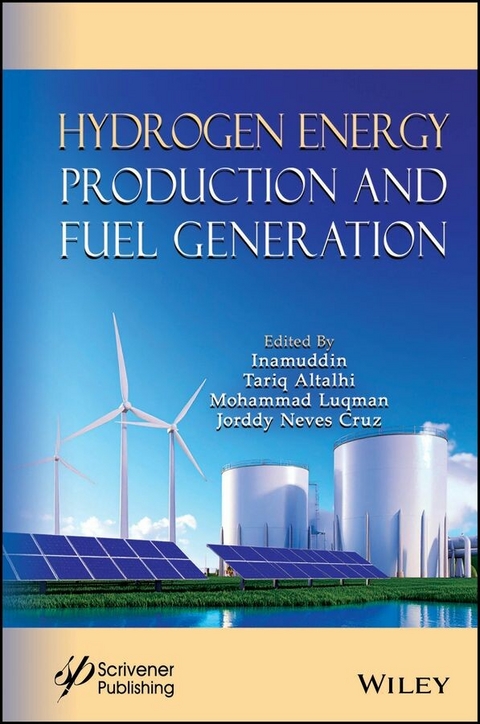
Hydrogen Energy Production and Fuel Generation (eBook)
937 Seiten
Wiley-Scrivener (Verlag)
978-1-394-24852-0 (ISBN)
Invest in the future of the planet by delving into this comprehensive guide on hydrogen energy, a critical solution for sustainable power, and gain the knowledge to contribute to this revolutionary field.
Hydrogen energy has emerged as one of the most promising solutions to the energy and environmental challenges of the 21st century. As we look for sustainable and clean alternatives to replace fossil fuels, hydrogen stands out not only for its abundance but also for its potential to revolutionize diverse sectors such as transport, industry, and energy generation. However, for this revolution to become a reality, a comprehensive and interdisciplinary understanding of the technologies and methods related to the production, storage, distribution, and utilization of hydrogen is essential. The subject of hydrogen energy production and fuel generation is closely linked to the broader goals of sustainability, energy transition, and climate change mitigation. The development of efficient and cost-effective methods to produce hydrogen from renewable sources, such as electrolysis powered by renewable electricity, contributes to the shift towards a green energy economy. Additionally, the integration of hydrogen with renewable energy systems enables the storage and utilization of intermittent renewable sources, enhancing the reliability and stability of the grid.
This book encompasses principles and advancements in chemistry, physics, materials science, engineering, and environmental sciences. This interdisciplinary approach fosters collaboration and knowledge exchange, leading to breakthroughs in hydrogen production, storage, and utilization. In terms of industry development, the book addresses the growing demand for alternative energy sources in sectors such as transportation, industry, and power generation. As the world moves towards decarbonization and reducing reliance on fossil fuels, hydrogen has emerged as a promising solution due to its high energy density and potential for zero-emission operations. The book explores the practical applications of hydrogen energy, including fuel cell vehicles, hydrogen-powered industrial processes, and integrated energy systems. By addressing this comprehensive context, the book serves as a valuable resource for researchers, professionals, and policymakers seeking to understand and contribute to the advancement of this critical field.
Inamuddin, PhD, is an assistant professor at the Department of Applied Chemistry, Zakir Husain College of Engineering and Technology, Faculty of Engineering and Technology, Aligarh Muslim University, Aligarh, India. He has extensive research experience in multidisciplinary fields of analytical chemistry, materials chemistry, electrochemistry, renewable energy, and environmental science. He has worked on different research projects funded by various government agencies and universities and is the recipient of awards, including the Department of Science and Technology, India, Fast-Track Young Scientist Award and Young Researcher of the Year Award 2020 from Aligarh Muslim University. He has published about 210 research articles in various international scientific journals, many book chapters, and dozens of edited books, many with Wiley-Scrivener.
Tariq Altalhi, PhD, is an associate professor in the Department of Chemistry at Taif University, Saudi Arabia. He received his doctorate degree from University of Adelaide, Australia in the year 2014 with Dean's Commendation for Doctoral Thesis Excellence. He has worked as head of the Chemistry Department at Taif university and Vice Dean of Science College. In 2015, one of his works was nominated for Green Tech awards from Germany, Europe's largest environmental and business prize, amongst top 10 entries. He has also co-edited a number of scientific books.
Mohammad Luqman, PhD, has more than 12 years of post-PhD experience in teaching, research, and administration. Currently, he is serving as an assistant professor of chemical engineering at Taibah University, Saudi Arabia. Moreover, he served as a post-doctoral fellow at Artificial Muscle Research Center, Konkuk University, South Korea, and he earned his PhD degree in the field of ionomers (Ion-containing Polymers), from Chosun University, South Korea. He has edited three books and published numerous scientific papers and book chapters. He is an editor for several journals, and he has been awarded several grants for academic research.
Jorddy Neves Cruz is a researcher at the Federal University of Pará and the Emilio Goeldi Museum. He has experience in multidisciplinary research in the areas of medicinal chemistry, drug design, extraction of bioactive compounds, extraction of essential oils, food chemistry and biological testing. He has published several research articles in scientific journals and is an associate editor of the Journal of Medicine.
Invest in the future of the planet by delving into this comprehensive guide on hydrogen energy, a critical solution for sustainable power, and gain the knowledge to contribute to this revolutionary field. Hydrogen energy has emerged as one of the most promising solutions to the energy and environmental challenges of the 21st century. As we look for sustainable and clean alternatives to replace fossil fuels, hydrogen stands out not only for its abundance but also for its potential to revolutionize diverse sectors such as transport, industry, and energy generation. However, for this revolution to become a reality, a comprehensive and interdisciplinary understanding of the technologies and methods related to the production, storage, distribution, and utilization of hydrogen is essential. The subject of hydrogen energy production and fuel generation is closely linked to the broader goals of sustainability, energy transition, and climate change mitigation. The development of efficient and cost-effective methods to produce hydrogen from renewable sources, such as electrolysis powered by renewable electricity, contributes to the shift towards a green energy economy. Additionally, the integration of hydrogen with renewable energy systems enables the storage and utilization of intermittent renewable sources, enhancing the reliability and stability of the grid. This book encompasses principles and advancements in chemistry, physics, materials science, engineering, and environmental sciences. This interdisciplinary approach fosters collaboration and knowledge exchange, leading to breakthroughs in hydrogen production, storage, and utilization. In terms of industry development, the book addresses the growing demand for alternative energy sources in sectors such as transportation, industry, and power generation. As the world moves towards decarbonization and reducing reliance on fossil fuels, hydrogen has emerged as a promising solution due to its high energy density and potential for zero-emission operations. The book explores the practical applications of hydrogen energy, including fuel cell vehicles, hydrogen-powered industrial processes, and integrated energy systems. By addressing this comprehensive context, the book serves as a valuable resource for researchers, professionals, and policymakers seeking to understand and contribute to the advancement of this critical field.
Preface
Hydrogen energy has emerged as one of the most promising solutions to the energy and environmental challenges of the 21st century. As we look for sustainable and clean alternatives to replace fossil fuels, hydrogen stands out not only for its abundance but also for its potential to revolutionize diverse sectors such as transport, industry, and energy generation. However, for this revolution to become a reality, a comprehensive and interdisciplinary understanding of the technologies and methods related to the production, storage, distribution, and utilization of hydrogen is essential. The subject of hydrogen energy production and fuel generation is closely linked to the broader goals of sustainability, energy transition, and climate change mitigation. The development of efficient and cost-effective methods to produce hydrogen from renewable sources, such as electrolysis powered by renewable electricity, contributes to the shift toward a green energy economy. Additionally, the integration of hydrogen with renewable energy systems enables the storage and utilization of intermittent renewable sources, enhancing the reliability and stability of the grid.
From a disciplinary perspective, the subject encompasses principles and advancements in chemistry, physics, materials science, engineering, and environmental sciences. Researchers in these disciplines are exploring innovative methods and technologies to produce hydrogen, store it efficiently, and utilize it as a clean fuel. This interdisciplinary approach fosters collaboration and knowledge exchange, leading to breakthroughs in hydrogen production, storage, and utilization. In terms of industry development, the book addresses the growing demand for alternative energy sources in sectors such as transportation, industry, and power generation. As the world moves toward decarbonization and reducing reliance on fossil fuels, hydrogen has emerged as a promising solution due to its high energy density and potential for zero-emission operations. The book explores the practical applications of hydrogen energy, including fuel cell vehicles, hydrogen-powered industrial processes, and integrated energy systems. Overall, the subject of hydrogen energy production and fuel generation represents a multidisciplinary effort that drives innovation, supports sustainable development, and contributes to the global transition toward a low-carbon future. By addressing this comprehensive context, the book provides a valuable resource for researchers, professionals, and policymakers seeking to understand and contribute to the advancement of this critical field. The chapters included in the book are summarized below:
Chapter 1 addresses the viability of a hydrogen (H2)–based economy, focusing on improving methods for making, storing, conveying, distributing, and modifying H2, as well as examining prospects and barriers. The chapter then discusses H2 production methods alongside H2 storage, transport, and distribution technologies. It explains how overcoming hurdles in H2 applications can lead to the implementation of large-scale H2 production, distribution, and transportation systems.
Chapter 2 explains various existing water-splitting methods for hydrogen production. The techniques discussed rely on solar energy as the main energy source, emphasizing that the sun is an unlimited pool of energy that can be conveniently harnessed.
Chapter 3 reviews recent advancements in catalysts and materials for sustainable hydrogen production, emphasizing alternative methods such as water electrolysis, photoelectrochemical water splitting, and biomass gasification. Key developments include the transition from noble metal-based to more abundant, cost-effective catalysts, advancements in nanostructured catalysts, and the integration of computational tools for material optimization, all contributing to enhanced efficiency and sustainability in hydrogen production processes.
Chapter 4 details the most relevant aspects of biohydrogen, including its generation through dark fermentation and the main production parameters. It specifies its differences from other processes and fuels, as well as the challenges and opportunities of biohydrogen in the current context.
Chapter 5 explains the use of metal hydrides for hydrogen storage. The global energy crisis has opened the door to new energy sources. Hydrogen carries three times more energy content than fossil fuel. The chapter also explains what metal hydrides are, their types, synthesis, morphology, and their effect on hydrogen storage.
Chapter 6 elaborates on advanced materials designed to safely and efficiently store hydrogen for various applications, including energy storage and transportation. These materials are crucial for overcoming challenges associated with the storage and use of hydrogen as a clean energy carrier under ambient conditions for easy transportation.
Chapter 7 explores the importance of hydrogen storage in the renewable energy process. This chapter explains various key factors that affect the hydrogen storage mechanism, such as the thermodynamics and kinetics of hydrogen. Different objects/nanomaterials (nanoparticles and nanocomposites) that support hydrogen storage are discussed in detail with suitable examples.
Chapter 8 discusses recent technological advancements regarding carbon-based materials for hydrogen storage. Hydrogen (H2) energy is emerging as a clean alternative to fossil fuels. Crucial factors for its storage include pressure, temperature, kinetics, heat transfer, and capacity. This chapter explores carbon-based materials, such as graphene and activated carbon, for efficient H2 storage, emphasizing performance, monitoring, and tuning techniques.
Chapter 9 provides detailed information about the importance of hydrogen energy storage. It explains hydrogen storage methods: physical methods, chemical storage methods, adsorption and desorption storage methods, and molecular storage methods. It also explains the role of composite materials in hydrogen storage. In the last part, composite material design parameters and their effects are investigated.
Chapter 10 reports the literature data regarding the history of the discovery and utilization of hydrogen, its prevalence in nature, atomic and molecular structures, isotope properties, key physical and chemical characteristics defining hydrogen’s use as a fuel, and the conditional color indexing of hydrogen.
Chapter 11 discusses technological innovations applicable to hydrogen production, use, and research. The discussion explores cleaner ways and resources for hydrogen production compared to fossil-based hydrogen. It further outlines how hydrogen can be used in many ways, especially in energy applications. The chapter concludes by reporting ongoing research in the hydrogen energy space.
Chapter 12 presents the applications of organic hydrides for the storage and transfer of hydrogen energy. The chapter also discusses the various types of organic hydrides that can be used to store hydrogen based on chemical methods. The potential of organic hydrides for carrying hydrogen with high storage capabilities and safe handling is also described.
Chapter 13 starts with a comprehensive overview of microbial electrolysis cells. It then provides detailed information related to the design of microbial electrolysis cell generation. The most effective substrate among the diverse substrates used in microbial electrolysis cells for H2 generation is determined using an AHP analysis.
Chapter 14 introduces hydrogen in power generation, explores catalysts for steam reforming, and examines partial oxidation. It covers hydrogen’s use in power generation and the transportation sector.
Chapter 15 discusses the potential of generating biohydrogen using thermophilic bacteria. Both temperature and partial pressure of hydrogen are known to influence the formation of biohydrogen. The application of thermophilic bacteria is expected to fulfill the requirements of generating biohydrogen efficiently under these conditions, revealing their potential as biohydrogen producers.
Chapter 16 covers hydrogen energy, including production, delivery, and storage. It explores hydrogen’s chemistry in fuel cells, the transition to fuel cells, and their economic and environmental impacts. Future prospects of fuel cells are also discussed.
Chapter 17 explores hydrogen energy production methods like electrolysis and steam methane reforming, emphasizing environmental benefits and renewable energy use. It discusses advancements in technology, scalable production, storage, transportation, and safety standards, highlighting global efforts to integrate hydrogen into sustainable energy infrastructure.
Chapter 18 explores hydrogen energy’s promise as a clean energy source, focusing on challenges in production, storage, transportation, and distribution infrastructure. It addresses key factors such as policy, technology, and investment needed to fully harness hydrogen’s potential for a sustainable future.
Chapter 19 discusses liquid organic hydrogen carriers’ storage and transportation. Several applications and advantages are discussed in detail. Additionally, the role of safety issues in liquid organic hydrogen carriers is examined. The major focus is on communicating the advantages, disadvantages, drawbacks, and future feasibility of available procedures reported in the literature.
Chapter 20 discusses the prospects of hydrogen energy and its application in the power production, storage, and transportation sectors. The...
| Erscheint lt. Verlag | 16.9.2025 |
|---|---|
| Sprache | englisch |
| Themenwelt | Technik ► Elektrotechnik / Energietechnik |
| Technik ► Maschinenbau | |
| Schlagworte | Alternative Fuel • Biomass conversion • Clean Energy • electrolysis • Energy Storage • Fuel cells • fuel generation • Hydrogen Energy • Hydrogen Production • hydrogen storage • Microbial electrolysis • Photoelectrochemical Processes • renewable energy • Solar-Driven Water Splitting • Sustainable energy |
| ISBN-10 | 1-394-24852-0 / 1394248520 |
| ISBN-13 | 978-1-394-24852-0 / 9781394248520 |
| Informationen gemäß Produktsicherheitsverordnung (GPSR) | |
| Haben Sie eine Frage zum Produkt? |
 EPUB (Adobe DRM)
Kopierschutz: Adobe-DRM
Adobe-DRM ist ein Kopierschutz, der das eBook vor Mißbrauch schützen soll. Dabei wird das eBook bereits beim Download auf Ihre persönliche Adobe-ID autorisiert. Lesen können Sie das eBook dann nur auf den Geräten, welche ebenfalls auf Ihre Adobe-ID registriert sind.
Details zum Adobe-DRM
Dateiformat: EPUB (Electronic Publication)
EPUB ist ein offener Standard für eBooks und eignet sich besonders zur Darstellung von Belletristik und Sachbüchern. Der Fließtext wird dynamisch an die Display- und Schriftgröße angepasst. Auch für mobile Lesegeräte ist EPUB daher gut geeignet.
Systemvoraussetzungen:
PC/Mac: Mit einem PC oder Mac können Sie dieses eBook lesen. Sie benötigen eine
eReader: Dieses eBook kann mit (fast) allen eBook-Readern gelesen werden. Mit dem amazon-Kindle ist es aber nicht kompatibel.
Smartphone/Tablet: Egal ob Apple oder Android, dieses eBook können Sie lesen. Sie benötigen eine
Geräteliste und zusätzliche Hinweise
Buying eBooks from abroad
For tax law reasons we can sell eBooks just within Germany and Switzerland. Regrettably we cannot fulfill eBook-orders from other countries.
aus dem Bereich