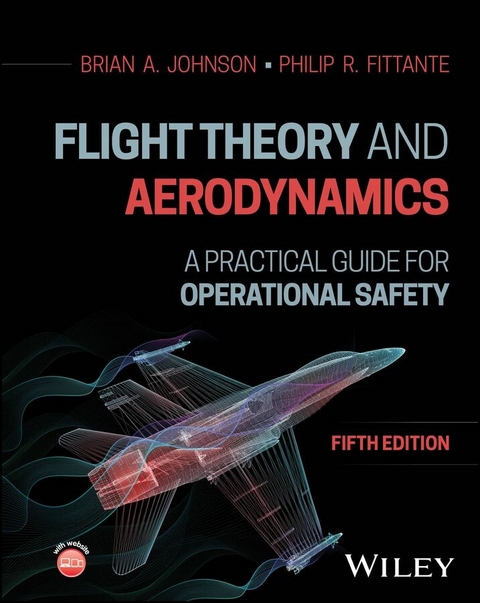
Flight Theory and Aerodynamics (eBook)
1133 Seiten
Wiley (Verlag)
978-1-394-28230-2 (ISBN)
Comprehensive introduction to aerodynamics applied to different types of modern aircraft, now updated with the latest FAA guidance
Flight Theory and Aerodynamics provides an introduction to aerodynamics using practical application to modern aircraft with step-by-step calculations. This fifth edition streamlines content, notably the chapters on aircraft stability, and incorporates updated FAA guidance and figures from the 2023 Pilot's Handbook of Aeronautical Knowledge as well as other FAA handbooks.
A balanced application of introductory physics and meteorology in the first five chapters evolves into an introduction to propeller and jet aircraft propulsion and eventually moves into a broad discussion on the application of physics to aircraft takeoff and landing performance. After the introductory material has been presented, principles from earlier in the textbook and prior coursework are correlated and applied to slow flight, aircraft stability, and high-speed flight. A new chapter on Unmanned Aerial Vehicle (UAV) flight theory is included.
The text features extensive instructor resources including detailed PowerPoint slides for each chapter, step-by-step guidance for end of chapter calculations, sample test bank questions for each chapter, and application sections within each chapter that allow the instructor to challenge the student with additional real-world scenarios based on chapter content.
Flight Theory and Aerodynamics includes information on:
- Elements of the flight environment, covering forces, mass, scalar and vector quantities, linear and rotational motion, friction, and power
- Atmosphere, altitude, and airspeed measurement, covering properties of the atmosphere, Bernoulli's equation, and pitot-static system advantages and disadvantages
- Jet aircraft performance, covering principles of propulsion, fuel flow, specific fuel consumption, and thrust-required curves
- Aircraft stability and control, covering oscillatory motion, weight and balance, and airplane reference axes
- Rotary-wing flight theory, airfoil selection, and helicopter control
- UAV flight theory, including UAV design considerations, the aerodynamics of UAV fuselage design, UAV powerplant design, and the future of UAV design and aerodynamics
- End of chapter questions focused on scenario-based learning as applied to the performance analysis of a Diamond DA50 and corresponding chapter material.
In addition to degree-oriented college programs, this latest edition of Flight Theory and Aerodynamics is also an essential resource for pilot training programs ranging from student pilots to flight instructors as well as practicing professionals flying a wide range of aircraft.
Brian A. Johnson is a former regional airline pilot, corporate pilot, and part 141 chief ground instructor. He holds an ATP with an MEL rating, commercial pilot SEL/SES and sUAS, and currently serves as an active gold seal CFII/MEI, full-time company pilot, and a regional FAASTeam representative.
Philip R. Fittante is a retired US Air Force Lieutenant Colonel with flight time in over 40 types of aircraft. He served as the Chief Developmental Test Pilot for the B-1B and B-2 bombers, possessing nearly 30 years of experience as an Air Force test pilot and Navy civilian test pilot and engineer.
1
Introduction to the Flight Environment
CHAPTER OBJECTIVES
After completing this chapter, you should be able to:
- Define basic units of measurement used in the introduction to aerodynamics in flight and convert from one unit of measurement to another.
- Identify the four forces on an airplane in constant altitude, unaccelerated flight.
- Calculate the mass of an aircraft.
- Define vector addition and apply it to an aircraft in a climb.
- Describe Newton's laws of motion and recognize how they apply to an introduction to aerodynamics.
- Define the purpose of linear motion in relation to constant acceleration, and then calculate aircraft acceleration, takeoff distance, and takeoff time.
- Describe the difference between energy and work and calculate the potential and kinetic energy of an aircraft in flight.
- Calculate the equivalent horsepower of an aircraft from a known thrust and speed.
- Define friction as it applies to an aircraft.
A basic understanding of the physical laws of nature that affect aircraft in flight and on the ground is a prerequisite for the study of aerodynamics. Modern aircraft have become more sophisticated, and more automated, using advanced materials in their construction requiring pilots to renew their understanding of the natural forces encountered during flight. Understanding how pilots control and counteract these forces better prepares pilots and engineers for the art of flying for harnessing the fundamental physical laws that guide them. Although at times this textbook will provide a quantitative approach to various principles and operating practices with formulas and examples using equations, it is more important that the reader understand WHY a principle of flight theory is discussed and how that subject matter intertwines with other materials presented; thus, a qualitative approach is used throughout this textbook.
Perhaps your goal is to be a pilot, who will “slip the surly bonds of earth,” as John Gillespie Magee wrote in his classic poem “High Flight.” Or you may wish to build or maintain aircraft as a skilled technician. Or possibly you wish to serve in another vital role in the aviation industry, such as manager, dispatcher, meteorologist, engineer, teacher, or unmanned aerial vehicle (UAV) operator. Whichever area you might be considering, this textbook will build on what you already know and will help prepare you for a successful aviation career.
INTRODUCTION
This chapter begins with a review of the basic principles of physics and concludes with a summary of mechanical energy, power, and linear motion. A working knowledge of these areas, and how they relate to basic aerodynamics, is vital as we move past the rudimentary “four forces of flight” and introduce thrust and power‐producing aircraft, lift and drag curves, stability and control, maneuvering performance, slow‐speed flight, and other topics.
You may already have been introduced to the four basic forces acting on an aircraft in flight: lift, weight, thrust, and drag. Now, we must understand how these forces change as an aircraft accelerates down the runway, or descends on final approach to a runway and gently touches down even when traveling twice the speed of a car on the highway. Once an aircraft has safely made it into the air, what effect does weight have on its ability to climb, and should the aircraft climb up to the flight levels or stay lower and take “advantage” of the denser air closer to the ground?
By developing an understanding of the aerodynamics of flight, and of the ways in which design, weight, load factors, and gravity affect an aircraft during flight maneuvers from stalls to high‐speed flight, the pilot learns how to control the balance between these forces. This textbook will help clarify these concepts among others, leaving you with a better understanding of the flight environment.
HISTORY OF AERODYNAMICS
The history of aerodynamics started well before the Wright brothers' first flight on December 17, 1903. In fact, a full accounting of the history of aerodynamics would warrant an entire textbook, so we offer a brief history of the primary pioneers and groups that had a hand in introducing aerodynamic principles covered in this textbook. Throughout the subsequent chapters, we will introduce additional historical tie‐ins to relevant material when applicable.
During the Italian Renaissance the painter Leonardo da Vinci sketched many designs of various types of flying machines, including a design of a wing‐flapping machine called the ornithopter. Many of his designs were based around the flight of birds but were only theoretical in nature as the flapping wings of a heavier‐than‐air device driven by only human muscle would never fly. Leonardo da Vinci even sketched an early design of what later would resemble a helicopter. Contracted by the Milanese court to research military technology, da Vinci eventually became intrigued by aerial reconnaissance and flying machines. Because his work was not published until centuries later in 1892 in a notebook entitled Codice sul volo degli uccelli (Codex on the Flight of Birds), his sketches were not part of the design basis for nineteenth‐century aviation pioneers.
Sir George Cayley is widely credited with designing the modern airplane, an aircraft with vertical and horizontal control surfaces on the rear of the aircraft, a fuselage with a place for the pilot, and a propulsion system that he termed “assisters.” He is also considered, by many, to be the world's first aeronautical engineer. Like many aviation pioneers to follow, Cayley used the concept of windmills and kites to develop gliders. He built a glider that included an empennage, a tail with a rudder, and an elevator, and he recognized the importance of the center of gravity (CG). In the mid‐nineteenth century, Cayley even designed a glider large enough to carry a person and is credited with the earliest‐known manned heavier‐than‐air flight (Figure 1.1). In Chapter 3, we will further introduce the structure of an airplane using the same design principles as Cayley's early gliders, and in Chapter 12, we will expand upon the importance of CG in modern aircraft.
Figure 1.1. Flying replica of Sir George Cayley's 1853 glider.
Source: U.S. Department of Transportation (2023a)/Public Domain.
The first notable attempt at providing a propulsion system beyond using gravity or human‐generated power was by two Englishmen, John Stringfellow and William Henson. They designed a 20‐foot model that used a steam engine to propel two six‐bladed pusher propellers. The model failed to achieve sustained flight under its own power, but it proved that with modifications (lighter weight steam engine) it may be possible to sustain heavier‐than‐air flight. Stringfellow continued with his research and eventually launched a ten‐foot model of an unmanned aircraft that hung on a wire. With improvements in the power‐to‐weight ratio of the steam engine, pioneers were now getting closer to heavier‐than‐air, sustained, manned flight.
Otto Lilienthal, considered by Wilbur Wright to be the most influential aviation pioneer in the nineteenth century, completed as many as 2 000 glider flights before dying in a glider crash in 1896. Many of those who followed him used his notes on aerodynamic data to develop their own wings or gliders. Experimenting with cambered wings, a rear elevator, and ornithopter wingtips, Lilienthal used hilltops to prove man could fly heavier‐than‐air aircraft without an engine (Figure 1.2). The development of a new type of engine, along with an improved power‐to‐weight ratio, gave way to the most famous aviation pioneers in history, the Wright brothers.
Figure 1.2. Otto Lilienthal in flight.
Source: U.S. Department of Transportation (2023a)/Public Domain.
The two bicycle mechanics from Dayton, OH, Wilbur and Orville Wright, first developed a biplane kite in 1899, based predominately on the aeronautical writings of aviation pioneers such as Otto Lilienthal and engineer and glider designer Octave Chanute. The glider included wings that could be warped in flight using cords to bank the glider, a fixed horizontal stabilizer, and wings that could be adjusted forward and backward to adjust for the CG. By moving to the Outer Banks of North Carolina seasonally to take advantage of consistently strong winds off the ocean, and the tall sand dunes for experimenting with gliders, the Wright brothers found that the stronger the headwind, the less power would be required from the engine to develop forward thrust. In Chapters 2–4, we will introduce a more detailed review of how air moves around a wing and why this methodology used by the Wright brothers was successful. The lift formula we will introduce in Chapter 4 is directly related to the equations used by Lilienthal, Chanute, and the Wright brothers. By 1902, the Wright brothers had solved the problem of control and could successively control the glider around the three axes of the airplane (introduced in Chapter 12). By December 1903, their mechanic in Ohio, Charles Taylor, had built a four‐cylinder, 12‐horsepower water‐cooled gasoline engine that finally solved the...
| Erscheint lt. Verlag | 15.9.2025 |
|---|---|
| Sprache | englisch |
| Themenwelt | Technik ► Maschinenbau |
| Schlagworte | Aerodynamic forces • Aerodynamics textbook • flight landing • flight stability • flight takeoff • flight textbook • High-speed flight • maneuvering flight • propulsion methods • rotary-wing flight • Slow flight • uav aerodynamics |
| ISBN-10 | 1-394-28230-3 / 1394282303 |
| ISBN-13 | 978-1-394-28230-2 / 9781394282302 |
| Informationen gemäß Produktsicherheitsverordnung (GPSR) | |
| Haben Sie eine Frage zum Produkt? |
 EPUB (Adobe DRM)
Kopierschutz: Adobe-DRM
Adobe-DRM ist ein Kopierschutz, der das eBook vor Mißbrauch schützen soll. Dabei wird das eBook bereits beim Download auf Ihre persönliche Adobe-ID autorisiert. Lesen können Sie das eBook dann nur auf den Geräten, welche ebenfalls auf Ihre Adobe-ID registriert sind.
Details zum Adobe-DRM
Dateiformat: EPUB (Electronic Publication)
EPUB ist ein offener Standard für eBooks und eignet sich besonders zur Darstellung von Belletristik und Sachbüchern. Der Fließtext wird dynamisch an die Display- und Schriftgröße angepasst. Auch für mobile Lesegeräte ist EPUB daher gut geeignet.
Systemvoraussetzungen:
PC/Mac: Mit einem PC oder Mac können Sie dieses eBook lesen. Sie benötigen eine
eReader: Dieses eBook kann mit (fast) allen eBook-Readern gelesen werden. Mit dem amazon-Kindle ist es aber nicht kompatibel.
Smartphone/Tablet: Egal ob Apple oder Android, dieses eBook können Sie lesen. Sie benötigen eine
Geräteliste und zusätzliche Hinweise
Buying eBooks from abroad
For tax law reasons we can sell eBooks just within Germany and Switzerland. Regrettably we cannot fulfill eBook-orders from other countries.
aus dem Bereich