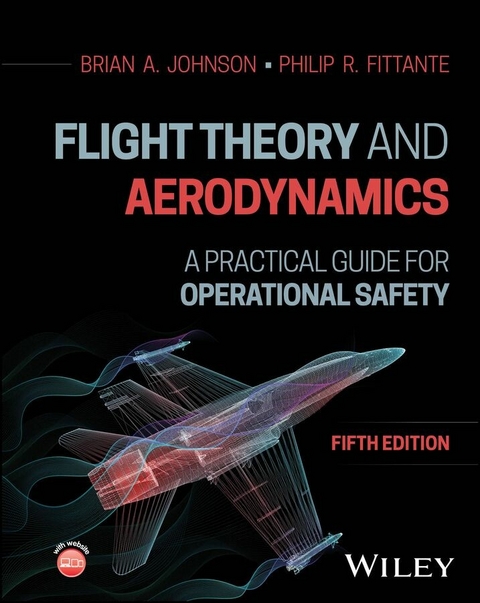
Flight Theory and Aerodynamics (eBook)
611 Seiten
Wiley (Verlag)
978-1-394-28231-9 (ISBN)
Comprehensive introduction to aerodynamics applied to different types of modern aircraft, now updated with the latest FAA guidance
Flight Theory and Aerodynamics provides an introduction to aerodynamics using practical application to modern aircraft with step-by-step calculations. This fifth edition streamlines content, notably the chapters on aircraft stability, and incorporates updated FAA guidance and figures from the 2023 Pilot's Handbook of Aeronautical Knowledge as well as other FAA handbooks.
A balanced application of introductory physics and meteorology in the first five chapters evolves into an introduction to propeller and jet aircraft propulsion and eventually moves into a broad discussion on the application of physics to aircraft takeoff and landing performance. After the introductory material has been presented, principles from earlier in the textbook and prior coursework are correlated and applied to slow flight, aircraft stability, and high-speed flight. A new chapter on Unmanned Aerial Vehicle (UAV) flight theory is included.
The text features extensive instructor resources including detailed PowerPoint slides for each chapter, step-by-step guidance for end of chapter calculations, sample test bank questions for each chapter, and application sections within each chapter that allow the instructor to challenge the student with additional real-world scenarios based on chapter content.
Flight Theory and Aerodynamics includes information on:
- Elements of the flight environment, covering forces, mass, scalar and vector quantities, linear and rotational motion, friction, and power
- Atmosphere, altitude, and airspeed measurement, covering properties of the atmosphere, Bernoulli's equation, and pitot-static system advantages and disadvantages
- Jet aircraft performance, covering principles of propulsion, fuel flow, specific fuel consumption, and thrust-required curves
- Aircraft stability and control, covering oscillatory motion, weight and balance, and airplane reference axes
- Rotary-wing flight theory, airfoil selection, and helicopter control
- UAV flight theory, including UAV design considerations, the aerodynamics of UAV fuselage design, UAV powerplant design, and the future of UAV design and aerodynamics
- End of chapter questions focused on scenario-based learning as applied to the performance analysis of a Diamond DA50 and corresponding chapter material.
In addition to degree-oriented college programs, this latest edition of Flight Theory and Aerodynamics is also an essential resource for pilot training programs ranging from student pilots to flight instructors as well as practicing professionals flying a wide range of aircraft.
Brian A. Johnson is a former regional airline pilot, corporate pilot, and part 141 chief ground instructor. He holds an ATP with an MEL rating, commercial pilot SEL/SES and sUAS, and currently serves as an active gold seal CFII/MEI, full-time company pilot, and a regional FAASTeam representative.
Philip R. Fittante is a retired US Air Force Lieutenant Colonel with flight time in over 40 types of aircraft. He served as the Chief Developmental Test Pilot for the B-1B and B-2 bombers, possessing nearly 30 years of experience as an Air Force test pilot and Navy civilian test pilot and engineer.
Comprehensive introduction to aerodynamics applied to different types of modern aircraft, now updated with the latest FAA guidance Flight Theory and Aerodynamics provides an introduction to aerodynamics using practical application to modern aircraft with step-by-step calculations. This fifth edition streamlines content, notably the chapters on aircraft stability, and incorporates updated FAA guidance and figures from the 2023 Pilot s Handbook of Aeronautical Knowledge as well as other FAA handbooks. A balanced application of introductory physics and meteorology in the first five chapters evolves into an introduction to propeller and jet aircraft propulsion and eventually moves into a broad discussion on the application of physics to aircraft takeoff and landing performance. After the introductory material has been presented, principles from earlier in the textbook and prior coursework are correlated and applied to slow flight, aircraft stability, and high-speed flight. A new chapter on Unmanned Aerial Vehicle (UAV) flight theory is included. The text features extensive instructor resources including detailed PowerPoint slides for each chapter, step-by-step guidance for end of chapter calculations, sample test bank questions for each chapter, and application sections within each chapter that allow the instructor to challenge the student with additional real-world scenarios based on chapter content. Flight Theory and Aerodynamics includes information on: Elements of the flight environment, covering forces, mass, scalar and vector quantities, linear and rotational motion, friction, and powerAtmosphere, altitude, and airspeed measurement, covering properties of the atmosphere, Bernoulli s equation, and pitot-static system advantages and disadvantagesJet aircraft performance, covering principles of propulsion, fuel flow, specific fuel consumption, and thrust-required curvesAircraft stability and control, covering oscillatory motion, weight and balance, and airplane reference axesRotary-wing flight theory, airfoil selection, and helicopter controlUAV flight theory, including UAV design considerations, the aerodynamics of UAV fuselage design, UAV powerplant design, and the future of UAV design and aerodynamicsEnd of chapter questions focused on scenario-based learning as applied to the performance analysis of a Diamond DA50 and corresponding chapter material. In addition to degree-oriented college programs, this latest edition of Flight Theory and Aerodynamics is also an essential resource for pilot training programs ranging from student pilots to flight instructors as well as practicing professionals flying a wide range of aircraft.
| Erscheint lt. Verlag | 4.9.2025 |
|---|---|
| Sprache | englisch |
| Themenwelt | Technik ► Maschinenbau |
| Schlagworte | Aerodynamic forces • Aerodynamics textbook • flight landing • flight stability • flight takeoff • flight textbook • High-speed flight • maneuvering flight • propulsion methods • rotary-wing flight • Slow flight • uav aerodynamics |
| ISBN-10 | 1-394-28231-1 / 1394282311 |
| ISBN-13 | 978-1-394-28231-9 / 9781394282319 |
| Informationen gemäß Produktsicherheitsverordnung (GPSR) | |
| Haben Sie eine Frage zum Produkt? |
 PDF (Adobe DRM)
Kopierschutz: Adobe-DRM
Adobe-DRM ist ein Kopierschutz, der das eBook vor Mißbrauch schützen soll. Dabei wird das eBook bereits beim Download auf Ihre persönliche Adobe-ID autorisiert. Lesen können Sie das eBook dann nur auf den Geräten, welche ebenfalls auf Ihre Adobe-ID registriert sind.
Details zum Adobe-DRM
Dateiformat: PDF (Portable Document Format)
Mit einem festen Seitenlayout eignet sich die PDF besonders für Fachbücher mit Spalten, Tabellen und Abbildungen. Eine PDF kann auf fast allen Geräten angezeigt werden, ist aber für kleine Displays (Smartphone, eReader) nur eingeschränkt geeignet.
Systemvoraussetzungen:
PC/Mac: Mit einem PC oder Mac können Sie dieses eBook lesen. Sie benötigen eine
eReader: Dieses eBook kann mit (fast) allen eBook-Readern gelesen werden. Mit dem amazon-Kindle ist es aber nicht kompatibel.
Smartphone/Tablet: Egal ob Apple oder Android, dieses eBook können Sie lesen. Sie benötigen eine
Geräteliste und zusätzliche Hinweise
Buying eBooks from abroad
For tax law reasons we can sell eBooks just within Germany and Switzerland. Regrettably we cannot fulfill eBook-orders from other countries.
aus dem Bereich